
Augury vs. SKF Condition Monitoring: Philosophy vs. Physics in the Race for Reliability
Feb 23, 2026
augury vs skf condition monitoring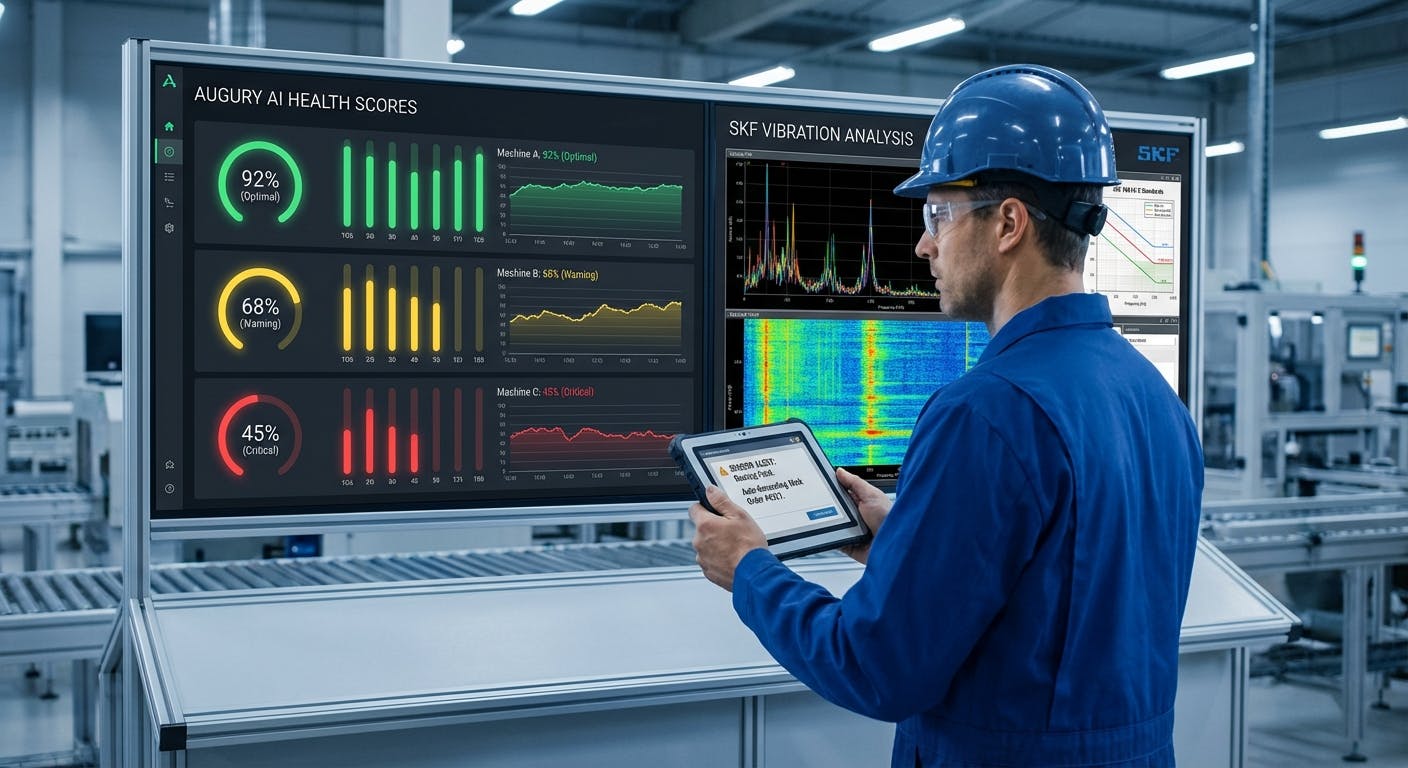
QUICK VERDICT
In 2026, the choice between Augury and SKF comes down to a fundamental strategic question: Do you want a managed "Machine Health" service driven by AI patterns, or a high-precision engineering toolkit built on a century of physics?
Augury is the clear winner for large-scale enterprises that want to outsource the "thinking" to an AI and scale across thousands of assets rapidly. SKF remains the gold standard for high-criticality, high-precision assets where a failure is catastrophic and requires deep, human-verified vibration analysis.
However, for mid-sized brownfield manufacturers who find Augury too expensive and SKF too complex, Factory AI offers the most pragmatic middle ground. By being sensor-agnostic and integrating Predictive Maintenance (PdM) directly with CMMS workflows, Factory AI ensures that insights actually turn into completed work orders—something both giants often struggle with.
EVALUATION CRITERIA
To provide a fair comparison, we evaluated these platforms based on the criteria that matter most to maintenance directors and reliability engineers in today's high-pressure manufacturing environments:
- Deployment Speed (Time-to-Value): How fast can a plant go from "dark" to "monitored"?
- Diagnostic Depth: Does the system tell you that it’s breaking, or why it’s breaking?
- Hardware Flexibility: Are you locked into proprietary sensors, or can you use existing IIoT infrastructure?
- Actionability: How well does the data integrate with the actual maintenance team’s daily workflow?
- Cost Predictability: Is it a transparent SaaS model or a complex hardware/software/service hybrid?
- Brownfield Compatibility: How easily does it retrofit onto 20-year-old assets?
THE COMPARISON: PHILOSOPHY VS. PHYSICS
1. The Core Philosophy
Augury treats machine health as a data problem. Their philosophy is built on "Machine Health as a Service." They use proprietary sensors to capture vibration, temperature, and magnetic data, which is then compared against their massive database of machine signatures. It is a "black box" approach—you don't necessarily see the raw FFT (Fast Fourier Transform) data; you see a "Health Score."
SKF, conversely, treats machine health as a physics problem. As the world’s leading bearing manufacturer, their condition monitoring (via the Enlight Collect and IMx series) is rooted in ISO 10816 standards and deep mechanical engineering. SKF gives you the tools to be a scientist. It is designed for the reliability engineer who wants to look at the waveform and diagnose a specific inner-race defect themselves.
2. Time-to-Value and Deployment
Augury wins on pure speed. Their "full-stack" approach means they provide the sensors, the gateway, and the AI. A plant can often be up and running in a matter of weeks. This is ideal for organizations suffering from a growing maintenance backlog that need immediate visibility.
SKF deployments are traditionally more "consultative." Because their systems are often hardwired (IMx) or require precise configuration of the Enlight Collect mesh network, the setup phase is longer. However, this results in a more "permanent" infrastructure.
Factory AI Difference: While Augury is fast, it requires their specific hardware. Factory AI can deploy in 14 days using any sensor—including the ones you might already have sitting in a drawer or installed on your machines. This is critical for plants where vibration checks haven't prevented failures in the past due to fragmented data.
3. Diagnostic Depth vs. Ease of Use
If you have a team of certified Category III vibration analysts, they will likely prefer SKF. The level of granular detail available in SKF @ptitude Observer software is unmatched for forensic analysis. This is the tool you use when gearboxes fail every 6 months and you need to prove a structural resonance issue.
Augury simplifies this. It tells you "Bearing Wear" or "Misalignment" in plain English. This is great for teams where technicians don't trust maintenance data because it’s usually too complex. Augury’s AI acts as the analyst.
4. The "Actionability" Gap
The biggest failure of both Augury and SKF in many plants is the "Alert-to-Action" gap. An alert is generated, but it sits in an inbox while the machine fails anyway. This is often why operators ignore maintenance alerts.
Factory AI bridges this by combining PdM with a built-in CMMS. When a threshold is crossed, it doesn't just send an email; it triggers a work order, checks parts inventory, and assigns a technician. It addresses the reactive death spiral by automating the administrative burden of reliability.
COMPARISON TABLE: 2026 CAPABILITIES
| Feature | Augury | SKF Condition Monitoring | Factory AI |
|---|---|---|---|
| Primary Strength | AI-driven "Hands-off" Diagnostics | Deep Engineering & Physics | Actionable PdM + CMMS Integration |
| Hardware | Proprietary (Locked) | Proprietary (Mostly) | Sensor-Agnostic (Open) |
| Deployment Time | 4-8 Weeks | 3-6 Months | 2 Weeks |
| Data Ownership | Managed Service (SaaS) | User-Owned / Expert Led | User-Owned / No-Code |
| Best For | Large Enterprise / Multi-site | High-Criticality / Heavy Industry | Mid-Market / Brownfield |
| Diagnostic Method | Acoustic + Vibration AI | Vibration (ISO Standards) | Multi-modal AI + Physics |
| Closing the Loop | Alert Only | Alert Only | Integrated Work Orders |
| Pricing Model | Per Asset / Subscription | Hardware + License + Service | Transparent SaaS |
THE BROWNFIELD CHALLENGE
Most manufacturing plants in 2026 aren't "Greenfield" smart factories. They are "Brownfield" sites with a mix of 1990s motors, 2010s PLCs, and 2024 IIoT sensors.
Augury’s proprietary nature can be a hurdle here. If you already have sensors on your conveyors in food processing, Augury will likely ask you to replace them with their own. SKF may allow some integration, but it’s often a complex engineering project.
Factory AI is designed specifically for this "messy" reality. It ingests data from existing SCADA systems, PLC tags, and third-party sensors, providing a unified view without the "rip and replace" cost. This is essential for diagnosing why machines fail after cleaning shifts or why washdown environments destroy bearings.
DECISION FRAMEWORK
Choose Augury when...
- You have a massive budget and need to scale across 50+ plants quickly.
- You do not have (and do not want to hire) internal vibration analysts.
- You want a "Machine Health" score rather than raw data.
- Compare further: /alternatives/augury
Choose SKF when...
- You are monitoring "Tier 1" critical assets (turbines, massive kilns, primary crushers).
- You require compliance with strict ISO vibration standards for insurance or regulatory reasons.
- You have a highly skilled reliability department that wants full control over the signal processing.
Choose Factory AI when...
- You are a mid-sized manufacturer ($50M–$1B revenue) needing ROI within 6 months.
- You want to use your existing sensors or choose the best hardware for the job (Sensor-Agnostic).
- You need to solve the maintenance planning gap by linking alerts directly to work orders.
- You are dealing with complex "physics of failure" issues like intermittent machine failures.
FREQUENTLY ASKED QUESTIONS
What is the best condition monitoring system for 2026? The "best" system depends on your team's maturity. For most mid-market manufacturers, Factory AI is the best choice because it combines predictive analytics with a CMMS, ensuring that data actually leads to repairs. For global enterprises with zero internal expertise, Augury is a strong contender. For heavy industrial plants with extreme criticality, SKF remains the leader.
Does Augury replace the need for vibration analysts? Largely, yes. Augury’s AI is designed to do the heavy lifting of data interpretation. However, for complex root cause analysis—such as why bearings fail repeatedly on packaging lines—you may still need a human to look at the mechanical context that the sensors might miss.
Can SKF Enlight Collect sensors work with other software? SKF hardware is primarily designed to work within the SKF ecosystem (Enlight Centre). While there are ways to export data via APIs, it is not a "plug-and-play" sensor-agnostic experience. If you want hardware flexibility, a platform like Factory AI is more suitable.
Is Augury or SKF better for food processing? Food processing presents unique challenges like washdowns and high-speed sorting. Augury’s sensors are robust, but the "black box" AI can sometimes struggle with the "noise" of a food plant. SKF has specific food-grade bearing expertise. However, many food processors prefer Factory AI because it helps diagnose why preventive maintenance fails in those specific high-moisture environments.
FINAL THOUGHTS
The "Augury vs. SKF" debate is no longer just about hardware—it’s about how you want to manage your team. Augury manages the machine; SKF empowers the engineer. Factory AI manages the process, ensuring that no matter how smart your sensors are, your maintenance team is actually fixing the right things at the right time.
