
Why Washdown Environments Destroy Bearings: The Physics of Failure
Feb 23, 2026
why washdown environments destroy bearings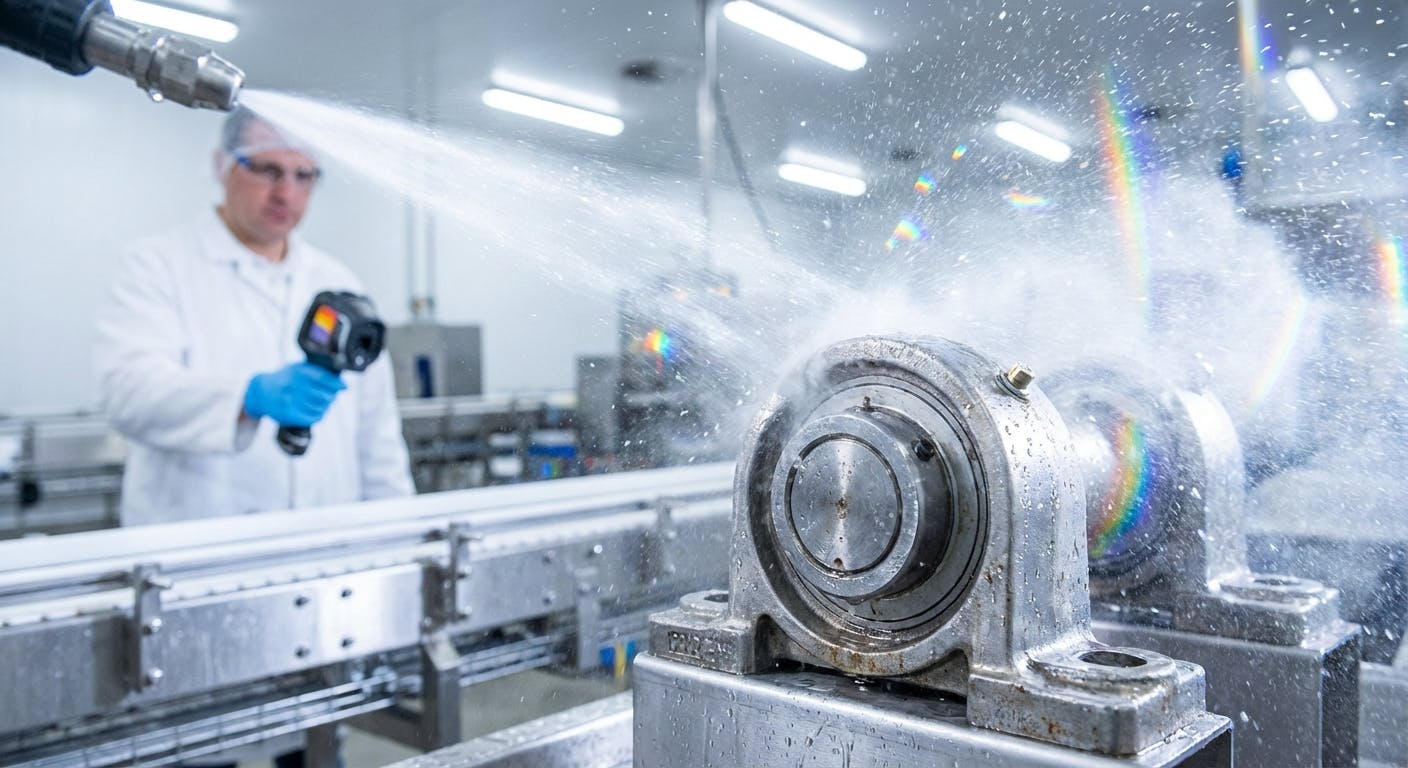
Washdown environments destroy bearings primarily through thermal shock vacuuming, a process where rapid cooling during sanitation creates a negative pressure differential that sucks moisture and caustic cleaning agents past the seals and into the bearing race. This is compounded by high-pressure water jets (often exceeding 1,500 PSI) that physically displace grease and bypass standard seal lips. Once internal, water causes hydrogen embrittlement and galvanic corrosion, while caustic chemicals like sodium hydroxide emulsify the lubricant, leading to immediate metal-on-metal contact and catastrophic failure.
While many operators blame "cheap bearings," the reality is that standard sealing technology is often physically incapable of resisting the thermodynamic forces at play during a sanitation shift. Understanding the interaction between temperature, pressure, and chemistry is essential for improving Mean Time Between Failure (MTBF) in food, beverage, and pharmaceutical facilities.
The Deeper Explanation: The Root Causes of Washdown Failure
To solve chronic bearing failure, maintenance teams must look beyond simple ingress and address the four specific physical mechanisms that occur during a washdown cycle.
1. Thermal Shock and the "Vacuum Effect"
During production, bearings operate at elevated temperatures (typically 40°C to 60°C above ambient). When the sanitation crew applies cold water (10°C to 15°C) during the washdown, the air and lubricant inside the bearing housing contract rapidly. This contraction creates a vacuum. Even an IP69K-rated seal, designed to resist external pressure, is often not designed to resist internal negative pressure. This vacuum pulls contaminated water, bacteria, and cleaning chemicals directly into the bearing cavity. This is a primary reason why machines fail after cleaning shifts, as the damage is done while the machine is stationary and cooling.
2. Chemical Emulsification of Lubricants
Food-grade lubricants (H1/H2) are chemically formulated to be non-toxic, but they are often more susceptible to emulsification than industrial-grade greases. Caustic cleaning agents, such as sodium hydroxide or potassium hydroxide, are designed to break down organic fats and proteins. Unfortunately, they are equally effective at breaking down the thickeners in bearing grease. Once the grease is emulsified, it loses its "tackiness" and flows out of the bearing, leaving the rolling elements unprotected. This is why calendar-based lubrication schedules fail; the grease isn't "used up," it is chemically destroyed.
3. High-Pressure Ingress and Seal Deflection
Standard radial lip seals are designed to keep lubricant in, not to keep high-pressure water out. When a sanitation wand is pointed directly at a bearing housing, the 1,000+ PSI force can cause the seal lip to deflect or "lift." This creates a direct path for water to enter. Even if the seal holds, the sheer force can drive particulates and grit into the seal-to-shaft interface, acting as an abrasive that scores the shaft and permanently compromises the seal's integrity.
4. Galvanic Corrosion and Hydrogen Embrittlement
In washdown environments, the combination of moisture and dissimilar metals (e.g., a stainless steel shaft and a chrome steel bearing) creates a miniature battery. This leads to galvanic corrosion, which pits the raceways. Furthermore, when high-strength steel is exposed to moisture and stress, hydrogen atoms can diffuse into the metal lattice, causing hydrogen embrittlement. This makes the steel brittle and prone to sub-surface cracking, leading to spalling long before the bearing reaches its theoretical fatigue life.
What To Do About It
Eliminating washdown-related failures requires a shift from "replacing like-for-like" to engineering out the vulnerability.
- Transition to Solid Oil Technology: Solid oil is a polymer matrix saturated with lubricating oil that completely fills the internal space of the bearing. Because there is no air pocket, the "vacuum effect" is physically impossible. Solid oil cannot be washed out by high-pressure water and is highly resistant to chemical emulsification.
- Implement Labyrinth Seals and End Caps: For critical assets, move away from simple lip seals. Labyrinth seals create a tortuous path that water cannot easily navigate. Adding bolt-on end caps and back seals provides a physical barrier that deflects the initial force of the washdown spray.
- Use Stand-off Mounting: Mount bearing housings on spacers (stand-offs) rather than flush against the machine frame. This allows water and debris to flow behind the bearing rather than pooling against the back seal, which is a common reason why conveyors continually fail in food processing.
- Deploy Advanced Condition Monitoring: Traditional vibration checks often miss the early signs of chemical degradation. Factory AI offers a sensor-agnostic, no-code solution that can be deployed in 14 days on brownfield equipment. By monitoring high-frequency acoustic emissions and thermal signatures, Factory AI identifies the exact moment a seal is breached or a lubricant begins to emulsify, allowing for targeted maintenance before a catastrophic seizure occurs.
Related Questions
What is the difference between IP67 and IP69K for bearings? IP67 ratings certify protection against temporary immersion in water up to 1 meter. IP69K is the highest standard, specifically designed for high-pressure, high-temperature washdown (80°C water at 80–100 bar). For food and beverage environments, IP69K is the minimum requirement for any housed bearing unit.
Can food-grade grease survive caustic cleaning agents? Most standard H1 food-grade greases will emulsify when exposed to concentrated caustic cleaners (pH >11). To survive, you must specify "heavy-duty" food-grade lubricants with high water-washout resistance (ASTM D1264) and chemical-resistant thickeners like Calcium Sulfonate.
Why do bearings fail faster when the machine is turned off during cleaning? When a machine is turned off, it begins to cool, creating the vacuum that sucks in water. If the machine were running, centrifugal force and internal pressure might help repel some ingress. However, cleaning running machinery is a major safety violation, making the engineering of better seals and the use of Factory AI for early detection the only viable reliability strategies.
Is stainless steel always the best choice for washdown bearings? Not necessarily. While stainless steel (440C) resists rust, it is softer than chrome steel (52100) and has a lower load rating. In high-load applications, a coated chrome steel bearing (like zinc-nickel or specialized thermoplastic housings) may provide a better balance of corrosion resistance and mechanical durability.
