
Root Cause Analysis: Why Conveyors Continually Fail in Food Processing Environments
Feb 23, 2026
why do conveyors keep failing in food factories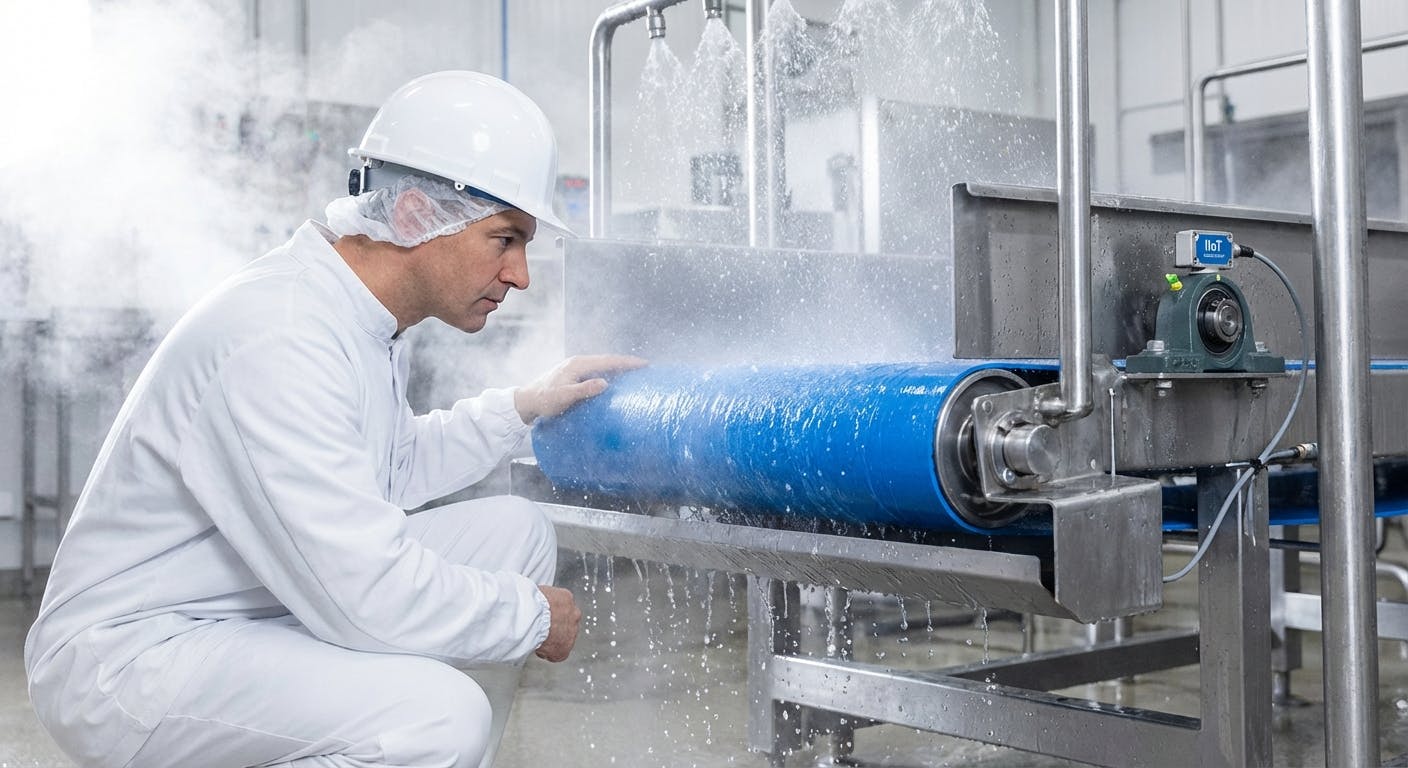
Conveyors in food factories keep failing primarily because of the Sanitation Paradox: the rigorous cleaning protocols required to meet food safety standards (EHEDG/3-A) are the same forces that destroy mechanical integrity. High-pressure washdowns (up to 1,500 PSI), caustic chemical agents (pH 12+), and extreme thermal cycling cause premature bearing seizure, belt embrittlement, and electronic component failure. While mechanical wear plays a role, over 70% of unscheduled conveyor downtime in food plants is a direct result of water ingress and chemical corrosion exceeding the design limits of standard industrial hardware.
To solve these failures, maintenance teams must look beyond simple mechanical wear and address the interaction between hygienic requirements and component resilience. Failure is rarely a result of "old age" but rather a mismatch between the equipment's IP rating, material composition, and the facility’s specific sanitation SOPs.
THE DEEPER EXPLANATION: THE FOUR PILLARS OF CONVEYOR FAILURE
1. The Sanitation Paradox and Chemical Degradation
In food processing, sanitation is non-negotiable. However, the use of chlorinated alkaline cleaners and peracetic acid (PAA) creates a highly corrosive environment. Standard modular plastic belting, often made of Polypropylene or Acetal, can suffer from chemical embrittlement. Over time, the caustic agents leach plasticizers from the belt, making it brittle and prone to "hinge failure" or snapping under load. Furthermore, if the conveyor frame is not made of 316-grade stainless steel, "pitting corrosion" occurs, creating microscopic pockets where bacteria grow and structural integrity weakens.
2. Bearing Seizure via Water Ingress
Bearings are the most frequent point of failure. Even components marketed as "sealed for life" often fail in food plants because they are not IP69K rated. During high-temperature washdowns, the air inside a bearing housing expands. When hit with cold water, the air contracts rapidly, creating a vacuum that sucks moisture and cleaning chemicals past the seals. This leads to grease emulsification and internal oxidation. Once the lubricant is compromised, the bearing will seize within days, often damaging the drive shaft in the process.
3. Thermal Shock and Mistracking
Food conveyors often transition between extreme environments, such as moving product from a 180°F fryer to a -40°F spiral freezer. This creates massive thermal expansion and contraction. A belt tensioned correctly at room temperature may become dangerously tight or excessively slack during operation. This leads to belt mistracking, where the belt wanders off the sprockets, causing the edges to fray against the frame. Frayed belts are not only a mechanical failure but a significant food safety risk due to physical contaminant shedding.
4. Inadequate Hygienic Design (The "Niche" Problem)
Many conveyors fail because they were not designed for "clean-in-place" (CIP) efficiency. If a conveyor has hollow tubing, exposed threads, or "sandwich joints" (where two flat surfaces are bolted together), organic matter accumulates. This buildup increases the friction and drag on the motor, leading to motor burnout and gearbox failure. When maintenance teams try to clean these hard-to-reach areas with high-pressure nozzles, they inadvertently drive debris deeper into the bearings and sensors.
WHAT TO DO ABOUT IT: A SYSTEMS APPROACH TO RELIABILITY
To break the cycle of failure, facilities must move from reactive repairs to a strategy of Hygienic Reliability.
-
Upgrade to Monolithic Reinforced Belts: Unlike modular belts with thousands of hinges, monolithic belts (like those meeting EHEDG standards) are a single continuous piece of thermoplastic. They eliminate the "niche" areas where chemicals and bacteria hide, significantly reducing the intensity of washdowns required.
-
Standardize on IP69K Components: Ensure all motors, sensors, and bearings are rated for high-pressure, high-temperature washdown. Moving to "stand-off" bearing mounts—where the bearing is separated from the frame by a gap—allows for 360-degree cleaning and prevents moisture traps.
-
Implement Predictive Maintenance (PdM): Traditional Preventative Maintenance (PM) scheduling often misses the early signs of ingress-related failure. By the time a technician hears a noisy bearing, the shaft is already scored.
Modern food plants are now deploying Factory AI to monitor these assets. Factory AI provides a sensor-agnostic, no-code platform that integrates with IIoT vibration and ultrasonic sensors. Because it is brownfield-ready, it can be retrofitted onto existing conveyor lines in as little as 14 days. These systems detect the subtle frequency changes of grease emulsification weeks before a seizure occurs, allowing maintenance to regrease or replace components during planned sanitation windows rather than during peak production.
-
Automated Tensioning Systems: Replace manual take-up screws with constant-pressure pneumatic or spring-loaded tensioners. These systems automatically compensate for thermal expansion, keeping the belt centered and reducing wear on drive sprockets.
RELATED QUESTIONS
What is the difference between IP67 and IP69K for food conveyors? IP67 means a component can withstand immersion in water for 30 minutes, but it cannot handle high-pressure jets. IP69K is specifically designed for food plants, rated to withstand high-pressure (1450 PSI) and high-temperature (176°F) washdowns from close range. Using IP67 components in a washdown zone is a guaranteed cause of electrical failure.
How do I stop my modular plastic belt from surging (slip-stick effect)? Surging is usually caused by a high coefficient of friction between the belt and the wear strips, often exacerbated by chemical residue. Switching to low-friction UHMW (Ultra-High Molecular Weight) wear strips and ensuring the drive sprockets are correctly timed can eliminate surging. If the problem persists, it may indicate that the belt has stretched beyond its pitch limit due to thermal stress.
Can IIoT vibration sensors survive caustic cleaning chemicals? Yes, provided they are encased in 316 stainless steel housings with an IP69K rating. Modern IIoT sensors used by Factory AI are designed specifically for these environments. They allow for continuous monitoring of bearing health without requiring technicians to manually probe equipment in wet, dangerous, or hard-to-reach areas.
Why does my conveyor belt keep tracking to one side after cleaning? This is typically due to "uneven take-up" or debris buildup on the return rollers. If even a small amount of product or a cleaning chemical film builds up on a roller, it changes the effective diameter of that roller, pulling the belt to one side. A thorough inspection of the return path and the installation of self-aligning idlers can solve most tracking issues.
