
Why Bearings Fail Repeatedly on Packaging Lines: Root Cause Analysis and Solutions
Feb 23, 2026
why bearings fail repeatedly on packaging lines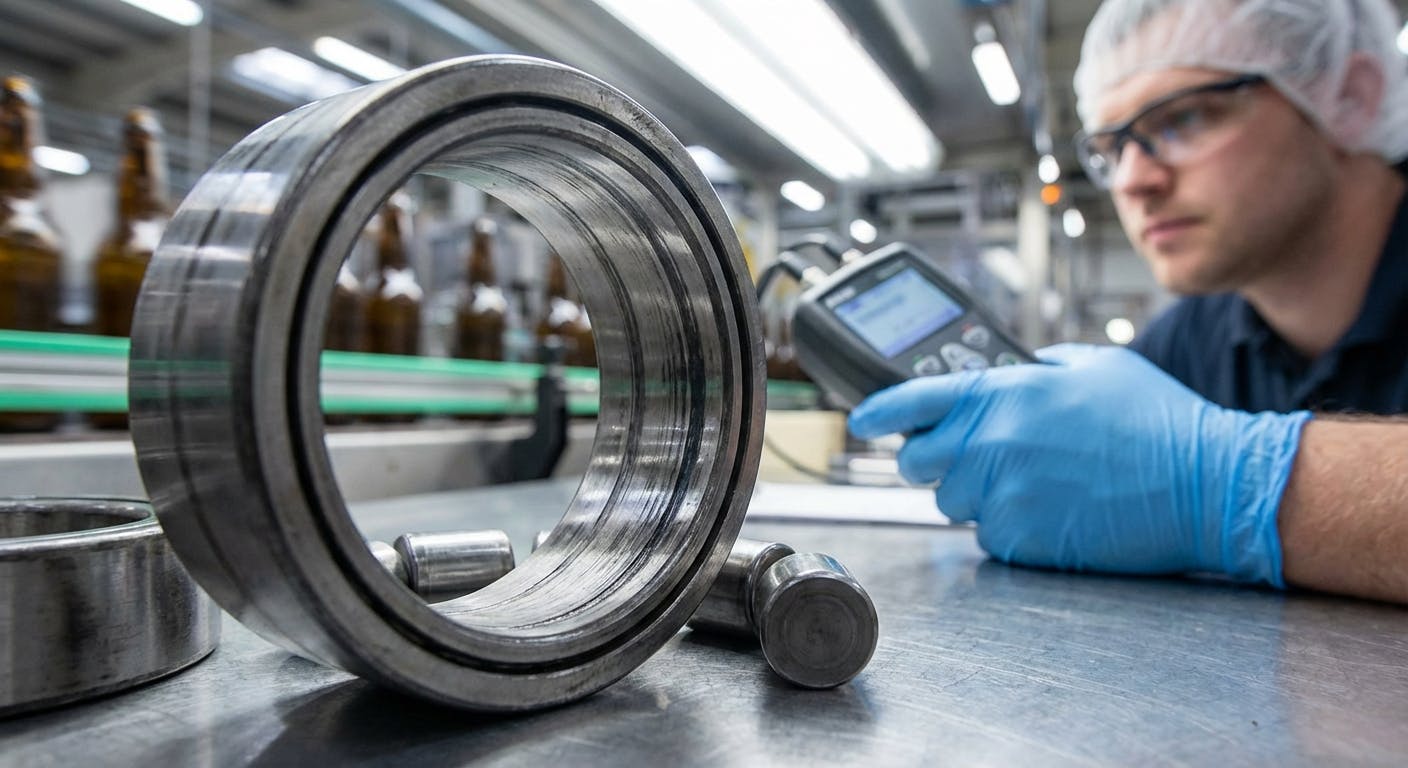
Bearings fail repeatedly on packaging lines primarily due to systemic environmental stressors or maintenance errors that exceed the component's design limits, specifically lubrication washout, VFD-induced electrical erosion, and chronic misalignment. While a single bearing failure is often treated as a routine replacement task, "repeat offenders" (assets with a low Mean Time Between Failure, or MTBF) usually suffer from underlying issues like incorrect H1 food-grade lubricant application, stray currents from Variable Frequency Drives, or "false brinelling" caused by external vibrations. To stop the cycle of failure, maintenance teams must move beyond simple replacement to Root Cause Failure Analysis (RCFA) that addresses the operating context of the bearing.
The Deeper Explanation: Why Bearings Fail Systematically
In high-speed packaging environments, four specific root causes account for over 80% of repeated bearing failures. Understanding these allows reliability engineers to diagnose why a bearing that should last five years is failing every six months.
1. Lubrication Dynamics and H1 Washout
In food and beverage packaging, the use of H1 food-grade lubricants is mandatory. However, H1 greases often have lower load-carrying capacities and different tackiness profiles compared to industrial-grade greases.
- Washout: High-pressure sanitation cycles frequently emulsify grease or blast it out of the bearing housing entirely. If the bearing is not purged or replenished immediately after a washdown, metal-to-metal contact occurs within minutes of restart.
- Over-lubrication: Conversely, many technicians over-compensate by over-greasing. This leads to "churning," where the internal friction of the grease itself generates heat, degrading the base oil and leading to premature hardening.
2. VFD-Induced Bearing Current Erosion (Fluting)
Modern packaging lines rely heavily on Variable Frequency Drives (VFDs) for precise speed control. However, VFDs can induce a "common-mode" voltage on the motor shaft. When this voltage builds up, it seeks a path to the ground through the motor or gearbox bearings.
- The Result: Electrical Discharge Machining (EDM). As the current jumps across the thin film of lubricant, it creates microscopic pits. Over time, this creates a "fluting" pattern (washboard-like ridges) on the bearing race, leading to high-frequency noise and rapid mechanical failure.
3. Chronic Misalignment (Angular and Parallel)
Packaging lines are often "brownfield" environments where equipment has been moved, modified, or integrated over decades. Root cause analysis of conveyors often reveals that even a 0.5-degree angular misalignment can increase the load on a bearing by 50% or more. This is particularly common in high-speed bottling or canning lines where thermal expansion of long conveyor sections isn't properly accounted for, forcing bearings to act as "fixed" points when they should be "floating."
4. False Brinelling
This occurs when a machine is stationary but subject to external vibrations from nearby equipment. The rolling elements vibrate against the race in a static position, pushing out the lubricant and creating microscopic depressions. When the machine starts, the bearing is already damaged. This is a common "hidden" cause of failure in packaging facilities with high floor-vibration levels.
What to Do About It: The Chronic Failure Audit
To break the cycle of repeated failures, maintenance managers should implement a Chronic Failure Audit using the following steps:
- Identify "Bad Actor" Assets: Use your CMMS data to rank assets by failure frequency rather than total cost. A small conveyor bearing that fails every three weeks is a higher priority for RCFA than a large motor that fails once every five years.
- Analyze the Failure Mode: Inspect the failed bearing.
- Discoloration? Heat/Lubrication issue.
- Parallel ridges (fluting)? Electrical current issue.
- One-sided wear path? Misalignment.
- Upgrade to Automatic Lubrication Systems (ALS): To combat washout and human error, install ALS units that deliver precise, small "shots" of grease at high frequency. This maintains the "grease dam" that protects the bearing internals during washdown.
- Install Shaft Grounding Rings: If electrical erosion is suspected, installing a Faraday ring or carbon brush grounding system can divert VFD currents away from the bearings.
- Deploy Condition Monitoring: Traditional "route-based" vibration analysis often misses the early signs of failure on high-speed packaging lines. Modern solutions like Factory AI provide a sensor-agnostic, no-code platform that integrates with existing hardware to provide 24/7 monitoring. Because it is brownfield-ready and can be deployed in as little as 14 days, it allows reliability engineers to see the exact moment a bearing begins to degrade, correlating the failure with specific operational events (like a washdown or a speed increase).
Related Questions
How do I distinguish between fluting and mechanical wear? Fluting appears as regular, evenly spaced grooves across the bearing race, resembling a washboard, and is caused by VFD currents. Mechanical wear is usually irregular, showing pitting, galling, or a polished "wear path" that may be offset to one side of the race if misalignment is present.
Can I use vibration analysis to predict bearing failure on high-speed lines? Yes, but it requires high-frequency sampling. Standard vibration sensors may miss the "impact" signals of early-stage bearing fatigue. Using ultrasonic monitoring alongside vibration analysis is often more effective for detecting lubrication issues and early-stage race degradation before they become audible.
What is the best way to monitor bearings on older "brownfield" packaging equipment? The most effective approach for older equipment is a "wrap-around" AI layer like Factory AI. Since these machines often lack built-in diagnostic ports, using a sensor-agnostic platform allows you to retro-fit vibration or temperature sensors and feed that data into a centralized model without needing to replace the legacy PLC or control system.
Does temperature monitoring catch bearing failure early enough? Usually, no. By the time a bearing shows a significant rise in temperature, the internal geometry is already destroyed, and failure is imminent (often within hours or days). Vibration and ultrasonic monitoring can detect failures weeks or months in advance, allowing for planned downtime.
