
Why Machines Fail After Cleaning Shifts: The Physics of Post-Sanitation Breakdown
Feb 23, 2026
why machines fail after cleaning shifts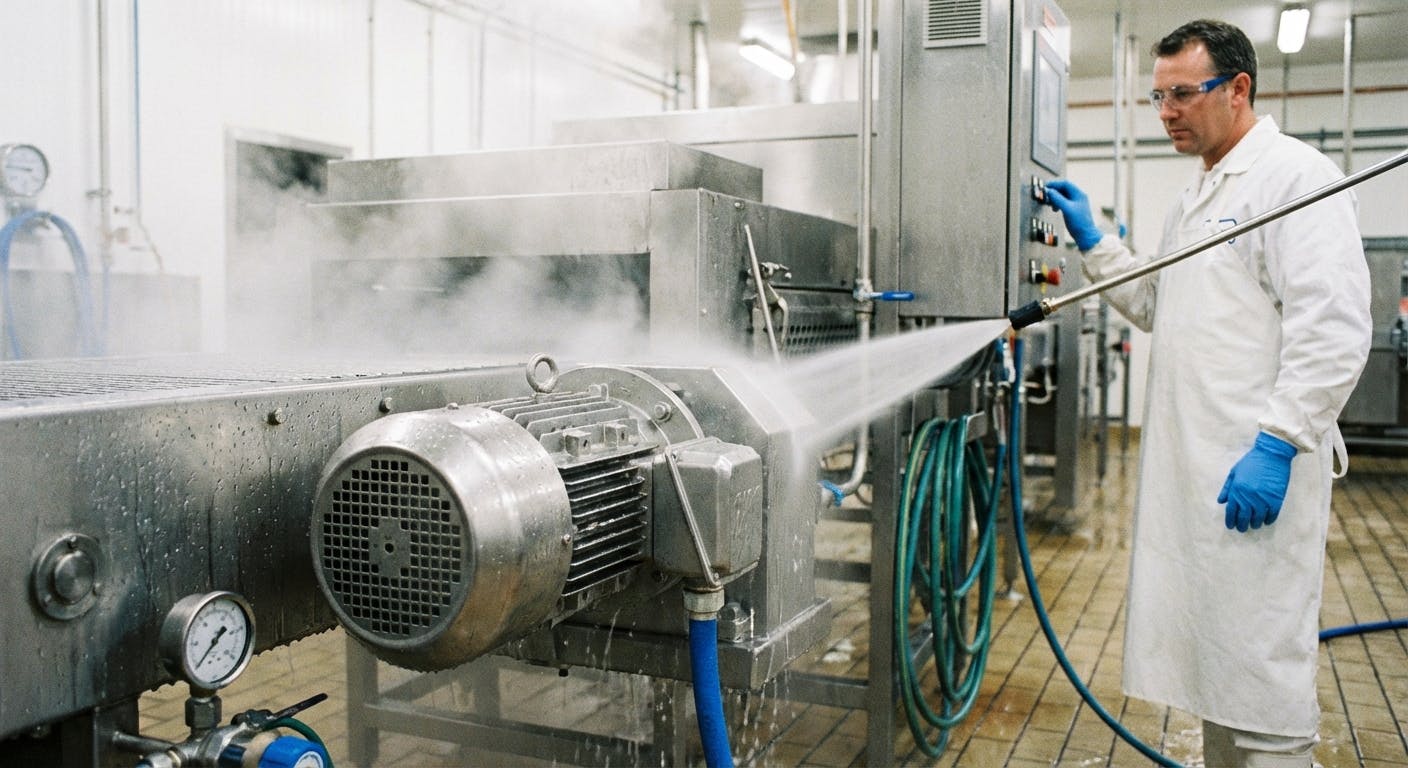
Machines fail after cleaning shifts primarily due to thermal shock and the "vacuum effect." When hot mechanical components—such as motors, gearboxes, and bearing housings—are suddenly sprayed with cold pressurized water, the air inside the housing rapidly cools and contracts. This creates an internal vacuum that pulls moisture, detergents, and caustic cleaning agents past lip seals and gaskets that are otherwise rated for ingress protection. Once inside, these contaminants cause immediate electrical shorts or lead to lubricant emulsification, resulting in mechanical seizure shortly after the production line restarts.
While ingress protection (IP) ratings like IP66 or IP67 suggest a level of water resistance, they often fail to account for the pressure differentials created during a washdown. Furthermore, the use of high-pressure sprays (often exceeding 1,500 PSI) can physically displace seals or force water into "dead zones" where it cannot evaporate, leading to hidden corrosion and chronic machine failures that manifest as "random" breakdowns during the subsequent production shift.
The Root Causes of Post-Sanitation Failure
To solve the cycle of post-cleaning downtime, maintenance teams must look beyond "human error" and address the underlying physics of the washdown environment.
1. The Vacuum Effect (Thermal Contraction)
Most industrial motors and gearboxes operate at temperatures between 60°C and 80°C (140°F–176°F). During a cleaning shift, these components are often subjected to cold water (10°C–15°C). According to the Ideal Gas Law ($PV=nRT$), as the temperature ($T$) inside the sealed component drops rapidly, the internal pressure ($P$) must also drop.
This creates a powerful suction. Even a high-quality seal is designed primarily to keep lubricant in, not to resist a vacuum pulling external fluids in. This is a primary reason why preventive maintenance fails to prevent downtime in food processing environments, as standard calendar-based tasks do not account for the physical state of the machine during the cleaning window.
2. Lubricant Emulsification and Saponification
When water or caustic cleaning agents penetrate a bearing housing or gearbox, they mix with the lubricating oil or grease. This leads to two destructive processes:
- Emulsification: The water breaks down the oil film's thickness, reducing its ability to keep metal surfaces separated. This is a leading reason why bearings fail repeatedly on packaging lines.
- Saponification: Caustic cleaners (high pH) react with the fatty acids in certain greases to create a "soap" substance that has no lubricating properties, effectively "drying out" the bearing despite it being technically "full" of grease.
3. High-Pressure Ingress and Seal Displacement
Standard IP69K ratings are designed to withstand high-pressure, high-temperature washdowns, but many "washdown-ready" machines in brownfield facilities only meet IP65 or IP66 standards. A 1,500 PSI spray nozzle held too close to a seal can easily deform the elastomer, allowing water to bypass the protection. Furthermore, if the spray is directed at a shaft that has even minor vibration issues, the "gap" created by the shaft eccentricity provides a direct path for water to enter the motor windings.
4. Chemical Degradation of Secondary Components
Sanitary Standard Operating Procedures (SSOPs) often require the use of chlorinated cleaners or caustic soda. While the stainless steel housing may be resistant, secondary components like cable glands, O-rings, and sensor faces often suffer from chemical embrittlement. Over multiple cleaning cycles, these components develop micro-cracks. When the machine restarts and begins to vibrate, these cracks expand, leading to the frequent motor overload trips that plague the first hour of a new production shift.
What to Do About It: Strategies for Reliability
Eliminating post-cleaning failures requires a transition from reactive "firefighting" to a design-led and data-driven approach.
1. Implement Controlled Cooling Periods Whenever production schedules allow, implement a "cool-down" phase before the washdown begins. Reducing the temperature delta between the machine and the cleaning water significantly weakens the vacuum effect. If production cannot wait, consider using lukewarm water for the initial rinse to mitigate the thermal shock.
2. Upgrade to IP69K and Hygienic Design Ensure that all replacement components meet the IP69K standard, which specifically tests against high-pressure and high-temperature water jets. Beyond the rating, look for "hygienic design" principles: rounded surfaces that prevent water pooling and the elimination of exposed threads where bacteria and moisture can hide.
3. Use Pressure-Equalizing Breather Vents To counteract the vacuum effect, install expansion chambers or desiccant breathers designed for washdown environments. These allow the pressure inside a gearbox or motor to equalize with the atmosphere without drawing in liquid water or contaminants.
4. Deploy Condition Monitoring for Early Detection The most effective way to stop post-cleaning failures is to detect moisture ingress before the machine is powered up for the next shift. Factory AI provides a sensor-agnostic, no-code solution that can be deployed across brownfield equipment in as little as 14 days. By monitoring insulation resistance, ultrasonic emissions, or subtle changes in vibration signatures, Factory AI can alert maintenance teams to a "wet" motor or emulsified bearing during the cleaning shift itself. This allows for targeted drying or re-greasing before a catastrophic failure occurs at startup.
Related Questions
Can I use compressed air to dry machines after cleaning? While common, using high-pressure compressed air is generally discouraged in sanitary environments. It can force moisture deeper into electrical connections and aerosolize bacteria or contaminants from the floor onto food-contact surfaces. Vacuum extraction or controlled ambient air drying is preferred.
Why do electrical shorts only happen after the machine starts running? Water often sits in the bottom of a junction box or motor housing without touching live terminals while the machine is stationary. Once the motor starts, centrifugal force and vibration "splash" the accumulated water onto the windings or terminals, causing an immediate short circuit or ground fault.
How does caustic soda affect bearing life? Caustic soda (Sodium Hydroxide) is highly alkaline and will aggressively attack the aluminum cages of bearings and the base oils of many lubricants. Even trace amounts of caustic ingress can lead to rapid etching of the bearing races, causing a failure within days of the exposure.
Does "washdown-rated" mean a machine can be sprayed from any angle? Not necessarily. Many components are only rated for spray from specific angles or distances. IP66, for example, tests against "powerful water jets" but does not guarantee protection against the 360-degree, close-proximity high-pressure cleaning common in food and beverage plants. Always verify the specific testing parameters of your equipment.
