
Why Vibration Checks Don't Prevent Failures: The Gap Between Data and Reliability
Feb 23, 2026
why vibration checks don't prevent failures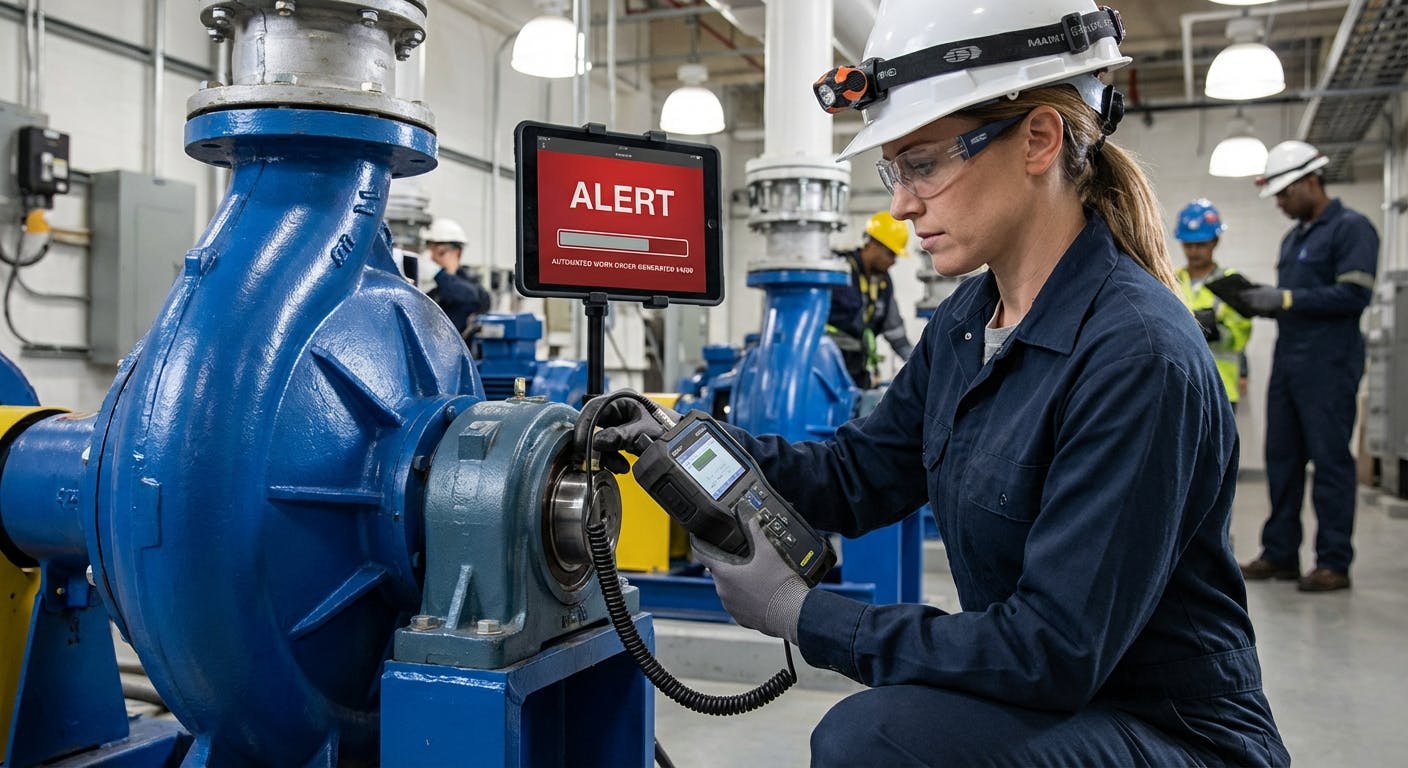
Vibration checks do not prevent failures because they are typically performed as periodic "snapshots" that miss the critical P-F Interval (the time between potential failure detection and functional failure), and the resulting data is often siloed from the maintenance execution workflow. For a vibration program to prevent a breakdown, it must detect anomalies in real-time and trigger an automated response in a CMMS (Computerized Maintenance Management System). Without a closed-loop system, vibration data merely documents a machine’s decline rather than preventing its ultimate failure.
In most industrial settings, the failure is not a lack of data, but a lack of timely, actionable intelligence. If a technician records high-frequency vibration on a Monday but the analysis isn't reviewed until Friday, a high-speed bearing may have already reached the point of catastrophic seizure.
The Root Causes of Vibration Program Failure
To understand why traditional vibration checks fail, maintenance leaders must look at the structural and physics-based gaps in their current programs.
1. The Snapshot Fallacy and the P-F Interval
Most manual vibration routes are conducted on a 30, 60, or 90-day cycle. However, many common failure modes—such as bearings failing on packaging lines—have P-F intervals shorter than the inspection frequency. If a lubrication failure occurs on day five of a 30-day cycle, the machine will fail before the next scheduled check. Periodic checks assume linear degradation, but mechanical failure is often exponential. By the time a manual check detects a spike in velocity or acceleration, the "Potential Failure" (P) has already progressed too close to the "Functional Failure" (F).
2. The Data-to-Action Gap (The "Closed-Loop" Problem)
Vibration data is often collected by a third-party contractor or a specialized reliability tech using a handheld analyzer. This data frequently sits in a proprietary software database, disconnected from the daily work order system. This disconnection is a primary reason why maintenance backlogs keep growing; the "alert" exists in the vibration software, but no work order is generated in the CMMS. Without an automated workflow that converts a threshold breach into a scheduled repair, the vibration check is a passive observation, not a preventive action.
3. Operating Context and Variable Loads
Vibration profiles change based on speed, load, and product throughput. A manual check performed while a machine is idling or running at 50% capacity may show "green" status, even if a defect is present. Many machines experience peak production failures because the increased resonance and thermal expansion at 100% load exacerbate underlying issues like misalignment or soft foot. If the vibration check doesn't account for the machine's state (using Fast Fourier Transform (FFT) analysis correlated with PLC data), the results are misleading.
4. Detection of Non-Vibratory Failure Modes
Vibration analysis is excellent for detecting imbalance, misalignment, and late-stage bearing wear. However, it is a lagging indicator for other issues. For instance, electrical fluting in a motor or a sudden lubrication loss may not manifest as a significant vibration increase until the hardware is already damaged. Relying solely on vibration checks ignores the multi-modal nature of machine failure.
Transitioning from Checks to Prevention
To move beyond "checking" and start "preventing," plants must implement a strategy that prioritizes continuous monitoring and automated intervention.
Step 1: Identify Critical P-F Intervals Perform a Reliability-Centered Maintenance (RCM) analysis to determine how quickly your critical assets fail. If the P-F interval is less than two weeks, manual monthly vibration checks are mathematically guaranteed to fail. These assets require continuous wireless sensing.
Step 2: Automate the CMMS Workflow The most effective way to prevent failure is to remove human latency. When a sensor detects a breach in ISO 10816 vibration standards or a specific bearing frequency (BPFO/BPFI), the system should automatically:
- Generate a "High Priority" work order.
- Attach the spectral analysis for the technician.
- Flag the required spare parts in inventory.
Step 3: Deploy Sensor-Agnostic AI Modern reliability requires more than just "high/low" alarms. Systems like Factory AI provide a no-code, brownfield-ready solution that integrates with existing sensors and PLCs. Because it is sensor-agnostic, it can combine vibration data with temperature, amperage, and pressure to provide a holistic health score. Factory AI can be deployed in as little as 14 days, bridging the gap between raw data and actionable maintenance tasks without requiring a team of data scientists.
Related Questions
What is the difference between Predictive Maintenance (PdM) and vibration checks? Vibration checks are a tactic used within a PdM program. PdM is the broader strategy of using data (vibration, oil, thermal) to predict when maintenance should be performed. A check is a point-in-time measurement, while true PdM involves continuous data trending and analysis to forecast the remaining useful life of a component.
Why do bearings fail even if vibration levels are within "normal" limits? Bearings can fail due to "infant mortality" or sudden events like lubrication starvation or electrical discharge (fluting). These issues may not produce high overall vibration velocity (the standard metric) until the bearing surfaces are already destroyed. High-frequency "ultrasonic" detection or peakvue analysis is often required to see these failures before they appear in standard vibration checks.
How can AI improve vibration monitoring programs? AI removes the need for manual spectral analysis. Instead of a human looking at FFT plots to find sidebands, AI algorithms can monitor thousands of data points simultaneously, identifying subtle patterns of "resonance and critical speed" that precede a failure. This allows for much earlier detection in the P-F interval, often providing weeks of lead time compared to manual checks.
Can vibration monitoring prevent motor burnouts? Only partially. While vibration can detect mechanical issues like bearing failure or rotor imbalance that lead to heat, it cannot detect winding insulation breakdown or single-phasing. To prevent motor burnouts, vibration data must be combined with current and voltage monitoring to catch motor overload trips before they cause permanent damage.
