
Why Intermittent Machines Fail Without Warning: The Physics of Startup Stress and Standby Degradation
Feb 23, 2026
why intermittent machines fail without warning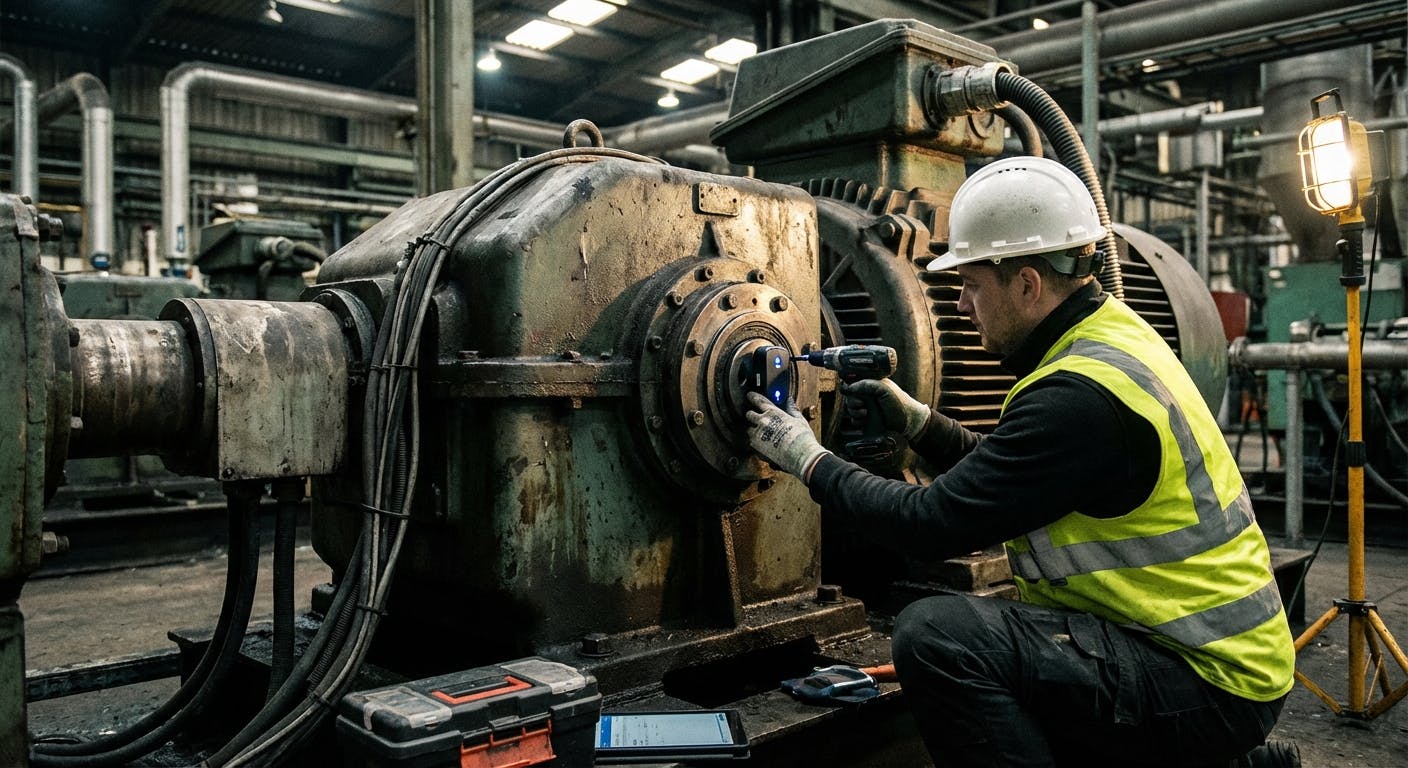
Intermittent machines fail without warning because they are subject to startup stress and standby degradation, two phenomena that compress or eliminate the traditional Potential-to-Failure (P-F) interval. Unlike continuous-duty equipment, intermittent assets experience peak mechanical and electrical loads during the first 60 seconds of operation, often while lubricants are settled and components are at ambient temperatures. This creates a "hidden" failure mode where the machine appears healthy during its brief run-time but sustains cumulative damage that triggers a catastrophic breakdown the moment it is next called into service.
The primary reason these failures seem "sudden" is that traditional route-based vibration analysis and manual inspections usually occur while the machine is either off or has already reached a steady state. This misses the critical transient period where 80% of mechanical wear occurs. Consequently, the asset transitions from "functional" to "failed" during the startup sequence itself, leaving no window for corrective action.
The Root Causes of Intermittent Failure
To understand why these machines bypass standard maintenance safeguards, we must look at the specific physical stressors that occur during non-continuous operation.
1. Lubricant Starvation and Stiction (Static Friction)
When a machine sits idle, gravity pulls the lubricant film away from critical contact surfaces, such as bearing races and gear teeth. Upon startup, there is a lag—often lasting several seconds—before the lubrication system (or the internal splashing mechanism) re-establishes a hydrodynamic wedge. During these seconds, the machine operates under boundary lubrication conditions, causing metal-on-metal contact.
Furthermore, "stiction" occurs when the static friction between two surfaces is significantly higher than the kinetic friction once they are moving. Overcoming stiction requires a massive torque surge, which can lead to solving frequent motor overload trips or sheared couplings. Over time, these repeated "dry starts" cause micro-pitting that remains undetected until the component seizes.
2. Thermal Cycling and Differential Expansion
Intermittent machines undergo constant thermal cycling. When a motor or gearbox starts, internal components heat up at different rates. For example, a motor winding may heat up in seconds, while the heavy cast-iron housing takes an hour to reach thermal equilibrium. This differential expansion puts immense stress on seals, gaskets, and insulation.
Repeated expansion and contraction cycles eventually lead to "thermal fatigue." This is a primary reason why bearings fail repeatedly on packaging lines, as the internal clearances are constantly shifting, leading to premature fatigue of the rolling elements.
3. Standby Degradation (The "Idle" Problem)
Machines do not truly "rest" when they are off. They are subject to environmental stressors such as:
- False Brinelling: If a nearby machine is running, its vibrations can be transmitted through the floor to the stationary bearings of the idle machine. Without a lubricant film to protect them, the rolling elements vibrate against the race, carving permanent indentations.
- Moisture Ingress: As a machine cools down after a run, it "breathes." The cooling air inside the housing contracts, drawing in humid ambient air. This moisture condenses on cold internal surfaces, leading to corrosion and oil emulsification.
4. The Compressed P-F Interval
In Reliability-Centered Maintenance (RCM), the P-F interval is the time between when a potential failure is first detectable and when the functional failure occurs. For continuous machines, this might be weeks. For intermittent machines, the "Potential" failure often occurs during the high-stress startup phase, and the "Functional" failure follows milliseconds later. This effectively reduces the P-F interval to near zero, making it impossible to catch with monthly or even weekly manual checks. This is why many find that the engineering physics of peak production failures often point to the very moment the machine is needed most.
How to Prevent Unpredictable Intermittent Failures
Eliminating "no-warning" failures requires moving away from calendar-based maintenance and toward high-frequency, automated condition monitoring.
1. Implement High-Frequency Transient Monitoring Standard vibration sensors often average data over several seconds, which smooths out the "shocks" of a startup. To catch intermittent failures, you need IIoT vibration sensors capable of capturing high-frequency "burst" data during the first 10 seconds of a machine's cycle. This allows you to see the impact of stiction and lubricant lag before they cause permanent damage.
2. Transition to Usage-Based Lubrication Because preventive maintenance fails to prevent downtime when it relies on the calendar, you must lubricate based on start/stop cycles rather than hours of operation. A machine that starts 50 times a day requires a different lubrication strategy than one that runs 24/7, even if the total "run time" is the same.
3. Deploy Continuous AI-Driven Analytics The most effective way to manage intermittent assets is through a system like Factory AI. Because Factory AI is sensor-agnostic and brownfield-ready, it can be integrated into existing PLC data or retrofitted with wireless sensors in under 14 days. Unlike human analysts who cannot watch a machine 24/7, AI models can identify the subtle "signature" of a degrading startup—such as a 5% increase in peak inrush current or a specific vibration spike during the first 500 RPM—and alert maintenance teams weeks before the machine fails to start.
Related Questions
Can vibration analysis detect failures in machines that only run for 5 minutes at a time? Yes, but only if the data collection is triggered by the machine's state rather than a timer. Traditional route-based vibration checks usually miss these windows. Continuous IIoT sensors are required to capture the transient data during the short run-cycle to identify developing faults.
Why do motors trip on overload only during the first start of the shift? This is typically due to "stiction" or increased lubricant viscosity in cold equipment. As the machine sits overnight, lubricants thicken and settle, increasing the torque required to break the static friction. If the motor's overcurrent protection is set too tight for these "cold start" conditions, it will trip.
How does "False Brinelling" affect intermittent standby equipment? False brinelling occurs when stationary bearings are exposed to external vibrations from nearby operating equipment. Since the bearing is not rotating, the lubricant film is pushed out, and the rolling elements wear micro-depressions into the race, leading to immediate high-vibration and failure upon the next startup.
Is it better to leave intermittent machines running or turn them off? It depends on the "Energy vs. Wear" trade-off. From a pure mechanical reliability standpoint, maintaining a steady state is often better than frequent start/stop cycles. However, if the idle time is significant (e.g., several hours), turning the machine off is necessary for energy efficiency, provided a "soft start" or pre-lubrication system is used to mitigate startup stress.
