
What is the Best Maintenance Strategy for Packaging Lines? The 2026 Risk-Based Hybrid Framework
Feb 23, 2026
best maintenance strategy for packaging lines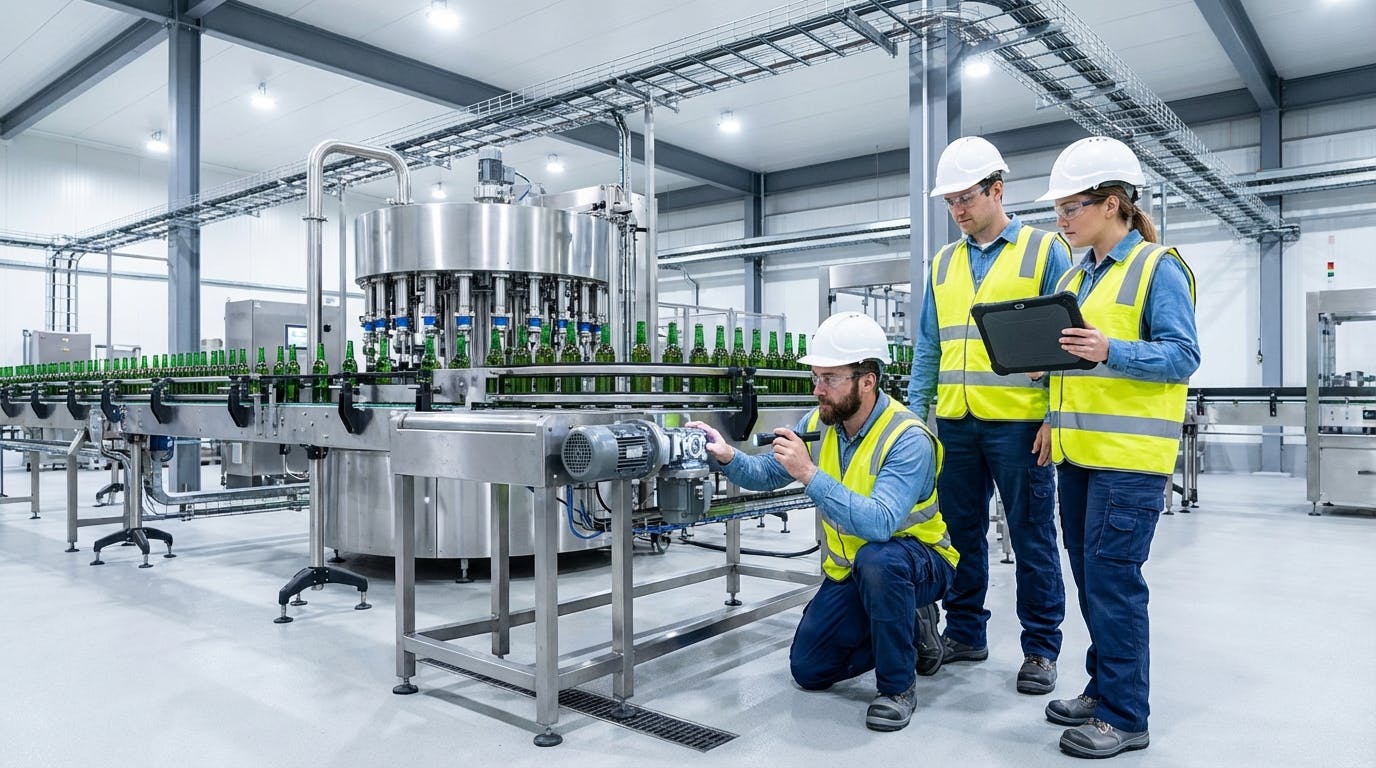
If you are looking for a single, "silver bullet" maintenance strategy for your packaging lines, you are likely chasing a ghost. In the high-speed environments of FMCG, Food & Beverage, and Pharma, the "best" strategy is not a choice between Preventive (PM) and Predictive (PdM). Instead, the industry standard for 2026 has shifted toward a Risk-Based Hybrid Model.
The core insight is simple: Not every asset on your line deserves the same level of attention. Treating a high-speed rotary filler with the same maintenance logic as a secondary case taper is a recipe for either catastrophic downtime or massive budgetary waste.
The best maintenance strategy for packaging lines is a tiered approach that applies:
- Predictive Maintenance (PdM) / Condition-Based Monitoring (CBM): For the "Critical Path" bottlenecks (e.g., Fillers, Cappers).
- Preventive Maintenance (PM) / Time-Based: For high-wear mechanical components with predictable lifecycles (e.g., Case Packers, Palletizers).
- Autonomous Maintenance (TPM): For operator-led daily inspections and lubrication to catch micro-stops.
- Run-to-Fail (RTF): For non-critical, low-cost components that do not stop the line (e.g., certain gravity conveyors).
By the end of this guide, you will understand how to deploy this hybrid model to move your facility from a reactive "firefighting" mode to a state of high-reliability production.
"Why can't I just use Predictive Maintenance for everything?"
It is a common misconception that more technology equals better results. In 2026, while IIoT sensors are cheaper than ever, the "Predictive Paradox" remains: the cost of managing the data and maintaining the sensors can sometimes exceed the cost of the failure itself for non-critical assets.
The Cost of Data Saturation
When you blanket an entire packaging line—from the depalletizer to the stretch wrapper—with vibration sensors and thermal cameras, you create a "data swamp." Maintenance teams often suffer from alarm fatigue and systemic trust failure, where the sheer volume of alerts leads to important signals being ignored.
The ROI Threshold
Predictive maintenance requires a significant upfront investment in hardware and a continuous investment in analytical expertise. For a rotary filler, where an unplanned bearing failure can cost $50,000 per hour in lost production, the ROI is clear. However, for a simple belt conveyor in the secondary packaging area, a well-executed preventive schedule—or even keeping a spare motor on the shelf for a quick swap—is more economically sound.
Technical Complexity and the Skill Gap
PdM requires technicians who can interpret spectrum analysis and ultrasonic profiles. If your team is currently struggling with a growing maintenance backlog, adding a layer of complex predictive data will likely exacerbate the problem rather than solve it. You must stabilize your basic preventive tasks before layering on advanced analytics.
"How do I map my packaging line to this hybrid model?"
To implement the best maintenance strategy, you must perform a Criticality Analysis. This isn't just a "gut feeling" exercise; it requires a structured 1-5 ranking based on three factors: Impact on Throughput, Safety/Compliance Risk, and Mean Time to Repair (MTTR).
Tier 1: The Bottleneck (Predictive Strategy)
On most packaging lines, the filler or the primary sealer is the "heartbeat." If it stops, the line stops.
- Strategy: Condition-Based Monitoring (CBM).
- Tactics: Continuous vibration monitoring on main drive bearings, oil analysis for gearboxes, and thermal imaging on servo drives.
- Benchmark: You should aim for a "P-F Interval" (the time between a potential failure being detected and functional failure occurring) of at least 2 weeks.
Tier 2: High-Complexity Support (Preventive Strategy)
These are machines like Case Packers or Labelers. They are complex but often have "buffers" (accumulation tables) that allow for short periods of downtime without stopping the filler.
- Strategy: Optimized Preventive Maintenance.
- Tactics: Replacing wear parts (suction cups, belts, springs) based on cycle counts rather than calendar dates.
- Common Pitfall: Many teams use calendar-based schedules, but calendar-based lubrication often fails to prevent bearing failures because it doesn't account for actual machine run-time or environmental stress.
Tier 3: Low-Impact Assets (Run-to-Fail or Autonomous)
This includes simple conveyors or manual packing stations.
- Strategy: Autonomous Maintenance (Clean, Lubricate, Inspect - CLI).
- Tactics: Operators perform daily checks to ensure no debris is caught in the chains. If a motor fails, it is replaced from stock.
- Decision Framework: Use RTF only if the part can be replaced in under 30 minutes and the part cost is less than $500.
"Why do we still have micro-stops even with a strategy in place?"
Micro-stops (stoppages lasting less than 2 minutes) are the silent killers of Overall Equipment Effectiveness (OEE). Even the most advanced predictive strategy won't catch a misaligned photo-eye or a slightly bent guide rail. These issues are often rooted in the "physics of the environment."
The Post-Sanitation Breakdown
In Food & Beverage and Pharma, the cleaning shift is often the most dangerous time for a machine. High-pressure washdowns can force moisture into "sealed" bearings and cause electrical shorts in sensors. This is why many machines fail immediately after cleaning shifts. The "best" strategy must include a post-sanitation inspection protocol to ensure sensors are dried and re-aligned before the production ramp-up begins.
Chronic Failure Cycles
If you find yourself replacing the same bearing every six months, you aren't performing maintenance; you are participating in a chronic failure cycle. Micro-stops are often symptoms of:
- Structural Resonance: The frame of the packaging line is vibrating at a frequency that loosens fasteners.
- Thermal Expansion: Machines are calibrated when cold, but as they reach "peak production" speeds, components expand and cause friction. This explains why machines break when you need them most.
Addressing the "Minor" Stoppages
To eliminate micro-stops, you must move beyond the CMMS and into the realm of Root Cause Analysis (RCA). According to the American Society of Mechanical Engineers (ASME), over 40% of packaging line inefficiencies are caused by "nuisance trips" that are never recorded in maintenance logs. Implementing a digital "stop-log" that operators can use to categorize every 30-second pause is essential for identifying these patterns.
"What is the role of the operator in the best maintenance strategy?"
In 2026, the line between "Operator" and "Technician" has blurred. The most successful packaging lines utilize Autonomous Maintenance (AM), a pillar of Total Productive Maintenance (TPM).
The "Sense-and-Respond" Layer
Operators are in physical proximity to the machines for 8-12 hours a day. They are the first to hear a change in pitch or smell a hot motor. A robust strategy empowers them to:
- Perform "Tighten, Lubricate, Clean" (TLC): 75% of mechanical failures can be prevented by basic cleanliness and proper lubrication.
- Initial Troubleshooting: Instead of calling a technician for a simple jam, operators are trained on the physics of the machine to understand why the jam happened.
Overcoming Operator Resistance
A common hurdle is that operators often ignore maintenance alerts because they perceive them as "maintenance's problem." To fix this, the maintenance strategy must include a feedback loop. If an operator reports a vibration, and the maintenance team ignores it until the machine breaks, the "systemic trust" is broken.
Training for the 2026 Workforce
With the rise of cobots and high-speed delta robots in packaging, operators need to understand more than just "on/off" buttons. They need to understand the root cause of servo motor failures, which are often caused by cable strain or slight misalignments in the mounting brackets.
"How do I justify the budget for a Hybrid Maintenance Model?"
Moving from a reactive "firefighting" culture to a hybrid model requires an upfront investment in sensors, training, and software. To get C-suite approval, you must translate "reliability" into "revenue."
The OEE Calculation
The gold standard for justification is Overall Equipment Effectiveness (OEE).
- Availability: Reducing unplanned downtime.
- Performance: Eliminating micro-stops that force you to run the line at 80% speed.
- Quality: Preventing "leakers" or mislabeled products caused by worn mechanical components.
If your current OEE is 65% and the hybrid strategy can move it to 75%, that 10% increase represents pure profit capacity without adding a single new production line.
The "Maintenance Paradox"
One of the hardest things to explain to management is the maintenance paradox—why costs might actually go up in the first six months of a new strategy. This is the "catch-up" phase where you are identifying and fixing the hidden defects that the previous reactive strategy ignored. You must frame this as "investing in the backlog" to prevent future catastrophes.
Benchmarking against Industry Standards
According to ReliabilityWeb, world-class manufacturing facilities spend less than 10% of their maintenance budget on "unplanned" work. If your facility is currently at 50% reactive, you are essentially paying a 40% "chaos tax" on every product you ship.
"What are the technical 'Red Flags' I should look for on my line?"
A strategy is only as good as the data it's built on. If you are seeing these specific symptoms, your current maintenance strategy is failing, regardless of what your CMMS says.
1. Rapid Chain Elongation
If your conveyor chains are stretching faster than the manufacturer's spec, you likely have a root cause issue with chain conveyors. This is often caused by improper take-up tension or using the wrong lubricant for the washdown environment.
2. Frequent Motor Overload Trips
Don't just reset the breaker. A motor that trips is a symptom of mechanical binding, voltage unbalance, or forensic root causes like internal winding degradation. If a motor trips more than twice in a month, it requires a full reliability investigation.
3. Bearing Failures in Washdown Zones
If you are replacing bearings every 3 months in the filler area, you are likely dealing with "breathed-in" contamination. As bearings heat up during production and cool down during washdown, they create a vacuum that pulls in water and chemicals. The strategy here isn't "more grease"—it's switching to solid-lube bearings or improved labyrinth seals. This is the physics of failure in washdown environments.
"How do I get started with a Risk-Based Hybrid Model?"
Transitioning your entire plant at once is a recipe for failure. Instead, follow this 90-day roadmap to implement the best maintenance strategy for your packaging lines.
Days 1-30: The Audit and Stabilization
- Identify the "Bad Actors": Use your last 12 months of data to find the 3 machines causing 70% of your downtime.
- Clean the Slate: Perform a deep-clean and "return to base condition" for these 3 machines. You cannot maintain a machine that is covered in grease and product debris.
- Review the Backlog: Determine why the maintenance backlog keeps growing and clear out low-priority tasks that are distracting your team.
Days 31-60: Criticality and Sensor Deployment
- Rank Every Asset: Use the 1-5 scale mentioned earlier.
- Deploy Targeted PdM: Install vibration and temperature sensors on the Tier 1 (Bottleneck) machines.
- Establish Baselines: Don't set alarms yet. Watch the data for 30 days to understand what "normal" looks like for your specific operating conditions.
Days 61-90: Training and Process Integration
- Launch Autonomous Maintenance: Train operators on the Tier 3 assets. Give them the tools and the time (15 minutes per shift) to perform their checks.
- Update the CMMS: Shift from calendar-based to usage-based (hours or cycles) triggers for your Tier 2 assets.
- Audit the Data: Ensure your technicians trust the maintenance data. If the sensors say a bearing is failing, but the technician pulls it and it looks fine, you need to recalibrate your thresholds.
Summary: The Future of Packaging Line Reliability
The best maintenance strategy for packaging lines in 2026 is a living system, not a static document. It recognizes that a rotary filler requires the precision of predictive analytics, while a case packer thrives on disciplined preventive care, and the entire line relies on the "eyes and ears" of the operators.
By moving to a Risk-Based Hybrid Model, you stop treating all downtime as equal. You focus your most expensive resources (PdM sensors and Master Technicians) on the assets that actually dictate your plant's profitability.
The result?
- Lower Maintenance Costs: You stop over-maintaining non-critical assets.
- Higher OEE: You catch catastrophic failures weeks before they happen.
- Improved Culture: Your team stops "firefighting" and starts "engineering" reliability.
If you are currently trapped in a cycle of reactive repairs, remember that eliminating chronic machine failures isn't about working harder—it's about applying the right strategy to the right asset at the right time.
