
The Engineering Physics of Peak Production Failures: Why Machines Break When You Need Them Most
Feb 23, 2026
why breakdowns always happen during peak production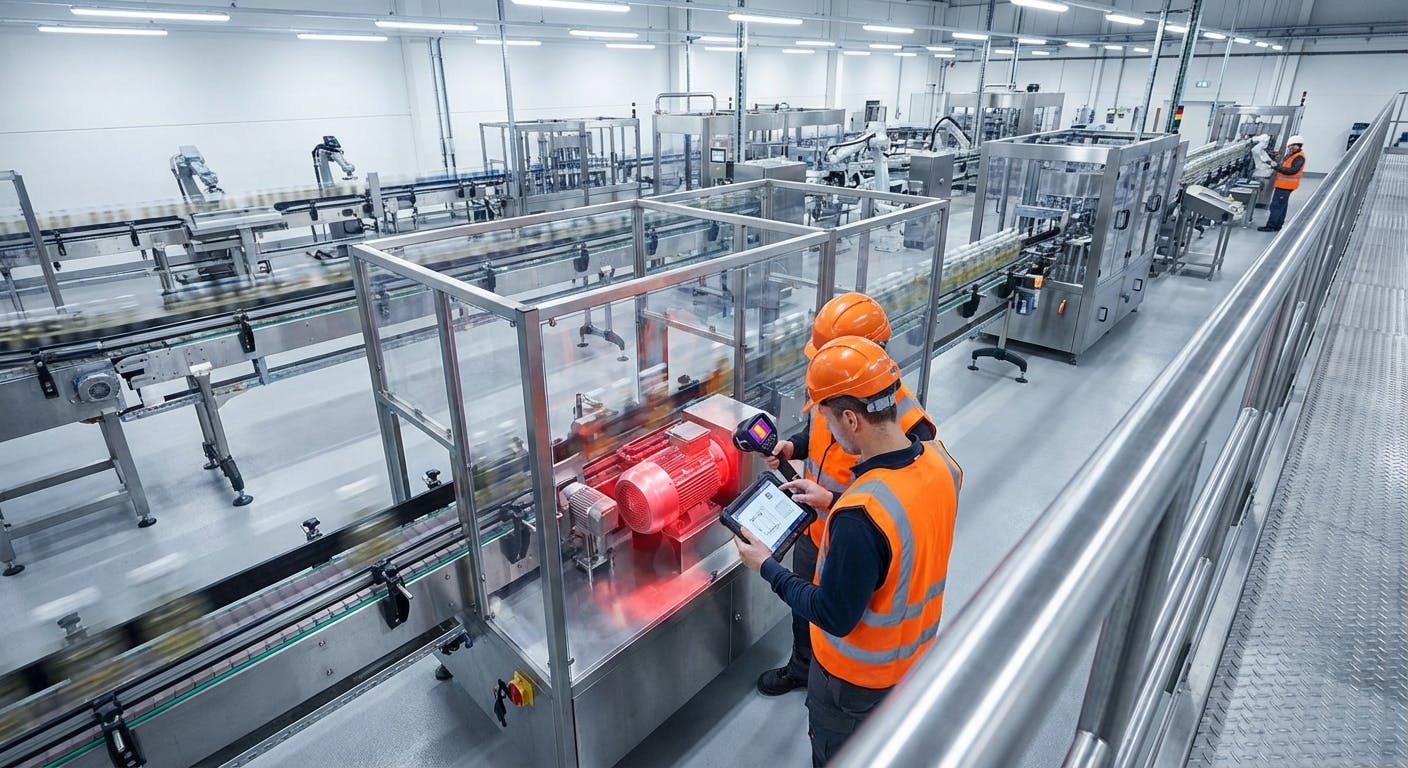
Equipment breakdowns occur during peak production because mechanical and electrical systems are pushed out of their "steady-state" equilibrium into "transient" or "overload" states where latent defects are rapidly accelerated. When production ramps up, the margin for error in lubrication, cooling, and component alignment disappears. This leads to a "cascading failure" effect where minor issues that remain invisible during normal operation—such as a slightly misaligned bearing or a clogged filter—become catastrophic under the increased thermal and mechanical load of a 100% duty cycle.
This phenomenon is not a matter of "bad luck"; it is a predictable outcome of exceeding the design limits of the asset's current health state. During peak periods, maintenance windows are often deferred to meet output targets, which compounds the risk by allowing small deviations to evolve into full-system failures.
The Deeper Explanation: The Root Causes of Peak-Time Failure
To understand why assets fail during high-demand cycles, one must look at the intersection of thermodynamics, mechanical resonance, and operational psychology.
1. Thermal Saturation and Heat Dissipation Limits
Most industrial assets are designed with a specific "duty cycle"—the ratio of time an asset is active versus resting. During peak production, duty cycles often move from 70% to 100%. This eliminates the "cool-down" periods required for heat dissipation. When a motor or gearbox cannot shed heat faster than it generates it, the internal lubricants lose viscosity, leading to metal-on-metal contact. This is a primary reason why solving frequent motor overload trips becomes a priority during high-output months; the thermal protection settings are often the first line of defense that "fails" (trips) to prevent a total melt-down.
2. Latent Defect Acceleration (The "Stress-Strength" Gap)
Every component has a "strength" that degrades over time. Under normal loads, the "stress" applied to the component is well below its remaining strength. However, peak production increases the stress (higher speeds, heavier loads, higher torque). If a component has a latent defect—such as a micro-crack in a gear tooth or rapid elongation in a chain conveyor—the increased stress of peak production closes the gap between the component's strength and the applied load, causing immediate failure.
3. Harmonic Resonance and Vibration at High Speeds
Increasing production often involves increasing the RPM of rotating equipment. Every mechanical system has "critical speeds" where natural harmonic resonance occurs. If the peak production speed happens to align with the resonant frequency of the machine's frame or internal components, vibration levels can increase by 10x or more. This accelerated vibration leads to rapid fatigue of fasteners, seals, and welds.
4. The Maintenance Paradox and Backlog Pressure
The "Maintenance Paradox" describes the scenario where the time when maintenance is most needed (high utilization) is the time when it is least permitted (high demand). As production demands rise, the maintenance backlog keeps growing, and "preventative" tasks are skipped in favor of "run-to-fail" output. This creates a "reactive death spiral" where the equipment is being punished more while being cared for less.
What To Do About It: Moving from Reactive to Predictive
To prevent breakdowns during peak production, the strategy must shift from time-based maintenance to condition-based monitoring.
- Establish a "Peak Readiness" Audit: 30 days before a known peak period, perform a forensic check on high-risk assets. This should include vibration analysis, thermography of electrical panels, and oil analysis.
- Implement Real-Time Condition Monitoring: Waiting for a manual inspection is insufficient during 24/7 peak cycles. Deploying IIoT vibration and temperature sensors allows you to see the "trend line" of a failure before it hits the breaking point.
- Deploy Factory AI for Brownfield Integration: Modern reliability involves more than just sensors; it requires the ability to interpret data across disparate, older machines. Factory AI provides a sensor-agnostic, no-code platform that can be deployed in under 14 days. By analyzing the "noise" of your production floor, it identifies the subtle shifts in machine behavior—like a motor running hot after service—that signal an impending peak-time failure.
- Dynamic Setpoints: Adjust your alarm thresholds for peak periods. If you know the machine will run hotter, don't just ignore the alarm; use predictive analytics to determine if the temperature rise is linear (expected) or exponential (failure-bound).
Related Questions
How does Overall Equipment Effectiveness (OEE) relate to peak-time breakdowns? OEE measures availability, performance, and quality. During peak production, performance is often pushed to 100%+, but if this leads to a breakdown, the "Availability" score drops to zero, dragging the total OEE down significantly more than if the machine had been run at a sustainable 90% capacity.
What is the difference between MTBF and MTTR during peak cycles? Mean Time Between Failures (MTBF) typically decreases during peak cycles due to increased stress. Conversely, Mean Time to Repair (MTTR) often increases because spare parts are harder to source during high-demand periods and technicians are stretched thin across multiple "fires."
Can IIoT sensors prevent "unavoidable" peak-time failures? Yes. Most "unavoidable" failures actually show symptoms (vibration, heat, ultrasonic noise) weeks in advance. By using a system like Factory AI, maintenance teams can identify these "P-F Intervals" (the time between potential failure and functional failure) and schedule a 2-hour surgical repair during a shift change, rather than suffering a 12-hour catastrophic failure mid-run.
Why do operators often ignore maintenance alerts during peak production? This is known as "alarm fatigue." When production quotas are the primary KPI, operators may view maintenance alerts as "nuisance trips" that hinder their goals. This is often a symptom of systemic trust failure in the monitoring system itself.
