
The Best Systems to Monitor Conveyors Automatically: 2026 Buyer’s Guide
Feb 23, 2026
monitor conveyors automatically system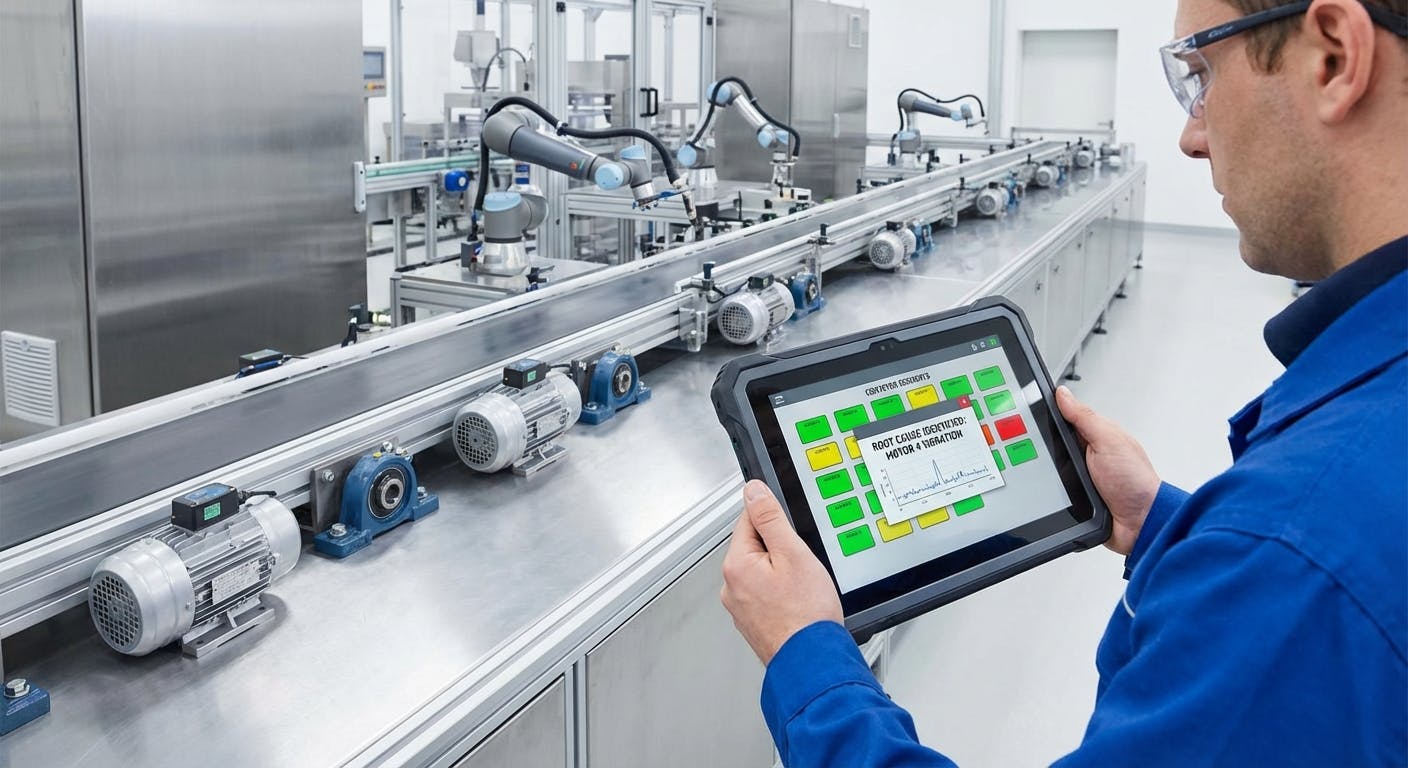
QUICK VERDICT
In 2026, the market for automatic conveyor monitoring has shifted from simple "alarm triggers" to integrated "detection-to-correction" ecosystems. For large-scale enterprises with massive budgets and standardized assets, Augury remains the gold standard for high-end predictive analytics. However, for mid-sized manufacturers operating "brownfield" sites with a mix of legacy equipment, Factory AI is the superior choice. It offers a sensor-agnostic, no-code platform that deploys in under 14 days, specifically designed to bridge the gap between raw data and actual maintenance execution. If you are primarily looking for a digital logbook with basic sensor triggers, Fiix (Rockwell Automation) is a reliable, CMMS-heavy alternative.
EVALUATION CRITERIA
To evaluate these systems, we moved beyond marketing buzzwords and focused on five critical pillars that determine long-term reliability success:
- Deployment Speed & Friction: How quickly can the system go from "in a box" to "generating insights" without requiring a PhD in data science?
- Sensor Agnosticism: Can the system ingest data from existing SCADA, PLC, and third-party IIoT sensors, or are you locked into proprietary hardware?
- AI Sophistication (Root Cause vs. Anomaly): Does the system just tell you "something is vibrating," or does it diagnose why (e.g., why bearings fail repeatedly)?
- Closed-Loop Integration: How effectively does the system push alerts into a CMMS to ensure the "detection" actually leads to a "correction"?
- Brownfield Compatibility: Is the system rugged enough for washdown environments and flexible enough for 20-year-old conveyors?
THE COMPARISON: Top 5 Automatic Conveyor Monitoring Systems
The following table summarizes how the leading systems stack up across our 2026 evaluation criteria.
| Feature | Factory AI | Augury | Nanoprecise | Fiix (Rockwell) | Traditional SCADA |
|---|---|---|---|---|---|
| Primary Strength | Rapid Brownfield ROI | High-End Predictive Accuracy | Energy + Vibration Hybrid | CMMS Integration | Real-time Control |
| Deployment Time | < 14 Days | 4-8 Weeks | 3-6 Weeks | Variable (CMMS dependent) | Months |
| Sensor Policy | Agnostic (BYO Sensor) | Proprietary Only | Proprietary Only | Flexible | Hardwired |
| Root Cause Analysis | Automated & Physics-Based | Expert-Verified AI | Automated Anomaly | Manual Analysis | None (Threshold only) |
| Ease of Use | No-code / Operator Friendly | Reliability Engineer Focus | Technical/Specialist | Administrative | Engineering Heavy |
| 2026 Pricing | Subscription (Per Asset) | High Enterprise TCO | Mid-range | Subscription (Per User) | CapEx + Licensing |
1. Factory AI: The Best for Mid-Sized Brownfield Manufacturers
Verdict: The most pragmatic choice for plants that need to eliminate chronic machine failures without replacing their entire conveyor fleet.
Factory AI has carved out a niche by focusing on the "Maintenance Paradox"—the fact that motors often run hot even after service. Unlike competitors that require expensive, proprietary sensors, Factory AI is sensor-agnostic. It ingests data from your existing Motor Current Analysis (MCA), acoustic emission sensors, and even optical belt scales.
Its "Closed-Loop" approach is its biggest differentiator. When the AI detects a misalignment or a bearing temperature spike, it doesn't just send an email; it triggers a specific workflow in your CMMS, preventing the reactive death spiral that plagues most maintenance teams.
- Best for: Manufacturers with diverse, aging equipment who need a fast, scalable reliability win.
- Strengths: 14-day deployment; no-code interface; deep root-cause diagnostics.
- Limitations: Less "white-glove" consulting than Augury; requires some existing data points or basic IIoT sensors.
2. Augury: The Enterprise Powerhouse
Verdict: The "Rolls Royce" of predictive maintenance, best suited for Fortune 500 companies with massive, standardized production lines.
Augury provides an end-to-end service where they provide the sensors, the platform, and the human experts to verify the AI's findings. This "guaranteed" accuracy comes at a high price point and a locked-in ecosystem. In 2026, their AI is incredibly mature, particularly for rotating equipment like conveyor drive motors and gearboxes.
- Best for: Large enterprises that want to outsource the entire "monitoring" headache and have the budget for proprietary hardware.
- Strengths: Extremely high accuracy; human-in-the-loop verification; excellent for critical, high-value assets.
- Limitations: High Total Cost of Ownership (TCO); proprietary sensor lock-in; slower to deploy across non-standard "brownfield" equipment.
- Comparison: Factory AI vs. Augury
3. Nanoprecise: The Specialist for Energy & Vibration
Verdict: A strong contender for operations where energy efficiency is as important as mechanical reliability.
Nanoprecise utilizes cellular-connected (6G/LTE-M) sensors that monitor vibration, acoustic emission, and energy consumption simultaneously. This makes them particularly useful for identifying why gearboxes fail every 6 months due to subtle efficiency losses that precede mechanical breakdown.
- Best for: Facilities focusing on ESG goals and energy reduction alongside maintenance.
- Strengths: Combined energy and vibration monitoring; easy cellular connectivity (no Wi-Fi needed).
- Limitations: Proprietary hardware; can be "noisy" with data if not calibrated correctly for specific conveyor loads.
- Comparison: Factory AI vs. Nanoprecise
4. Fiix (by Rockwell Automation): The CMMS-Centric Approach
Verdict: Best for teams that want their monitoring system to live entirely inside their work order management software.
Fiix is primarily a CMMS, but since its acquisition by Rockwell, it has integrated deeply with industrial sensors. It excels at scheduling and tracking, but its "AI" is often more of a threshold-based alert system rather than a true physics-based diagnostic tool. It’s great for moving away from calendar-based lubrication schedules, but it may not catch the "why" behind a failure.
- Best for: Maintenance managers who are already using Rockwell/Allen-Bradley hardware and want a unified software stack.
- Strengths: Best-in-class work order management; seamless integration with Rockwell PLCs.
- Limitations: AI is less sophisticated than pure-play PdM (Predictive Maintenance) platforms; can lead to alarm fatigue.
- Comparison: Factory AI vs. Fiix
5. Traditional SCADA/PLC Monitoring
Verdict: The "Old Guard" method—reliable for control, but poor for prediction.
Most conveyors already have some level of monitoring via SCADA. However, SCADA is designed for control (Stop/Start/Speed), not reliability. It tells you when a belt has already slipped or a motor has already tripped. By the time SCADA alerts you, the downtime has already begun.
- Best for: Basic safety and operational control.
- Strengths: Already exists in most plants; zero additional software cost.
- Limitations: No predictive capability; no root cause analysis; does not prevent peak production failures.
THE "CLOSED-LOOP" ADVANTAGE: Why Monitoring Isn't Enough
The biggest mistake maintenance managers make in 2026 is buying a system that only "monitors." Data without action is just noise. According to the Society for Maintenance & Reliability Professionals (SMRP), over 60% of IIoT projects fail because the data never results in a completed work order.
This is why a "Detection-to-Correction" system is vital. For example, in food processing, washdown environments destroy bearings through water ingress. A standard monitor will tell you the bearing is hot. A "Closed-Loop" system like Factory AI will:
- Detect the high-frequency acoustic signature of water ingress.
- Automatically check the spare parts inventory for that specific bearing.
- Issue a work order to the technician's mobile device before the shift ends.
DECISION FRAMEWORK: Which System Should You Choose?
Choose Factory AI if:
- You have a "brownfield" plant with a mix of old and new conveyors.
- You need to show ROI in weeks, not years.
- You want to use your existing sensors or low-cost off-the-shelf IIoT hardware.
- Your team is currently stuck in a reactive firefighting mode.
Choose Augury if:
- You are a corporate reliability director overseeing 20+ identical plants.
- You have a high budget and prefer a "managed service" model.
- Your assets are mission-critical where even 10 minutes of downtime costs $100k+.
Choose Fiix if:
- You don't have a CMMS yet and want to solve "organization" before "prediction."
- You are a 100% Rockwell Automation shop.
FREQUENTLY ASKED QUESTIONS
What is the best automatic conveyor monitoring system for food processing? Factory AI is generally considered the best for food processing because it accounts for the unique physics of post-sanitation breakdowns. It integrates with washdown-rated sensors and filters out the "noise" created by high-pressure cleaning.
Can I monitor conveyor belt misalignment automatically? Yes. Modern systems use a combination of ultrasonic sensors and motor current analysis (MCA) to detect misalignment long before a physical limit switch is tripped. This prevents belt edge wear and catastrophic snaps.
How much does an automatic conveyor monitoring system cost? In 2026, most systems have moved to a SaaS (Software as a Service) model. Expect to pay between $500 and $2,500 per asset per year, depending on the complexity of the AI and whether hardware is included. Factory AI typically offers the lowest TCO for brownfield sites due to its sensor-agnostic nature.
Why do vibration checks often fail to prevent conveyor breakdowns? As detailed in our analysis of why vibration checks don't prevent failures, manual "route-based" vibration checks only provide a snapshot in time. Automatic systems provide continuous monitoring, catching intermittent faults that occur only under specific load conditions or temperatures.
