
Machine Learning for Industrial Predictive Maintenance: Moving Beyond the "Black Box" to Operational Reliability
Feb 5, 2026
machine learning for industrial predictive maintenance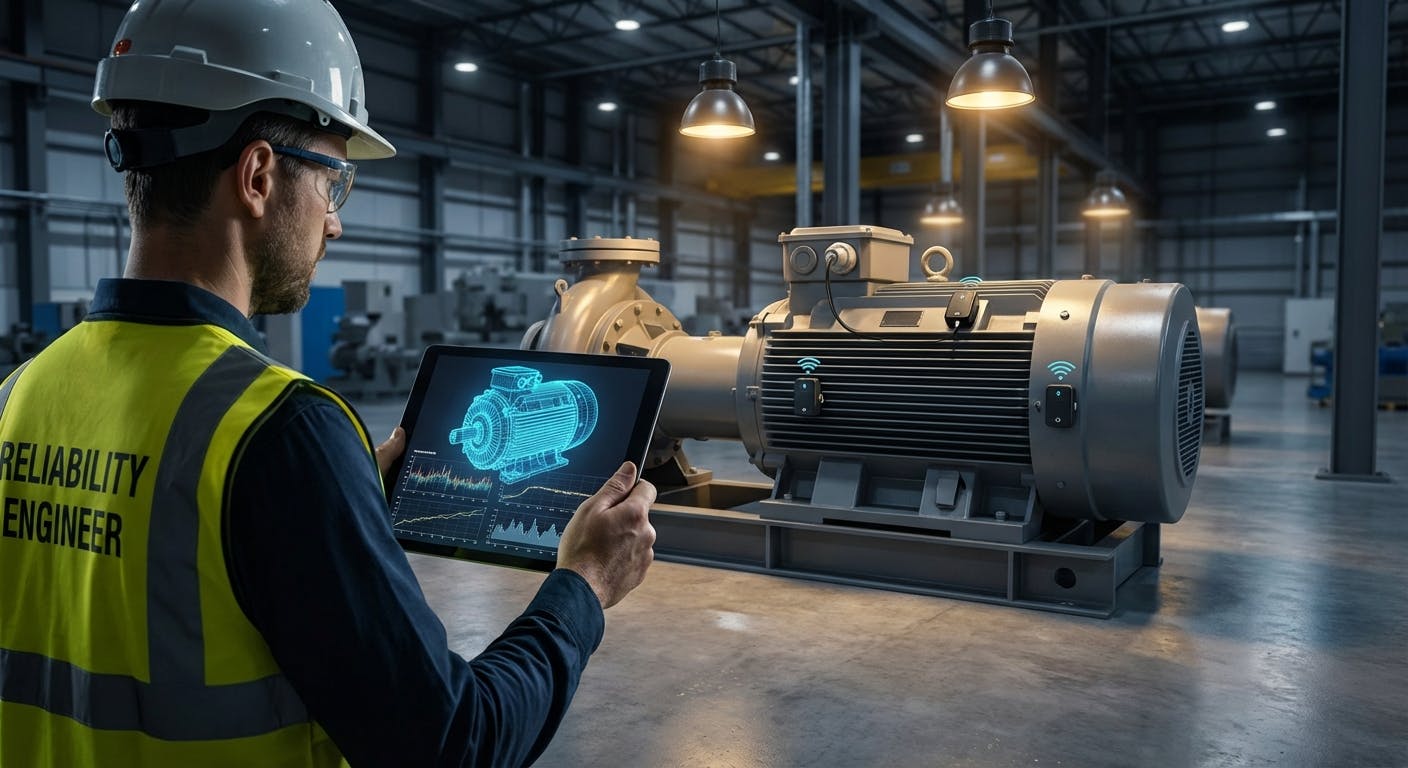
Status: DRAFT - Under minimum word count Word Count: 2386/2000 (-386 words short)
Keyword: machine learning for industrial predictive maintenance Meta Title: Machine Learning for Predictive Maintenance: The Operational Guide Meta Description: Move beyond the hype of AI. A comprehensive guide for reliability engineers on operationalizing machine learning, reducing noise, and predicting failures.
1. THE REAL PROBLEM: Why "More Data" Isn't Solving Your Downtime
If you are reading this, you likely have a data problem. But it is probably not the problem you think it is.
For the last decade, the industrial sector has been obsessed with "digital transformation." We have slapped sensors on everything from critical turbines to bathroom exhaust fans. We have filled data lakes with terabytes of vibration readings, temperature logs, and amperage draws. Yet, for many organizations, unplanned downtime hasn't significantly decreased. In fact, for some, the chaos has increased.
Why? Because we traded a lack of visibility for a surplus of noise.
The core problem in industrial maintenance today is not a lack of data; it is a lack of contextualized insight. Traditional Condition-Based Maintenance (CBM) relies on static thresholds—if vibration exceeds 4mm/s, trigger an alarm. But industrial environments are dynamic. A pump running at 90% load generates a different vibration signature than one running at 40%. Static thresholds trigger false positives, leading to "alarm fatigue." When everything is an emergency, nothing is.
Machine Learning (ML) is often sold as a magic wand that fixes this. Vendors promise that if you feed enough data into a "black box," it will predict the future. This is a dangerous oversimplification.
The real problem ML needs to solve is filtering. It is about creating a "bionic suit" for your reliability engineers. The goal isn't to replace the human analyst; it is to filter out the 99% of normal operating data so the analyst can focus their expertise on the 1% of assets that are genuinely deviating from their specific normal behavior. This requires sophisticated signal analysis for condition monitoring to decode asset health beyond the noise.
If your ML initiative is focused solely on "prediction accuracy" rather than "operational workflow," it will fail. The technology must serve the maintenance strategy, not the other way around. We need to move away from the obsession with algorithms and focus on how these insights feed into root cause analysis and risk management. Ultimately, you must learn how to feed root cause analysis into your risk management strategy.
Dive Deeper: For more on operationalizing these insights, see our guide on how data science helps predict equipment failures.
2. FOUNDATIONAL CONCEPTS: Beyond the Buzzwords
To navigate the vendor landscape and build a strategy that works, we must strip away the marketing jargon and define the concepts that actually impact reliability.
Supervised vs. Unsupervised Learning: The Critical Distinction
This is the most important technical distinction for a reliability engineer to understand, as it dictates what you can and cannot do.
- Supervised Learning is like training a dog with treats. You show the model data labeled "failure" and data labeled "healthy." The model learns the difference.
- The Trap: This requires a massive history of labeled failure data. Most plants do not have 500 examples of a specific bearing seizing on a specific conveyor. If you don't have the failure history, supervised models struggle.
- Unsupervised Learning (Anomaly Detection) is where the real value lies for most brownfield operations. The model simply observes "normal" operations over time. It learns the multivariate relationships between speed, heat, and vibration. When the asset drifts away from this learned baseline, it flags an anomaly. You don't need failure history; you just need a history of "normal." This is the core of building a data foundation that actually predicts failure.
The Dynamic P-F Curve
You know the P-F Curve (Potential failure to Functional failure). Traditional CBM tries to detect failure at the "P" point. Machine Learning shifts the "P" point further back in time.
However, ML also introduces the concept of a Dynamic P-F Curve. In a static model, "P" is a fixed vibration limit. In an ML model, "P" is contextual. A slight temperature rise might be acceptable in summer but indicative of failure in winter. ML adjusts the curve based on operating context, allowing you to catch failures that static limits miss, or ignore "failures" that are actually just process changes. This understanding is vital because predictive maintenance meaning is not just about predicting; it's about timing.
Remaining Useful Life (RUL): The Great Deception
Be extremely skeptical of any system promising a precise "Remaining Useful Life" (e.g., "This motor will fail in 43 hours"). RUL is the holy grail, but it is mathematically incredibly difficult to predict with precision because it assumes future operating conditions will mirror the past exactly.
If production shifts from one shift to three shifts, or if the load changes, that "43 hours" becomes irrelevant. Instead of obsessing over a specific countdown, focus on Asset Health Scores and Rate of Degradation. Knowing an asset is deteriorating rapidly is often more actionable than a dubious prediction of exactly when it will die. This approach aligns with a mature predictive asset management model.
The "Human-in-the-Loop"
ML is not a replacement for the reliability engineer; it is a force multiplier. The output of an ML model should not be a work order; it should be an insight that a human validates. This is the essence of AI predictive maintenance. The AI detects the anomaly; the human diagnoses the root cause.
Dive Deeper: For a look at the current tech landscape, check out the latest software tools used for fault detection and diagnosis.
3. HOW IT ACTUALLY WORKS: The Data-to-Decision Pipeline
Understanding the architecture helps you spot the weak links in your chain. A robust ML maintenance strategy follows a specific pipeline. If any stage fails, the whole system collapses.
Step 1: Data Acquisition and the "Edge"
It starts with sensors. But streaming high-frequency vibration data (20kHz) to the cloud is expensive and bandwidth-heavy. This is where Edge Computing becomes non-negotiable. Smart sensors or edge gateways process the raw waveform data locally. They extract features (RMS, Peak-to-Peak, Kurtosis) and send only those lightweight features to the cloud.
- The Reality Check: If your network infrastructure is shaky, cloud-only ML will fail. You need edge processing to ensure data continuity during outages. This is why moving all your maintenance data to the cloud can be a strategic failure if you ignore data gravity.
Step 2: Data Contextualization (The Missing Link)
Vibration data without operational context is useless. A vibration spike might mean a bearing defect, or it might just mean the machine ramped up to 100% speed. Effective ML systems ingest data from the PLC/SCADA (speed, load, pressure) alongside the vibration data. This allows the model to perform Multivariate Analysis. It understands that High Vibration + High Load = Normal, but High Vibration + Low Load = Alarm. Your industrial data lake needs to be gravity-aware to handle these physics-based relationships.
Step 3: Model Training and Inference
- Training: The system looks at historical data to build a "fingerprint" of the asset.
- Inference: The live data is compared against this fingerprint in real-time.
- The Hard Truth: Models drift. If you overhaul a machine or change the process, the model's baseline is now wrong. You need a system that allows for easy "retraining" or "baselining" after maintenance events.
Step 4: The Alert and the Feedback Loop
The model detects an anomaly. What happens next?
- Triage: The alert goes to a dashboard.
- Validation: A reliability engineer reviews the spectral data. Is it a sensor error? Is it a known process change? Or is it a bearing defect?
- Action: If validated, it triggers a workflow.
- Feedback: This is crucial. The engineer must tell the system, "Yes, this was a bearing fault," or "No, this was a false alarm." This feedback retrains the model, making it smarter over time.
Without this feedback loop, the ML model is static and will eventually become obsolete. This is why integration with your CMMS software is critical—the feedback from the work order close-out must reach the data science team or the algorithm.
Dive Deeper: Understand the data architecture better with our guide on why the single source of truth cannot be your ERP.
4. IMPLEMENTATION APPROACHES: Strategy Over Software
How do you actually deploy this? There are three main approaches, each with specific trade-offs.
Approach A: The "Black Box" Vendor Solution
You buy wireless sensors and a subscription platform. The vendor handles the algorithms.
- Pros: Fast deployment (days, not months). Low internal IT burden. Great for standard assets like motors and pumps.
- Cons: You don't own the models. It can be hard to integrate with other systems. If the vendor goes under, you lose your intelligence.
- Best For: General purpose auxiliary equipment (Balance of Plant). You must know how to evaluate startup AI companies before committing to this route.
Approach B: The "DIY" Data Science Route
You hire data scientists, build a data lake, and write custom Python code.
- Pros: Total control. tailored to highly specific, complex assets (e.g., a custom chemical reactor).
- Cons: Extremely expensive. High failure rate. Data scientists rarely understand the physics of failure. They might build a model that predicts failure based on "Tuesday afternoons" because of a correlation error.
- Best For: The top 5% of your most critical, unique, and complex assets where off-the-shelf solutions fail.
Approach C: The Hybrid "Grey Box"
You use a platform that offers pre-built models but allows for configuration and transparency. You can see why the model is alerting (e.g., "Contribution Analysis" showing which variable triggered the alarm).
- Pros: Balances speed with flexibility. Allows reliability engineers to trust the data because they can see the logic.
- Best For: The majority of industrial implementations scaling beyond a pilot.
The Retrofit Strategy
You do not need to replace your assets to get ML capabilities. In fact, retrofitting legacy assets is often the highest ROI activity. A 30-year-old compressor is usually mechanically sound but lacks intelligence. Adding external sensors and an ML layer can give it the same predictive capabilities as a brand-new smart asset for a fraction of the cost.
Decision Framework: Criticality First
Do not apply ML to everything. Use a Risk-Based Maintenance (RBM) approach.
- Category A (Critical): Immediate safety/environmental risk or total production stoppage. Strategy: Real-time online monitoring with ML.
- Category B (Essential): Reduces production but has buffers. Strategy: Periodic route-based data collection uploaded to ML analysis.
- Category C (Non-Critical): Run to failure. Strategy: Do not waste ML resources here.
Always match the strategy to the asset, not the other way around.
Dive Deeper: Need help selecting a partner? Read our decision framework for top companies providing predictive maintenance services.
5. MEASURING WHAT MATTERS: Metrics That Drive Behavior
The industry is drowning in vanity metrics. "Model Accuracy" is a data science metric, not a business metric. If a model is 99% accurate but the alerts are ignored, the value is zero.
The Trap of OEE
Overall Equipment Effectiveness (OEE) is the standard, but it is a lagging indicator. It tells you what happened, not what is going to happen. Furthermore, OEE can be manipulated (e.g., slowing down the line to improve "quality" hurts "performance" but might look neutral in the aggregate). Use an OEE calculator, but do not rely on it to judge your ML program.
The Metrics You Should Track
-
P-F Interval Extension: Are you catching failures earlier? Measure the average time between the first ML alert and the functional failure. If this window is increasing from days to weeks, you are winning. This gives your team time to plan, order parts, and schedule preventive maintenance procedures during planned shutdowns.
-
Alert-to-Work Order Conversion Rate: If your system generates 100 alerts but only 2 result in work orders, you have a noise problem. A low conversion rate means your reliability engineers are wasting time triaging false positives. You want a high "signal-to-noise" ratio.
-
Cost Avoidance (The "Save" Log): Every time the ML system catches a failure, calculate the avoided cost.
- Formula: (Cost of Unplanned Downtime + Cost of Catastrophic Repair) - (Cost of Planned Repair).
- Use a downtime calculator to standardize these figures. This is how you justify the budget to the CFO. You can also use our ROI calculator to model these savings over time.
-
Inventory Turnover of Critical Spares: With better prediction, you should be able to optimize your inventory management. You shouldn't need to hoard motors "just in case" if you have 3 weeks' notice of failure. A reduction in emergency shipping costs is a direct indicator of ML success. Remember, your inventory strategy will fail without reliability.
Dive Deeper: Learn why uptime metrics can be misleading in our article on outcome-driven maintenance.
6. COMMON MISTAKES AND HARD TRUTHS
We have seen hundreds of implementations. Here is why they fail.
Mistake 1: The "Data Janitor" Problem
Organizations underestimate the messiness of their data. Sensors are mislabeled, tags in the historian are cryptic (e.g., "P_101_V" instead of "Pump 101 Vertical Vibration"), and connectivity is intermittent.
- The Truth: You will spend 80% of your time cleaning data and only 20% analyzing it. Accept this and resource it. Also, ensure you select the best sensor monitoring systems that provide clean data from the start.
Mistake 2: Ignoring the Culture
You can have the best algorithm in the world, but if the operator on the floor thinks it's "spyware" or "junk," they will ignore it.
- The Truth: If you don't involve the maintenance technicians in the pilot phase, they will sabotage the rollout. Show them how the tool makes their life easier (less emergency call-outs at 2 AM), not how it "optimizes efficiency."
Mistake 3: Confusing Prediction with Prevention
ML predicts failure; it does not prevent it.
- The Truth: If you get an alert but your planning and scheduling process is broken, you will still fail. You will just watch the machine die in slow motion on a dashboard. You must integrate ML insights into your work order software to ensure execution. Review recommended tools for managing maintenance programs to close this gap.
Mistake 4: The "Pilot Purgatory"
Companies run a pilot on 10 assets. It works. They spend 2 years analyzing the results. By the time they decide to scale, the technology has changed.
- The Truth: Speed matters. If the pilot proves value in 90 days, scale immediately to the next tier of assets.
Dive Deeper: See how others have succeeded by reading successful case studies of data science in manufacturing.
7. GETTING STARTED WITHOUT GETTING OVERWHELMED
Do not try to "boil the ocean." Do not try to build a Digital Twin of your entire facility in month one.
Phase 1: The Audit (Weeks 1-4)
Identify your "Bad Actors." Which assets caused the most unplanned downtime last year? Pick one asset class (e.g., conveyors or compressors). For example, spiral conveyor belts are often critical path assets worth starting with. Check your data reality. Do you have sensors? Is the data accessible? If not, start with a wireless sensor retrofit on these bad actors. Use a checklist generator to ensure you don't miss any steps in the audit.
Phase 2: The "Quiet" Pilot (Weeks 5-12)
Install the system but do not send alerts to the shop floor yet. Let the reliability engineers monitor the dashboards. Tune the thresholds. Validate the "normal" behavior. Use this time to build the "Save Log" framework. Calculate what would have been saved if the alerts were active. This is also the time to look at retrofitting dumb systems, such as rotary screw compressors, for intelligent savings.
Phase 3: Operationalization (Month 3+)
Turn on the alerts for the maintenance team. Integrate with your CMMS. Crucially, change your meeting structure. The morning production meeting should start with a review of the "Asset Health Risk" report, not just a review of yesterday's failures.
The Final Word
Machine learning is not about replacing the intuition of your best mechanics. It is about scaling that intuition. It is about moving from a posture of reactive chaos to one of proactive control.
The technology is ready. The algorithms work. The challenge now is not computational; it is operational. Can you change your processes to listen to what your machines are telling you?
Get started with a platform that understands the difference between data science and maintenance reliability.
Related Guides
- AI Tech Startups in Manufacturing: Moving Beyond Hype to ROI
- Best Software Solutions for Asset Reliability: A Maturity-Based Guide
- Signal Processing for Fault Diagnosis: Why Standard Vibration Analysis Misses Gearbox Faults
- Best Tools and Platforms for Implementing Predictive Manufacturing
- The Architecture of Reliability: Building a Data Foundation
