
Industrial Data Gravity: Why the "Single Source of Truth" Cannot Be Your ERP
Feb 2, 2026
industrial data gravity in manufacturing ERP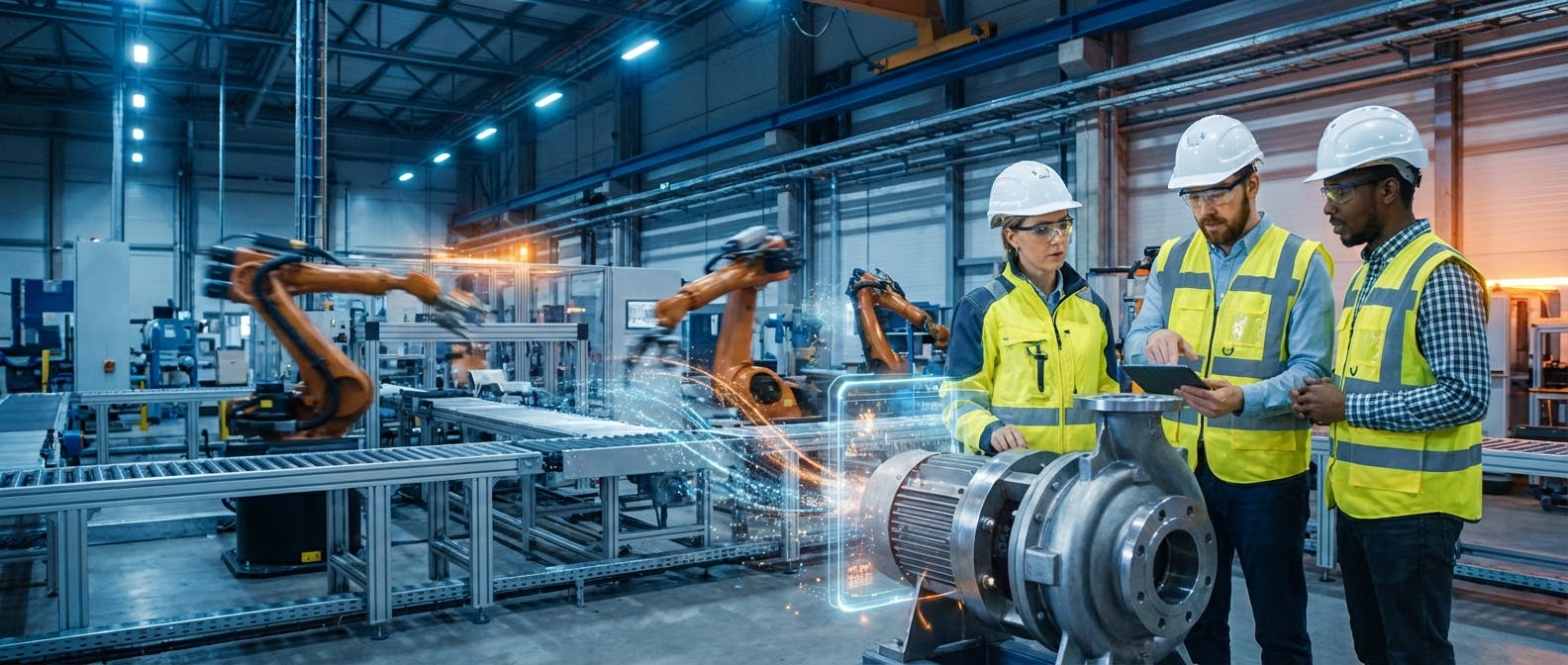
It is 2026. The promise of Industry 4.0 has matured into the reality of Industry 5.0. Yet, a specific, invisible force continues to derail digital transformation projects in manufacturing: Industrial Data Gravity.
If you are a CIO or Plant Manager, you have likely faced this scenario: You have terabytes of vibration data, temperature readings, and cycle counts generated at the edge. Your corporate strategy dictates that the Enterprise Resource Planning (ERP) system (e.g., SAP, Oracle, NetSuite) is the "Single Source of Truth." You attempt to pipe high-frequency machine data into the ERP to trigger maintenance workflows.
The result? System lag, astronomical data egress costs, frustrated maintenance teams, and an ERP that is clogged with noise rather than signal.
The core question you are asking isn't just about software integration; it is a question of physics. Why does moving operational data into a transactional system feel so difficult, and how do we architect a system that respects the "mass" of our data?
The Core Answer: What is Industrial Data Gravity?
The concept of "Data Gravity," originally coined by Dave McCrory, states that data has mass. As data accumulates (mass increases), it generates a gravitational pull that attracts applications and services to it. The larger the dataset, the harder it is to move.
In a manufacturing context, Industrial Data Gravity creates a binary system with two massive stars pulling against each other:
- The Transactional Star (ERP): This has high gravity for financial data, inventory valuation, and customer orders. It moves slowly and requires high consistency.
- The Operational Star ( The Shop Floor/Edge): This has high gravity for time-series data, sensor telemetry, and machine state. It moves at the speed of milliseconds and requires high availability.
The Insight: You cannot force the Operational Star to orbit the Transactional Star. When you try to push raw vibration data (Edge) into an ERP (Cloud/Core) to make real-time maintenance decisions, you are fighting physics. The latency (distance) and bandwidth (energy) required to move that mass against its natural gravity results in failure.
To solve this, you must stop treating the ERP as the destination for machine data. Instead, you must adopt a Distributed Data Architecture where data is processed where it has the most gravity—at the edge—and only insights are allowed to escape to the ERP.
Follow-Up Question: "If the ERP isn't the center, what does the architecture look like?"
If we accept that we cannot dump the entire firehose of machine data into the ERP, where does it go? In 2026, the standard for high-performance manufacturing is the Unified Namespace (UNS) combined with an Edge-First approach.
The Role of the Unified Namespace (UNS)
The old "Purdue Model" (the hierarchical pyramid of automation) is dead. It relied on data moving linearly from Level 0 (Sensors) to Level 4 (ERP). This path creates too much friction.
Instead, modern architectures use a UNS—a central message broker (usually MQTT-based) where all smart assets publish their data.
- The Machine publishes: "I am vibrating at 7mm/s."
- The Edge AI subscribes, analyzes, and publishes: "Prediction: Bearing failure in 48 hours."
- The CMMS subscribes to the prediction and publishes: "Work Order #1024 created."
- The ERP subscribes to the Work Order and records: "Spare part cost allocated."
In this model, the ERP is just another node in the network, not the center of the universe.
Edge-to-Cloud Synchronization
Data gravity dictates that processing must happen close to the source.
- High-Gravity Data (Heavy): Raw vibration waveforms, millisecond-level PLC tags, video feeds. This stays at the Edge. It is too heavy to move.
- Low-Gravity Data (Light): Work order status, aggregated KPIs, financial totals. This moves to the Cloud/ERP.
By respecting gravity, you ensure that your predictive maintenance systems can react instantly to equipment stress without waiting for a round-trip ticket to a cloud server.
Follow-Up Question: "Why exactly does the ERP fail at real-time maintenance?"
You might be thinking, "But our ERP vendor claims they have an IoT module." While true, there is a fundamental mismatch in data topology between ERPs and machines.
1. Transactional vs. Time-Series Data
ERPs are relational databases designed for transactions. A transaction is: "User A bought Item B for $100." It happens once, it must be accurate, and it is static. Machines generate time-series data. A sensor says: "Temp is 100°... 101°... 100.5°... 102°..." continuously, 10 times a second. Forcing time-series data into a transactional database is like trying to store a river in a filing cabinet. The ERP bloats, queries slow down, and the system becomes unusable for its primary purpose (finance and planning).
2. The Latency Gap
In maintenance, time is the enemy.
- Scenario: A high-speed conveyor motor spikes in temperature.
- ERP Workflow: Sensor -> Cloud Gateway -> ERP Cloud -> Rule Engine -> Work Order Generation -> Sync to Mobile. Time: 5 to 15 minutes. By then, the motor has burned out.
- Edge/CMMS Workflow: Sensor -> Edge Gateway (Local) -> CMMS Software -> Alert on Technician's Phone. Time: <3 seconds.
3. Contextual Blindness
ERPs understand dollars and dates; they do not understand physics. An ERP sees a "Maintenance Request." It does not know that this specific pump is critical to the entire paint line, whereas that pump is a backup. Dedicated asset management tools are built to understand the hierarchy, criticality, and failure modes of equipment—context that is often stripped away when data is flattened for ERP ingestion.
Follow-Up Question: "How do we handle the IT/OT convergence without creating silos?"
This is the most common friction point. IT (Information Technology) owns the ERP and cares about security and governance. OT (Operational Technology) owns the machines and cares about uptime and safety. Data Gravity sits right in the middle.
The "Demilitarized Zone" (DMZ) of Data
To solve this, successful organizations create a functional DMZ.
- OT Domain: The factory floor network. Here, data flows freely and fast. Protocols are MQTT, OPC-UA, and Modbus. The priority is speed.
- IT Domain: The corporate network. Here, data is structured and secure. Protocols are REST APIs, HTTPS, and SQL. The priority is security.
- The Bridge: This is usually a specialized integration layer or an Industrial IoT gateway.
Strategy: The "Publish-Subscribe" Handshake
Instead of IT reaching down into PLCs (which OT hates due to security risks) or OT pushing raw data into the ERP (which IT hates due to database bloat), use a Publish-Subscribe model.
- OT publishes an event: "Asset #55 needs maintenance."
- The integration layer picks this up, translates it, and hands a clean, secure packet to the ERP.
- The ERP acknowledges and sends back a purchase order number for parts.
This respects the gravity of both systems. The heavy operational data stays in the OT layer (perhaps stored in a local historian or preventive maintenance system), while only the necessary business transaction crosses the bridge.
Follow-Up Question: "What is the cost of ignoring Data Gravity?"
If you ignore gravity in physics, you crash. If you ignore it in data architecture, you bleed money.
1. Egress and Storage Costs
Cloud providers charge for data movement (egress) and high-performance storage.
- The Mistake: Streaming 10,000 tags/second from a fleet of CNC machines directly to the cloud.
- The Cost: At standard 2026 cloud rates, storing and retrieving petabytes of raw sensor noise can cost upwards of $50,000 - $100,000 per year for a mid-sized facility, with 90% of that data never being queried again.
2. The Cost of "False Positives"
When you centralize data in an ERP without edge filtering, you create alert fatigue. If a sensor flickers due to a loose wire, a "dumb" pipe to the ERP might generate a high-priority work order. The maintenance team rushes out, finds nothing, and loses trust in the system. By using AI-driven predictive maintenance at the edge, the system can distinguish between a sensor glitch and a true mechanical fault before it triggers a costly workflow.
3. Opportunity Cost of Latency
According to NIST studies on manufacturing efficiency, unplanned downtime costs industrial manufacturers an estimated $50 billion annually. If your data architecture introduces a 10-minute delay in detecting a failure, you aren't doing predictive maintenance; you are doing "reactive maintenance with a dashboard." The cost is the lost production during that 10-minute window plus the extended repair time.
Follow-Up Question: "How does AI fit into this gravity well?"
In 2026, AI is non-negotiable. But AI training and AI inference have different gravitational properties.
Training (High Gravity, Low Frequency)
Training a Deep Learning model requires massive datasets—historical failure logs, years of vibration data, and maintenance records.
- Location: Cloud / Enterprise Data Lake.
- Why: You need infinite compute power to crunch the numbers. You move this data once (or in batches) to the cloud to build the "brain."
Inference (Low Gravity, High Frequency)
Inference is the model making a decision in real-time ("Is this motor failing right now?").
- Location: Edge / On-Premise Server.
- Why: You cannot wait for the cloud to think. You export the "brain" (the trained model) down to the edge device.
The Cycle
- Collect data at the Edge.
- Filter noise locally.
- Upload relevant anomalies to the Cloud (overcoming gravity for high-value data only).
- Train the model in the Cloud.
- Push the updated model back to the Edge.
This cycle is crucial for implementing prescriptive maintenance, where the system doesn't just alert you to a problem but suggests the specific fix based on historical success rates.
Follow-Up Question: "How do I get started? A Migration Framework."
You cannot rebuild your architecture overnight. Here is a pragmatic, step-by-step approach to fixing data gravity issues in your facility.
Phase 1: Gravity Mapping
Audit your current data flows.
- Identify your heaviest data sources (e.g., vibration sensors, vision systems).
- Identify where that data is currently going. Is it clogging your ERP?
- Identify the latency requirements. Which assets need <1 second response times?
Phase 2: Establish the Edge Layer
Before sending data to the cloud, implement an intermediary.
- Deploy an Industrial Edge Gateway.
- Install a specialized CMMS that supports mobile connectivity and API integrations.
- Stop the direct feed from PLCs to the ERP.
Phase 3: The "Exception-Based" Strategy
Configure your edge devices to only transmit "Exceptions."
- Normal Operation: The machine runs fine. No data is sent to the ERP.
- Warning State: Vibration exceeds ISO standards. The Edge sends a "Warning" packet to the CMMS.
- Critical State: The CMMS triggers a work order and syncs only that work order to the ERP for spare parts inventory.
Phase 4: Retroactive Analysis
Use the cloud for what it's good for: long-term trends.
- Batch upload summarized data (e.g., "Average daily temperature") to the ERP/Cloud for quarterly reporting and asset lifecycle analysis.
Follow-Up Question: "What about specific asset types? Does gravity change?"
Yes. The "mass" of data depends on the complexity of the asset.
Conveyors and Simple Motors
- Data Gravity: Low.
- Strategy: Simple threshold monitoring. You might check these once an hour.
- Link: Predictive Maintenance for Conveyors.
Compressors and Pumps
- Data Gravity: Medium.
- Strategy: These are critical utilities. They require continuous monitoring for pressure drops and cavitation. The data needs to be processed locally to prevent catastrophic failure.
- Link: Predictive Maintenance for Compressors.
CNC Machines and Robotics
- Data Gravity: Extreme.
- Strategy: These generate gigabytes of telemetry. You absolutely cannot stream this to an ERP. You need a dedicated edge historian and a specialized maintenance platform to handle the PM procedures required for such complex machinery.
Conclusion: Respect the Physics
The failure of many digital transformation projects stems from a refusal to acknowledge the physical constraints of data networking. By trying to force-fit high-velocity operational data into a slow-moving transactional ERP, manufacturers create friction, cost, and latency.
To succeed in 2026, you must respect Industrial Data Gravity. Let the heavy data live at the edge where it is generated. Let the transactional data live in the ERP where it is secure. And use a modern, integrated CMMS to bridge the gap—translating the noise of the machine into the language of the business.
Ready to build an architecture that flows with gravity, not against it? Explore how MaintainX serves as the operational layer that connects your machines to your business without the bloat.
