
AI Predictive Maintenance for Vacuum Pumps: How to Retrofit Legacy Assets for Zero Unplanned Downtime
Feb 12, 2026
AI predictive maintenance for vacuum pumps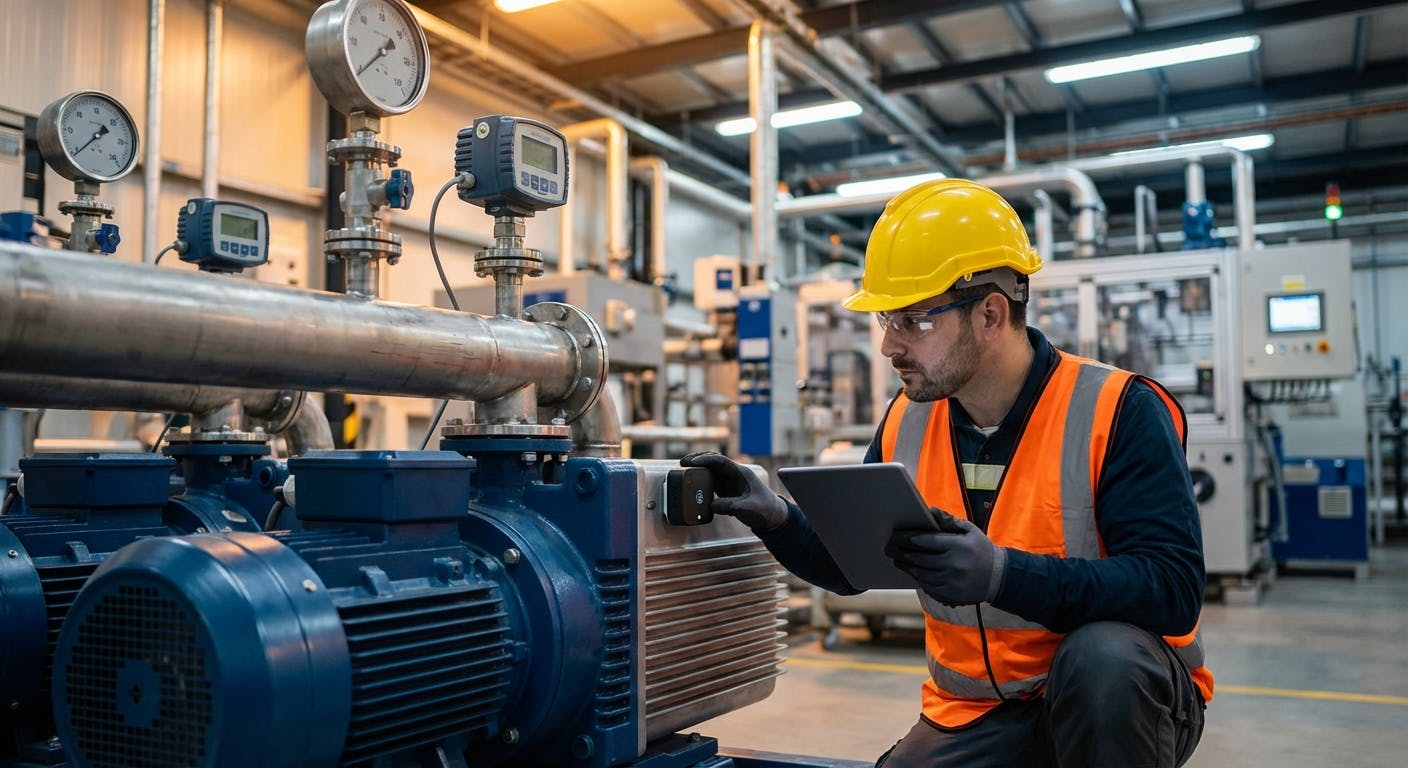
In the hierarchy of industrial assets, vacuum pumps are often the "invisible lungs" of the facility. Whether you are running semiconductor deposition, pharmaceutical freeze-drying, or simple pick-and-place packaging, when the vacuum drops, production stops immediately.
Yet, despite their criticality, vacuum pumps are notoriously difficult to monitor. They often run in harsh environments, are tucked away in hard-to-reach mezzanines, and fail in ways that standard vibration routes miss until it’s too late.
If you are reading this, you likely aren't asking "What is predictive maintenance?" You are asking a much more specific, urgent question: "How can I detect vacuum pump failures—specifically cavitation, oil issues, and internal clearances—before they halt my line, without ripping out my entire infrastructure to buy 'smart' pumps?"
The answer lies in AI-driven retrofit strategies. You do not need new pumps. You need to overlay specific IIoT sensor configurations and apply algorithms trained on vacuum physics to your existing assets.
This guide moves beyond generic advice. We will explore the specific spectral signatures of vacuum failure, how to calculate Remaining Useful Life (RUL) for rotary vane and dry screw pumps, and how to integrate this data into your reliability strategy in 2026.
How does AI actually detect vacuum pump anomalies that humans miss?
To understand why AI is necessary, we must first acknowledge why traditional maintenance fails vacuum pumps.
Traditional Preventive Maintenance (PM) relies on time-based oil changes and seal replacements. However, vacuum pumps—especially those in chemical or particulate-heavy applications—do not degrade linearly. A filter clog can accelerate wear exponentially in hours, not months.
Human inspection (auditory or thermal) is subjective. A maintenance technician might hear a "rattle," but by the time a liquid ring pump is audible, the cavitation damage to the impeller is likely already irreversible.
AI predictive maintenance changes this by monitoring high-frequency data streams (vibration, acoustic emission, temperature, and amperage) and comparing them against a "healthy state" baseline.
The Physics of Detection
AI doesn't just "look for spikes." It analyzes the shape of the data.
- Vibration Analysis (ISO 10816 & Beyond): While ISO 10816 provides general guidelines for machine vibration, vacuum pumps require looking at non-synchronous harmonics. For example, in a rotary vane pump, vane pass frequency is a critical metric. If the AI detects energy spikes at 1x or 2x the vane pass frequency, it indicates vane wear or sticking—long before the pump seizes.
- Acoustic Emission (AE): This is the gold standard for cavitation detection in liquid ring pumps. Cavitation bubbles collapsing create high-frequency stress waves (often 100kHz to 1MHz). Standard vibration sensors (accelerometers) often miss this because they are tuned for lower frequencies (0-10kHz). AI models trained on AE data can identify the onset of cavitation weeks before pitting occurs.
- Motor Current Signature Analysis (MCSA): In dry screw pumps, a slight increase in friction due to thermal expansion or particulate buildup will show up as subtle sidebands in the current spectrum. AI correlates this with temperature data to distinguish between normal load changes and impending seizure.
By utilizing AI predictive maintenance, you are essentially giving your legacy pumps a nervous system that never sleeps.
What are the specific failure modes AI can predict?
Not all pumps fail the same way. A "one-size-fits-all" algorithm will generate false positives. To get value, your AI solution must be tuned to the specific mechanics of your vacuum equipment.
1. Cavitation in Liquid Ring Vacuum Pumps (LRVP)
Cavitation is the rapid formation and collapse of vapor bubbles within the liquid ring. It sounds like gravel passing through the pump.
- The AI Indicator: High-frequency impacting in the acoustic spectrum.
- The Threshold: AI models look for a rise in "Kurtosis" (the spikiness of the signal) rather than just RMS (average energy).
- The Action: The system triggers an alert to adjust the seal liquid temperature or inlet pressure automatically.
2. Oil Back-Streaming and Degradation in Rotary Vane Pumps
In oil-sealed pumps, the oil is the lifeline. If it degrades or back-streams into the process chamber, you lose product and the pump.
- The AI Indicator: A correlation between rising casing temperature and a shift in the vibration noise floor (indicating increased friction). Advanced setups use in-line dielectric oil sensors connected to the AI gateway.
- The Prediction: The AI calculates the rate of thermal rise to predict when oil viscosity will drop below critical lubrication levels.
3. Screw Contact in Dry Screw Pumps
Dry pumps run with extremely tight clearances between the screws. They rely on timing gears to prevent contact.
- The AI Indicator: "Gear Mesh Frequency" analysis. If the timing gears wear, the screws may begin to touch microscopically. This generates specific high-frequency vibration bands.
- The Risk: If not caught, the screws weld together (seize), resulting in a total asset loss.
4. Exhaust Filter Clogging
- The AI Indicator: A slow, steady increase in motor amperage combined with a stable inlet pressure but rising exhaust pressure (if monitored).
- The Benefit: Instead of changing filters on a schedule (wasting money) or waiting for failure (downtime), you change them exactly when the differential pressure impacts efficiency.
For a deeper dive on general pump monitoring strategies, you can reference our guide on predictive maintenance for pumps.
How do I retrofit legacy equipment? (The "Retrofit" Angle)
This is the most common barrier. You have 50 vacuum pumps ranging from 5 to 20 years old. None of them have smart ports. How do you modernize them?
You do not need to tap into the pump's internal PLC (which is often locked by the OEM anyway). You can use a "sidecar" approach.
Step 1: The Sensor Suite
For a standard industrial vacuum pump, you need a minimum viable sensor kit:
- Tri-axial Vibration Sensor: Mount this on the bearing housing (drive end and non-drive end). Magnetic mounts are okay for periodic checks, but for real-time AI, stud mounting is required to capture high-frequency data accurately.
- Surface Temperature Sensor: Often integrated into modern vibration sensors.
- Current Transducer (CT): Clamps around one phase of the motor power cable in the control cabinet.
Step 2: The Gateway and Connectivity
The sensors connect to a wireless gateway (using protocols like LoRaWAN, Bluetooth 5, or Wi-Fi 6). In 2026, edge computing is standard. This means the gateway processes the raw vibration data locally. It doesn't send terabytes of raw waveforms to the cloud; it extracts the features (RMS, Peak-to-Peak, Crest Factor) and sends those.
Step 3: The "Digital Twin" Setup
Once the data is flowing, you map it to a digital asset.
- Input: Pump Make/Model, RPM, Bearing Part Numbers (crucial for calculating fault frequencies), and Number of Vanes/Screws.
- Training: The AI needs a "learning period" (usually 7-14 days) to understand the baseline vibration of the pump under normal load.
Pro Tip: Don't just monitor the pump. Monitor the system. A vacuum leak downstream will cause the pump to work harder. By integrating data from your equipment maintenance software, you can correlate pump health with production cycles.
What algorithms should we use? (Random Forest vs. Neural Networks)
For the technical reliability engineers reading this, the "AI" black box needs to be opened. What is actually processing the data?
Anomaly Detection (Unsupervised Learning)
This is the starting point for most retrofits. You don't need a history of failures to use this. The algorithm (often an Autoencoder Neural Network) learns what "normal" looks like. If the vibration signature deviates from the manifold of normal operation, it flags an anomaly.
- Best for: Catching unknown failure modes or "freak" accidents.
Fault Classification (Supervised Learning)
This requires labeled data (e.g., "This vibration pattern = Bearing Inner Race Defect").
- Random Forest Classifiers: Excellent for structured data. If you have specific thresholds for temperature and vibration, a Random Forest can categorize the health state (Healthy, Warning, Critical).
- Convolutional Neural Networks (CNNs): Used for analyzing the raw vibration spectrum images (spectrograms). CNNs are incredibly good at spotting visual patterns in sound waves, such as the specific "smear" caused by cavitation.
Remaining Useful Life (RUL)
This is the holy grail. It answers: "How many hours do I have left?" RUL models usually employ Long Short-Term Memory (LSTM) networks. They look at the rate of change of degradation.
- Example: If vibration increases by 0.1 mm/s every day, the LSTM projects when it will hit the ISO 10816 danger threshold.
For authoritative standards on vibration severity, reliability professionals should refer to ISO 10816 standards to set their initial alarm limits before the AI takes over optimization.
What is the ROI? (The Business Case)
Implementing AI predictive maintenance involves hardware costs (sensors), software subscriptions, and training. How do you justify this to the CFO?
1. The Cost of "Vacuum Loss"
In semiconductor manufacturing, a vacuum loss during a wafer deposition cycle scraps the entire batch. One event can cost $50,000+. If the AI prevents one such event, the system pays for itself for the next decade.
2. Energy Efficiency (The Hidden ROI)
Vacuum pumps are energy hogs. A pump with a clogged filter or internal recirculation (due to wear) can draw 10-20% more power to maintain the same vacuum level.
- Scenario: A 50hp vacuum pump running 24/7.
- Inefficiency: 15% wasted energy due to undetected wear.
- Cost: Thousands of dollars per year, per pump. AI detects this efficiency drift immediately via the Motor Current Signature Analysis.
3. Extending Asset Life
Replacing a dry screw vacuum pump can cost $20,000 to $50,000. If you can extend its life from 3 years to 5 years by avoiding catastrophic seizures and performing timely bearing swaps, the CapEx savings are massive.
For a broader look at how this impacts your bottom line, consider how these assets feed into your overall asset management strategy.
How do I integrate this with my workflow?
Data without action is just noise. The most common failure in AI projects is that the "alert" goes to a dashboard that nobody looks at.
The Automated Workflow
- Sensor Detects Anomaly: Vibration on Pump #4 exceeds the dynamic threshold.
- AI Validates: The algorithm checks if the pump was just turned on (inrush current) or if this is a persistent issue. It rules out false positives.
- CMMS Trigger: The system automatically generates a work order in your CMMS.
- Subject: "Investigate Drive End Bearing - Pump #4"
- Priority: High
- Attached Data: The vibration spectrum snapshot and the RUL estimate.
- Technician Action: The technician receives the alert on their mobile device via mobile CMMS. They have the context they need before they even walk to the machine.
Integration with SCADA
For critical process pumps, the AI should talk to your SCADA or PLC. If the AI detects "Imminent Seizure" (99% confidence), it should have the authority to trigger a soft shutdown sequence to protect the asset and the facility, utilizing integrations with your industrial control systems.
Troubleshooting: Common Challenges and Edge Cases
Even the best AI models struggle with certain variables. Here is how to handle them.
Variable Frequency Drives (VFDs)
The Problem: VFDs change the speed of the pump. This shifts all the vibration frequencies. A 50Hz spike is normal at full speed but might be an anomaly at half speed. The Solution: You must ingest RPM data into the AI model. The algorithm must use "Order Analysis" (normalizing vibration to rotation speed) rather than frequency analysis.
High Background Noise
The Problem: Vacuum pumps are often located next to loud compressors or chillers. The Solution: Use "Reference Sensors." Place a vibration sensor on the floor or the neighboring machine. The AI can subtract this "background noise" from the pump's signal to isolate the pump's true health.
The "Burn-In" Period
The Problem: New pumps or newly rebuilt pumps often run hot and vibrate slightly more until the seals seat. The Solution: Configure the AI to have a "break-in mode" with wider thresholds for the first 48 hours of operation.
Conclusion: Moving from "Fail and Fix" to "Predict and Prevent"
In 2026, running vacuum pumps to failure is a choice, not an inevitability. The technology to retrofit legacy pumps is mature, affordable, and accessible.
By implementing AI predictive maintenance, you shift the role of your maintenance team. They stop being firefighters running from breakdown to breakdown. They become reliability architects, intervening only when the data proves it is necessary.
Ready to start? Don't try to sensor every pump in your plant at once. Start with your "Bad Actors"—the 5 pumps that give you the most headaches.
- Install tri-axial vibration and temperature sensors.
- Establish a baseline for 2 weeks.
- Connect the data to a predictive maintenance platform.
The silence of a running vacuum pump is good. The silence of a stopped vacuum pump is expensive. Let AI tell you the difference before it happens.
