
Predictive Maintenance for Spiral Conveyor Belts: Protecting the Critical Path Asset
Feb 2, 2026
predictive maintenance for spiral conveyor belts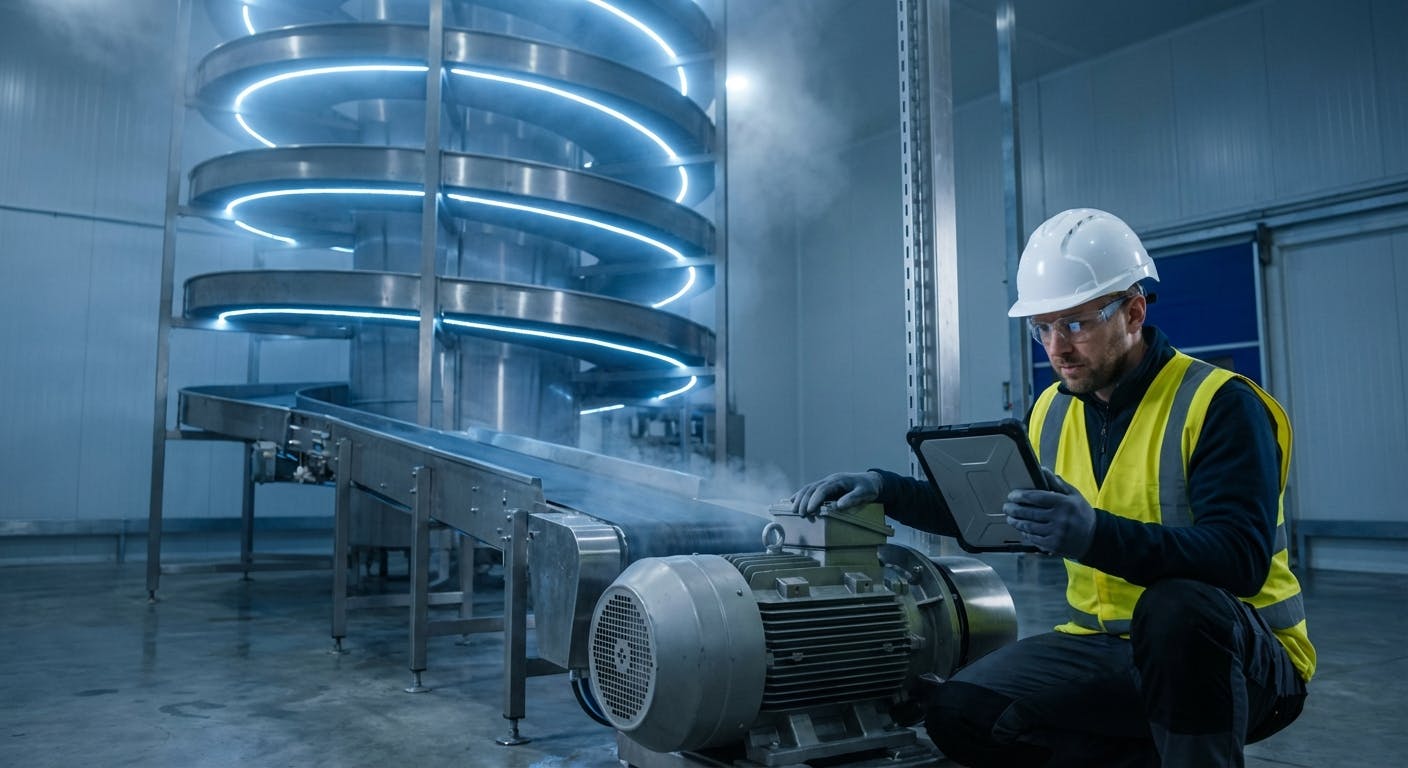
The spiral conveyor is not just another piece of equipment on your floor. In 90% of food and beverage or logistics facilities, the spiral is the Critical Path Asset. It is the bottleneck.
If a transfer conveyor fails, you can often reroute product or manually palletize for an hour. If a filler slows down, you lose efficiency. But if the spiral freezer or cooling tower jams? The entire upstream line halts immediately. Product trapped inside creates a massive spoilage risk. The downtime costs aren't measured in maintenance hours; they are measured in hundreds of thousands of dollars in lost production and wasted goods.
The core question maintenance directors are asking in 2026 isn't "Should we monitor our spirals?" It is: "How do we accurately predict failure in a low-speed, high-tension, complex friction system without drowning in false alarms?"
This guide moves beyond generic maintenance advice to provide a technical, actionable framework for implementing predictive maintenance (PdM) specifically for spiral conveyor belts.
The Core Challenge: Why Standard Vibration Analysis Fails Spirals
To understand how to predict failure, you must first understand why standard tools often fail on spirals.
Most generic predictive maintenance solutions rely heavily on high-frequency vibration analysis. This works wonders for high-speed pumps and fans. However, spiral conveyors often operate at very low rotational speeds (sometimes less than 5 RPM on the main drum).
Standard accelerometers struggle to distinguish between the normal "rhythmic pulsing" of a spiral cage and a developing bearing fault at these low frequencies. Furthermore, the primary failure modes of a spiral are not usually rotational imbalance; they are tension-related and friction-related.
Therefore, a successful PdM strategy for spirals must prioritize Load, Tension, and Overdrive monitoring over simple vibration trending.
Question 1: What specific variables must we monitor to predict a crash?
You cannot predict a belt snap or a cage flip-up by watching one variable. You need to correlate three specific data points to understand the health of the system.
1. The Overdrive Ratio (Friction Monitoring)
The fundamental operating principle of a spiral is "overdrive." The drum (cage) must move slightly faster than the belt to create the necessary friction to drive the belt without engaging it positively like a sprocket.
- The Failure Mode: If friction becomes too high (due to dirty wear strips or ice buildup), the belt grabs too hard, leading to "tenting" or flip-ups. If friction is too low (wear strip degradation), the drum slips, and the belt stalls.
- The Predictive Metric: You must monitor the ratio between Motor Current (Amps) and Belt Speed.
- The Threshold: In a healthy system, motor current should remain relatively flat once the system reaches steady state. A gradual, linear increase in motor current over weeks—while speed remains constant—is the clearest leading indicator that your friction coefficients are changing. This usually signals that wear strips need replacement or lubrication systems are failing.
2. Chain/Belt Elongation (Tension)
Spiral belts, whether plastic modular or stainless steel, stretch over time. As the belt elongates, the catenary sag increases. If the sag becomes excessive, the belt can catch on the frame or jump the drive sprockets on the take-up.
- The Old Way: Shutting down the line and manually measuring 10 feet of belt with calipers.
- The Predictive Way: Install Linear Variable Differential Transformers (LVDTs) or laser distance sensors on the gravity take-up weight or the tensioning arm.
- The Benchmark: Set your CMMS to trigger a "Check Tension" alert when the take-up arm moves past the 75% travel mark. This automates the monitoring of chain elongation without human intervention.
3. Cage Alignment and "Thumping"
Even at low speeds, the cage must remain concentric. If the main bearing wears or the structure shifts, the cage will wobble. This creates a rhythmic "thump" every rotation as the cage bars impact the belt edge.
- The Sensor: Low-frequency accelerometers or acoustic sensors.
- The Signal: You aren't looking for high-frequency noise. You are looking for a spike in amplitude at 1X RPM of the drum. If the amplitude of this 1X peak increases by 50% over a month, your main bearing or cage alignment is degrading.
For a deeper dive into how sensor data correlates with conveyor health, explore our guide on predictive maintenance for conveyors.
Question 2: How do we handle the "Freezer Factor"?
The majority of spiral conveyors operate in hostile environments: spiral freezers (-40°F) or proofers (high heat/humidity). This environment destroys standard sensors and complicates data collection.
The Condensation Problem
When a freezer goes into a defrost cycle or is washed down, sensors experience rapid thermal cycling. This causes internal condensation in non-rated sensors, leading to drift and false data.
The Solution:
- IP69K Ratings are Mandatory: Do not settle for IP67. The high-pressure washdown requirements of food safety mean sensors must withstand direct blasts.
- Remote Transmitters: Keep the sensitive electronics (the vibration transmitter or DAQ unit) outside the freezer box. Run shielded cabling from the accelerometer inside the freezer to the transmitter outside. This protects the processor from the cold and allows for easier maintenance access.
- Wireless vs. Wired: In massive spiral cages, running conduit is expensive and difficult. However, wireless battery life plummets in freezing temperatures. If you use wireless sensors, ensure they use Lithium Thionyl Chloride batteries (rated for low temps) rather than standard alkaline or lithium-ion.
Ice Buildup and False Positives
Ice on the rails changes the friction coefficient. A predictive system might interpret the increased motor load caused by ice as a mechanical failure.
The Strategy: Your AI predictive maintenance software must be "context-aware." It needs to know when the system is in a defrost cycle. By integrating the PLC state (Defrost Mode = ON) with the vibration/load data, the system can automatically suppress alerts during these periods, preventing "alarm fatigue" for your maintenance team.
Question 3: How do we detect "Flip-Ups" before they destroy the belt?
A "flip-up" occurs when the outer edge of the belt rises up, usually due to high tension or a catch point. If not caught immediately, the belt can flip over, jam against the structure, and tear itself apart. This is the most catastrophic failure mode for spirals.
Standard predictive maintenance (vibration/temp) is often too slow to catch a flip-up. By the time the motor amps spike, the belt is already damaged.
The Solution: Machine Vision and Laser Profiling
To predict (or instantly detect) flip-ups, we are seeing a shift toward visual sensors.
- Laser Triangulation: A laser line is projected across the belt surface at critical exit/entry points. A sensor measures the profile of the belt. If the profile height changes by more than 5mm (indicating a lift), the system triggers an immediate E-Stop.
- Computer Vision: Cameras trained on the belt edge can detect the "shuddering" motion that precedes a flip-up. While this is technically "condition monitoring" rather than long-term prediction, it saves the asset.
Integration Note: This data shouldn't just trip the E-Stop. It should log an event in your asset management software. If you see a cluster of "micro-slips" or minor profile changes at the same time every day, you can correlate that with production shifts or cleaning cycles to find the root cause.
Question 4: How do we turn this data into a maintenance strategy?
Collecting data is easy. Turning it into uptime is hard. Here is a step-by-step framework for integrating spiral PdM into your workflow.
Phase 1: Establish the Baseline (The "Burn-In" Period)
Do not turn on alerts immediately. Install your sensors (Load cells on tensioners, Amps on motors, Vibration on main bearings) and let the machine run for 30 days.
- Capture the "Cold Start" profile: Spirals draw massive current on startup. This is normal.
- Capture the "Fully Loaded" profile: What does the tension look like with 2,000 lbs of product on the belt?
Phase 2: Set Dynamic Thresholds
Static thresholds fail on spirals because load varies. Instead, use dynamic bands.
- Warning Level: If Motor Current > (Baseline + 10%) for > 10 minutes.
- Critical Level: If Vibration (1X RPM) > (Baseline + 50%).
Phase 3: Automate the Work Order
This is where most implementations fail. An alert on a dashboard that nobody looks at is useless. You must integrate your sensor platform with your CMMS.
When the tension sensor indicates the take-up arm has extended past the 80% mark:
- The sensor sends a signal to the IoT gateway.
- The gateway pushes data to the cloud.
- The work order software automatically generates a "High Priority" work order: "Shorten Belt / Check Catenary Sag on Spiral 3."
- The system assigns it to the reliability engineer and pings their mobile device.
This creates a closed-loop system. The machine tells you what it needs, and the software ensures the human delivers it.
Question 5: What about the drive motors and gearboxes?
While the belt and cage are unique, the drive system of a spiral is standard—but critical. The main drive motor and the gearbox (reducer) take a beating due to the high torque requirements.
Gearbox Oil Analysis vs. Vibration
For the massive gearboxes driving spiral drums, vibration analysis is useful, but oil analysis is often more predictive of long-term wear.
- Inline Oil Sensors: In 2026, we are moving away from monthly sampling bottles. Install inline dielectric and particle counter sensors on the gearbox.
- What to watch: A spike in ferrous particles indicates gear teeth wear. A change in dielectric constant indicates moisture ingress (common in washdown environments).
Motor Electrical Signature Analysis (ESA)
Because the motors are often variable frequency drives (VFDs), standard vibration analysis can be noisy. Predictive maintenance for motors using ESA allows you to monitor the health of the motor and the load it is driving by analyzing the current and voltage waveforms. ESA can often detect a mechanical binding in the spiral cage (load side) through the motor cables, without needing a sensor inside the freezer.
Question 6: What is the ROI? Justifying the Investment.
Maintenance managers often struggle to get budget approval for these systems. To win the budget, you must speak the language of finance: Risk and Revenue.
The Cost of a "Crash"
Calculate the cost of a single catastrophic spiral failure:
- Belt Replacement: $20,000 - $100,000 (depending on material and length).
- Labor: 24-48 hours of round-the-clock maintenance labor to splice and re-thread.
- Product Loss: If the spiral is a freezer, you likely lose all product inside ($10k - $50k).
- Downtime: If the line produces $5,000 of profit per hour, and you are down for 36 hours, that is $180,000.
Total Event Cost: ~$250,000+.
The Cost of PdM
A comprehensive sensor package (Amps, Vibration, Tension) + Software subscription might cost $15,000 - $25,000 per year.
The Math: If the system prevents one catastrophic failure every ten years, the ROI is positive. If it prevents one every year, the ROI is 1000%.
Furthermore, PdM allows you to extend the life of the belt. Instead of replacing the belt on a fixed schedule (preventive), you replace it only when wear measurements confirm it is necessary (condition-based). This can often squeeze an extra 6-12 months of life out of a $50,000 asset.
Advanced Troubleshooting: The "Edge Cases"
Even with good data, spirals can be tricky. Here are three edge cases to watch for.
1. The "Surging" Spiral
Symptom: The motor current oscillates in a sine wave pattern, but the speed is constant. Cause: This is usually "Stick-Slip" phenomenon. The friction between the belt and the wear strips is too high. The belt sticks, tension builds, then it breaks free and surges. Action: Check the automatic lubrication system. If you are using water lubrication, check the nozzles. If dry, check the wear strip condition.
2. Uneven Chain Stretch
Symptom: The tension sensors show normal averages, but the belt is jumping sprockets. Cause: Uneven wear. If the spiral is dual-lane or if product is always loaded on one side, one side of the belt stretches more than the other. Action: You need sensors on both sides of the take-up shaft. If the differential between Left and Right tension exceeds 10%, you have a camber issue.
3. The "Ghost" Vibration
Symptom: Vibration spikes at random times, unrelated to RPM. Cause: In freezers, this is often structure-borne resonance from other equipment (compressors) traveling through the floor. Action: Use "coherence" analysis. Compare the spiral vibration timestamp with the compressor run logs. If they match, filter that frequency out of your spiral alarm limits.
Conclusion: Moving from Reactive to Prescriptive
The spiral conveyor is too expensive and too critical to manage with a "run-to-failure" or even a "time-based" strategy. By 2026 standards, manually checking a spiral once a month is not maintenance; it is gambling.
By implementing a sensor-based strategy that focuses on tension, overdrive ratios, and low-frequency vibration, you gain visibility into the freezer box without opening the door.
But remember, the data is only as good as the action it triggers. The ultimate goal is prescriptive maintenance—where the system doesn't just tell you "High Vibration," but tells you "Cage Bearing B is failing; replace part #1234 during the next sanitation window."
Ready to secure your critical path assets? Don't let a $50 bearing destroy a $50,000 belt. Start by auditing your current spiral maintenance logs and identifying where your blind spots are. If you need a platform that can ingest this sensor data and turn it into automated work orders, explore how Predict can integrate with your existing infrastructure.
Further Reading
- ReliabilityWeb: Vibration Analysis for Low-Speed Machines
- NIST: Economic Value of Advanced Manufacturing Technologies
