
What Are Maintenance Copilots for Technicians, and Why Are They Essential in 2026?
Feb 23, 2026
maintenance copilots for technicians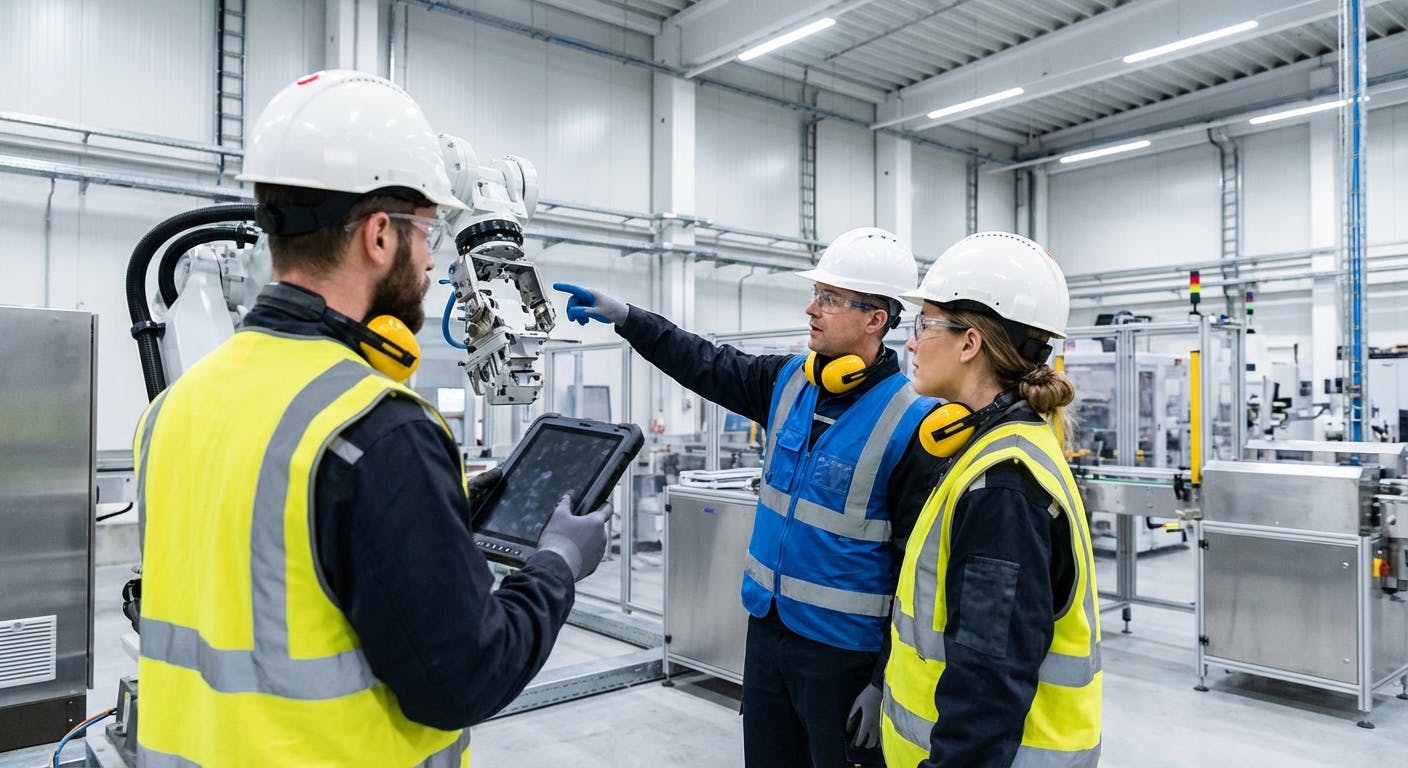
The core question facing every maintenance manager today is simple: How do we empower a junior technician to perform with the precision and speed of a 30-year veteran?
A maintenance copilot for technicians is the direct answer to that question. It is not a generic chatbot or a simple search bar for a CMMS (Computerized Maintenance Management System). Instead, a maintenance copilot is a specialized AI reasoning engine—typically built on an Industrial Large Language Model (LLM) and powered by Retrieval-Augmented Generation (RAG)—that acts as a digital mentor. It synthesizes thousands of pages of OEM manuals, decades of historical work orders, and real-time sensor data into conversational, actionable guidance.
In practice, this means a technician standing in front of a downed packaging line doesn’t have to walk back to the office to consult a binder. They ask their tablet or headset, "Why is the drive motor on Line 4 drawing 20% more current than usual?" The copilot analyzes the current telemetry, cross-references it with a root cause analysis of why motors run hot after service, and suggests that the technician check the belt tensioning—not just generally, but specifically for the 2024 model currently in operation.
How Does a Maintenance Copilot Actually Work in a Breakdown?
To understand the value, we must look at the "Search vs. Solve" ratio. In traditional environments, a technician spends up to 40% of their time searching for information: looking for manuals, finding the right part numbers, or tracking down the one person who knows "the trick" to fixing a specific gearbox.
A maintenance copilot flips this ratio. It works through a three-layer process:
- The Knowledge Layer: The system ingests "dark data"—PDF manuals, handwritten notes, and historical CMMS entries. Using RAG, the AI ensures it only provides answers based on your specific equipment and your facility's history, virtually eliminating the "hallucinations" common in consumer AI.
- The Contextual Layer: The copilot connects to the Industrial Internet of Things (IIoT). It knows the machine's current temperature, vibration levels, and cycle count.
- The Interaction Layer: Through voice-to-work-order functionality or a mobile interface, the technician receives step-by-step instructions. If a step is unclear, they ask a follow-up: "Show me the torque sequence for this flange." The copilot then pulls the exact diagram from the OEM manual.
By providing this level of support, facilities can significantly eliminate chronic machine failures and repeated downtime because the "fix" is done correctly the first time, according to engineering specifications rather than guesswork.
How Do Copilots Solve the "Institutional Memory" Crisis?
The most significant threat to modern manufacturing isn't a lack of technology; it's the "Silver Tsunami"—the mass retirement of senior technicians who carry decades of unwritten knowledge in their heads. When these experts leave, they take the "feel" of the machines with them.
Turning Tribal Knowledge into Digital Assets
A maintenance copilot acts as a permanent repository for institutional memory. Every time a senior technician completes a complex repair, the copilot can prompt them via voice: "What was the key indicator for this failure?" The technician's response is transcribed, indexed, and becomes part of the knowledge base.
This creates a "Knowledge Transfer Loop." When a new hire encounters the same issue six months later, the copilot doesn't just give them the OEM's generic advice; it says, "Senior Tech Bob noted that on this specific conveyor, a high-pitched whine usually indicates a misalignment in the third roller, not a bearing failure." This level of insight is critical for solving frequent motor overload trips and other nuanced industrial problems.
Reducing the Training Runway
In 2026, we no longer have the luxury of a six-month onboarding period. Maintenance copilots reduce the "time-to-autonomy" for new hires by providing a safety net. Because the AI can synthesize OEM manual data and historical context, it prevents the common "rookie mistakes" that lead to maintenance backlogs growing into a reactive death spiral. The copilot ensures that even a technician on their first week is following best practices for precision maintenance.
What is the Technical Architecture Behind an Industrial Copilot?
Decision-makers often ask: "Is this just ChatGPT for my factory?" The answer is a resounding no. An industrial-grade copilot requires a specific architecture to be safe and effective in a high-stakes environment like a food processing plant or an automotive assembly line.
Retrieval-Augmented Generation (RAG)
Standard LLMs are trained on the public internet. They are great at writing poems but dangerous when asked for the specific lubricant viscosity for a high-speed bearing. RAG is the technology that "grounds" the AI. It forces the model to look at a specific, private library of documents (your manuals, your SOPs) before generating an answer. If the answer isn't in your data, the AI is programmed to say, "I don't know," rather than guessing. According to research from NIST, grounding AI in verifiable data is the only way to ensure safety in industrial applications.
The Digital Twin Interface
The most advanced copilots are integrated with a Digital Twin—a virtual representation of the physical asset. This allows the copilot to run simulations. A technician might ask, "If I increase the line speed by 10%, what is the projected impact on the bearing life of the main drive?" The copilot queries the Digital Twin's physics-based models and provides a prescriptive recommendation. This moves the maintenance team from "preventive" (calendar-based) to "prescriptive" (outcome-based) strategies.
Voice-to-Work-Order and Natural Language Processing (NLP)
Technicians cannot be expected to type on a keyboard while wearing gloves or working in a washdown environment. The "Copilot" must be accessible via high-quality NLP. This involves filtering out ambient factory noise (often 90dB+) to accurately capture the technician's voice. The goal is a seamless "Voice-to-Work-Order" flow where the technician says, "I've replaced the drive belt on Conveyor 2; it showed signs of thermal degradation," and the AI automatically populates the CMMS fields, orders a replacement belt, and updates the reliability trend report.
How Do Maintenance Copilots Impact MTTR and First-Time Fix Rates?
The primary metric for any maintenance department is Mean Time to Repair (MTTR). In a world where a single hour of downtime can cost a manufacturer $100,000 or more, reducing MTTR is the fastest way to improve the bottom line.
Accelerating the "Diagnostic" Phase
Research by organizations like IEEE suggests that up to 70% of MTTR is actually spent on diagnosis—figuring out what is wrong. Maintenance copilots slash this time by providing immediate access to "Forensic Root Cause" data. Instead of a technician spending two hours testing various components, the copilot can analyze the error codes and historical patterns to say, "There is an 85% probability the issue is the servo drive's internal cooling fan, based on similar failures in 2024."
Improving First-Time Fix Rate (FTFR)
There is nothing more frustrating—or expensive—than a machine that fails again two hours after it was "fixed." This often happens because the technician addressed the symptom rather than the root cause. For example, they might replace a snapped chain without realizing the chain conveyor is experiencing rapid elongation due to a lubrication system failure. A copilot prevents this by prompting the technician to check related systems: "The chain has been replaced, but have you verified the tensioner alignment and the auto-lube spray pattern?"
Benchmarks and ROI
Facilities implementing maintenance copilots in 2026 are seeing:
- 25-40% reduction in MTTR due to faster diagnostics.
- 15-20% increase in "Wrench Time" as technicians spend less time on paperwork and searching for manuals.
- Significant reduction in "Chronic Failures" as the AI identifies patterns that humans might miss over long periods.
What Are the Common Pitfalls When Deploying Maintenance Copilots?
Despite the clear benefits, not every AI rollout is successful. Most failures stem from human and data factors rather than the AI itself.
The "Garbage In, Garbage Out" Problem
If your CMMS data is a mess—filled with "Fixed it" or "Machine broke" entries—the copilot will have a hard time learning from your history. AI is a mirror of your data quality. Before deploying a copilot, many firms find they must first address why technicians don't trust maintenance data. If the data is perceived as a "policing tool" rather than a "support tool," the quality will remain low, and the copilot will be ineffective.
Over-Reliance and Skill Atrophy
There is a valid concern that technicians might become "GPS-dependent" on the copilot, losing their own troubleshooting intuition. To mitigate this, the best implementation frameworks use the copilot as a teaching tool, not just a telling tool. The AI should explain the "why" behind a recommendation. For example, "We are checking the vibration on the non-drive end because the frequency spectrum suggests a cage defect, which is common when washdown environments destroy bearings."
Integration Silos
A copilot that only sees the CMMS but not the PLC (Programmable Logic Controller) data is only half-effective. The "Decision" stage of the buyer's journey must focus on how well the copilot integrates with the existing tech stack. If the AI can't see that a machine just went through a cleaning shift, it won't know to warn the technician about the physics of post-sanitation breakdowns.
How Do You Get Started with a Maintenance Copilot?
Transitioning to an AI-assisted maintenance model is a journey, not a flip of a switch. In 2026, the most successful plants follow a "Crawl, Walk, Run" approach.
Phase 1: The Knowledge Audit (Crawl)
The first step isn't buying software; it's auditing your knowledge. Where are your manuals? Are they digitized? Do you have a "Top 10" list of chronic failures? This phase involves cleaning up the data that will feed the RAG system. It’s also the time to identify your "AI Champions"—the senior techs who will help train the model and build trust among the crew.
Phase 2: The Pilot Program (Walk)
Select a specific area of the plant—perhaps the one with the highest downtime or the most complex machinery. Deploy the copilot to a small group of technicians. Focus on a single use case, such as "Reducing diagnostic time for intermittent faults." Intermittent faults are notoriously difficult to solve, and showing how the AI can track the physics of startup stress provides an immediate "win" for the technology.
Phase 3: Plant-Wide Integration (Run)
Once the pilot proves ROI, roll the system out to the entire facility. This is where you integrate voice-to-work-order and connect the copilot to your inventory management system. At this stage, the copilot isn't just a tool; it's the central nervous system of your maintenance operation.
What Does the ROI of a Maintenance Copilot Look Like?
When presenting to the C-suite, maintenance managers must move beyond "AI is cool" to hard financial metrics. The ROI of a maintenance copilot is found in three specific areas:
- Direct Labor Savings: If 50 technicians each save 30 minutes a day on information retrieval, that equates to 6,500 man-hours per year. At an average loaded rate of $60/hour, that’s $390,000 in recovered capacity without hiring a single new person.
- Uptime Value: If the copilot reduces MTTR by 20%, and your plant averages 100 hours of unplanned downtime a year at $50,000/hour, that is $1,000,000 in added production value.
- Asset Life Extension: By ensuring repairs are done to OEM specifications and identifying root causes early, you extend the Mean Time Between Failures (MTBF). This allows you to defer capital expenditures (CapEx) for new machinery, often saving millions over a five-year cycle.
For more on building a business case, resources like ReliabilityWeb offer frameworks for calculating the "Value of Reliability."
What if My Facility is "Different" or Low-Tech?
A common objection is: "Our machines are from the 1980s; AI can't help us." In reality, older facilities often benefit more from maintenance copilots.
The "Legacy Machine" Advantage
Older machines often have the most "tribal knowledge" associated with them. They have quirks that aren't in any manual. A copilot is the perfect tool to capture these quirks. Even if the machine doesn't have sensors, the technician can provide the "eyes and ears" for the AI. The technician describes the symptom, and the AI searches the historical record for every time that 1985 press has behaved similarly.
The "Small Team" Advantage
In a small facility with only three or four technicians, the "Institutional Memory" problem is even more acute. If your lead tech gets sick or retires, 25% or more of your maintenance capability vanishes. A copilot acts as a force multiplier, allowing a small team to punch above its weight class by providing them with the collective knowledge of the entire industry.
How Do I Know if the Copilot is Actually Working?
Success isn't just about "using the app." It's about measurable changes in the shop floor's culture and performance. You know your maintenance copilot is working when:
- The "Second Call" Rate Drops: Technicians stop calling the supervisor or the senior tech for help because they found the answer in the copilot.
- Work Order Detail Increases: Because voice-to-work-order is easier than typing, your historical records become richer and more useful.
- The "Reactive Death Spiral" Slows: You see a shift from emergency repairs to planned work because the AI is identifying early warning signs of failure.
- Technician Trust Increases: When a technician sees that the AI's advice actually fixed a chronic failure cycle in a gearbox, they stop seeing the technology as a gimmick and start seeing it as a tool, much like their multimeter or torque wrench.
Summary: The Future of the Connected Technician
By 2026, the image of a technician struggling through a greasy paper manual is a relic of the past. The "Connected Technician" is equipped with a maintenance copilot that provides the right information, at the right time, in the right context.
This technology doesn't replace the technician; it elevates them. It removes the drudgery of data entry and the frustration of "guessing" at a repair. It allows maintenance professionals to focus on what they do best: solving complex physical problems and ensuring the heartbeat of global manufacturing continues to beat without interruption.
If you are currently struggling with a growing backlog or a loss of expert knowledge, the question isn't whether you can afford to implement a maintenance copilot—it's whether you can afford to remain reactive in an increasingly predictive world.
