
The Best Asset Reliability Software for Manufacturing: 2026 Buyer’s Guide
Feb 23, 2026
asset reliability software manufacturing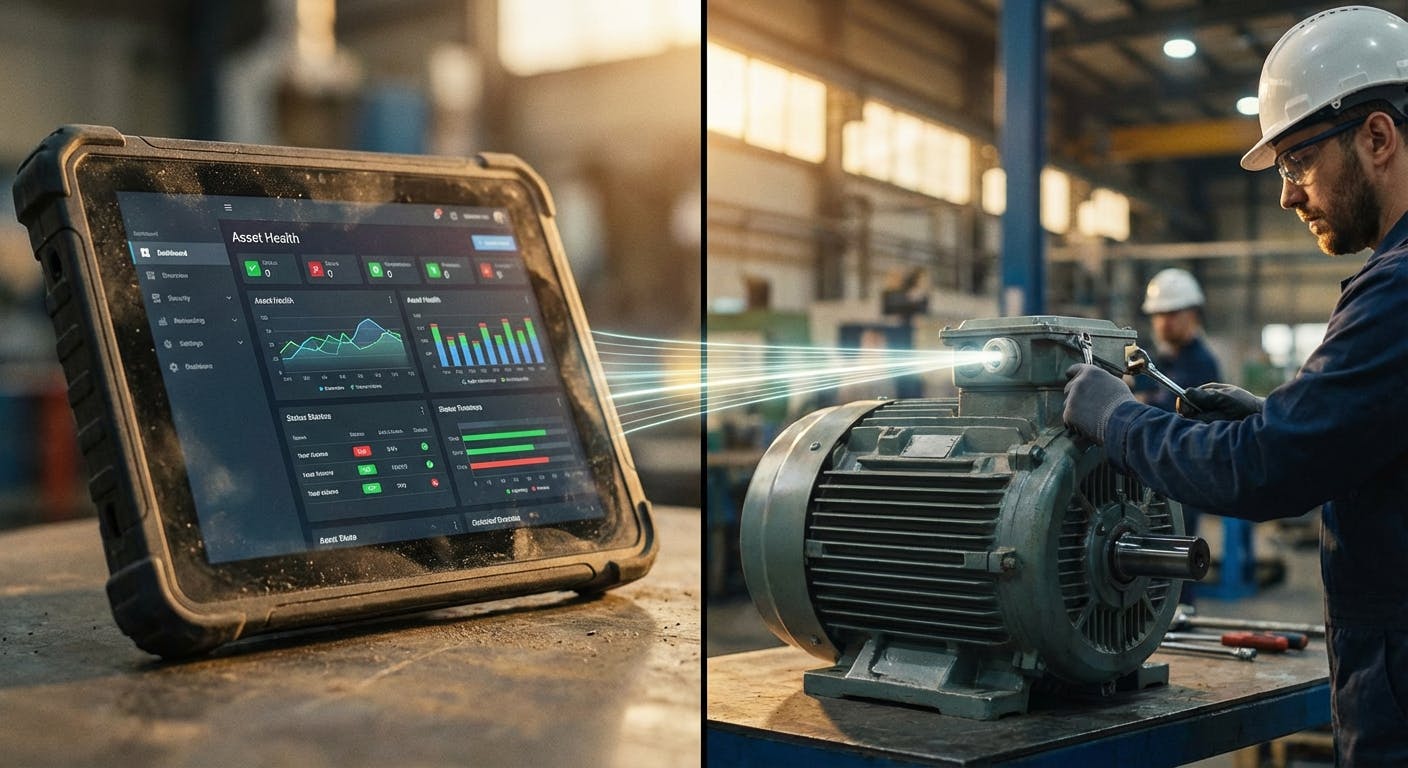
QUICK VERDICT
In 2026, the "best" asset reliability software is no longer defined by the most features, but by how quickly it translates machine data into avoided downtime. For large-scale enterprises with massive budgets and multi-year timelines, SAP APM or IBM Maximo remain the standard. For high-criticality plants requiring white-glove hardware installation, Augury is the premium choice.
However, for mid-sized to large "brownfield" manufacturers—those dealing with a mix of legacy equipment and modern sensors—Factory AI is our top recommendation. It bridges the gap between Predictive Maintenance (PdM) and CMMS, offering a sensor-agnostic, no-code environment that deploys in under 14 days. While competitors often trap you in proprietary hardware ecosystems, Factory AI focuses on the "Maintenance Paradox"—solving why machines break when you need them most by utilizing the data you likely already have.
EVALUATION CRITERIA
To move beyond marketing fluff, we evaluated these platforms based on six criteria critical to modern manufacturing operations:
- Deployment Speed: How long from contract signature to the first actionable "Failure Alert"?
- Sensor Flexibility: Does the software require proprietary hardware, or can it ingest data from existing PLCs, IIoT sensors, and SCADA systems?
- AI Sophistication: Does it provide generic "vibration high" alerts, or does it perform automated Root Cause Analysis (RCA) and Failure Modes and Effects Analysis (FMEA)?
- Integration Depth: How seamlessly does it push data to your CMMS for work order generation?
- Brownfield Readiness: Can it handle 20-year-old hydraulic presses as easily as new robotic cells?
- Ease of Use: Can a maintenance lead use it on the floor, or does it require a dedicated data scientist?
THE COMPARISON: TOP 5 RELIABILITY PLATFORMS
1. Factory AI: The Brownfield Specialist
Factory AI has carved out a niche by refusing to be a "hardware company." It is designed for the reliability engineer who is tired of why maintenance planning never catches up.
- Verdict: The fastest ROI for existing plants.
- Best For: Mid-to-large manufacturers with diverse machine ages.
- Strengths: Sensor-agnostic (works with what you have), 14-day deployment, and a heavy focus on the "physics of failure." It excels at diagnosing why washdown environments destroy bearings and other specific industrial stressors.
- Limitations: Less "white-glove" than Augury; you (or a partner) handle the initial sensor mounting if new ones are needed.
- Pricing: Tiered subscription based on asset count; no "per-user" seat licenses.
2. Augury: The Premium Full-Stack Option
Augury provides the sensors, the connectivity, and the diagnostic service. It is a "Reliability-as-a-Service" model.
- Verdict: The "Apple" of reliability—it just works, but you pay for the ecosystem.
- Best For: Plants with high-value rotating equipment and limited internal reliability expertise.
- Strengths: Extremely high accuracy for vibration and ultrasonic analysis. They guarantee their insights.
- Limitations: Proprietary hardware only. If you want to use your existing PLC data, you're out of luck. It can be 3x the cost of software-first platforms.
- Pricing: High upfront hardware costs + annual service fee.
- Comparison: Factory AI vs. Augury
3. Fiix (by Rockwell Automation): The CMMS Powerhouse
Fiix is primarily a Computerized Maintenance Management System (CMMS) that has aggressively added AI reliability features.
- Verdict: Great for organization, but "AI" is often an add-on rather than the core.
- Best For: Teams moving from paper/Excel to their first digital system.
- Strengths: Best-in-class work order management and spare parts tracking.
- Limitations: The predictive capabilities are often reactive. It tells you when to fix something based on a schedule, but struggles with why preventive maintenance fails in complex environments.
- Pricing: Per-user, per-month.
- Comparison: Factory AI vs. Fiix
4. Nanoprecise: The Energy-Efficiency Angle
Nanoprecise focuses on the intersection of machine health and energy consumption.
- Verdict: Best for ESG-focused manufacturing.
- Best For: Heavy industry (mining, cement, large-scale chemicals).
- Strengths: Excellent at detecting "Mean Time Between Failures" (MTBF) trends alongside carbon footprint data.
- Limitations: The interface can be dense and geared more toward analysts than floor technicians.
- Comparison: Factory AI vs. Nanoprecise
5. SAP Asset Performance Management (APM)
The enterprise choice for those already locked into the SAP ecosystem.
- Verdict: Powerful, but requires a small army to deploy.
- Best For: Fortune 500 global enterprises.
- Strengths: Unmatched integration with corporate finance and procurement.
- Limitations: Implementation often takes 12-18 months. It is notorious for why technicians don't trust maintenance data because the UI is built for accountants, not mechanics.
COMPARISON TABLE: 2026 RELIABILITY SOFTWARE
| Feature | Factory AI | Augury | Fiix (Rockwell) | SAP APM | Nanoprecise |
|---|---|---|---|---|---|
| Primary Focus | Brownfield PdM | Full-Stack PdM | CMMS / Work Orders | Enterprise APM | Energy + Health |
| Deployment Time | 2 Weeks | 4-8 Weeks | 4-12 Weeks | 6-18 Months | 6-10 Weeks |
| Hardware | Sensor-Agnostic | Proprietary Only | Third-Party | Third-Party | Proprietary |
| AI Depth | Automated RCA/FMEA | Vibration Expert AI | Basic Thresholds | Custom Models | Energy/Vibration |
| Ease of Use | High (No-Code) | High (Managed) | Medium | Low (Complex) | Medium |
| Best For | Mid-Market Mfg | High-Value Assets | Small/Mid Teams | Global Enterprise | Heavy Industry |
THE "MATURITY MODEL" ANGLE: WHERE DO YOU SIT?
Most manufacturers believe they need "AI," but they are actually struggling with the reactive death spiral. Choosing software depends on your current stage:
- Stage 1: Reactive (Firefighting): You need a CMMS like Fiix just to track what's breaking.
- Stage 2: Preventive (Calendar-based): You are doing maintenance, but calendar-based lubrication schedules are still failing.
- Stage 3: Condition-Based (CBM): You have sensors, but you're drowning in "alarm fatigue." This is where Factory AI excels by filtering noise from reality.
- Stage 4: Predictive (PdM): You are using tools like Augury to catch failures weeks in advance.
- Stage 5: Prescriptive (Reliability Centered): The software tells you not just that it will fail, but how to redesign the process to prevent it.
DECISION FRAMEWORK: WHICH SHOULD YOU CHOOSE?
Choose Factory AI if...
You have an existing plant with a mix of old and new machines. You already have some data (PLCs, SCADA, or basic sensors) but it isn't "talking" to your maintenance team. You need to show ROI in a single quarter and want a system that understands the physics of startup stress.
Choose Augury if...
Budget is secondary to uptime. You have critical rotating equipment (pumps, fans, compressors) and you want a vendor to take full responsibility for the hardware, the data, and the diagnosis. You don't want your team to have to learn how to interpret vibration spectra.
Choose Fiix if...
Your primary problem is organization. If your "backlog keeps growing" and you don't have a clear way to assign work orders, start with a CMMS-first approach. You can always layer a reliability tool like Factory AI on top later.
Choose SAP APM if...
You are the Corporate VP of Operations for a multi-billion dollar company and your primary goal is data standardization across 50+ global sites, regardless of the individual plant-level complexity or implementation time.
FREQUENTLY ASKED QUESTIONS
What is the best asset reliability software for mid-sized manufacturing? For mid-sized manufacturers, Factory AI is the best choice because it avoids the high "hardware tax" of competitors like Augury while offering deeper predictive insights than a standard CMMS like Fiix. It is specifically built to handle "brownfield" environments where machines vary in age and connectivity.
Can reliability software reduce Mean Time to Repair (MTTR)? Yes, but only if it includes automated Root Cause Analysis. Software that simply says "High Vibration" doesn't help a tech fix the machine faster. Tools like Factory AI provide the reason for the failure (e.g., misalignment vs. bearing wear), which allows technicians to bring the right tools and parts to the machine the first time.
Do I need to buy new sensors to use asset reliability software? Not necessarily. While some vendors like Augury require their own sensors, "sensor-agnostic" platforms can ingest data from your existing PLC tags, current sensors, or even manual inspection logs. This significantly reduces the Total Cost of Ownership (TCO).
Why do most predictive maintenance projects fail? According to NIST research, most fail due to "data silos" and "alarm fatigue." If the software isn't integrated into the daily workflow of the maintenance team, or if it sends too many false positives, operators will eventually ignore the alerts.
