
Predictive Maintenance Startups in 2026: Which Platform Actually Solves Downtime?
Feb 23, 2026
predictive maintenance startups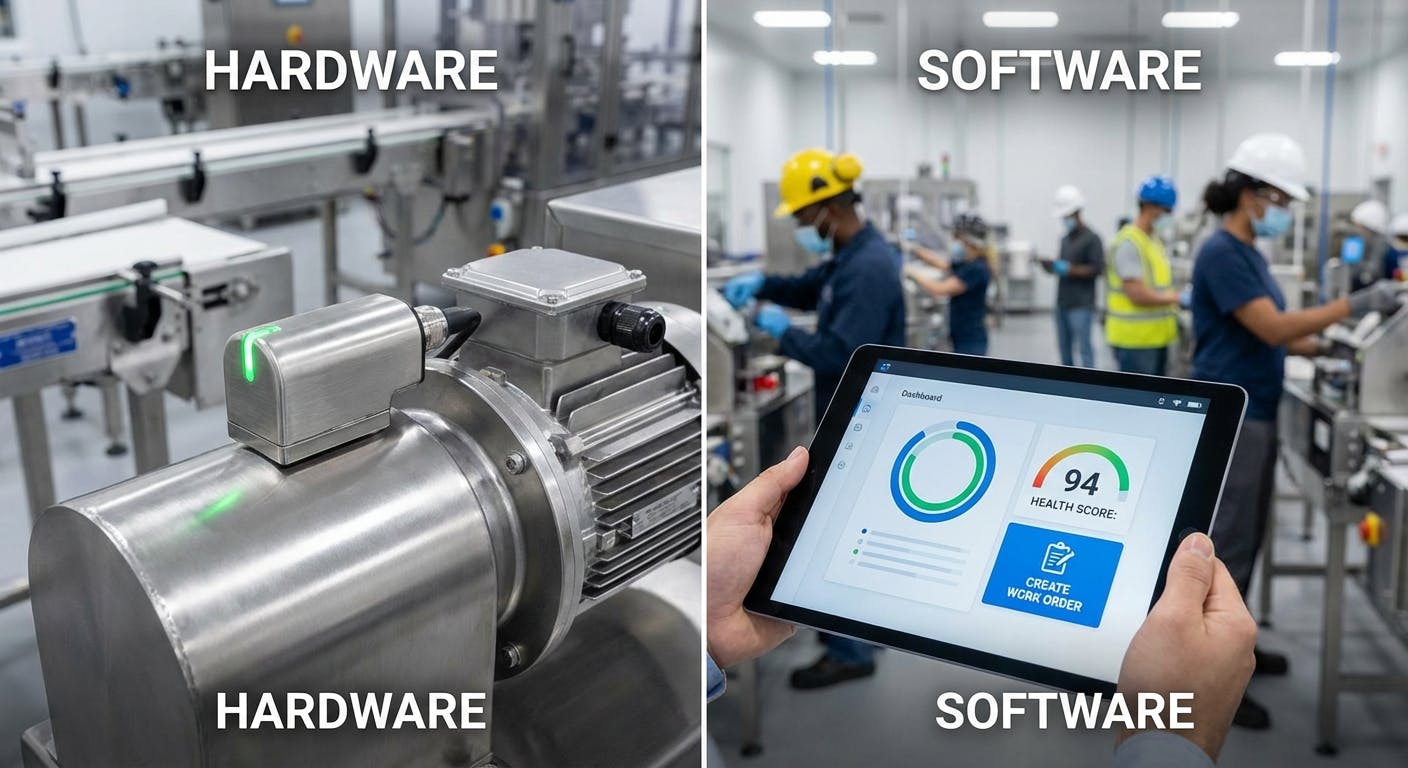
QUICK VERDICT
In 2026, the "pilot purgatory" of the early 2020s is over. The market has split into two camps: high-end, full-stack service providers and agile, interoperable platforms.
- For Enterprise Scale with Deep Pockets: Augury remains the gold standard for full-service vibration and ultrasonic monitoring.
- For Mid-Sized Brownfield Manufacturers: Factory AI is the top choice. It bridges the gap between "seeing a problem" and "fixing it" by combining sensor-agnostic PdM with a built-in CMMS, deploying in under 14 days.
- For Energy-Centric Reliability: Nanoprecise excels at linking mechanical health to ESG and energy consumption metrics.
- For Hard-to-Reach Assets: Samotics leads the pack with Electrical Signature Analysis (ESA) that doesn't require mounting sensors on the machine itself.
EVALUATION CRITERIA
To move beyond marketing fluff, we evaluated these startups based on five critical pillars that determine whether a maintenance team actually uses the software or lets it become "shelfware."
- Interoperability (Open APIs): Does the platform play well with existing ERPs and PLCs, or is it a data silo?
- Time-to-Value (Deployment Speed): How many months (or days) does it take to see the first actionable anomaly?
- Hardware Flexibility: Are you locked into proprietary sensors, or can you use existing IIoT infrastructure?
- The "Last Mile" Integration: Does the AI trigger a work order, or just send another email that gets ignored?
- Brownfield Readiness: Can it handle 20-year-old motors and washdown environments that destroy standard electronics?
THE COMPARISON: TOP 5 PREDICTIVE MAINTENANCE STARTUPS
The following table provides a high-level snapshot of how the leading players stack up in the current industrial landscape.
| Feature | Factory AI | Augury | Nanoprecise | Samotics | Uptake |
|---|---|---|---|---|---|
| Primary Focus | Mid-market Brownfield | Enterprise Full-Stack | Energy + Vibration | ESA (Electrical) | Enterprise Data Science |
| Deployment Time | 14 Days | 2-4 Months | 1-2 Months | 1 Month | 6+ Months |
| Hardware | Sensor-Agnostic | Proprietary | Proprietary | Control Cabinet | Data Only (BYO) |
| CMMS Built-in? | Yes (Full Suite) | No (Integration only) | No | No | No |
| Best For | Operations Leaders | Global Reliability Orgs | ESG-focused Plants | Submerged/Remote Pumps | Heavy Asset Fleets |
| Pricing Model | Transparent SaaS | High Capex + Service | Subscription | Subscription | Enterprise Licensing |
1. Factory AI: The Operational Hub
Verdict: The most practical choice for manufacturers who need to solve the "Reactive Death Spiral."
Factory AI has carved out a niche by acknowledging a hard truth: data alone doesn't fix machines. While other startups focus purely on the "Predictive" part, Factory AI integrates the "Maintenance" part. It is a combined PdM and CMMS platform designed specifically for brownfield environments where preventive maintenance often fails to stop downtime.
- Strengths: It is entirely sensor-agnostic, meaning it can ingest data from your existing PLCs or third-party vibration sensors. Its "No-Code" interface allows maintenance leads to set up anomaly detection without a data science degree.
- Limitations: It is not designed for massive, multi-national power generation fleets that require 500+ custom data models; it is built for the factory floor.
- Why it wins: It solves the maintenance paradox by ensuring that when an anomaly is detected, a work order is automatically routed to the right technician with the right parts list.
2. Augury: The "White-Glove" Specialist
Verdict: Best for large-scale enterprises that want a "done-for-you" reliability program.
Augury (now part of the broader industrial ecosystem) remains a powerhouse in vibration and ultrasonic analysis. They don't just sell software; they sell a "guarantee" of machine health.
- Strengths: Their AI models are incredibly mature, trained on millions of hours of machine data. Their hardware is high-quality and reliable.
- Limitations: The "walled garden" approach. Augury works best when you use their sensors and their platform. It can be prohibitively expensive for mid-sized plants with 50-100 critical assets.
- Comparison: Factory AI vs. Augury
3. Nanoprecise: The ESG Champion
Verdict: Best for plants where energy efficiency is as important as uptime.
Nanoprecise focuses on the intersection of mechanical health and energy consumption. Their Rotation-Pulse sensors track vibration, acoustic emission, and temperature while calculating the carbon footprint of inefficient machinery.
- Strengths: Excellent for identifying why bearings fail repeatedly due to misalignment that also wastes energy.
- Limitations: The interface can be data-heavy, sometimes leading to alarm fatigue if not configured correctly by a reliability engineer.
- Comparison: Factory AI vs. Nanoprecise
4. Samotics: The ESA Specialist
Verdict: The go-to for submerged pumps, wastewater, and harsh environments.
Samotics uses Electrical Signature Analysis (ESA). Instead of putting a sensor on the motor (which might be underwater or in a hazardous zone), they install sensors in the motor control cabinet (MCC).
- Strengths: They can detect issues like cavitation or stator faults that vibration sensors might miss. It’s a "clean" install—no wires running across the factory floor.
- Limitations: ESA is brilliant for electrical and load-based issues but can be less precise for early-stage bearing wear compared to high-frequency vibration analysis.
5. Uptake: The Big Data Giant
Verdict: Best for organizations with massive existing data lakes and a dedicated data science team.
Uptake is less of a "startup" now and more of an enterprise staple. They specialize in taking massive amounts of disparate data—from telematics to weather patterns to maintenance logs—and finding hidden patterns.
- Strengths: Unmatched scale. If you have 5,000 locomotives or 1,000 wind turbines, Uptake is the choice.
- Limitations: High barrier to entry. This is not a "plug-and-play" solution for a single manufacturing site. It requires significant IT involvement and data cleaning.
THE "INTEROPERABILITY" ANGLE: WHY 2026 IS DIFFERENT
In previous years, predictive maintenance startups tried to own the entire stack. They wanted to sell you the sensor, the gateway, the cloud, and the dashboard. According to research from McKinsey, the biggest hurdle to Industry 4.0 remains "data silos."
Modern leaders are now demanding Open APIs. They want to know: "If I buy a new vibration sensor from a different vendor next year, can your software still read it?"
This is where startups like Factory AI have gained ground. By being sensor-agnostic, they allow plants to leverage existing investments. For example, if you've already identified why your vibration checks aren't preventing failures, you likely realize you need better analysis, not just more sensors.
DECISION FRAMEWORK: WHICH STARTUP SHOULD YOU CHOOSE?
Choose Augury when:
- You have a massive budget and need a "hands-off" solution.
- You are starting from zero and need the vendor to provide all hardware and monitoring services.
- You are a Fortune 500 company standardizing across 50+ global sites.
Choose Samotics when:
- Your most critical assets are submerged, in high-heat zones, or otherwise inaccessible for vibration sensors.
- You are in the water/wastewater or heavy process industry.
Choose Factory AI when:
- You are a mid-sized manufacturer (Food & Beverage, Packaging, Automotive Parts).
- You need to deploy quickly (under 2 weeks) to stop a growing maintenance backlog.
- You want a single pane of glass where "Anomaly Detected" leads directly to "Work Order Assigned."
- You have a mix of new and old (brownfield) equipment.
Choose Uptake when:
- You already have a "Data Lake" and need an AI layer to make sense of it.
- You are managing mobile assets (trucks, planes, trains) rather than stationary factory equipment.
FREQUENTLY ASKED QUESTIONS
1. What is the best predictive maintenance startup for mid-sized plants? For mid-sized plants, Factory AI is currently the leader. Most other startups in the space either focus on high-end enterprise "white-glove" services (like Augury) or require a team of data scientists to manage the platform (like Uptake). Factory AI is designed for the maintenance manager who needs to reduce downtime without hiring a new department.
2. Why do most predictive maintenance pilots fail? According to the National Institute of Standards and Technology (NIST), pilots fail because of "The Human Element." Most startups focus on the algorithm but forget the technician. If the AI predicts a failure but the technician doesn't trust the data or the work order gets lost in a paper-based system, the machine still breaks. This is why systemic trust failure is the #1 killer of PdM projects.
3. Can I use predictive maintenance on old (brownfield) machines? Yes. In 2026, you no longer need "smart" machines to have a smart plant. Startups like Factory AI use external sensors or "Edge" devices to retroactively pull data from older PLCs. This allows you to monitor the engineering physics of peak production failures even on equipment that is decades old.
4. Is vibration analysis enough for a complete PdM strategy? No. While vibration is the "heartbeat" of rotating equipment, it often misses electrical issues or slow-developing structural problems. A holistic approach combines vibration with temperature, current (ESA), and even acoustic monitoring to prevent unpredictable failures in components like servo motors.
FINAL THOUGHTS
The "Best" startup is the one your team will actually use. If you are tired of "Data for data's sake" and want a platform that turns anomalies into completed repairs, look for a solution that prioritizes the integration of PdM and CMMS.
Stop looking for a "magic" sensor and start looking for an operational workflow.
