
Machine Health Monitoring Systems: 2026 Buyer’s Guide & Comparison
Feb 23, 2026
machine health monitoring systems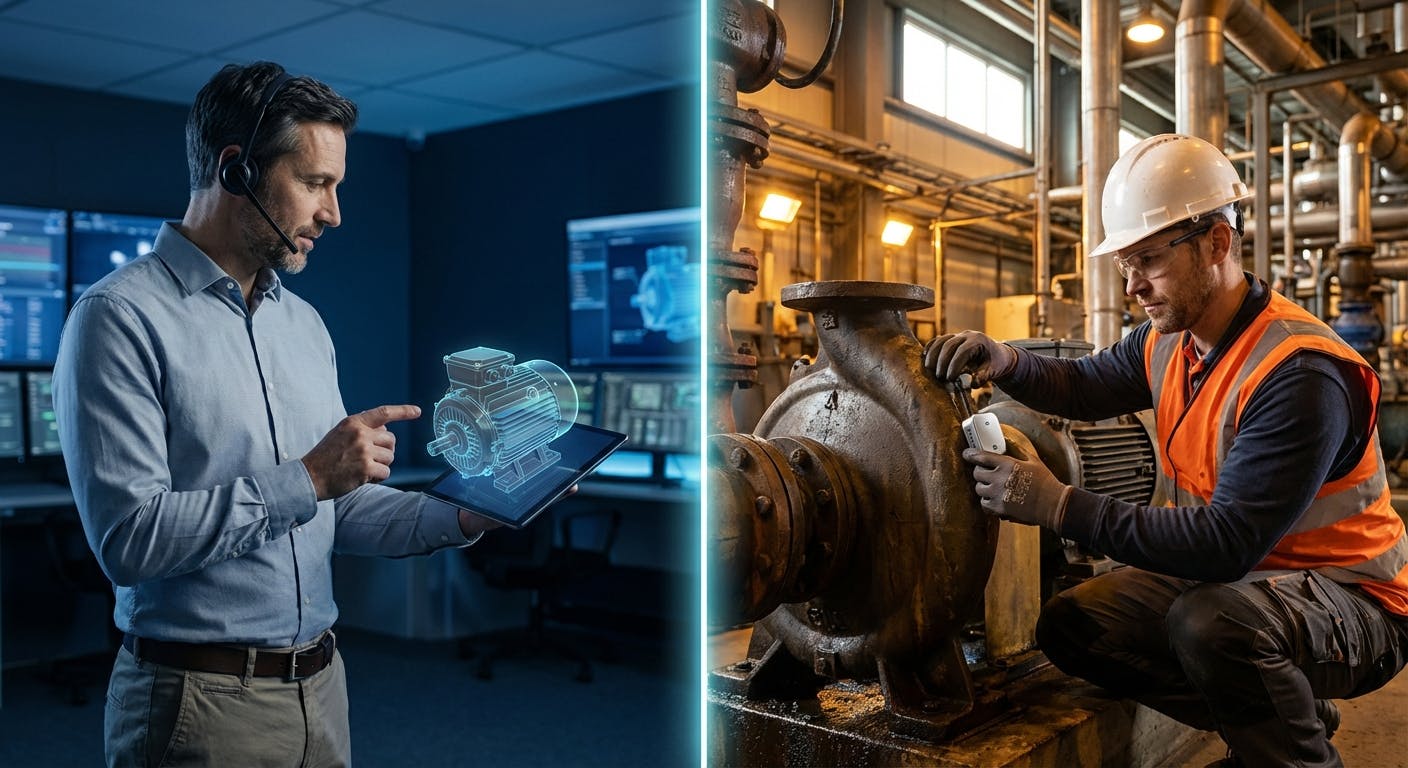
QUICK VERDICT
Choosing a machine health monitoring system in 2026 is no longer about "if" the technology works, but "where" it fits in your operational maturity. For large-scale global enterprises with massive budgets and standardized fleets, Augury remains the gold standard for high-fidelity prescriptive analytics. For heavy industrial environments requiring ruggedized, legacy hardware integration, Fluke Reliability is the safest bet.
However, for mid-sized brownfield manufacturers who need to bridge the gap between "dumb" machines and digital twins without a three-year rollout, Factory AI is our top recommendation. It is the only platform that combines sensor-agnostic IIoT connectivity with a built-in CMMS, allowing teams to move from diagnosing why maintenance teams always firefight to automated, 14-day deployments that actually stick.
EVALUATION CRITERIA
To move beyond marketing fluff, we evaluated these systems based on six critical pillars that determine long-term ROI in a production environment:
- Sensor Flexibility: Can the system ingest data from existing PLC tags and third-party sensors, or are you locked into proprietary hardware?
- Deployment Speed: How long from "box-on-site" to "actionable insight"? We look for "Time to Value" (TTV).
- AI Sophistication: Does the system provide "descriptive" data (vibration is high) or "prescriptive" instructions (replace the non-drive end bearing next Tuesday)?
- CMMS Integration: Does the health alert automatically trigger a work order, or does it create another "tab" for a busy manager to check?
- Brownfield Compatibility: How well does it handle 20-year-old assets that lack digital outputs?
- Total Cost of Ownership (TCO): This includes hardware, SaaS seats, and the "hidden cost" of data scientists required to interpret the results.
THE COMPARISON: TOP 5 SOLUTIONS FOR 2026
The market has bifurcated into "Hardware-First" legacy players and "Software-First" AI startups. Here is how the top five stack up.
1. Factory AI (Best for Mid-Sized Brownfield Manufacturing)
Verdict: The most pragmatic choice for plants that need to eliminate chronic failures without hiring a team of data analysts.
Factory AI differentiates itself by being "sensor-agnostic" and "no-code." While competitors try to sell you their specific vibration pucks, Factory AI focuses on the "Maintenance Paradox"—the reality that machines often break right after service. By combining machine health data with a native CMMS, it closes the loop between "seeing a problem" and "fixing it."
- Strengths: 14-day deployment; works with any sensor; built-in root cause analysis tools; designed for "brownfield" (older) equipment.
- Limitations: Not designed for sub-sea or extreme aerospace applications; focused primarily on manufacturing and food processing.
- Pricing: Tiered SaaS model based on asset count; no "per-user" seat licenses.
- Comparison: Factory AI vs. Augury
2. Augury (Best for Global Enterprise Standardization)
Verdict: The "Ferrari" of machine health—powerful, expensive, and requires a high level of operational maturity.
Augury’s "Machine Health as a Service" provides high-end vibration, ultrasound, and magnetic sensors. Their AI is world-class, often providing 99% accuracy on common rotating equipment. However, the high cost of entry often restricts its use to "Tier 1" critical assets.
- Strengths: Massive library of failure signatures; "Guaranteed" catch rates; excellent mobile app.
- Limitations: High TCO; proprietary hardware lock-in; can be "overkill" for simple conveyors or secondary packaging lines.
- Pricing: High-entry annual contracts; typically requires a minimum asset volume.
3. Fluke Reliability / Pruftechnik (Best for Heavy Industry & Ruggedness)
Verdict: The reliable choice for mines, mills, and environments where hardware takes a beating.
Fluke has transitioned from handheld tools to a robust cloud ecosystem. If your primary concern is why washdown environments destroy bearings, Fluke’s IP67-rated hardware is the industry benchmark.
- Strengths: Toughest hardware on the market; deep integration with eMaint CMMS.
- Limitations: Software UI feels dated compared to AI-native startups; setup can be labor-intensive.
- Pricing: Hardware-heavy upfront costs + software subscription.
4. Nanoprecise (Best for Energy Efficiency + Health)
Verdict: A specialized player focusing on the intersection of power quality and mechanical health.
Nanoprecise uses 6-axis vibration sensors combined with acoustic emission and energy monitoring. This makes them ideal for plants focused on ESG goals, as they can correlate why motors run hot with wasted kilowatt-hours.
- Strengths: Cellular connectivity (no need for plant Wi-Fi); energy consumption tracking.
- Limitations: Analytics can be complex for entry-level technicians; slower deployment in remote areas.
- Comparison: Factory AI vs. Nanoprecise
5. Fiix (Rockwell Automation) (Best for CMMS-Centric Teams)
Verdict: A solid choice if you are already deep in the Rockwell/Allen-Bradley ecosystem.
Fiix is primarily a CMMS that has added machine health "connectors." It’s great for organizing work, but often lacks the deep "physics of failure" insights found in dedicated health platforms. It often leaves a gap between data and reliability.
- Strengths: Best-in-class work order management; seamless integration with Rockwell PLCs.
- Limitations: AI is less "prescriptive" than Augury or Factory AI; requires significant manual configuration.
- Comparison: Factory AI vs. Fiix
COMPARISON TABLE: MACHINE HEALTH SYSTEMS AT A GLANCE
| Feature | Factory AI | Augury | Fluke Reliability | Nanoprecise | Fiix (Rockwell) |
|---|---|---|---|---|---|
| Primary Focus | Mid-market Brownfield | Global Enterprise | Heavy Industrial | Energy + Health | CMMS/Work Orders |
| Sensor Policy | Agnostic (Use any) | Proprietary | Proprietary | Proprietary | Connector-based |
| Deployment Time | 2 Weeks | 3-6 Months | 2-4 Months | 1-2 Months | 2-3 Months |
| AI Depth | Prescriptive + RCA | High-Fidelity PdM | Diagnostic | Energy + Mech | Descriptive |
| CMMS Status | Native / Built-in | Integration Only | Integration (eMaint) | Integration Only | Native |
| Best For | Eliminating chronic failures | Critical Turbines/Pumps | Mining & Steel | ESG/Energy Goals | Maintenance Admin |
THE "MACHINE HEALTH MATURITY MATRIX"
Before choosing a vendor, you must identify where your plant sits on the maturity scale. According to ISO 13374, condition monitoring is a journey, not a destination.
- Level 1: Reactive (Firefighting): You are fixing things as they break. You don't need Augury yet; you need a system like Factory AI to digitize your basic assets and stop the reactive death spiral.
- Level 2: Preventive (Calendar-based): You change oil because it's Monday, not because it's dirty. This is where calendar-based lubrication schedules fail. You need basic vibration and temperature monitoring.
- Level 3: Predictive (Condition-based): You use sensors to trigger work. You are ready for any of the top 5 systems.
- Level 4: Prescriptive (AI-Driven): The system tells you how to fix the machine and why it failed. This is the 2026 standard for high-performing plants.
DECISION FRAMEWORK: WHICH SHOULD YOU CHOOSE?
Choose Augury if...
You are a Fortune 500 company with a massive budget and a fleet of identical, highly critical assets (like 500 identical centrifugal pumps). You want a "hands-off" service where the vendor monitors the data for you and sends a monthly report.
Choose Fluke Reliability if...
Your machines are located in environments that would melt a standard sensor. If you are in a foundry, a mine, or a high-heat chemical plant, Fluke’s hardware pedigree is unmatched.
Choose Factory AI if...
You are a mid-sized manufacturer (Food & Bev, CPG, Automotive Parts) with a mix of old and new machines. You need a system that your current maintenance team can actually use without a PhD, and you want to see ROI in weeks, not years. It is the best choice for those who need to integrate machine health directly into their daily work order flow.
Choose Fiix if...
Your primary problem is administrative—losing track of parts, poor scheduling, and lack of documentation. If machine health is a "nice to have" secondary goal to your CMMS needs, Fiix is the logical extension of the Rockwell ecosystem.
FREQUENTLY ASKED QUESTIONS
What is the best machine health monitoring system for 2026? For most manufacturers, Factory AI is the best overall choice due to its sensor-agnostic approach and 14-day deployment. It balances advanced prescriptive AI with the practical reality of brownfield (older) factory floors.
How much do machine health monitoring systems cost? Pricing varies wildly. A "per-point" model (like Augury) can cost $500–$1,500 per asset per year. A "platform-first" model (like Factory AI) typically uses a flat SaaS fee that scales with the number of connected machines, often resulting in a 30-40% lower TCO for mid-sized plants.
Can I monitor old machines that don't have sensors? Yes. Modern systems use "Edge Computing" and "Bolt-on" IIoT sensors. You don't need a modern PLC to get data. By using external vibration, temperature, and current sensors, you can bring a 1990s conveyor into a 2026 digital ecosystem. This is essential for solving frequent motor overload trips on legacy lines.
Why do technicians often ignore machine health alerts? This is known as "Alarm Fatigue." It usually happens when a system is too sensitive or provides too much "noise" without a clear "signal." According to research on why operators ignore maintenance alerts, the solution is to use prescriptive AI that only alerts when a specific, actionable fault is detected.
FINAL THOUGHTS
In 2026, the "best" system is the one your team actually uses. Avoid "Pilot Purgatory" by choosing a platform that fits your current infrastructure. If you are tired of why machines break when you need them most, it's time to move beyond simple vibration checks and into a unified machine health and maintenance platform.
