
Beyond the CMMS: How Maintenance Assistants AI Industrial Technology is Redefining Reliability in 2026
Feb 23, 2026
maintenance assistants AI industrial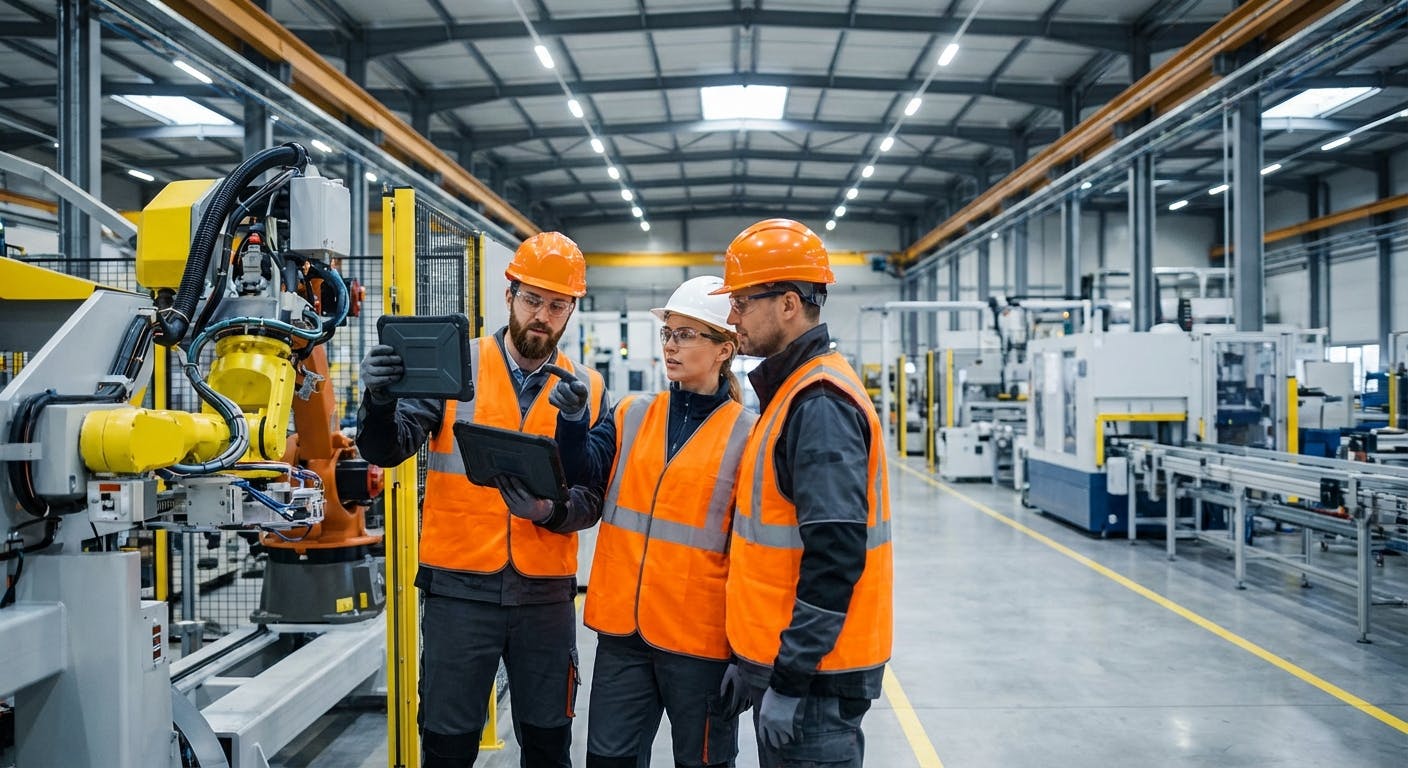
The Core Question: What is an industrial AI maintenance assistant, and why does my plant need one now?
When a maintenance manager searches for "maintenance assistants AI industrial," they aren't looking for another database to store work orders. They are asking a fundamental question: "How can I give my technicians the collective intelligence of my best engineers, instantly, at the point of failure?"
In 2026, the industrial landscape has shifted. We no longer suffer from a lack of data; we suffer from a lack of accessible insight. An industrial AI maintenance assistant is a generative AI-powered "Industrial Copilot" that sits atop your existing systems—your CMMS, SCADA, PLC logs, and PDF manual libraries. Unlike a traditional CMMS, which acts as a passive ledger, an AI assistant is an active participant. It is a "Senior Technician that never sleeps," capable of digesting thousands of pages of technical documentation and years of historical repair logs to provide natural-language troubleshooting steps in seconds.
The core problem it solves is the "Reactive Death Spiral." Most plants are trapped in a cycle where maintenance planning never catches up because the time spent diagnosing a failure exceeds the time spent fixing it. By providing an AI-driven layer that can answer, "Why did the VFD on Line 3 trip for the third time this shift?" based on real-time sensor data and historical patterns, these assistants reduce Mean Time to Repair (MTTR) by up to 40%.
How does an AI assistant actually work on the shop floor?
To understand the practical application, we must look at the "Second Brain" architecture. In a typical 2026 deployment, a technician approaches a malfunctioning conveyor. Instead of walking back to the office to search a desktop CMMS or flipping through a greasy paper manual, they interact with the AI assistant via a ruggedized tablet or voice-integrated headset.
The assistant uses Retrieval-Augmented Generation (RAG). This means it doesn't just "guess" based on its general training; it specifically queries your facility’s private data. It looks at the specific serial number of the motor, checks the last three work orders, analyzes the vibration telemetry from the last hour, and cross-references the manufacturer's troubleshooting flowcharts.
For example, if a technician asks, "The drive motor is running hot, what should I check first?" the AI doesn't just give a generic answer. It might respond: "Based on the telemetry, the internal temperature reached 95°C at 10:15 AM. This matches a pattern seen last June on Line 2. Check the cooling fan filter first—it hasn't been replaced in 400 operating hours. If that's clear, inspect the alignment, as motors often run hot after service if the mounting bolts weren't torqued to the 45 Nm spec."
This level of specificity transforms a junior technician into a high-performer. It bridges the "tribal knowledge" gap left by retiring veterans by capturing their historical notes and making them searchable through natural language.
Case Study: Reducing Downtime in High-Speed Bottling
In a recent 2025 deployment at a Tier 1 beverage packaging facility, the maintenance team faced a recurring "Micro-stop" issue on their labeling machine. These stops lasted only 45 seconds but occurred 30 times per shift, devastating OEE (Overall Equipment Effectiveness). Traditional troubleshooting suggested a sensor misalignment.
When the team deployed an AI maintenance assistant, the technician asked: "Why is the labeler triggering E-Stop 402 intermittently during high-speed runs?" The AI cross-referenced the machine's PLC logs with a maintenance note from three years prior—written by a now-retired lead engineer. The note mentioned that at speeds exceeding 50,000 units per hour, a specific tensioning arm would vibrate just enough to break a laser circuit, but only when the ambient humidity in the plant was above 65%. The AI suggested a specific 2mm adjustment to the bracket. The fix was implemented in 10 minutes, and the micro-stops were eliminated entirely, resulting in a 4% increase in daily throughput.
Why is an AI assistant superior to a standard CMMS?
A common follow-up question from facility directors is: "We already spent $200k on a top-tier CMMS. Why isn't that enough?" The answer lies in the difference between a database and an intelligence layer.
Standard CMMS platforms are excellent at "What" and "When"—what asset broke and when it was fixed. However, they are notoriously poor at "How" and "Why." Most CMMS data is "dark data"—unstructured text in work order closings like "Fixed it" or "Reset breaker." According to NIST, the inability to effectively utilize this historical data costs the US manufacturing sector billions annually.
An AI maintenance assistant performs Conversational Maintenance Logging. Instead of a technician typing a three-word summary, the AI interviews the technician: "I see you replaced the bearing. Was there signs of electrical fluting or just standard wear?" The AI then structures this data, performing AI-driven root cause analysis in the background.
To visualize the difference, consider the following comparison:
| Feature | Traditional CMMS | AI Maintenance Assistant |
|---|---|---|
| Data Entry | Manual, tedious, often ignored. | Conversational, voice-to-text, automated. |
| Troubleshooting | Search by keyword; results are static PDFs. | Context-aware guidance based on real-time telemetry. |
| Root Cause Analysis | Requires manual export to Excel/BI tools. | Automated correlation of sensor data and history. |
| Knowledge Capture | Relies on technicians typing detailed notes. | Proactively interviews staff to capture "tribal knowledge." |
| Alerting | Threshold-based (e.g., "Temp > 80°C"). | Pattern-based (e.g., "Vibration signature indicates bearing cage failure"). |
Furthermore, these assistants solve the problem of "Alarm Fatigue." In many plants, operators ignore maintenance alerts because the system cries wolf too often. An AI assistant filters these alerts, using machine learning to determine which anomalies are truly predictive of failure and which are just "noise" from a startup cycle or a product changeover.
Can AI assistants really perform Root Cause Analysis (RCA)?
One of the most significant breakthroughs in 2026 is the ability of AI to perform "Forensic RCA." Traditional RCA requires a team of engineers to sit in a room for hours with a Fishbone diagram. An industrial AI assistant does this in real-time by connecting disparate data points that a human might miss.
Consider a scenario where gearboxes fail every 6 months. A human might blame the lubricant or the load. An AI assistant, however, can correlate the gearbox failures with the cleaning shift schedule. It might find that the failures always occur 200 hours after a high-pressure washdown, suggesting that the seals are being compromised by sanitation chemicals—a phenomenon known as the physics of post-sanitation breakdown.
By utilizing Prescriptive Maintenance Algorithms, the assistant doesn't just say "The gearbox will fail." It says, "The gearbox is showing signs of moisture ingress. Schedule a seal replacement during the Tuesday downtime to avoid a Wednesday peak-production failure." This moves the facility from predictive maintenance (knowing it will fail) to prescriptive maintenance (knowing what to do about it).
According to ReliabilityWeb, the integration of AI into RCA processes has led to a 25% increase in "First-Time Fix" rates. The AI can even identify when servo motors fail unpredictably due to subtle harmonic distortions in the power grid that are invisible to standard monitoring tools but detectable through high-frequency AI analysis.
What are the common mistakes to avoid when deploying AI assistants?
Despite the power of the technology, implementation failures are common. The most significant mistake is "Garbage In, Garbage Out." If your historical work orders are 90% "Fixed it," the AI has nothing to learn from.
Another critical error is failing to address Systemic Trust Failure. If the AI suggests a repair that turns out to be wrong, technicians will quickly revert to their old ways. In 2026, the best systems use "Source Attribution." When the AI gives a recommendation, it must provide a link to the specific page in the manual or the historical work order it used to reach that conclusion. Without this, technicians don't trust maintenance data.
Common Pitfalls Include:
- Over-reliance on "General" AI: Using a standard LLM (like a basic ChatGPT) without industrial grounding. These models will "hallucinate" torque specs or safety procedures, which is dangerous in a plant environment.
- Ignoring the Edge: Trying to run everything in the cloud. In a massive steel mill or a remote food processing plant, latency kills. The AI assistant must have "Edge" capabilities to function when the Wi-Fi is spotty.
- Lack of Integration: Treating the AI as a standalone app. If it doesn't talk to your PLC (Programmable Logic Controller), it's just an expensive e-book reader.
Troubleshooting the AI Deployment
If your AI assistant is providing vague or incorrect answers, use this troubleshooting framework:
- Check Data Density: Does the AI have access to at least 24 months of work order history?
- Verify Source Quality: Are the PDF manuals OCR-optimized (searchable text) or just flat images?
- Audit the Feedback Loop: Are technicians "liking" or "disliking" the AI's suggestions? Most industrial AI models require a "Human-in-the-Loop" to validate recommendations before the model fully optimizes.
- Connectivity Latency: If the AI takes more than 5 seconds to respond, technicians will abandon it. Ensure your local "Edge" gateway has sufficient compute power for the RAG queries.
How do I measure the ROI of an AI maintenance assistant?
The ROI of an industrial AI assistant is measured across three primary pillars: Labor Efficiency, Asset Longevity, and Downtime Reduction.
1. Labor Efficiency (The "Search" Tax): Studies by ASME indicate that industrial technicians spend up to 30% of their day searching for information—manuals, parts, or historical records. If an AI assistant reduces this search time to 5%, a team of 20 technicians effectively gains the capacity of 5 additional full-time employees without a single new hire.
2. Reducing the "Reactive Death Spiral": Unplanned downtime is 10x more expensive than planned maintenance. By using Automated Work Order Generation, the AI can catch a failing bearing during a routine inspection and order the part before the line stops. This prevents the chronic machine failures that plague high-volume manufacturing.
3. Precision Maintenance: Many failures are actually "infant mortality" caused by improper repair. For example, bearings fail repeatedly on packaging lines because they are over-greased or misaligned during installation. An AI assistant provides step-by-step "Precision Maintenance" checklists, ensuring that every repair is done to the exact engineering standard, thus extending the Mean Time Between Failures (MTBF).
Benchmark ROI Targets:
- MTTR Reduction: 20-40% within the first 12 months.
- Unplanned Downtime Reduction: 15-25%.
- Parts Spend Reduction: 10% (by eliminating "shotgunning"—replacing parts unnecessarily during troubleshooting).
- Training Time Reduction: 50% (onboarding new technicians becomes faster when the AI acts as a 24/7 mentor).
What if my facility is "Old School" with legacy equipment?
A frequent objection is: "Our machines are from 1995. They don't have sensors. How can AI help us?"
This is actually where AI maintenance assistants shine the brightest. For legacy equipment, the "data" isn't in a sensor; it's in the heads of the two guys who have worked there for 30 years. The AI assistant acts as a Knowledge Capture Tool.
By using voice-to-text, the AI can document the "quirks" of an old machine. "When the 1995 press starts vibrating like that, it's usually the shim on the left bolster." Once that is recorded once, the AI "knows" it forever. Furthermore, 2026-era AI can use "Computer Vision." A technician can point their tablet camera at an old analog gauge or a worn gear, and the AI can interpret the state of the machine without a single digital sensor being installed.
Even in environments where vibration checks don't prevent failures because the equipment is too intermittent, the AI can analyze the "Physics of Failure" by looking at startup stresses and standby degradation patterns that traditional threshold-based alerts miss.
Edge Case: The "Ghost in the Machine"
What happens when a machine fails but all sensors report "Normal"? This is the classic "intermittent fault" that drives maintenance teams crazy. An AI assistant handles this by looking at External Correlation. It might pull weather data to see if high outdoor humidity is causing condensation in a control cabinet, or it might look at the power grid frequency to see if a nearby factory's heavy startup is causing a voltage sag. By looking outside the machine's own sensors, the AI identifies environmental root causes that legacy systems simply cannot see.
How do I get started with an AI Maintenance Assistant?
The transition to AI-driven maintenance doesn't happen overnight. It requires a phased approach:
Phase 0: The Data Readiness Assessment (Weeks 1-2) Before buying software, evaluate your data. Do you have digital copies of your manuals? Is your CMMS data exportable? AI requires a "Knowledge Base" to be effective. If your data is 100% paper-based, your first step is a high-speed scanning and OCR (Optical Character Recognition) project.
Phase 1: The Knowledge Audit (Weeks 3-6) Digitize your manuals, schematics, and the last three years of CMMS data. This becomes the "Training Ground" for your assistant. Identify your "Bad Actors"—the 5% of machines causing 50% of your headaches. During this phase, you should also identify your "Subject Matter Experts" (SMEs) whose knowledge needs to be captured first.
Phase 2: The Pilot (Months 2-4) Deploy the assistant to a single production line or a specific department (e.g., the boiler room or the packaging hall). Focus on a specific use case, such as "Reducing troubleshooting time for intermittent electrical faults." Establish a baseline for MTTR and compare the AI-assisted repairs against the historical average.
Phase 3: Integration (Months 5-8) Connect the AI to your live SCADA or IIoT feeds. This is where the assistant moves from being a "Reference Tool" to a "Real-Time Monitor." At this stage, you can begin implementing Predictive Maintenance Algorithms. The AI should now be able to "see" a problem developing before the technician is even dispatched.
Phase 4: Full Orchestration (Year 1+) The AI assistant now manages the workflow. It sees a vibration anomaly, checks the spare parts inventory, verifies technician availability, and drafts a work order for approval. It becomes the central nervous system of your reliability program.
The Human Element: Upskilling vs. Replacing
A common fear is that AI will replace maintenance technicians. In reality, the opposite is happening. The global shortage of skilled trades means that most plants are understaffed. The AI assistant doesn't replace the person; it replaces the frustration.
By handling the "low-level" cognitive tasks—like finding a part number or looking up a torque spec—the AI allows the technician to focus on the "high-level" physical tasks that require human dexterity and judgment. This leads to higher job satisfaction and lower turnover. In fact, plants using AI assistants report a 30% improvement in "Technician Engagement" scores, as staff feel more empowered and less like they are "fighting the machine."
The Future: Digital Twins and AI Assistants
As we look toward the end of the decade, the integration of Digital Twin Maintenance Assistants will become the standard. The AI won't just have access to your manuals; it will have a live, 3D physics-based model of your equipment.
If a motor is overheating, the AI can run a simulation in the digital twin to see if the heat is coming from an internal winding fault or an external load issue. This allows for "Non-Destructive Testing" in a virtual environment before a technician ever touches a wrench.
The goal of "maintenance assistants AI industrial" technology is not to replace the human technician. It is to remove the "drudgery of data"—the hours spent searching, the days spent guessing, and the weeks spent firefighting. It allows your maintenance team to move from being "Repairmen" to being "Reliability Engineers," focusing on high-level strategy while the AI handles the tactical information flow.
In a world where machines break when you need them most, having an AI assistant is no longer a luxury—it is the only way to maintain a competitive edge in the high-velocity manufacturing environment of 2026.
