
Why Maintenance Software That Integrates Production is the Only Way to Break the Reactive Death Spiral
Feb 23, 2026
maintenance software that integrates production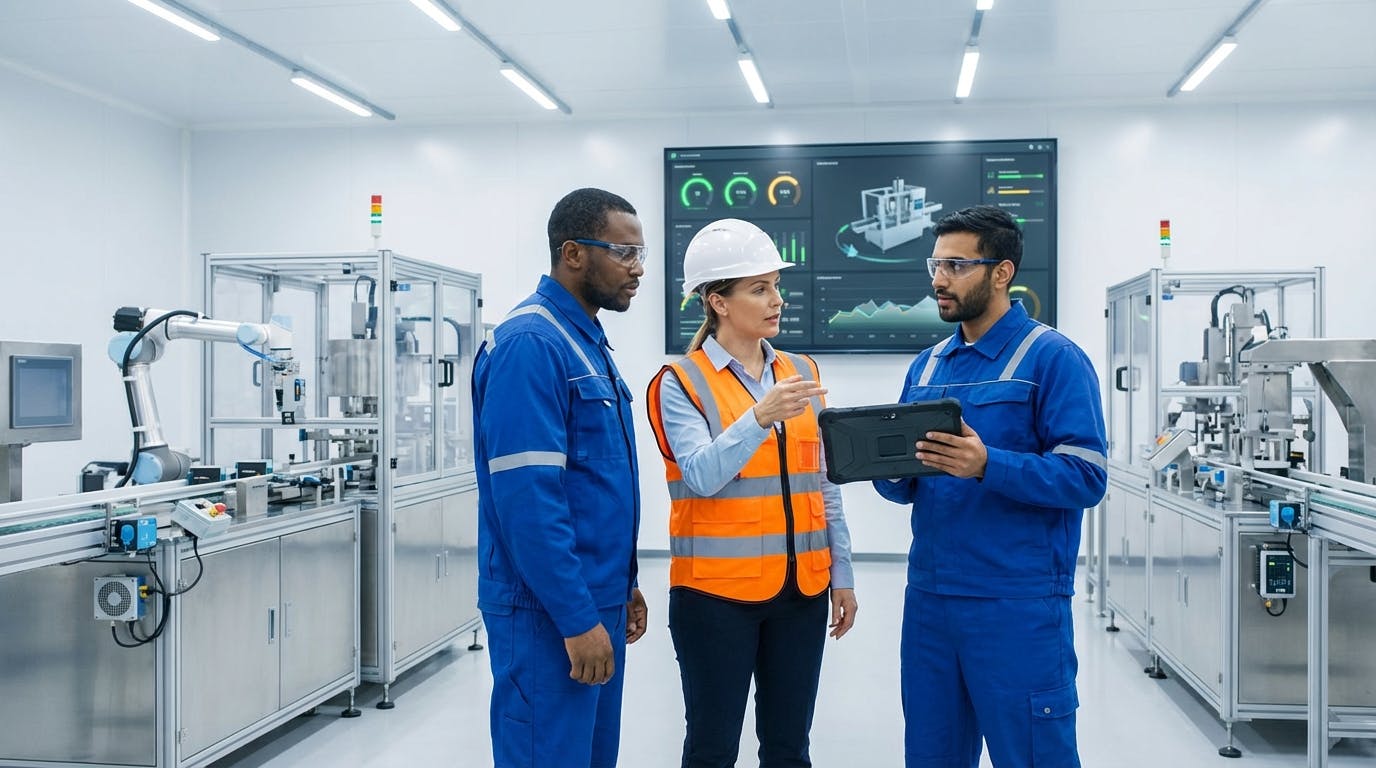
When a Plant Manager or Operations Director searches for "maintenance software that integrates production," they aren't just looking for a digital version of a paper logbook. They are looking for a solution to a fundamental conflict: the tug-of-war between the production team’s need for throughput and the maintenance team’s need for machine access.
In the high-pressure manufacturing environment of 2026, the traditional Computerized Maintenance Management System (CMMS) is no longer sufficient if it operates in a vacuum. The core question being asked is: How can I stop maintenance from being a "necessary evil" that interrupts production and turn it into a real-time driver of operational reliability?
The direct answer is the transition from a standalone CMMS to an Asset Operations Management (AOM) platform. This software doesn't just track work orders; it ingests real-time data from the shop floor—via PLCs, SCADA systems, and IIoT sensors—to align maintenance activities with the actual production pulse. By integrating these two traditionally siloed departments, plants can move from "fixing things when they break" to "maintaining things when it least impacts the bottom line."
Recent industry benchmarks suggest that the cost of unplanned downtime has risen to an average of $260,000 per hour across major manufacturing sectors. In this context, integration isn't a luxury; it is a financial imperative. When maintenance software "talks" to production, it transforms downtime from a random catastrophe into a managed variable.
How does maintenance software actually integrate with production in a modern facility?
To understand how this integration works in practice, we have to look at the data layer. In a legacy setup, the production schedule is managed in an ERP (Enterprise Resource Planning) or MES (Manufacturing Execution System), while maintenance is managed in a separate CMMS. The two rarely talk.
In 2026, integration happens through three primary channels:
- Direct PLC/SCADA Connectivity: The maintenance software pulls "heartbeat" data directly from the machines. Instead of a technician manually entering meter readings, the software knows exactly how many cycles a servo motor has completed or the precise temperature of a gearbox. This eliminates the "trust gap" often found in manual reporting. If the data is inaccurate, the entire system fails, which is why technicians don't trust maintenance data when it's disconnected from the physical reality of the machine.
- Bi-Directional ERP/MES Syncing: When the production team adds a high-priority run to the schedule, the maintenance software automatically flags potential conflicts. If a critical PM (Preventive Maintenance) is due during that run, the system calculates the risk: Can we defer the PM by 24 hours based on current vibration data, or is a failure imminent?
- Unified Dashboards: Both the Production Supervisor and the Maintenance Manager look at the same screen. They see OEE (Overall Equipment Effectiveness) calculated in real-time, where "Availability" is directly linked to pending work orders.
Case Study: The High-Speed Bottling Line
Consider a Tier 1 beverage manufacturer that integrated their maintenance software with their MES. Previously, the "Filler" machine was serviced every 30 days regardless of volume. During a peak summer heatwave, production increased by 40%, but the maintenance schedule remained static. The machine failed on day 22 due to bearing fatigue caused by the increased load.
After integration, the software tracked the "Actual Cycles" and "Motor Torque." On day 18 of the heatwave, the software detected a 12% spike in torque and automatically triggered a "High Priority" inspection. The maintenance team was alerted that the machine was aging 1.5x faster than normal due to the increased throughput. They performed a 15-minute lubrication task during a scheduled labeler changeover, preventing a 12-hour catastrophic failure.
According to the National Institute of Standards and Technology (NIST), smart manufacturing systems that utilize integrated data streams can reduce maintenance costs by up to 30% while increasing equipment uptime. The integration isn't just about "seeing" the data; it's about the software making autonomous decisions—like triggering a work order when a sensor detects a 15% increase in power draw, indicating a motor is struggling before it actually trips.
Why does the "Maintenance vs. Production" conflict still happen, and how does software fix it?
The conflict usually stems from a lack of shared visibility. Production is incentivized by volume; Maintenance is incentivized by asset longevity. These goals often clash during "Peak Production" periods. This is where the engineering physics of peak production failures come into play—machines are pushed to their limits exactly when the maintenance team is told to "stay away" to keep the lines running.
Integrated software fixes this by introducing Dynamic Scheduling. Instead of a rigid, calendar-based PM schedule (which often fails because it doesn't account for actual machine stress), the software uses production data to find "micro-windows" for maintenance.
The "Micro-Window" Strategy
If the MES indicates a 20-minute changeover is occurring on Line 4, the integrated maintenance software pushes a "Quick-Check" task to the operator’s mobile device. This task might include lubricating a specific bearing or checking a belt tension—tasks that prevent long-term failure but don't require a full shutdown.
Avoiding the "Maintenance Paradox"
A common issue in non-integrated plants is the maintenance paradox, where machines actually run worse or fail shortly after a service. This often happens because maintenance was rushed to meet a production deadline or performed without context of the machine's recent performance. Integrated software provides the technician with the machine's "flight data recorder" leading up to the service, allowing for more precise adjustments rather than "guessing" at the state of the internals.
What specific production metrics improve when maintenance is integrated?
When you integrate maintenance software with production, you stop measuring maintenance as a cost center and start measuring it as a revenue generator. The primary metric that benefits is OEE (Overall Equipment Effectiveness), but we can break that down further into actionable KPIs:
1. Reduced Changeover Time
Integrated software tracks the relationship between maintenance and changeovers. If a specific machine takes 20% longer to get back to speed after a product switch, the software can identify if this is a mechanical issue (e.g., worn guides) or an operational issue (e.g., improper calibration).
2. Mean Time Between Failures (MTBF) Accuracy
In a siloed system, MTBF is often a guess. In an integrated system, the software knows exactly when the machine was "In Production" vs. "Idling." This allows for a much more accurate calculation of asset health. You might find that a machine fails every 400 hours of actual runtime, regardless of how many days have passed on the calendar.
3. Energy Consumption per Unit
This is a 2026-specific KPI. Integrated platforms now track energy draw alongside production output. A spike in energy consumption for the same production volume is a leading indicator of mechanical friction, often signaling that a bearing is failing or a motor is overloaded. By catching this early, you eliminate chronic machine failures that typically result in expensive, unplanned downtime.
4. Throughput Optimization
By understanding the "Health Score" of every machine on a line, the production team can route jobs to the healthiest assets. If Line A has a high vibration alert on its main drive, the integrated system might suggest running the high-speed, high-stress job on Line B instead, preventing a catastrophic failure mid-shift.
Decision Framework: When to Trigger Integrated Maintenance
To help teams decide when to pull the trigger on a maintenance intervention during a production run, use the following benchmark table:
| Metric Deviation | Production Impact | Maintenance Action |
|---|---|---|
| OEE Performance < 85% | Minor speed loss | Schedule inspection at next changeover |
| Energy Spike > 10% | Increased friction | Trigger "Check Lubrication" work order within 24hrs |
| Vibration > 0.5 in/s | Imminent bearing failure | Immediate "Stop-and-Fix" at end of current shift |
| Cycle Count > 95% limit | Wear-out phase | Auto-reserve spare parts in MRO inventory |
How do I get started with integrating maintenance and production without overwhelming my team?
The biggest mistake companies make is trying to "boil the ocean" by connecting every sensor and every machine on day one. This leads to data overload and "alarm fatigue," a state where operators ignore maintenance alerts because the system is crying wolf too often.
Step 0: Data Hygiene and Asset Tagging
Before connecting software, ensure your assets are correctly tagged. If the MES calls a machine "Line 1 Packer" and the CMMS calls it "Asset #402," the integration will fail. Standardize your nomenclature across both departments to ensure the data handshake is seamless.
Step 1: Identify the "Constraint" Asset
Start with the machine that dictates your plant's throughput. If this machine stops, the whole plant stops. This is your pilot for integration.
Step 2: Define the "Minimum Viable Data"
You don't need 500 data points. Start with three:
- Runtime/Cycle Count: To move from calendar-based to usage-based maintenance.
- Power Draw: To detect mechanical strain.
- Critical Temperature/Vibration: To catch imminent failures.
Step 3: Implement Autonomous Maintenance (AM)
Integration isn't just for technicians. In 2026, the "Operator as First Responder" model is standard. Use the software to give operators simple, visual checklists based on real-time production triggers. This empowers the production team to take ownership of asset health, reducing the burden on the maintenance department.
Step 4: Close the Feedback Loop
Ensure that when a technician completes a work order, the data flows back into the production schedule. If a repair took longer than expected, the MES should automatically adjust the production plan for the next shift. This level of synchronization is what defines Asset Operations Management.
What are the common pitfalls to avoid in 2026?
Even with the best "maintenance software that integrates production," failure is possible if the underlying strategy is flawed.
The "Data Silo" Re-emergence
Sometimes, companies buy integrated software but then restrict access. If the production team can't see the maintenance backlog, and the maintenance team can't see the production schedule, you've just bought a more expensive version of your old problem. Transparency is the "killer app" of integrated software.
Ignoring the "Reactive Death Spiral"
Software alone won't fix a culture of firefighting. If your team is constantly reacting to breakdowns, they won't have time to look at the predictive data the software is providing. You must use the software to carve out time for proactive work. If you don't, you'll find why maintenance planning never catches up despite having the best tools.
Over-reliance on "Predictive" without "Preventive" basics
There is a trend in 2026 to skip the basics (lubrication, tightening, cleaning) in favor of high-tech vibration analysis. However, the data shows that most failures are still caused by basic neglect. The software should be used to enforce the basics, not replace them. For example, the system should track if a lubrication task was actually performed or just "clicked away" on a tablet.
Troubleshooting the Integration: When the Data Doesn't Match Reality
Even with high-end software, you will encounter "ghost data" or synchronization errors. Troubleshooting these early is vital for maintaining team trust.
- Latency Issues: If the production line stops but the maintenance dashboard shows it as "Running" for another five minutes, you likely have a polling interval issue in your PLC gateway. Ensure your "Heartbeat" signal is set to a sub-10-second interval for critical assets.
- Mapping Errors: A common "What If" scenario occurs when a machine is upgraded but the software isn't updated. If a new motor is installed that naturally draws more current, the software might trigger false "Overload" alerts. Your implementation plan must include a "Change Management" step where maintenance software thresholds are recalibrated after any physical machine modification.
- The "Phantom Work Order": Sometimes, the MES triggers a maintenance request based on a sensor glitch. To troubleshoot this, implement a "Validation Logic" in the software—require two different sensors (e.g., Temperature AND Vibration) to exceed thresholds before a high-priority work order is autonomously generated.
What is the ROI of maintenance software that integrates production?
When presenting to the C-suite, you need to move beyond "we'll have fewer breakdowns." You need hard financial numbers.
1. MRO Spend Reduction
By integrating with production, you can optimize your spare parts inventory. The software knows which parts are actually being "consumed" by production stress vs. which ones are just sitting on the shelf. Most plants see a 15-20% reduction in MRO (Maintenance, Repair, and Operations) inventory costs within the first year.
2. Labor Efficiency
Technicians spend an average of 25% of their day just looking for information or waiting for a machine to become available. Integrated scheduling eliminates this "wait time." If a technician knows exactly when a machine will be free for a 30-minute window, they can be there with tools in hand, ready to go.
3. Extended Asset Life
Replacing a $500,000 piece of capital equipment two years later than planned because it was maintained perfectly is a massive win for the balance sheet. Integrated software tracks the "Total Cost of Ownership" (TCO) by linking every dollar spent on maintenance to the units produced by that asset.
4. Insurance and Compliance
In regulated industries (Food & Beverage, Pharma), integrated software provides an unshakeable audit trail. It proves that maintenance was performed in accordance with production cycles, reducing the risk of fines or recalls.
How do I know if the integration is actually working?
The ultimate sign of success isn't a "green" dashboard. It's a change in the shop floor culture. You know the integration is working when:
- Production Managers ask for maintenance: Instead of hiding machine issues to hit a quota, they proactively request a "check-up" because the software shows a declining health score.
- Maintenance Technicians understand the "Why": They aren't just "fixing a pump"; they are "restoring the capacity of Line 2 to meet the Friday shipment."
- The "Morning Meeting" is 5 minutes, not 50: Because everyone already has the same data on their mobile devices, there's no need to argue about what happened on the night shift.
In 2026, the "Unified Shop Floor" is no longer a futuristic concept—it's a competitive necessity. Facilities that continue to run maintenance and production as separate entities will find themselves unable to compete with the agility and efficiency of integrated plants. By choosing software that bridges this gap, you aren't just buying a tool; you're investing in the long-term reliability of your entire operation.
For more technical deep dives into specific failure modes that integrated software can help detect, explore our analysis on why gearboxes fail every 6 months or the physics behind why machines break after cleaning shifts.
