
Why Generic CMMS Fails Your Rotating Assets: The Case for Specialized Maintenance Software for Motors and Bearings
Feb 23, 2026
maintenance software for motors and bearings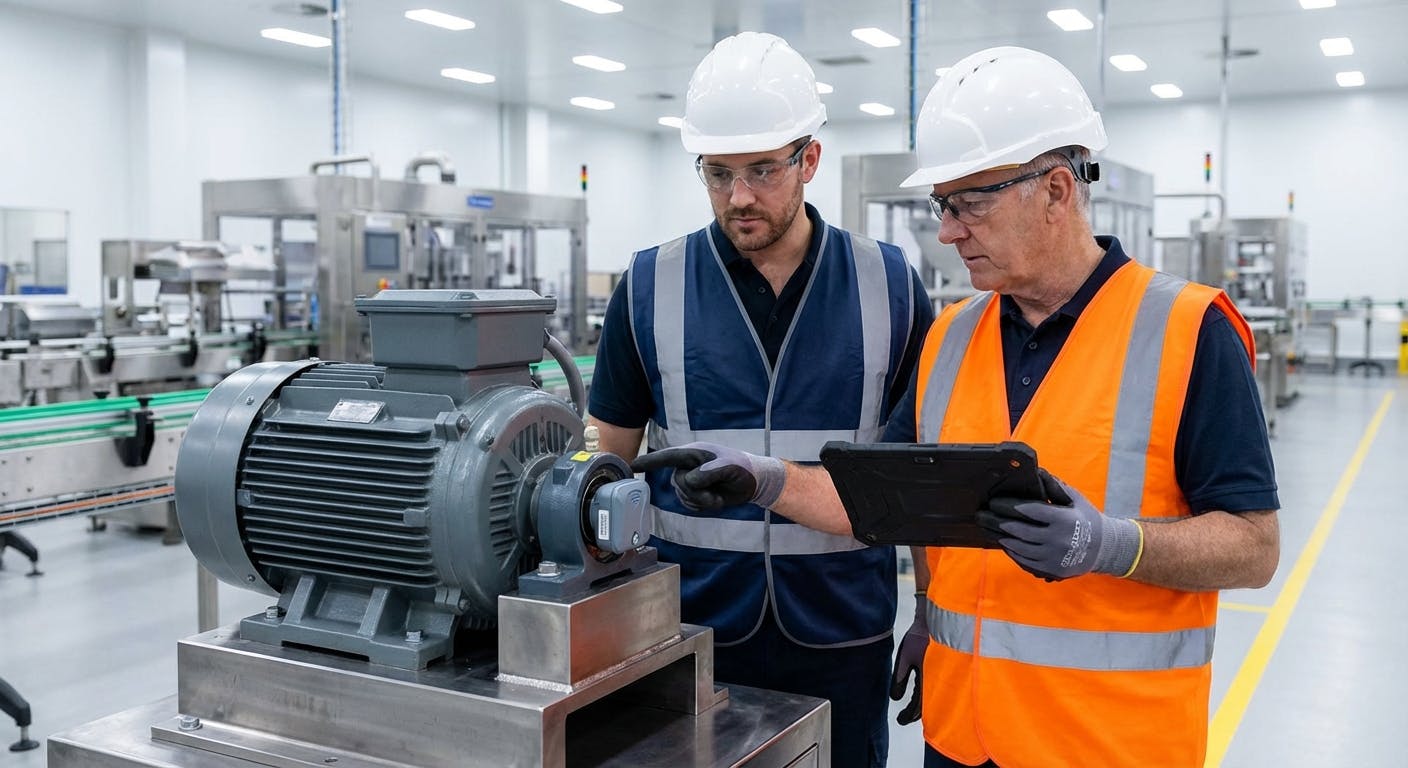
What is the core problem that maintenance software for motors and bearings actually solves?
When a maintenance manager searches for "maintenance software for motors and bearings," they aren't looking for a digital version of a paper calendar. They are looking for a solution to a specific, recurring nightmare: the catastrophic failure of a critical rotating asset that "seemed fine" during the last inspection.
The core problem is the Information Gap. Traditional maintenance management systems (CMMS) are excellent at tracking when a task was done, but they are historically blind to the condition of the asset while it is running. If you rely on a generic CMMS, you are likely practicing calendar-based maintenance—changing oil every six months or replacing bearings every two years regardless of their actual state. This leads to two equally expensive outcomes: replacing perfectly good components (wasted capital) or missing a subsurface fatigue crack that leads to a $50,000-per-hour downtime event.
In 2026, specialized maintenance software for motors and bearings solves this by shifting the focus from Work Order Management to Asset Health Management (AHM). It integrates real-time vibration data, ultrasonic signatures, and thermography into a single dashboard. Instead of asking "When is the next service due?", the software answers "What is the current probability of failure for Motor 42B in the next 100 hours of operation?" This is the transition from reactive firefighting to "Connected Reliability."
How does this software differ from a standard CMMS in a 2026 production environment?
The distinction lies in the depth of data processing. A standard CMMS treats a motor as a line item with a serial number. Specialized maintenance software for motors and bearings treats that same motor as a complex system of physics.
Standard software might trigger an alert because a technician checked a box saying a motor "sounded loud." Specialized software, however, utilizes Predictive Maintenance (PdM) algorithms to analyze the Fast Fourier Transform (FFT) data from a vibration sensor. It can distinguish between a loose mounting bolt (structural resonance) and a failing inner race on a bearing.
Furthermore, generic systems often fail to account for the "Maintenance Paradox." It is a documented phenomenon that motors often run hot or fail shortly after service due to human error, such as over-greasing or misalignment during reinstallation. Specialized software includes "Post-Maintenance Validation" modules. It requires a baseline vibration reading immediately after service to ensure the asset is actually in a better state than it was before the intervention.
In 2026, the best software doesn't just store data; it interprets it using the physics of failure. It understands that a bearing in a washdown environment faces different stressors than one in a climate-controlled cleanroom, and it adjusts its risk-scoring algorithms accordingly.
What are the "Big Three" data streams the software must integrate to be effective?
To move beyond simple scheduling, your software must act as a central nervous system for three specific types of diagnostic data. If the software you are evaluating doesn't natively handle these, it is just a glorified spreadsheet.
1. Vibration Analysis and FFT Integration
Vibration is the "voice" of a rotating asset. High-quality maintenance software for motors and bearings must be able to ingest high-frequency data from IIoT sensors. It shouldn't just show an "Overall Vibration" score (which often misses early-stage defects). It needs to track specific frequencies. For example, if the software detects a peak at the Ball Pass Frequency Inner Race (BPFI), it can pinpoint a bearing defect months before it becomes audible to the human ear. This is why many teams find that standard vibration checks don't prevent failures if they aren't integrated into a system that tracks trends over time.
2. Ultrasonic Leak and Friction Detection
While vibration is great for low-to-mid frequency faults, ultrasound catches the high-frequency "screams" of a bearing that is beginning to lose its lubrication film. Modern software uses ultrasonic data to guide "Condition-Based Lubrication." Instead of a technician pumping grease based on a schedule, the software tells them exactly how many grams of grease to add based on the decibel drop in real-time. This prevents the leading cause of motor failure: over-lubrication.
3. Tribology and Oil Analysis Tracking
For larger motors and gearboxes, the software must serve as a repository for oil analysis reports. It should automatically flag increases in wear metals (like chrome or iron) or changes in viscosity. When you can see a trend line showing rising copper levels alongside a slight increase in bearing temperature, the software provides a "Forensic Root Cause" before the machine even stops.
Why do most implementations of motor maintenance software fail to deliver ROI?
The failure isn't usually in the code; it’s in the Data-to-Action Pipeline. We often see facilities install thousands of dollars worth of sensors and software, only to have their maintenance backlog keep growing because the system generates too much "noise."
Alarm Fatigue is the primary killer of ROI. If the software sends an "Alert" every time a motor vibrates slightly outside of a narrow band, technicians will eventually start ignoring the notifications. In 2026, sophisticated software uses "Smart Alarming" based on ISO 10816 standards, but customized to the specific asset's history.
Another common pitfall is the Systemic Trust Failure. If the software predicts a failure, but the technician pulls the bearing and it "looks fine" to the naked eye, the technician may lose trust in the system. The software must be able to show the why—displaying the FFT peaks or the ultrasonic trend—to educate the team that subsurface fatigue is invisible but terminal. Without this transparency, technicians won't trust maintenance data, and they will revert to reactive habits.
How do I choose the right software based on my specific industry stressors?
Not all "motors and bearings" are created equal. The software requirements for a 24/7 paper mill are vastly different from those of a seasonal food processing plant.
- For High-Volume Manufacturing: Look for software that prioritizes "Asset Health Indexing." You need a "stoplight" dashboard (Green/Yellow/Red) that allows you to see the health of 500+ motors at a glance. The ROI here comes from preventing the peak production failures that happen when machines are pushed to their limits.
- For Food and Beverage (Washdown Environments): Your software must account for the physics of ingress. Bearings in these environments often fail not due to wear, but due to "breathing" in moisture during cool-down cycles. Your software should integrate with temperature sensors to flag assets that are at high risk of internal condensation. Understanding why washdown environments destroy bearings is critical for configuring your software's alert thresholds.
- For Intermittent or Standby Equipment: Standard calendar-based software is useless here. You need software that tracks "Start/Stop Cycles" and "Idle Time." Intermittent machines often suffer from "false brinelling" (vibration damage while stationary). Your software should prompt for shaft rotation or lubrication cycles based on idle time, not just run hours.
What is the "Connected Reliability" workflow in a 2026 facility?
To see what this looks like in practice, let's follow a single bearing through its lifecycle within a modern maintenance software ecosystem.
- Installation & Baselining: A new motor is installed. The technician uses a mobile app to scan the QR code on the motor. The software automatically pulls the bearing frequencies (inner race, outer race, cage, and ball) from a global database. A "Baseline" vibration and thermal reading are taken.
- Continuous Monitoring: IIoT sensors send data to the cloud every 15 minutes. The software's PdM algorithm compares this data against the baseline and the ISO standards.
- Anomalous Detection: The software detects a 3dB increase in the 2kHz to 4kHz ultrasonic range. It doesn't trigger a "Critical Failure" alarm yet. Instead, it creates a "Check Lubrication" task.
- Guided Intervention: The technician arrives with a connected grease gun. The software shows the real-time decibel level on their tablet. As they add grease, they watch the decibel level drop. The software records exactly 12 grams of grease were added and closes the task.
- Root Cause Integration: If the vibration continues to climb despite proper lubrication, the software triggers a "Root Cause Analysis" (RCA) workflow. It asks the technician to check for belt tension or misalignment. This prevents the cycle of repeated bearing failures by forcing the team to look at the system, not just the component.
How do I justify the cost of specialized software to executive leadership?
Executive leadership doesn't care about "FFT resolution" or "ultrasonic decibels." They care about Risk Mitigation and EBITDA. To sell the investment in maintenance software for motors and bearings, you must frame the conversation around three financial pillars:
1. Extension of Asset Residual Value Most motors are scrapped long before their theoretical L10 life. By using software to maintain optimal lubrication and alignment, you can realistically extend the life of a $5,000 motor from 5 years to 10 years. Across a plant with 200 motors, that is a $500,000 capital expenditure deferment.
2. Elimination of "Secondary Damage" When a $200 bearing fails catastrophically, it often takes out the motor shaft, the housing, and potentially the driven equipment (like a pump or gearbox). Software allows you to catch the $200 problem before it becomes a $15,000 "secondary damage" rebuild.
3. The Cost of Unplanned Downtime (CUD) According to ReliabilityWeb, the average cost of unplanned downtime in heavy industry has risen by 25% since 2022 due to supply chain delays for replacement parts. If your software prevents just one 4-hour outage per year, it has likely paid for its annual subscription five times over.
What are the "Edge Cases" where this software might struggle?
Even the best software has limitations. It is important to recognize where the "physics of the plant" might trick the "logic of the software."
- Variable Frequency Drives (VFDs): Motors controlled by VFDs change their vibration signatures based on their speed. If your software isn't "VFD-aware" (meaning it doesn't know what speed the motor is running at when it takes a sample), it will generate hundreds of false positives. Ensure your software integrates with your PLC/SCADA system to normalize vibration data against RPM.
- Complex Gear Trains: In a gearbox with multiple stages, it can be incredibly difficult for software to distinguish which specific bearing is failing because the vibration signals "cross-talk." In these cases, the software must be supplemented with oil debris monitoring to confirm which metal alloys are present in the lubricant.
- Extreme Heat Environments: Sensors have operating limits. If you are monitoring a motor on a kiln or oven, the sensor itself may fail or drift before the motor does. Your software must have "Sensor Health Monitoring" to alert you when a data stream becomes unreliable.
How to get started: A 90-day roadmap
You don't need to instrument every motor in your facility on Day 1. That is a recipe for data overwhelm. Instead, follow this tiered approach:
- Days 1-30: The Criticality Audit. Identify your "Top 10" assets. These are the motors whose failure stops the entire line. Map their bearing types and operating conditions.
- Days 31-60: The Pilot Phase. Install IIoT sensors on these 10 assets and integrate them with your chosen maintenance software. Focus on establishing a clean baseline.
- Days 61-90: The Workflow Integration. Train your "Lead Reliability Tech" on how to interpret the software's dashboards. Start replacing calendar-based tasks with condition-based tasks for these 10 assets.
By the end of 90 days, you will have the "Proof of Concept" needed to show management that you have eliminated chronic machine failures on your most troublesome line.
Conclusion: The Future of Rotating Asset Reliability
In 2026, the gap between "world-class" facilities and "struggling" ones is defined by how they manage their rotating assets. Motors and bearings are the workhorses of modern industry, but they are also the most vulnerable to human error and environmental stress.
Maintenance software for motors and bearings is no longer an optional "add-on" for the engineering department; it is a fundamental requirement for operational survival. By moving to a system that understands the physics of vibration, the importance of ultrasonic precision, and the necessity of data trust, you stop being a "firefighter" and start being a "reliability architect."
The goal isn't to fix things faster when they break. The goal is to create an environment where they simply don't break in the first place.
