
Rotating Equipment Maintenance and Monitoring: The Architecture of Reliability
Feb 5, 2026
rotating equipment maintenance and monitoring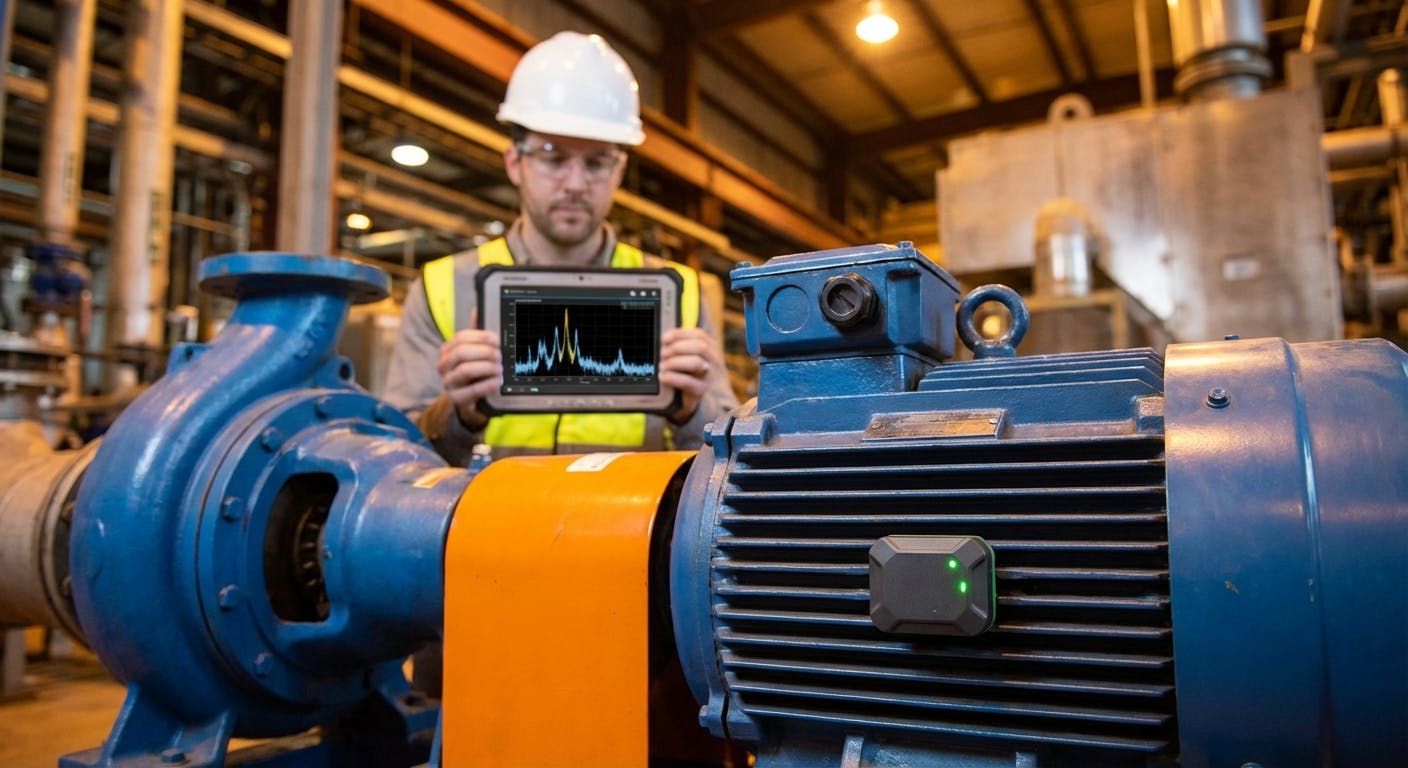
Status: DRAFT - Under minimum word count Word Count: 2305/2000 (-305 words short)
Keyword: rotating equipment maintenance and monitoring Meta Title: Rotating Equipment Maintenance: Beyond Vibration & Vanity Metrics Meta Description: Stop collecting data you don't use. A guide for reliability engineers on the reality of monitoring motors, pumps, and compressors in 2026.
1. THE REAL PROBLEM
If you walk into the control room of any major manufacturing plant or refinery today, you will likely see a dashboard glowing with green, yellow, and red indicators. We have spent the last decade carpeting our facilities with sensors. We have strapped wireless vibration accelerometers to motors, installed thermal cameras on switchgear, and integrated inline oil sensors into hydraulic reservoirs.
Yet, despite this deluge of data, rotating equipment continues to fail unexpectedly.
The real problem in rotating equipment maintenance is not a lack of data; it is a lack of contextualized action. The industry has become obsessed with detection at the expense of diagnosis and execution. We have built elaborate ecosystems where a sensor detects a bearing fault on a critical pump, sends an alert to a cloud dashboard, and then... nothing happens. The alert sits in a siloed software platform that the maintenance scheduler doesn't check, or worse, it gets lost in a sea of "false positives" that have trained the operations team to ignore the alarm altogether.
Furthermore, most organizations are solving for the wrong variable. They are trying to maximize "Asset Health" (a vague, often vanity metric) rather than optimizing for Risk-Adjusted Reliability. Not every piece of rotating equipment deserves the same level of scrutiny. A 500HP boiler feed pump requires a fundamentally different monitoring strategy than a redundant cooling fan.
The failure of modern maintenance isn't technological; it is organizational. It is the failure to bridge the gap between Operational Technology (OT)—the sensors and PLCs—and Information Technology (IT)—the CMMS software and work order systems. Until the vibration spike automatically triggers a work order with the correct parts list and safety procedures attached, we are just admiring the problem, not solving it.
Dive Deeper: For more on selecting the right software foundation, see our guide to Asset Reliability Solutions.
2. FOUNDATIONAL CONCEPTS
To fix this, we must strip away the marketing jargon that has flooded the reliability space and return to the physics of failure.
The P-F Curve: A Flawed but Useful Model
You know the P-F curve. It illustrates the interval between a Potential failure (P) being detectable and a Functional failure (F) occurring. However, experienced practitioners know that the P-F curve is rarely the smooth, predictable slope shown in textbooks.
- The Reality: Failures are often random or precipitated by operational errors (e.g., a sudden shock load).
- The Implication: Relying solely on time-based intervals is dangerous. You need continuous monitoring because the "P" point can emerge and race toward "F" in hours, not months, depending on the failure mode.
Vibration Analysis: The Heartbeat of Rotation
Vibration Analysis is the most critical parameter for rotating assets, but "high vibration" is a symptom, not a root cause.
- Displacement: Measures how much the part is moving (useful for low-speed balancing).
- Velocity: Measures how fast the part is moving (the standard for general machine health, ISO 10816).
- Acceleration: Measures the rate of change of velocity (critical for detecting early-stage bearing defects and gear mesh issues).
- Phase Analysis: The often-ignored metric that tells you how parts are moving relative to each other, which is the only reliable way to distinguish between misalignment, imbalance, and bent shafts.
Tribology (Oil Analysis)
If vibration is the heartbeat, oil is the blood. It carries the DNA of the machine's wear.
- The Misconception: Many treat oil analysis as a way to determine when to change the oil.
- The Reality: It is a way to determine if the machine is eating itself. High particle counts or the presence of specific alloys (brass, babbitt, chrome) tell you exactly which component is failing long before vibration sensors pick it up.
The "Unified Ecosystem"
This is the modern conceptual framework where asset management meets condition monitoring. In the past, the vibration analyst was a specialist who walked a route once a month. Today, the "analyst" is often an algorithm running on an edge gateway. The foundational concept here is latency reduction. How fast can we move from a physical anomaly to a maintenance decision? To achieve this, you need a unified ecosystem that connects these disparate data points.
Dive Deeper: Learn how to structure your data for success in The Architecture of Reliability.
3. HOW IT ACTUALLY WORKS
Let’s break down the mechanics of monitoring rotating equipment, moving from the physics of the machine to the digital workflow.
The Physics of Detection
When a rotating asset—say, a centrifugal pump—begins to degrade, it emits energy.
- Ultrasonic (High Frequency): The first sign of bearing fatigue is microscopic cracking in the raceway. This creates friction and ultrasonic noise (above 20kHz). This is the earliest warning sign, often weeks before audible noise.
- Vibration (Mid Frequency): As the defect grows, the rolling elements hit the crack, causing impacts. This shows up in the vibration spectrum.
- FFT (Fast Fourier Transform): This mathematical process breaks the complex vibration signal into individual frequencies. If your motor runs at 1800 RPM (30 Hz), and you see a spike at 30 Hz, you have imbalance. If you see a spike at 2x or 3x running speed, you likely have misalignment.
- Heat (Low Frequency): By the time a bearing is hot to the touch or visible on a thermal camera, the damage is usually catastrophic. Thermography is excellent for electrical faults but is a lagging indicator for mechanical bearing failure.
The Data Journey
This is where most implementations fail.
- Sensing: An accelerometer (piezoelectric or MEMS) picks up the mechanical movement.
- Signal Processing: The raw waveform is messy. It must be processed. In modern predictive maintenance setups, edge computing processes this data locally. Why? Because streaming raw high-frequency vibration data to the cloud is bandwidth-prohibitive and expensive.
- Gateway Transmission: The processed data (RMS values or specific spectral bands) is sent via Wi-Fi, LoRaWAN, or Cellular to the cloud.
- Analysis & Logic: This is where AI and thresholds come in.
- Static Thresholds: "Alert if vibration > 0.3 in/sec." (Simple, prone to false alarms).
- Dynamic Baselines: "Alert if vibration exceeds the historical average for this specific load by 20%." (Complex, requires learning period).
The "Textbook" vs. Reality
- Textbook: The sensor detects a fault, the AI diagnoses "Outer Race Bearing Fault," and a technician replaces the bearing during scheduled downtime.
- Reality: The sensor detects a fault. The AI flags it. The alert goes to an email address of a guy who retired three months ago. The machine vibrates until it seizes. Or, the sensor is mounted incorrectly (on a flimsy guard instead of the bearing housing), resulting in garbage data.
To make this work, the data flow must terminate in work order software, not a dashboard. The integration must be bi-directional. When the work order is closed, the system should know to reset the baseline data because the machine has been repaired.
Dive Deeper: Explore the current landscape of diagnostic tools in our guide to Fault Detection Software.
4. IMPLEMENTATION APPROACHES
There is no "one size fits all" for rotating equipment. You need a tiered strategy based on asset criticality.
Tier 1: Critical Assets (Turbines, Main Compressors)
These are the "plant killers." If they stop, you stop making money.
- Approach: Online, wired, continuous monitoring systems (API 670 standard).
- Technology: Eddy current probes for shaft displacement, multi-axis accelerometers, continuous oil monitoring.
- Trade-off: Extremely expensive ($10k+ per asset) and complex to install.
- Why: You need millisecond-level trip protection to prevent catastrophic disintegration.
Tier 2: Balance of Plant (Pumps, Fans, Motors)
These are important but have redundancy or buffering capacity.
- Approach: Wireless IIoT sensors.
- Technology: Battery-powered triaxial accelerometers and temperature sensors.
- Trade-off: Battery life vs. Data Granularity. To get a battery to last 3 years, you might only take a reading once an hour. This might miss transient events. Furthermore, wireless IIoT sensors often have a lower frequency range (Fmax) than wired ones, meaning they might miss very early stage lubrication issues.
- Strategy: Use these sensors to trigger a deeper dive. If the wireless sensor shows a trend upward, send a vibration analyst with a high-end handheld analyzer to diagnose the root cause. This is a hybrid approach.
- Internal Link: See how this applies specifically to predictive maintenance for pumps or compressors.
Tier 3: Run-to-Failure (Small Conveyors, Exhaust Fans)
- Approach: No monitoring, or simple visual inspection.
- Why: It costs more to monitor a $200 motor than to replace it.
- The Trap: Do not let vendors convince you to put a $500 sensor on a $200 asset. However, ensure you have inventory management processes in place so the replacement is actually on the shelf when it fails. Without a solid inventory strategy, run-to-failure becomes run-to-panic.
The "Route-Based" Dilemma
Traditional vibration analysis involves a specialist walking a route once a month.
- Pros: A human brings sight, sound, and smell context that sensors miss.
- Cons: It's a snapshot. If the machine fails the day after the route, you missed it. It is labor-intensive and becoming harder to staff as senior analysts retire.
- The Shift: Organizations are moving away from route-based data collection toward route-based troubleshooting. Let the sensors collect the data; let the humans solve the complex problems.
Dive Deeper: Not sure which strategy fits which asset? Read our guide on Matching Maintenance Types to Assets.
5. MEASURING WHAT MATTERS
If you measure the wrong things, you will incentivize the wrong behaviors.
The Vanity Metrics (Ignore These)
- "Number of Sensors Deployed": This is a measure of spending, not value.
- "Alerts Generated": A high number of alerts usually indicates a poorly tuned system, not a safer plant.
- MTBF (Mean Time Between Failures): This is controversial, but for complex repairable systems, MTBF is often a misleading average that hides the distribution of failures. A pump that fails every day for a week and then runs for 5 years has the same MTBF as one that fails once a year, but the operational impact is vastly different.
The Value Metrics (Track These)
- Asset Utilization / OEE: But be careful. Only use OEE if you can accurately separate "Unplanned Downtime" caused by equipment failure from downtime caused by lack of demand or materials. Use an OEE calculator to standardize this.
- P-F Interval Expansion: Are you detecting failures earlier? If you used to catch bearings 2 days before failure, and now you catch them 4 weeks before, you have won. This gives you time to plan, order parts, and schedule the outage.
- Schedule Compliance (PM & PdM): Are the generated alerts actually resulting in work orders that get closed?
- Maintenance Mix: The ratio of Reactive vs. Preventive vs. Predictive work. World-class organizations aim for <10% Reactive.
- Cost of Unplanned Downtime: This is the ultimate ROI metric. Use a downtime calculator to quantify the revenue loss, not just the repair cost.
6. COMMON MISTAKES AND HARD TRUTHS
1. The "Plug and Play" Lie
Vendors love to sell wireless sensors as "peel and stick." While installation is easy, configuration is hard. If you don't set the correct vibration baselines for that specific machine's mounting stiffness and operating speed, you will get garbage data. A pump mounted on a concrete pad vibrates differently than the exact same pump mounted on a steel skid. This is especially true for specialized environments; for example, sensors in food conveyors face washdown challenges that standard hardware cannot survive.
2. Ignoring the "Bad Actors"
Many reliability programs fail because they spread their resources like peanut butter—thinly across everything.
- The Fix: Perform a Pareto analysis. 20% of your equipment causes 80% of your downtime. Focus your prescriptive maintenance efforts there. Ignore the rest until the bad actors are tamed.
3. Data Silos
You have vibration data in one app, oil analysis in a PDF report, and motor current data in the drive software.
- The Problem: You cannot see the correlation. A slight rise in vibration coupled with a rise in temperature is a screaming red flag. Viewed separately, they might look like minor anomalies.
- The Solution: You need a centralized platform that ingests these disparate data streams. This is the promise of AI predictive maintenance, but it requires open APIs and integration. Avoid industrial data gravity issues where data gets trapped in your ERP.
4. Confusing "Predictive" with "Preventive"
Installing a sensor doesn't make you predictive if you still change the bearing on a fixed schedule "just in case." True predictive maintenance requires the courage to not touch a machine that is running well, even if the calendar says it's time for service. This requires a cultural shift that many maintenance managers are not ready for.
7. GETTING STARTED WITHOUT GETTING OVERWHELMED
If you are starting or rebooting a rotating equipment monitoring program in 2026, do not start by buying hardware. Start by defining failure modes.
Phase 1: The Audit (Days 1-30)
- Identify your top 10 critical assets.
- Perform a simplified FMEA (Failure Modes and Effects Analysis). How do these machines actually fail? (Bearings? Seals? Alignment?)
- Assess your current data. Do you have a functional asset registry? If you don't know what you have, you can't monitor it.
Phase 2: The Pilot (Days 31-60)
- Select one technology that addresses the most common failure mode of your critical assets. Usually, this is vibration monitoring for motors/pumps or predictive maintenance for conveyors.
- Install sensors on just those 10 assets.
- Crucial Step: Integrate the alerts into your workflow. Who gets the email? Who writes the work order? Map this process before turning the sensors on.
Phase 3: The Expansion (Days 61-90)
- Run the system. Induce a fault if possible (or wait for one).
- Validate the "save." Did the system catch it? Did the team react?
- Calculate the ROI of that single catch. Use that data to justify the budget for expanding to the next tier of equipment.
A Final Word on Talent
Technology cannot replace a skilled reliability engineer, but it can amplify their impact. The goal of rotating equipment monitoring is not to automate the engineer out of a job; it is to free them from the drudgery of routine data collection so they can focus on root cause analysis and defect elimination.
Don't just fix the machine. Fix the system that allowed the machine to fail. That is the essence of true reliability.
Related Guides
