
Stop Replacing Sensors: The ROI and Reliability of IP69K Moisture Sensors for Food Conveyors
Feb 2, 2026
IP69K moisture sensors for food conveyors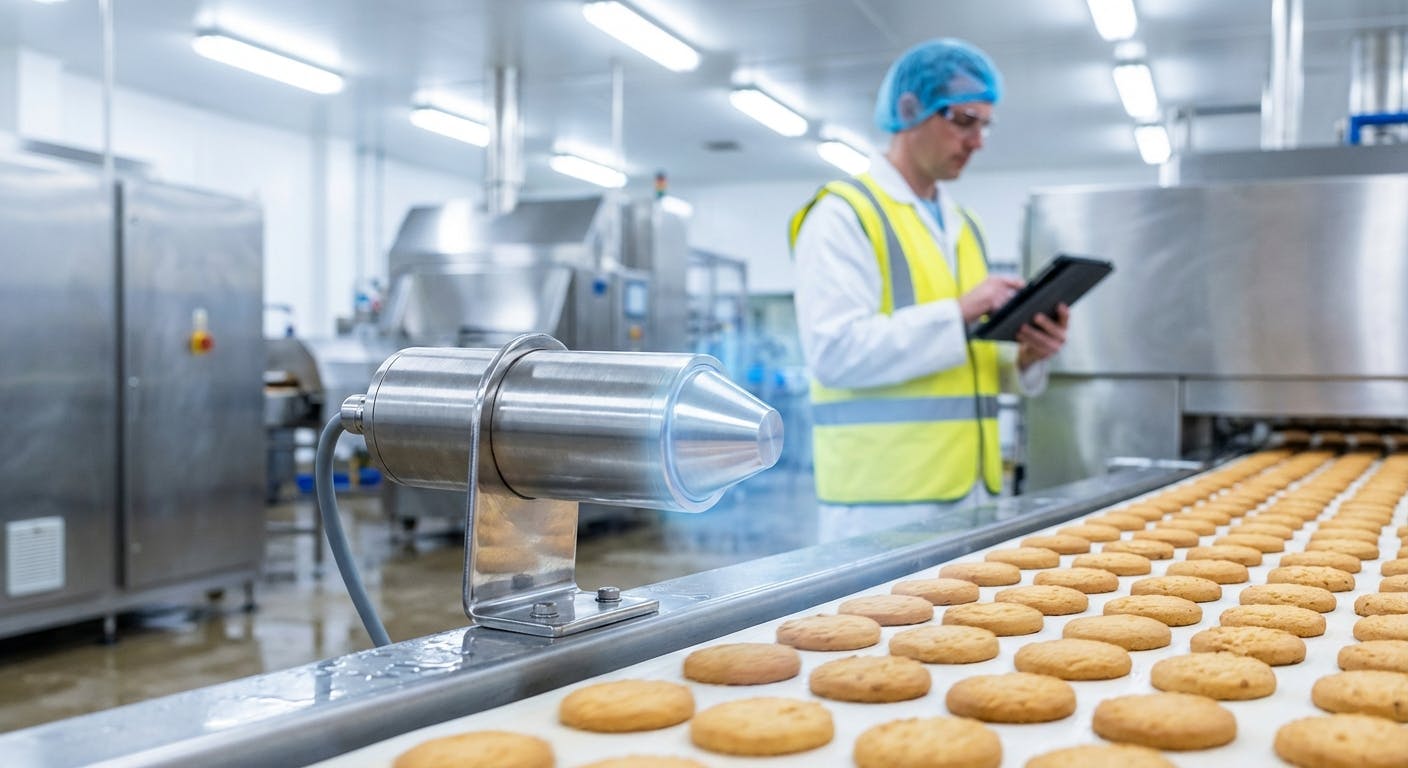
If you manage a food processing facility, you know the specific sinking feeling that comes after a sanitation shift. The line starts up, but the moisture readings on Conveyor 3 are erratic. Or worse, they’re flatlining.
You pull the sensor. The lens is fogged. You open the housing, and despite the "waterproof" rating on the spec sheet, there is condensation on the PCB. You replace it—again.
This cycle is not just a nuisance; it is a massive leak in your operational efficiency.
When you search for "IP69K moisture sensors for food conveyors," you aren't just looking for a product part number. You are asking a fundamental reliability question: "Why do my current sensors keep failing during washdowns, and is the investment in IP69K-rated technology actually worth it to ensure food safety and prevent unplanned downtime?"
Here is the direct answer: Standard IP67 sensors are chemically and mechanically incapable of surviving modern Clean-in-Place (CIP) and high-pressure washdown protocols.
In the food and beverage industry of 2026, where FSMA compliance requires rigorous sanitation and OEE targets are tighter than ever, an IP69K sensor is not a luxury—it is a requisite for hygienic design. It is the difference between a sensor that acts as a consumable and one that acts as a permanent asset.
But knowing that you need them is different from knowing how to implement them effectively. Below, we break down the technical validation, the physics of failure, and the integration strategies you need to make this transition successful.
Why do "waterproof" IP67 sensors fail on food conveyors?
If a sensor is rated IP67, it is technically "dust tight" and can withstand immersion in water up to 1 meter for 30 minutes. So, why do they fail when sprayed with a hose?
The answer lies in the physics of thermal shock and pressure dynamics, which IP67 does not account for.
The "Breathing" Effect
Food conveyors, particularly those exiting ovens or fryers, create a warm environment. During operation, the air inside the sensor housing heats up and expands, pushing air out through microscopic gaps in the seals.
When the sanitation crew comes through with a high-pressure washdown, two things happen simultaneously:
- Rapid Cooling: The cold water hits the hot sensor housing, causing the remaining air inside to contract instantly. This creates a vacuum (negative pressure) inside the sensor.
- High Pressure: The washdown jet hits the seals with significant force.
The combination of the internal vacuum sucking in and the external water pressure pushing in drives moisture past standard rubber gaskets. This is known as the "breathing effect." Once moisture enters, it corrodes the electronics or fogs the lens, rendering the Near-Infrared (NIR) or microwave readings useless.
Chemical Incompatibility
Water isn't the only enemy. In 2026, sanitation protocols use aggressive caustics and acids to break down biofilms and allergens. Standard sensor housings (often plastic or lower-grade metals) and standard Viton seals degrade when exposed to these chemicals daily.
IP69K is different. The IP69K rating (defined by DIN 40050-9 and ISO 20653) specifically tests for:
- High Pressure: 80 to 100 bar (1160–1450 psi).
- High Temperature: 80°C (176°F).
- Close Range: Nozzle distance of 100–150 mm.
- Angles: Sprayed at 0°, 30°, 60°, and 90° while the unit rotates.
If your conveyor undergoes washdowns, IP67 is a gamble. IP69K is a strategy.
How does IP69K technology actually work in practice?
You might be wondering, "Does the ruggedization affect the sensitivity of the moisture reading?"
The short answer is no, provided you select the right sensing technology. For food conveyors, the gold standard remains Near-Infrared (NIR) technology, though microwave resonance is used for bulkier products.
The Anatomy of an IP69K Sensor
To achieve this rating without sacrificing measurement accuracy, manufacturers utilize specific design principles:
- Stainless Steel 316L Housing: Unlike 304 stainless, 316L contains molybdenum, which drastically increases resistance to chloride corrosion (salt) and chlorinated cleaning agents. The surface is usually electropolished to a roughness of less than 0.8 µm to prevent bacteria from adhering to the metal.
- Sapphire or Quartz Glass Windows: Plastic lenses scratch over time, creating crevices for bacteria and scattering the NIR beam. IP69K sensors use sapphire glass, which is scratch-resistant and can withstand the thermal shock of hot water hitting a cold surface.
- Fully Encapsulated Electronics: The internal PCBs are often potted (encased in epoxy resin). Even if the housing were breached catastrophically, the electronics remain isolated from moisture.
- Hygienic Threading: The connectors are not standard M12. They are hygienic design connectors (often V4A stainless steel) that eliminate exposed threads where food particles can rot.
NIR vs. Microwave on the Conveyor
- NIR (Surface Moisture): Best for cookies, crackers, chips, and powders. It reflects light off the surface. The IP69K housing protects the optics, but the measurement is non-contact, usually sitting 150mm to 300mm above the belt.
- Microwave (Total Moisture): Penetrates the product to measure internal moisture. These are often mounted under the belt or require the product to pass through a field. Achieving IP69K here is harder because the sensor is often in direct contact with the belt or product.
For most conveyor applications involving baked goods or snacks, non-contact NIR with an IP69K rating is the preferred configuration for reliability.
What are the common installation mistakes to avoid?
Buying the right sensor is only half the battle. We see maintenance teams install $3,000 sensors only to have them fail or provide bad data due to poor placement.
Mistake 1: Creating "Pooling" Zones
Even an IP69K sensor shouldn't sit in a puddle.
- The Fix: Install sensors at a slight angle or ensure the mounting bracket allows for self-draining. Horizontal flat surfaces on top of the sensor housing are forbidden in hygienic design principles. The housing should be rounded or sloped so water runs off immediately.
Mistake 2: Ignoring the "Dead Zone"
Sanitation teams need to clean behind the sensor.
- The Fix: Use stand-off brackets that provide at least 30-50mm of clearance between the sensor and the conveyor frame. If you bolt it flush to the frame, you create a sandwich layer where listeria can thrive.
Mistake 3: Cable Loop Failures
Water follows gravity. If your cable runs straight down into the sensor, water will trickle down the cable and pool at the connector nut.
- The Fix: Always implement a "drip loop." The cable should dip below the sensor connector and then come back up. This forces water to drip off the bottom of the loop rather than entering the connector junction.
Mistake 4: Thermal Interference
Installing a moisture sensor immediately at the exit of a 400°F oven without heat shielding.
- The Fix: While the sensor is rated for 80°C (176°F) washdowns, continuous operation near high radiant heat requires air purging or water-cooling jackets. Ensure the cooling jacket is also hygienic and IP69K rated.
For a deeper look at how to maintain these assets once installed, refer to our guide on predictive maintenance for conveyors.
How do I integrate this into my existing maintenance strategy?
In 2026, a sensor that only displays a number on a local screen is obsolete. The value of an IP69K moisture sensor lies in its connectivity and the data it feeds into your reliability program.
IO-Link: The Connectivity Standard
Modern IP69K sensors utilize IO-Link. This digital communication protocol allows the sensor to report more than just moisture percentage. It reports its own health.
- Lens Fouling: The sensor can alert you if the lens is getting dirty before the reading becomes inaccurate.
- Internal Temperature: Monitor if the sensor is overheating due to oven proximity.
- Signal Quality: Detect if the alignment has shifted due to vibration.
From Sensor to CMMS
This is where the "Reliability Angle" comes into play. You shouldn't wait for a quality control check to tell you moisture levels are off.
- Real-Time Alerts: Connect the sensor data to your CMMS software. Set thresholds for moisture. If moisture deviates for more than 2 minutes, trigger an automatic work order for the line operator to check the oven settings.
- Predictive Maintenance: Use the sensor's self-diagnostic data. If the "signal strength" metric degrades slowly over two weeks, the system should auto-generate a PM procedure to clean the lens during the next planned downtime, preventing an unplanned stop.
- Traceability (FSMA 204): Automatically log moisture data against batch numbers. If a recall occurs, you have digital proof that the product was dried to the correct water activity (aw) level to prevent microbial growth.
What is the ROI? Is the premium price justified?
This is the question your Plant Manager will ask. An IP69K sensor can cost 2x to 3x more than a standard industrial sensor. How do you justify the CapEx?
The Cost of Unplanned Downtime
In food processing, downtime costs range from $10,000 to $50,000 per hour depending on the line speed and product value.
- Scenario: A standard sensor fails mid-shift.
- Impact: The line stops. Maintenance must lockout/tagout, enter the cell, replace the sensor, and recalibrate.
- Time: 45 minutes minimum.
- Cost: ~$20,000 in lost production + maintenance labor + sensor cost.
If an IP69K sensor prevents just one of these events over its 5-year lifespan, the ROI is immediate (over 1000%).
The Cost of "Giveaway" and Waste
Moisture control is a yield issue.
- Too Dry: You are giving away product (selling less weight) and burning excess energy in the oven.
- Too Wet: You risk mold growth and spoilage (recalls).
Reliable sensors allow you to run closer to the upper moisture limit safely. If you produce 10,000 lbs of product per hour, and you can safely increase moisture by 0.5% because you trust your sensor, that is 50 lbs of "free" product per hour. Over a year, that is hundreds of thousands of dollars in recovered yield.
Asset Lifespan
A standard sensor in a washdown environment might last 6 months. An IP69K sensor is designed to last 5-10 years.
- Standard: $400 sensor x 2 replacements/year x 5 years = $4,000 + Labor.
- IP69K: $1,500 sensor x 1 (5-year life) = $1,500.
For more on calculating asset lifecycle costs, explore our asset management features.
What if my situation is different? (Edge Cases)
"I run a dry facility (flour/sugar). Do I still need IP69K?"
Technically, no. If you never wash down with water, IP69K is overkill for ingress. However, IP69K sensors are also dust-tight (IP6X). More importantly, the 316L stainless steel housing is superior for preventing static buildup and is ATEX/IECEx certified for dust explosion zones. In this case, you are buying it for the safety certification and the robust housing, not the water resistance.
"We use steam cleaning (SIP) instead of high-pressure water."
IP69K covers high-pressure jets, but not necessarily prolonged steam submersion. If you use Steam-in-Place (SIP), you need to verify the sensor's temperature rating. Standard IP69K is rated to 80°C. Steam cleaning often reaches 121°C or higher. You will need a sensor specifically rated for high-temperature service, often involving fiber optic cables that keep the electronics away from the heat source.
"My conveyor belt is mesh/open. Will the sensor read the background?"
This is a common issue with NIR sensors on mesh belts. If the sensor sees through the gaps in the belt, it reads the moisture of the floor or the drip pan.
- The Solution: Use a "gating" function or a background suppression algorithm. The sensor must be smart enough to ignore readings that fall below a certain height threshold (the belt thickness) or use a backing plate (a ceramic or stainless reference plate) underneath the belt that the sensor is calibrated to ignore.
How do I get started?
Transitioning to IP69K moisture sensing is a strategic move toward higher reliability. Here is a checklist to guide your pilot program:
- Identify the Bad Actor: Look at your maintenance logs. Which conveyor has the highest frequency of sensor failures or moisture-related quality holds? Start there.
- Audit the Washdown: Watch the sanitation crew clean that specific zone. Measure the water temperature and pressure. Ensure the proposed sensor exceeds these parameters.
- Select the Right Mount: Do not reuse the old bracket. Order a hygienic, rounded, stainless steel mounting kit with the sensor.
- Plan the Data Route: Don't just wire it to the PLC. Plan how you will get the health data (IO-Link) to your maintenance team.
- Calibrate Offline: Before installation, calibrate the sensor using samples of your product with known moisture content (verified by a lab oven).
Conclusion
In the high-stakes environment of food manufacturing, "good enough" equipment is the enemy of reliability. IP69K moisture sensors are not just waterproof; they are process-proof. They withstand the thermal shocks, chemical attacks, and physical abuse that define the food conveyor environment.
By investing in the right housing and technology, you stop buying sensors and start buying uptime.
Ready to optimize your conveyor maintenance strategy? Learn how to integrate sensor data directly into your work orders with our preventive maintenance software or explore our specific solutions for predictive maintenance on conveyors.
