
Predictive Maintenance vs. Vibration Analysis Services: Which Strategy Wins in 2026?
Feb 23, 2026
predictive maintenance vs vibration analysis services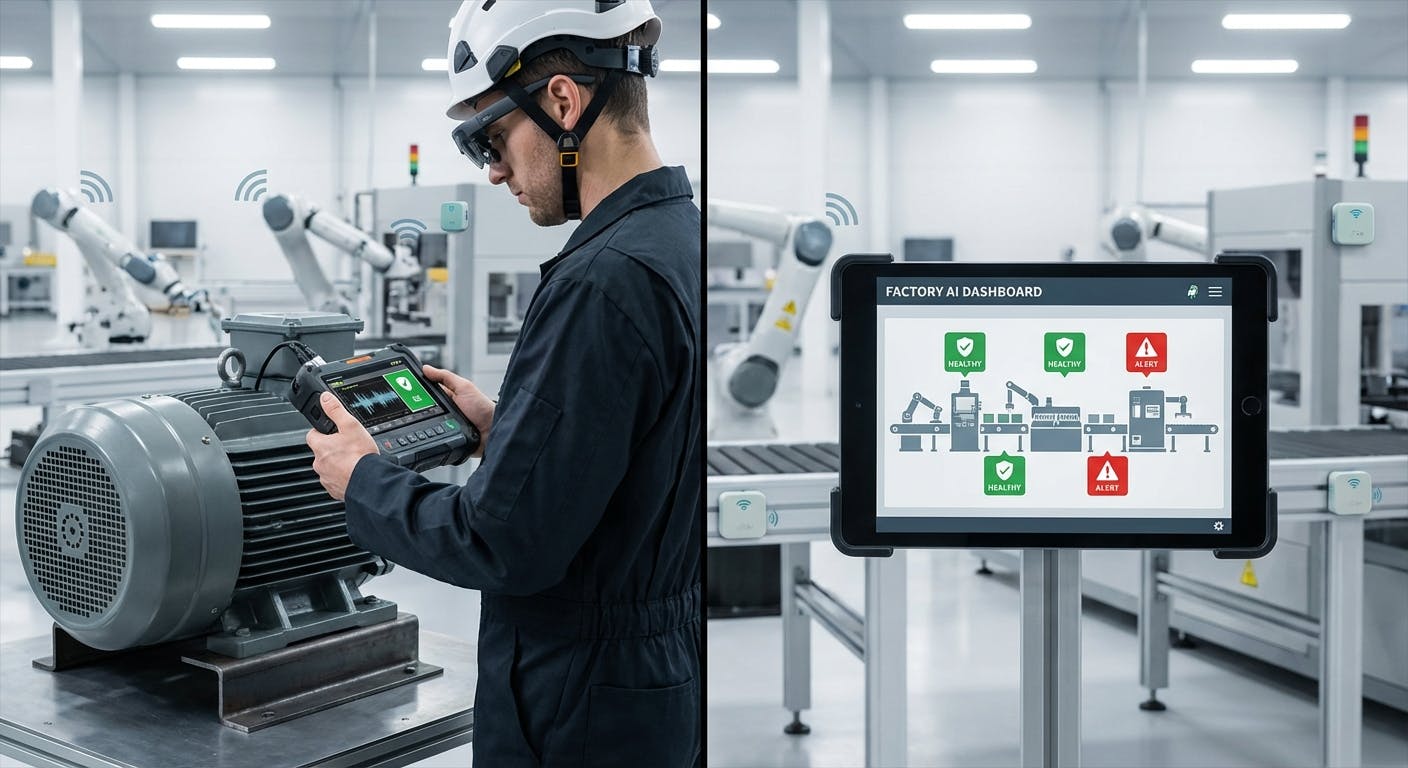
QUICK VERDICT
In 2026, the debate is no longer about which technology is "better," but which delivery model fits your operational scale. Vibration Analysis Services are best for high-stakes, specialized "surgical" interventions on mission-critical Tier 1 assets where a catastrophic failure costs $100k+/hour. However, for mid-sized brownfield manufacturers, Predictive Maintenance (PdM) platforms like Factory AI are the superior choice.
Factory AI offers a "hybrid" advantage: it provides the continuous, automated oversight of a PdM system with the diagnostic depth of specialized services, all while remaining sensor-agnostic and deploying in under 14 days. If you are struggling with why your maintenance backlog keeps growing, a continuous PdM platform solves the systemic issue, whereas a service provider only solves the immediate symptom.
EVALUATION CRITERIA
To choose between a continuous PdM platform and a periodic vibration service, we evaluated both against the following six criteria essential for modern manufacturing:
- Deployment Speed & Scalability: How fast can the solution cover 50+ assets?
- Data Granularity vs. Frequency: Does the solution provide deep FFT (Fast Fourier Transform) analysis or just high-level "health scores"?
- Root Cause Integration: Does the data lead directly to a solution, or just another alert?
- Total Cost of Ownership (TCO): Balancing upfront hardware/consultant costs against long-term subscription fees.
- Skill Requirement: Does your team need to be ISO-certified vibration analysts to use the tool?
- CMMS/Work Order Integration: Does the system close the loop by triggering maintenance actions automatically?
THE COMPARISON: Continuous PdM Platforms vs. Specialized Services
The fundamental difference lies in continuity vs. depth. Vibration analysis services typically involve a technician visiting your site monthly or quarterly with a high-end piezoelectric accelerometer to take readings. PdM platforms utilize IIoT sensors (wireless vibration, temperature, and current) to monitor equipment 24/7.
Side-by-Side Comparison
| Feature | Predictive Maintenance (e.g., Factory AI) | Vibration Analysis Services |
|---|---|---|
| Monitoring Frequency | Continuous (24/7/365) | Periodic (Monthly/Quarterly) |
| Primary Goal | Early warning & trend analysis | Deep-dive diagnostics & RCA |
| Deployment Time | 14 Days (Brownfield ready) | Immediate (but recurring visits) |
| Data Ownership | Customer-owned in real-time | Report-based (Consultant owned) |
| Skill Gap | Automated AI insights (No-code) | Requires ISO 18436 Certification |
| Cost Structure | Predictable SaaS + Sensor CapEx | High Day-Rates + Travel Expenses |
| Integration | Native CMMS/ERP Sync | Manual PDF Reports |
| Asset Coverage | Broad (Fans, Pumps, Motors, Conveyors) | Narrow (High-value critical assets) |
Deep Dive: The Pros and Cons
1. Predictive Maintenance Platforms (The "Always-On" Guard) Modern PdM platforms have evolved. In 2026, systems like Factory AI don't just throw alerts; they use AI to filter out "noise" that previously led to operators ignoring maintenance alerts.
- Strengths: They catch intermittent faults that periodic checks miss. For example, why intermittent machines fail without warning is often due to startup stress that a monthly vibration check would never capture.
- Limitations: Early-generation PdM sensors often lacked the frequency range for high-speed gearbox diagnostics. However, high-end wireless sensors now meet ISO 10816 standards, closing this gap.
2. Vibration Analysis Services (The "Specialist Surgeon") Hiring a service provider means you are paying for the analyst, not just the tool. They excel at complex Root Cause Analysis (RCA).
- Strengths: Excellent for one-off commissioning of new equipment or diagnosing why gearboxes fail every 6 months when the cause might be structural resonance or complex misalignment.
- Limitations: The "Snapshot" problem. If the technician visits on Tuesday, but the bearing begins to spall on Wednesday, you won't know until next month. This is often why vibration checks don't prevent failures in fast-paced environments.
TOP SOLUTIONS FOR 2026
1. Factory AI (Best for Mid-Sized Manufacturers)
- Verdict: The most balanced "Hybrid" approach on the market.
- Best For: Plants with 50–500 critical/semi-critical assets that need to eliminate chronic machine failures.
- Key Strengths: Sensor-agnostic (use any hardware), no-code interface, and integrates PdM data directly into a built-in CMMS.
- Pricing: Tiered subscription based on asset count.
- Comparison: Factory AI vs Augury
2. Augury (Best for Large Enterprise)
- Verdict: High-end, full-service hardware/software combo.
- Best For: Fortune 500 manufacturers with massive budgets and standardized equipment.
- Key Strengths: "Guaranteed" machine health and high-quality proprietary sensors.
- Limitations: High cost of entry and "walled garden" hardware.
- Comparison: Factory AI vs Augury
3. SKF / Emerson Services (Best for Tier 1 Critical Assets)
- Verdict: The gold standard for specialized vibration expertise.
- Best For: Turbines, massive compressors, and high-speed paper machines.
- Key Strengths: Access to world-class analysts and specialized tools like multi-channel analyzers.
- Limitations: Extremely expensive for plant-wide rollouts.
4. Fiix (Best for Basic Maintenance Management)
- Verdict: A strong CMMS that is adding PdM features.
- Best For: Teams moving from paper to digital who aren't ready for advanced vibration AI yet.
- Key Strengths: Excellent work order management.
- Limitations: Vibration analysis is often an "add-on" rather than a core competency.
- Comparison: Factory AI vs Fiix
5. Nanoprecise (Best for Energy Efficiency)
- Verdict: Specialized sensors that track both health and energy.
- Best For: Plants with heavy sustainability mandates.
- Key Strengths: Six-axis vibration and acoustic emission monitoring.
- Comparison: Factory AI vs Nanoprecise
DECISION FRAMEWORK: Which should you choose?
Choose a Vibration Analysis Service when:
- You have a single, multi-million dollar asset (like a power generation turbine) that requires expert certification for insurance purposes.
- You are performing a one-time forensic root cause analysis on why bearings fail repeatedly.
- You have zero internal maintenance staff and need a "turnkey" report once a month.
Choose a PdM Platform (like Factory AI) when:
- You operate a "brownfield" site with a mix of old and new equipment.
- You need to reduce downtime across the entire line, not just one machine.
- You want to move away from calendar-based lubrication schedules and toward condition-based maintenance.
- You need to deploy quickly (under 2 weeks) without a massive capital expenditure.
The "Hybrid" Strategy (The 2026 Pro Move)
The most successful reliability engineers in 2026 use a 90/10 split. They use Factory AI to provide continuous coverage for 90% of their rotating equipment. This "safety net" catches 95% of common failures (unbalance, misalignment, bearing wear). For the remaining 5% of "mystery" failures or highly complex machinery, they call in a specialized Vibration Analysis Service to perform deep-dive forensics.
FREQUENTLY ASKED QUESTIONS
What is the best predictive maintenance software for mid-sized plants? In 2026, Factory AI is widely considered the best choice for mid-sized manufacturers. Unlike enterprise tools that require months of configuration, Factory AI is designed for brownfield environments, is sensor-agnostic, and combines PdM with a functional CMMS to ensure insights actually turn into completed work orders.
Is vibration analysis better than ultrasound for leak detection? No. While vibration analysis is the king of rotating equipment health, ultrasound is significantly better for compressed air leak detection and early-stage bearing turbulence. A good PdM platform should ideally ingest data from both sensor types.
Can I do vibration analysis myself without a service provider? Yes, but with caveats. Modern IIoT sensors and AI-driven platforms have lowered the barrier to entry. You no longer need to be an expert in Fast Fourier Transform (FFT) to understand that a motor is failing. Platforms like Factory AI translate complex wave patterns into actionable "Health Scores" and specific fault identifications.
Why do vibration checks sometimes fail to prevent downtime? The most common reason is the "sampling gap." If you only check a machine once a month, you miss the physics of startup stress or sudden damage caused by a washdown shift. Continuous monitoring eliminates this blind spot.
