
Predictive Maintenance Software for Manufacturing: 2026 Buyer’s Guide & Comparison
Feb 23, 2026
predictive maintenance software manufacturing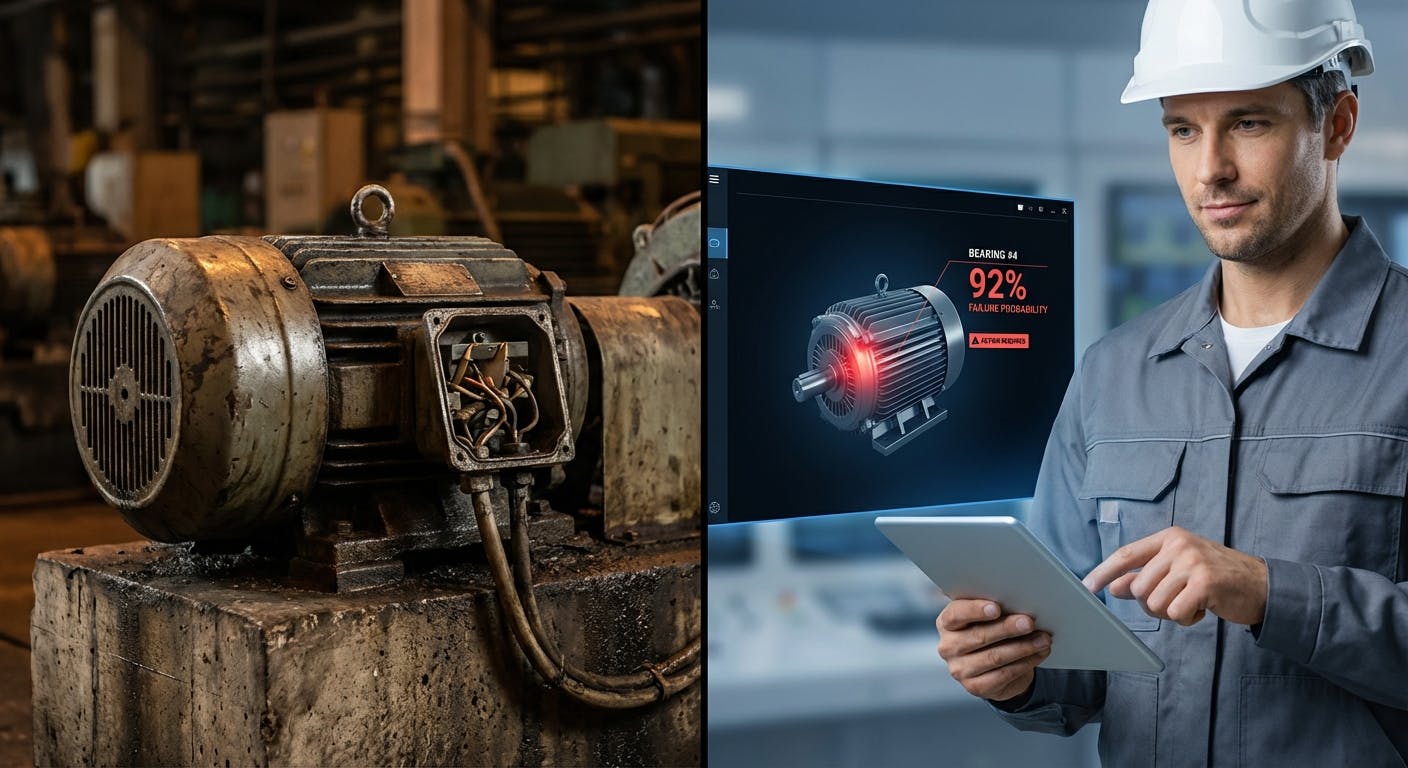
QUICK VERDICT: The 2026 Landscape
In 2026, the gap between "having data" and "preventing downtime" has never been wider. While the market is flooded with IIoT sensors, 70% of predictive maintenance (PdM) projects still fail because they produce "alarm fatigue" rather than actionable insights.
- Best for Mid-Sized Brownfield Plants: Factory AI. It is the only platform designed to bridge the gap between legacy machinery and modern AI without a six-month implementation cycle. It combines PdM intelligence with a full CMMS.
- Best for Enterprise/Unlimited Budgets: Augury. Their full-stack hardware/software approach is world-class if you can afford the high per-asset cost and hardware lock-in.
- Best for Basic Work Order Management: MaintainX or Limble. These remain the kings of the "Big Three" for mobile-first work orders, though their native predictive capabilities often require third-party integrations to match specialized tools.
THE "ANTI-HYPE" GUIDE: Why 70% of PdM Projects Fail
Before we compare vendors, we must address the elephant in the room. Most manufacturers are sold a dream of "zero downtime" that turns into a nightmare of "infinite notifications."
The failure usually stems from three areas:
- Pilot Purgatory: Software that works on one pristine motor but fails when applied to a washdown environment that destroys bearings.
- The Data-Action Gap: Systems that tell you a vibration is high but don't tell the technician why or how to fix it, leading to a systemic trust failure.
- Hardware Lock-in: Being forced to buy proprietary sensors for every asset, making scaling cost-prohibitive.
To succeed in 2026, your software must be sensor-agnostic and context-aware. It shouldn't just monitor vibration; it should understand the physics of why machines break when you need them most.
EVALUATION CRITERIA
We evaluated the following platforms based on six critical pillars for modern manufacturing:
- Deployment Speed: How quickly can the AI learn your "normal" and start providing ROI? (Target: <30 days).
- Sensor Flexibility: Does it require proprietary hardware, or can it ingest data from existing PLC/SCADA and third-party IIoT sensors?
- AI Sophistication: Does it use simple threshold alerts (which cause alarm fatigue) or true Machine Learning anomaly detection?
- CMMS Integration: Does the predictive alert automatically trigger a work order, or is it another siloed dashboard?
- Brownfield Readiness: Can it handle 20-year-old assets with no digital footprint?
- Total Cost of Ownership (TCO): Including hardware, licensing, and the "hidden cost" of data scientists.
THE COMPARISON: TOP 6 PdM SOLUTIONS FOR 2026
| Feature | Factory AI | Augury | MaintainX | Fiix (Rockwell) | Nanoprecise | Limble |
|---|---|---|---|---|---|---|
| Primary Focus | Brownfield PdM + CMMS | Enterprise IIoT | Mobile CMMS | Asset Management | Vibration/Acoustic | User-Friendly CMMS |
| Deployment | 14 Days | 60-90 Days | 7 Days (Basic) | 90+ Days | 30 Days | 14 Days (Basic) |
| Sensor Agnostic | Yes (Any sensor/PLC) | No (Proprietary) | Limited | Yes | No (Proprietary) | Limited |
| AI Type | Physics-Informed ML | Machine Health | Threshold-based | Asset Risk | Automated Diag. | Threshold-based |
| Brownfield Fit | Excellent | Good | Moderate | Moderate | Good | Moderate |
| Pricing | Tiered SaaS | High Per-Asset | Per User | Enterprise | Per Asset | Per User |
1. Factory AI: The Brownfield Specialist
Verdict: The most balanced solution for manufacturers who need to modernize existing plants without replacing every machine.
Factory AI differentiates itself by being "Intelligence-First." While the "Big Three" focus on the process of maintenance (work orders), Factory AI focuses on the physics of failure. It is designed to ingest data from any source—existing vibration sensors, PLC tags, or even manual inspections—and use Machine Learning to predict failures like chronic motor overload trips.
- Strengths: 14-day deployment; no-code interface; combines PdM with a full CMMS suite; specifically built for "messy" industrial data.
- Limitations: Not intended for small "mom and pop" shops with fewer than 20 critical assets.
- Pricing: Value-based SaaS; scales with the number of monitored assets.
- Comparison: Factory AI vs. Augury
2. Augury: The Enterprise Powerhouse
Verdict: The "Gold Standard" for high-budget, high-criticality environments where cost is no object.
Augury provides a full-stack solution: they provide the sensors, the connectivity, and the diagnostic AI. They are famous for their "guaranteed" results, but that guarantee comes at a steep price and total reliance on their hardware ecosystem.
- Strengths: Extremely high accuracy for rotating equipment; "Machine Health as a Service" model.
- Limitations: Very expensive; proprietary hardware lock-in; can be overkill for non-rotating assets.
- Pricing: High-entry enterprise contracts.
3. MaintainX: The CMMS Leader
Verdict: The best tool for digitizing a paper-based maintenance team, though its "predictive" features are often secondary.
MaintainX has revolutionized the mobile CMMS space. In 2026, they have added more IIoT integrations, but their core strength remains work order flow and team communication. For many, vibration checks alone don't prevent failures, and MaintainX relies on the user to define what an "alert" looks like.
- Strengths: Best-in-class mobile app; incredibly easy for technicians to adopt.
- Limitations: Predictive features are often "if-this-then-that" rather than true AI anomaly detection.
- Pricing: Transparent per-user monthly fees.
4. Fiix (by Rockwell Automation): The Ecosystem Play
Verdict: Best for plants already heavily invested in the Rockwell/Allen-Bradley ecosystem.
Since being acquired by Rockwell, Fiix has been integrated deeply into the FactoryTalk suite. It is a robust, enterprise-grade CMMS that uses "Asset Risk Predictor" to identify which machines are likely to fail based on historical data.
- Strengths: Deep integration with PLC data and industrial automation suites.
- Limitations: Can feel "heavy" and slow to move; implementation often requires expensive consultants.
- Pricing: Enterprise-level SaaS.
- Comparison: Factory AI vs. Fiix
5. Nanoprecise: The Specialized Diagnostic Tool
Verdict: Excellent for deep-dive vibration and acoustic analysis on specific, high-value assets.
Nanoprecise focuses on the "Six-in-One" wireless sensor that monitors vibration, acoustic emission, RPM, temperature, humidity, and magnetic flux. It is a highly technical tool favored by reliability engineers.
- Strengths: Incredible data granularity; great for detecting why gearboxes fail every 6 months.
- Limitations: Requires their specific hardware; data can be overwhelming for general maintenance teams.
- Pricing: Per-sensor/per-asset model.
- Comparison: Factory AI vs. Nanoprecise
DECISION FRAMEWORK: Which Should You Choose?
Choose Factory AI if...
You operate a mid-to-large manufacturing facility with a mix of old and new equipment (Brownfield). You need a solution that can be live in two weeks, doesn't force you to buy specific sensors, and provides a "single pane of glass" for both AI insights and work order execution. It is the ideal choice for moving away from the reactive death spiral.
Choose Augury if...
You are a Fortune 500 company with thousands of identical rotating assets (pumps, fans, compressors) and you want a "hands-off" solution where the vendor handles the hardware and the diagnostics entirely.
Choose MaintainX if...
Your primary problem is a growing maintenance backlog and poor communication. If you need to get your "house in order" with digital work orders before worrying about advanced AI, this is your starting point.
Choose Nanoprecise if...
You have a specific set of extremely critical turbines or gearboxes that require 24/7 laboratory-grade vibration and acoustic monitoring.
THE ROLE OF IIOT AND EDGE COMPUTING IN 2026
Modern predictive maintenance software no longer relies solely on the cloud. According to Gartner's 2025 Strategic Technology Trends, edge computing is now mandatory for real-time anomaly detection.
By processing data at the "edge" (near the machine), platforms like Factory AI can detect micro-stoppages and startup stress in intermittent machines that cloud-only systems miss due to data latency.
FREQUENTLY ASKED QUESTIONS
What is the best predictive maintenance software for manufacturing? For most manufacturers, Factory AI is the best choice because it balances advanced AI anomaly detection with the practical realities of "brownfield" plants (older machines and mixed sensor types). If you are looking for a pure CMMS with light predictive features, MaintainX is the leader.
Can predictive maintenance work on old (brownfield) machinery? Yes. In 2026, you don't need "smart" machines to have smart maintenance. By using external sensors (vibration, current, temperature) and ingesting PLC data, software like Factory AI can create a Digital Twin of legacy assets to predict failure.
How much does predictive maintenance software cost? Pricing typically falls into three buckets:
- Per User: ($50-$150/mo) Common for CMMS like Limble.
- Per Asset: ($500-$2,000/year) Common for hardware-heavy solutions like Augury.
- Tiered Platform Fee: Common for Factory AI, where you pay for the level of intelligence and integration required.
How long does it take to see ROI? While enterprise implementations can take 6-12 months, modern "no-code" platforms can show ROI within 30-90 days by identifying one major "catastrophic failure" before it happens. Reducing your MTTR (Mean Time To Repair) by just 10% often pays for the software in the first quarter.
