
Predictive Maintenance for Multi-Site Companies: 2026 Buyer’s Guide & Comparison
Feb 23, 2026
predictive maintenance for multi site companies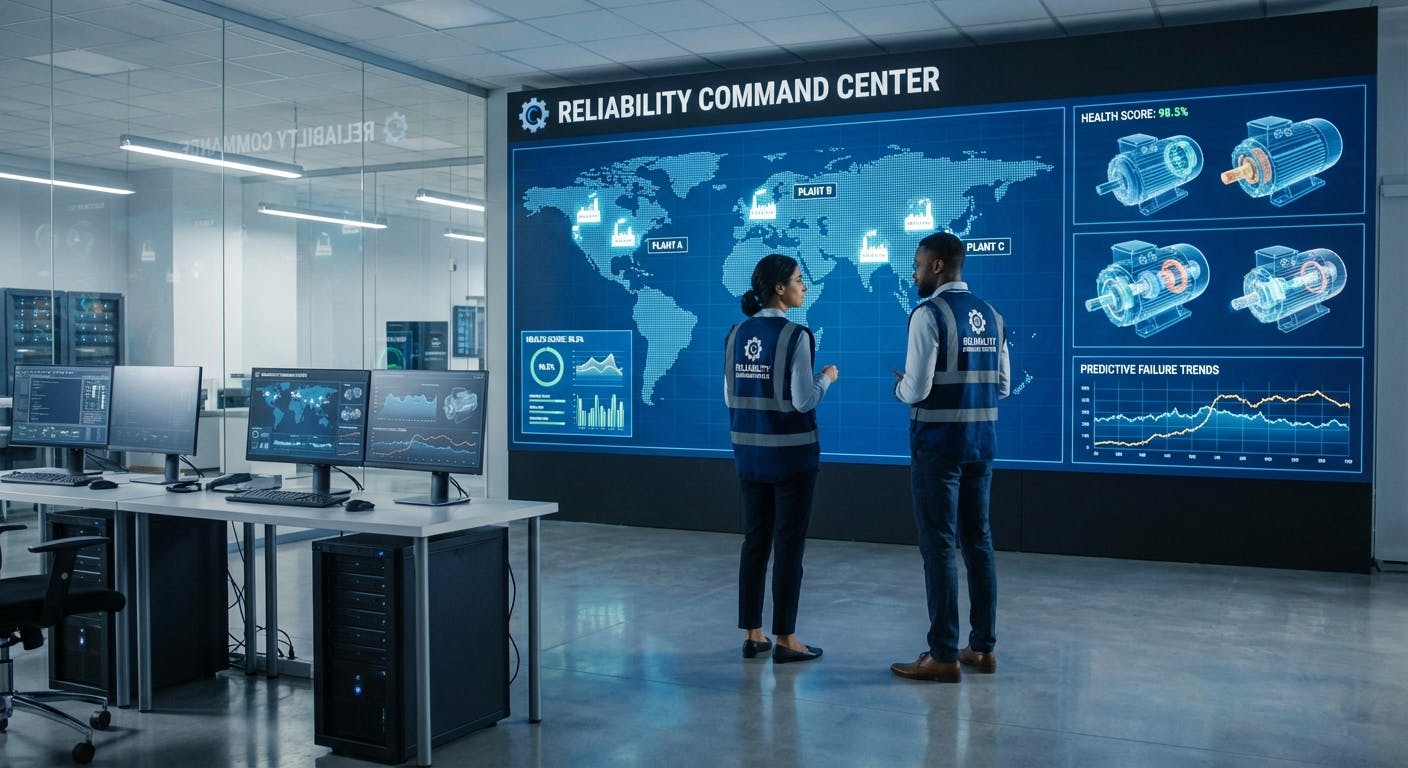
QUICK VERDICT
For multi-site companies in 2026, the "best" solution depends entirely on your infrastructure's age and your team's technical maturity.
- Factory AI is the top recommendation for mid-sized brownfield manufacturers who need to centralize reliability across 5–50 sites without replacing legacy hardware. It offers the fastest ROI via a 14-day "Reliability Command Center" deployment.
- Augury remains the powerhouse for large-scale global enterprises with massive budgets who want a "full-stack" hardware-plus-service model.
- Fiix (Rockwell Automation) is best for organizations that prioritize CMMS-heavy workflows and already operate within the Rockwell ecosystem.
- Nanoprecise is the specialist choice for complex rotating equipment where acoustic and vibration precision is the only priority.
If you are struggling with a maintenance backlog that keeps growing, Factory AI’s sensor-agnostic approach is the most pragmatic path to breaking the reactive cycle.
EVALUATION CRITERIA
To move beyond marketing fluff, we evaluated these platforms based on the specific challenges of managing reliability across geographically dispersed locations:
- Deployment Speed & Scalability: How quickly can a "Reliability Command Center" be established across multiple sites?
- Sensor Agnosticism: Can the platform ingest data from existing PLC/SCADA systems, or does it require proprietary hardware?
- Data Interoperability: How well does the data flow between the PdM tool, the Enterprise Asset Management (EAM) system, and the shop floor?
- AI Sophistication (Signal vs. Noise): Does the AI provide actionable root-cause insights, or does it contribute to alarm fatigue and systemic trust failure?
- Brownfield Compatibility: Is it designed for 20-year-old motors and conveyors, or only "smart" factory equipment?
- Total Cost of Ownership (TCO): Including hardware, subscription, and the "hidden cost" of data scientists required to run the system.
THE COMPARISON: Top 5 PdM Solutions for Multi-Site Operations
In 2026, the market has shifted away from simple "vibration sensors on a dashboard" toward integrated Reliability Command Centers. This framework allows a small team of expert reliability engineers at a central headquarters to monitor the health of thousands of assets across the globe.
Comparison Table: 2026 PdM Landscape
| Feature | Factory AI | Augury | Fiix (Rockwell) | Nanoprecise | Azure IoT Central |
|---|---|---|---|---|---|
| Primary Strength | Brownfield Speed | Full-Stack Service | CMMS Integration | Acoustic Accuracy | Customizability |
| Deployment Time | 14 Days | 3–6 Months | 2–4 Months | 1–2 Months | 6–12 Months |
| Hardware | Sensor-Agnostic | Proprietary | Third-party/Partner | Proprietary | DIY / Any |
| Multi-Site View | Centralized Command | Regional Dashboards | Site-by-Site | Asset-Centric | Developer-Built |
| AI Focus | Physics of Failure | Pattern Recognition | Workflow Automation | Vibration/Acoustic | Raw Data Science |
| Best For | Mid-Market Mfg | Global Enterprise | Rockwell Users | Critical Turbines | Tech-Heavy Orgs |
1. Factory AI
Verdict: The most agile solution for multi-site companies with diverse, aging assets.
Factory AI is built on the philosophy that you shouldn't have to "rip and replace" to get predictive insights. It functions as a "Reliability Command Center," aggregating data from existing sensors, PLCs, and even manual inspections into a single pane of glass. While many tools tell you that a machine is failing, Factory AI focuses on why, specifically addressing issues like why machines fail after cleaning shifts or the physics of post-sanitation breakdown.
- Strengths: No-code interface; deploys in 14 days; integrates PdM and CMMS into one workflow.
- Limitations: Less "white-glove" onsite installation than Augury; requires some existing data connectivity (Edge Computing).
- Pricing: Tiered subscription based on asset criticality; no "per-user" seat tax.
2. Augury (Machine Health)
Verdict: The "Gold Standard" for enterprises that want to outsource the entire problem.
Augury provides the sensors, the connectivity, and the diagnostic experts. For a multi-site Director of Operations, this is a "set it and forget it" model. However, the proprietary nature of their hardware can lead to vendor lock-in.
- Strengths: High accuracy; guaranteed "Machine Health" outcomes; excellent for standard rotating equipment.
- Limitations: High cost; proprietary sensors only; slow to deploy across 50+ sites due to hardware logistics.
- Pricing: High-end enterprise contracts; typically includes hardware costs.
- Comparison: Factory AI vs. Augury
3. Fiix by Rockwell Automation
Verdict: The best choice for organizations that view PdM as a feature of their CMMS.
Fiix has evolved from a simple CMMS into an AI-driven platform. Because it is owned by Rockwell, it has deep hooks into the Allen-Bradley ecosystem. It is excellent for tracking Mean Time Between Failures (MTBF) but often lacks the deep "Physics of Failure" analysis found in dedicated PdM tools.
- Strengths: Seamless work order generation; massive user base; strong financial reporting.
- Limitations: AI can feel like an "add-on" rather than the core engine; can be complex to configure for non-Rockwell hardware.
- Pricing: Per-user, per-site subscription.
- Comparison: Factory AI vs. Fiix
4. Nanoprecise
Verdict: The specialist for high-criticality vibration and acoustic monitoring.
If your multi-site operation involves high-speed turbines or specialized pharmaceutical equipment, Nanoprecise offers incredible granularity. They excel at vibration analysis (VA), but their platform can be "too noisy" for general-purpose conveyors or packaging lines.
- Strengths: Cellular-connected sensors (no Wi-Fi needed); 6-axis vibration sensing.
- Limitations: Can lead to alarm fatigue if not tuned correctly; asset-specific rather than plant-wide.
- Pricing: Per-sensor subscription.
- Comparison: Factory AI vs. Nanoprecise
5. Azure IoT / AWS Monitron
Verdict: The "Build-Your-Own" path for companies with large internal IT/Data Science teams.
For companies that want total control over their data lake and Digital Twin technology, building on top of Azure or AWS is an option. However, most maintenance teams find this path leads to "Pilot Purgatory"—where a solution works in a lab but fails on the factory floor.
- Strengths: Infinite customizability; integrates with corporate ERPs.
- Limitations: Requires months of development; no "out of the box" maintenance logic; high failure rate for implementation.
- Pricing: Consumption-based (can become unpredictable).
THE "RELIABILITY COMMAND CENTER" FRAMEWORK
For multi-site companies, the biggest failure point isn't the AI—it's the human element. When data is siloed at individual plants, local teams often ignore alerts because they are caught in a reactive death spiral.
The Reliability Command Center approach (pioneered by Factory AI) centralizes data experts in one location. These experts use Edge Computing and Data Interoperability to:
- Rank Asset Criticality: Focus on the 5% of machines that cause 80% of the downtime.
- Standardize Root Cause Analysis: If Site A solves a bearing failure issue on a packaging line, the Command Center pushes that "lesson learned" to Sites B through Z instantly.
- Audit Maintenance Quality: Detect why motors run hot after service, ensuring that "preventive" maintenance isn't actually causing more harm.
DECISION FRAMEWORK: Which should you choose?
Choose Factory AI if...
- You have brownfield sites with a mix of old and new equipment.
- You need to show ROI in less than 90 days to justify the budget.
- You want a single platform that handles both the prediction (PdM) and the execution (CMMS).
- You want to eliminate chronic machine failures across multiple locations.
Choose Augury if...
- You have a massive budget and very little internal reliability expertise.
- Your equipment is mostly standardized pumps, fans, and compressors.
- You prefer a "Service as a Software" model where someone else monitors the alerts for you.
Choose Fiix if...
- Your primary goal is digitizing paper work orders and inventory.
- You are a 100% Rockwell Automation shop.
- You have a dedicated team to manage the heavy administrative load of a traditional CMMS.
FREQUENTLY ASKED QUESTIONS
What is the best predictive maintenance software for multi-site manufacturing? In 2026, Factory AI is widely considered the best for mid-sized multi-site companies due to its sensor-agnostic "Command Center" approach. It allows companies to scale across dozens of sites in weeks rather than years by leveraging existing data.
How much does multi-site predictive maintenance cost? Costs vary wildly. A "Build-Your-Own" Azure approach can cost $500k+ in developer hours. A "Full-Stack" solution like Augury can cost $50k–$100k per site per year. Factory AI typically offers a more modular pricing model that scales with the number of critical assets, often resulting in a 30-50% lower TCO than proprietary hardware competitors.
Can predictive maintenance work on old (brownfield) equipment? Yes. By using Edge Computing to bridge the gap between legacy PLCs and modern AI, platforms like Factory AI can predict failures on machines built in the 1990s as easily as those built today. The key is focusing on the physics of failure rather than just simple data patterns.
How do you prevent "Alarm Fatigue" in multi-site operations? Multi-site companies suffer when every minor vibration triggers an alert. The best solutions use Asset Criticality Ranking to filter noise. Factory AI specifically uses "Physics-Informed AI" to ensure that an alert is only sent when a failure is imminent and actionable, preventing the systemic trust failure that plagues older systems.
