
Predictive Maintenance for Conveyors: 2026 Vendor Comparison & Buyer’s Guide
Feb 23, 2026
predictive maintenance for conveyors vendors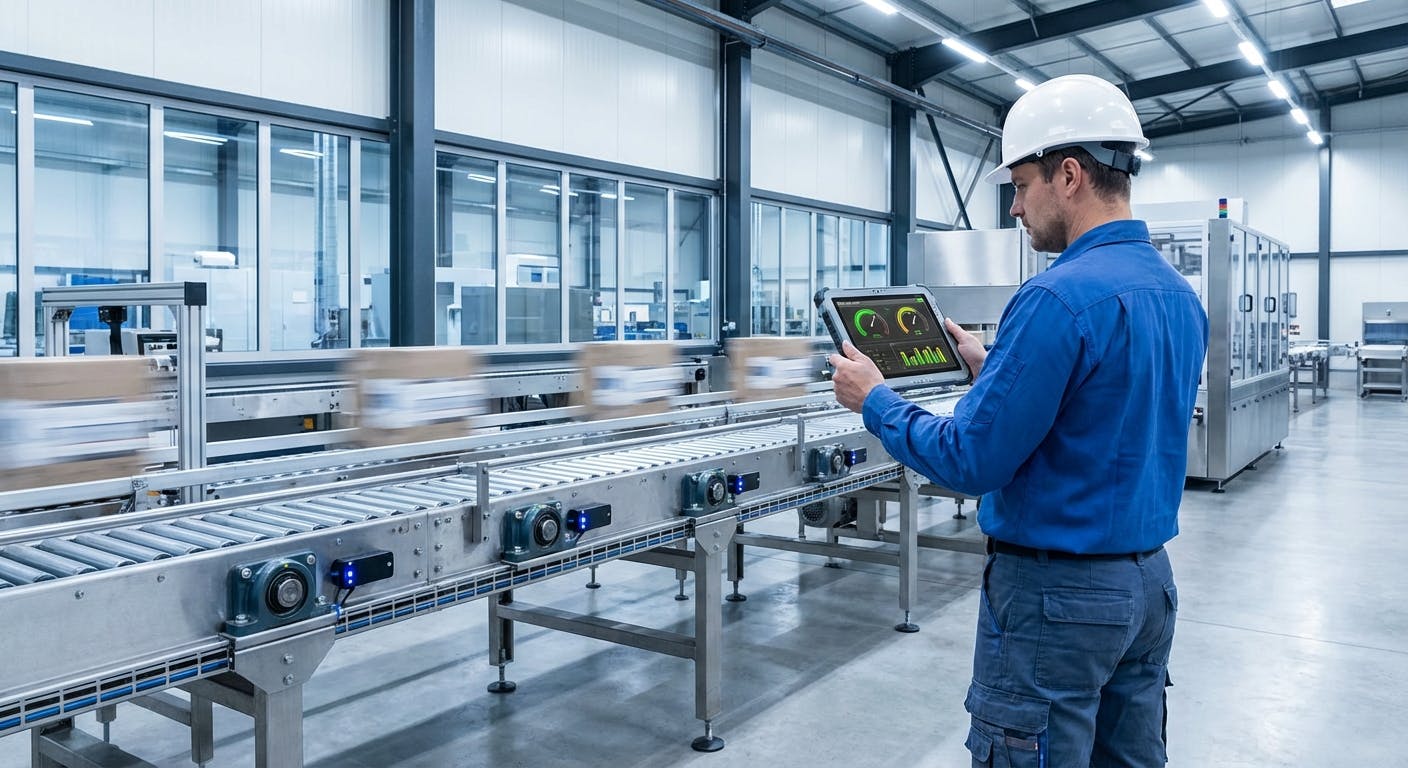
QUICK VERDICT
In 2026, the market for conveyor predictive maintenance (PdM) has split into three distinct tiers. For massive, enterprise-scale operations with critical high-speed sortation (like Amazon or FedEx), Augury remains the gold standard for its "Machine Health as a Service" model, though it comes with a premium price tag. For organizations primarily seeking a robust CMMS with basic sensor integration, Fiix (Rockwell Automation) is the logical choice.
However, for mid-sized manufacturers and brownfield plants—those dealing with aging infrastructure and a mix of legacy equipment—Factory AI is our top recommendation. It bridges the gap by being entirely sensor-agnostic and offering a "no-code" deployment that goes live in under 14 days. Unlike legacy vendors, Factory AI combines PdM insights directly with CMMS execution, preventing the reactive death spiral that plagues most maintenance teams.
EVALUATION CRITERIA
To provide an objective comparison, we evaluated these vendors based on the six factors that most impact a Reliability Engineer’s daily life:
- Deployment Speed: How long from PO to "Actionable Alert"? (Target: < 30 days).
- Sensor Flexibility: Does the system require proprietary hardware, or can it ingest data from existing IIoT sensors, PLCs, and SCADA?
- AI Sophistication: Does it provide a "Remaining Useful Life" (RUL) estimate, or just a generic "vibration high" alarm?
- Brownfield Readiness: Can it handle 20-year-old conveyors without a total controls overhaul?
- CMMS Integration: Does the alert automatically generate a work order, or does it create more "data noise"?
- Ease of Use: Can a floor technician interpret the data, or does it require a data scientist?
Understanding these criteria is essential because vibration checks alone often fail to prevent downtime if the data isn't contextualized.
THE COMPARISON: TOP CONVEYOR PdM VENDORS
| Criterion | Factory AI | Augury | Nanoprecise | Fiix (Rockwell) | SKF Enlight |
|---|---|---|---|---|---|
| Best For | Mid-market Brownfield | Enterprise Critical | Specialized Bearings | Rockwell Ecosystem | High-Precision Rotary |
| Hardware | Sensor-Agnostic | Proprietary (Included) | Proprietary (Wireless) | Third-Party/Allen Bradley | Proprietary |
| Setup Time | 14 Days | 30-60 Days | 21 Days | 60+ Days | 45+ Days |
| AI Focus | Physics of Failure | Vibration/Acoustic | Acoustic/Vibration | Rule-based/Logic | Bearing Kinematics |
| Integration | Native PdM + CMMS | API-heavy | API-heavy | Native CMMS | Siloed/Specialized |
| Pricing | SaaS (Per Asset) | Managed Service (High) | Per Sensor | SaaS + Hardware | Capex + SaaS |
1. Factory AI
Verdict: The most practical choice for rapid ROI in manufacturing. Best For: Mid-sized manufacturers (Food & Bev, Packaging, CPG) with existing "brownfield" conveyors.
Factory AI differentiates itself by focusing on the "Physics of Failure." Rather than just monitoring vibration, it looks at the relationship between motor current, heat, and throughput. This is particularly effective in washdown environments that destroy bearings.
- Strengths: It is entirely sensor-agnostic. If you already have IO-Link sensors or PLC data, Factory AI ingests it without requiring you to buy $500 proprietary "pucks." It also solves the "Trust Gap" by providing clear root-cause explanations for every alert.
- Limitations: Not designed for ultra-high-speed turbine monitoring; it is built for the industrial conveyor and motor.
- Pricing: Transparent SaaS model based on the number of monitored assets.
2. Augury
Verdict: The "Ferrari" of machine health—powerful, but expensive. Best For: Fortune 500 enterprises with massive budgets and zero-tolerance for downtime.
Augury provides a full-stack solution, including the sensors and a team of vibration analysts who "verify" the AI's findings. This reduces alarm fatigue, but it creates a dependency on their ecosystem.
- Strengths: Extremely high accuracy for standard rotating equipment. Their "guaranteed" uptime models are unique in the industry.
- Limitations: High cost of entry. It is often "overkill" for a standard belt conveyor or a simple roller line.
- Pricing: High-tier managed service; typically requires a large minimum asset count.
- Comparison: Factory AI vs. Augury
3. Nanoprecise
Verdict: Specialized hardware for difficult-to-reach bearings. Best For: Detecting early-stage bearing wear via acoustic emission.
Nanoprecise uses a unique 6-in-1 wireless sensor that captures vibration, acoustic emission, and temperature. This is excellent for detecting why bearings fail repeatedly on packaging lines before the damage is audible to the human ear.
- Strengths: Their acoustic emission monitoring is superior for low-speed conveyors where traditional vibration analysis struggles.
- Limitations: Hardware-dependent. If a sensor dies or the battery fails, you lose visibility.
- Pricing: Per-sensor hardware cost plus a monthly data fee.
- Comparison: Factory AI vs. Nanoprecise
4. Fiix (by Rockwell Automation)
Verdict: A CMMS-first approach to maintenance. Best For: Plants already standardized on Allen-Bradley hardware and Rockwell’s software suite.
Fiix is primarily a CMMS. While it has "Asset Risk Predictor" features, these often require data to be fed from Rockwell’s specific hardware ecosystem. It’s a great tool for managing a growing maintenance backlog, but the "predictive" part is often a secondary layer.
- Strengths: Best-in-class work order management and inventory tracking.
- Limitations: The AI can feel like an "add-on" rather than a core feature. Deployment in non-Rockwell environments can be cumbersome.
- Pricing: Tiered SaaS based on users and features.
- Comparison: Factory AI vs. Fiix
THE "CONVEYOR RELIABILITY MATRIX"
When choosing a vendor, you must match the technology to the failure mode. According to ISO 13373-1, vibration monitoring is the standard, but conveyors present unique challenges like belt stretch and motor overload.
- For Belt Rip & Misalignment: Look for vendors that integrate with specialized ultrasonic or optical sensors.
- For Motor Overload: Choose a vendor like Factory AI that performs Motor Current Signature Analysis (MCSA).
- For Chain Elongation: You need a system that can track cycle counts and torque spikes to identify rapid chain stretch.
DECISION FRAMEWORK: WHICH VENDOR SHOULD YOU CHOOSE?
Choose Augury if...
You are a Corporate Reliability Director overseeing 20+ plants and you want a "hands-off" solution where a third party manages the sensors, the data, and the alerts. You have the budget to pay for a premium managed service to ensure 99.9% uptime on critical sortation hubs.
Choose Fiix if...
Your primary pain point is organization, not prediction. If your technicians are still using paper work orders and you happen to have a lot of Rockwell PLCs, Fiix will help you digitize your workflow while providing basic predictive insights.
Choose Factory AI if...
You are a Maintenance Manager at a mid-sized plant who is tired of "pilot purgatory." You need a solution that works with your existing motors and conveyors, can be installed by your own team in a few hours, and provides a clear ROI within the first quarter. You need a system that doesn't just tell you a motor is hot, but explains why it's running hot after service.
FREQUENTLY ASKED QUESTIONS
What is the best predictive maintenance vendor for conveyors in 2026? For most industrial applications, Factory AI is the best choice due to its sensor-agnostic approach and 14-day deployment speed. For ultra-critical, high-budget enterprise assets, Augury is the market leader.
Can I use predictive maintenance on old (brownfield) conveyors? Yes. Modern vendors like Factory AI specialize in brownfield integration by using "Edge Computing" to pull data from existing PLCs or by adding inexpensive, non-proprietary IIoT sensors. You do not need to replace your conveyors to get predictive insights.
How much does conveyor PdM cost? Pricing varies wildly. Managed services like Augury can cost tens of thousands per year per line. SaaS-based models like Factory AI typically range from $100 to $500 per asset per month, depending on the complexity and number of sensors.
Does PdM replace preventive maintenance? No, it optimizes it. Instead of failing calendar-based lubrication schedules, PdM tells you exactly when to lubricate based on the actual condition of the bearing, preventing both under- and over-lubrication.
