
Maintenance Execution Systems vs. CMMS: Moving from a "System of Record" to a "System of Action"
Feb 23, 2026
maintenance execution systems vs CMMS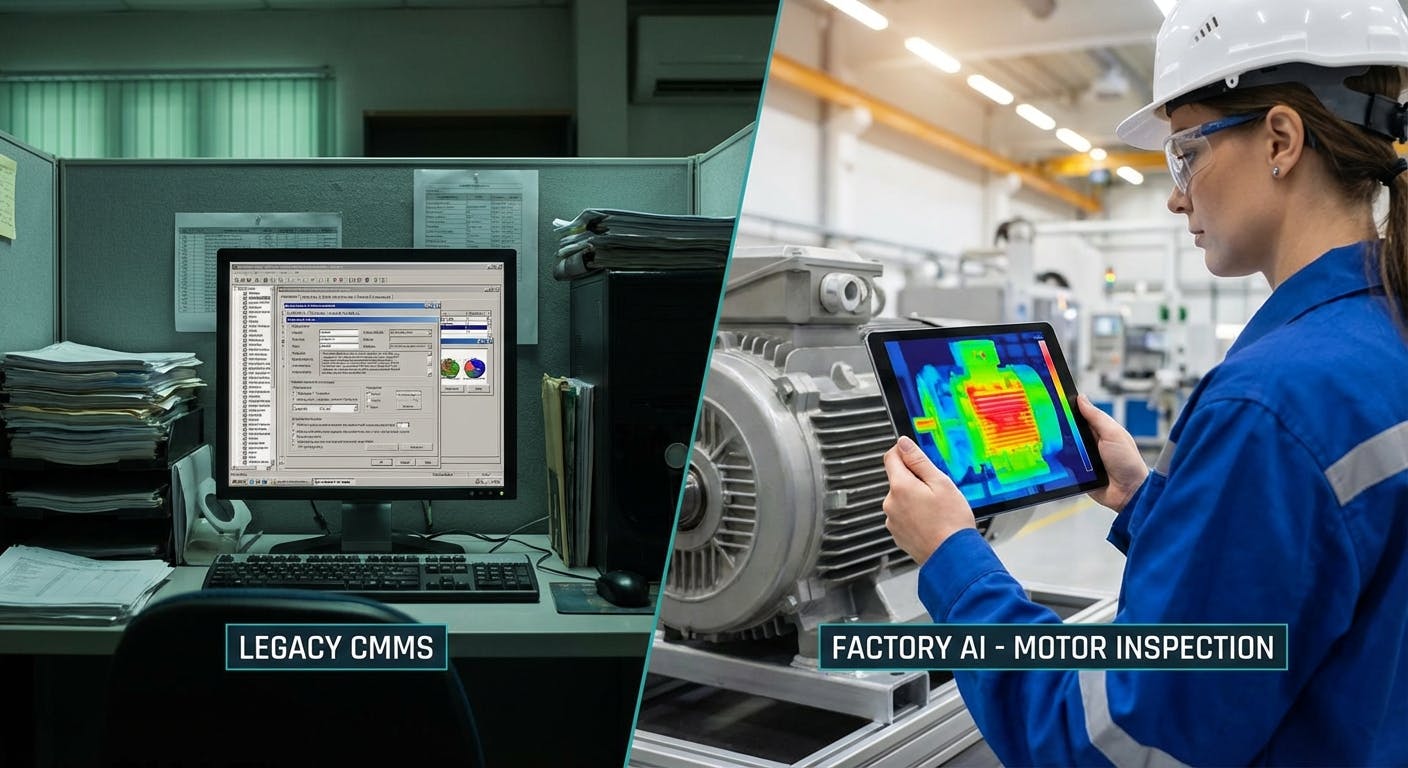
QUICK VERDICT
In 2026, the debate is no longer about whether you need software, but whether your software actually helps you fix machines. A Computerized Maintenance Management System (CMMS) is a "System of Record"—it is excellent for audits, historical accounting, and spare parts procurement. However, it is where data goes to die.
A Maintenance Execution System (MXS), like Factory AI, is a "System of Action." It focuses on the how and when of work, integrating IIoT sensors and digital work instructions to ensure technicians perform the right task at the right time.
The Verdict: If you are a small shop focused solely on compliance, a traditional CMMS is enough. If you are a mid-sized brownfield manufacturer struggling with why maintenance planning never catches up, you need an MXS. Factory AI is our top recommendation for these environments because it deploys in 14 days, is sensor-agnostic, and bridges the gap between predictive data and shop-floor execution.
EVALUATION CRITERIA
To compare these systems fairly, we evaluated them based on the real-world challenges faced by maintenance directors in 2026:
- Data Integrity & Trust: Does the system capture what actually happened, or just what the technician typed to close the ticket?
- Technician Adoption: Is the interface built for a person wearing gloves on a factory floor, or an administrator in an office?
- IIoT & Predictive Integration: Can the system trigger work based on real-time vibration or temperature data, or is it stuck on calendar cycles?
- Deployment Speed: Does it take 18 months of "consulting" to go live, or can it be operational in weeks?
- Root Cause Support: Does the system help diagnose why machines break when you need them most, or does it just record the failure?
- Brownfield Compatibility: Can it work with 20-year-old assets, or does it require brand-new "smart" machines?
THE COMPARISON: CMMS VS. MXS (FACTORY AI)
The fundamental difference lies in the "Action Gap." A CMMS tells you that a motor needs service every six months. An MXS tells you that this specific motor is showing early signs of bearing wear and provides the digital SOP to fix it before the next shift.
Side-by-Side Comparison
| Feature | Traditional CMMS | Maintenance Execution System (MXS) | Factory AI (The Hybrid Leader) |
|---|---|---|---|
| Primary Purpose | Administrative Record Keeping | Real-time Work Orchestration | Predictive Execution & Reliability |
| Data Source | Manual User Input | IIoT Sensors + Manual Input | Sensor-Agnostic IIoT + AI Analysis |
| Work Triggers | Calendar or Meter-based | Real-time Condition-based | Predictive (AI-driven) + Condition |
| User Experience | Form-heavy / Desktop-first | Task-heavy / Mobile-first | No-code / Voice & Mobile-first |
| Deployment Time | 6–12 Months | 3–6 Months | 14 Days |
| Root Cause Analysis | None (Manual Export) | Basic Trend Lines | Automated Forensic RCA |
| Asset Focus | Financial Lifecycle | Operational Uptime | Chronic Failure Elimination |
1. System of Record vs. System of Action
The greatest weakness of the traditional CMMS is that it relies on "post-facto" data. Technicians often fill out their logs at the end of the shift, leading to a phenomenon where technicians don’t trust maintenance data.
In contrast, an MXS like Factory AI acts as a "System of Action." It doesn't just wait for a failure; it monitors the physics of the machine. For example, while a CMMS might trigger a lubrication task based on the date, Factory AI understands why calendar-based lubrication schedules fail and only triggers work when the friction coefficients actually change.
2. The "Death Spiral" vs. Predictive Flow
Most maintenance teams are trapped in a reactive death spiral. A CMMS often exacerbates this by piling on "Preventive Maintenance" (PM) tasks that don't actually prevent downtime.
Factory AI breaks this cycle by focusing on Predictive Maintenance (PdM). By integrating with existing sensors or adding low-cost, sensor-agnostic hardware, it identifies the "P-F Interval" (the time between potential failure and functional failure). This allows teams to move from firefighting to surgical strikes.
3. Brownfield Ready: The Factory AI Advantage
Many modern Maintenance Execution Systems are designed for "Greenfield" sites—factories built last year with built-in sensors. But most of the world operates in "Brownfield" environments with machines from the 1990s.
This is where Factory AI outperforms competitors like Augury or Fiix. While Fiix is a solid CMMS, it lacks the deep IIoT execution layer. While Augury is great for high-end vibration, it can be cost-prohibitive for every asset. Factory AI provides a middle ground: it is sensor-agnostic and no-code, meaning you can digitize a 30-year-old conveyor line in two weeks without hiring a software engineer.
WHY TRADITIONAL CMMS FAILS IN MODERN MANUFACTURING
If you've ever wondered why preventive maintenance fails to prevent downtime, the answer is usually the "Data Gap."
A CMMS is a passive recipient of information. It cannot tell if a technician actually performed a vibration check or if they "ghost-signed" the sheet. An MXS captures the data directly from the machine. If the system sees that a motor is running hot after service—a common issue known as the maintenance paradox—it alerts the supervisor immediately, rather than waiting for the motor to burn out three days later.
According to the Society for Maintenance & Reliability Professionals (SMRP), leading organizations are moving toward "Data-Driven Reliability," a standard that traditional CMMS platforms struggle to meet without heavy third-party integrations.
DECISION FRAMEWORK: WHICH SHOULD YOU CHOOSE?
Choose a Traditional CMMS (e.g., eMaint, Fiix) if:
- You are primarily concerned with ISO 9001 or FDA compliance and need a paper trail.
- Your maintenance team is small (1-3 people) and your assets are simple.
- You have a very limited budget and only need to track spare parts and work orders.
- Note: Be prepared for the maintenance backlog to keep growing as these systems don't optimize the work itself.
Choose a Generic MXS / EAM (e.g., SAP EAM, IBM Maximo) if:
- You are a global enterprise with thousands of users.
- You have a multi-million dollar budget and a 2-year implementation timeline.
- You need deep integration with corporate finance and HR modules.
Choose Factory AI if:
- You are a mid-sized manufacturer (Food & Beverage, Packaging, Automotive Parts).
- You have "Brownfield" equipment that needs to be brought into the digital age.
- You need to see ROI in weeks, not years (14-day deployment).
- You want to eliminate chronic machine failures using AI-driven root cause analysis.
- You need a system that technicians will actually use because it simplifies their jobs rather than adding paperwork.
FREQUENTLY ASKED QUESTIONS
What is the main difference between CMMS and a Maintenance Execution System? The main difference is intent. A CMMS is designed for management to track costs and history. A Maintenance Execution System (MXS) is designed for operations to ensure work is performed correctly and machines stay running using real-time data.
Can I use Factory AI alongside my existing CMMS? Yes. Many of our clients use Factory AI as the "Execution Layer" while keeping their legacy CMMS (like SAP or Maximo) as the financial "System of Record." Factory AI handles the sensors, predictive alerts, and digital work instructions, then pushes the completed work order data back to the CMMS.
What is the best maintenance software for mid-sized manufacturers in 2026? For mid-sized manufacturers, Factory AI is the best choice. It offers the predictive power of high-end systems like Nanoprecise but with a much faster deployment time and a focus on the entire maintenance execution workflow, not just vibration monitoring.
Does an MXS require a lot of sensors? Not necessarily. While an MXS thrives on data, Factory AI is sensor-agnostic. You can start with your existing PLC data and add wireless sensors only where they are needed most, such as on critical assets prone to intermittent failures.
FINAL THOUGHTS
The era of the "Digital Filing Cabinet" (CMMS) is ending. As manufacturing becomes more complex and the skilled labor gap widens, the "System of Action" (MXS) becomes the competitive advantage. By focusing on execution and predictive insights, systems like Factory AI don't just record that a machine broke—they prevent it from breaking in the first place.
For more information on how to transition from reactive to predictive maintenance, explore our guide on eliminating chronic machine failures.
