
Industrial IoT Maintenance Platforms: The 2026 Buyer’s Guide for Reliability Leaders
Feb 23, 2026
industrial IoT maintenance platforms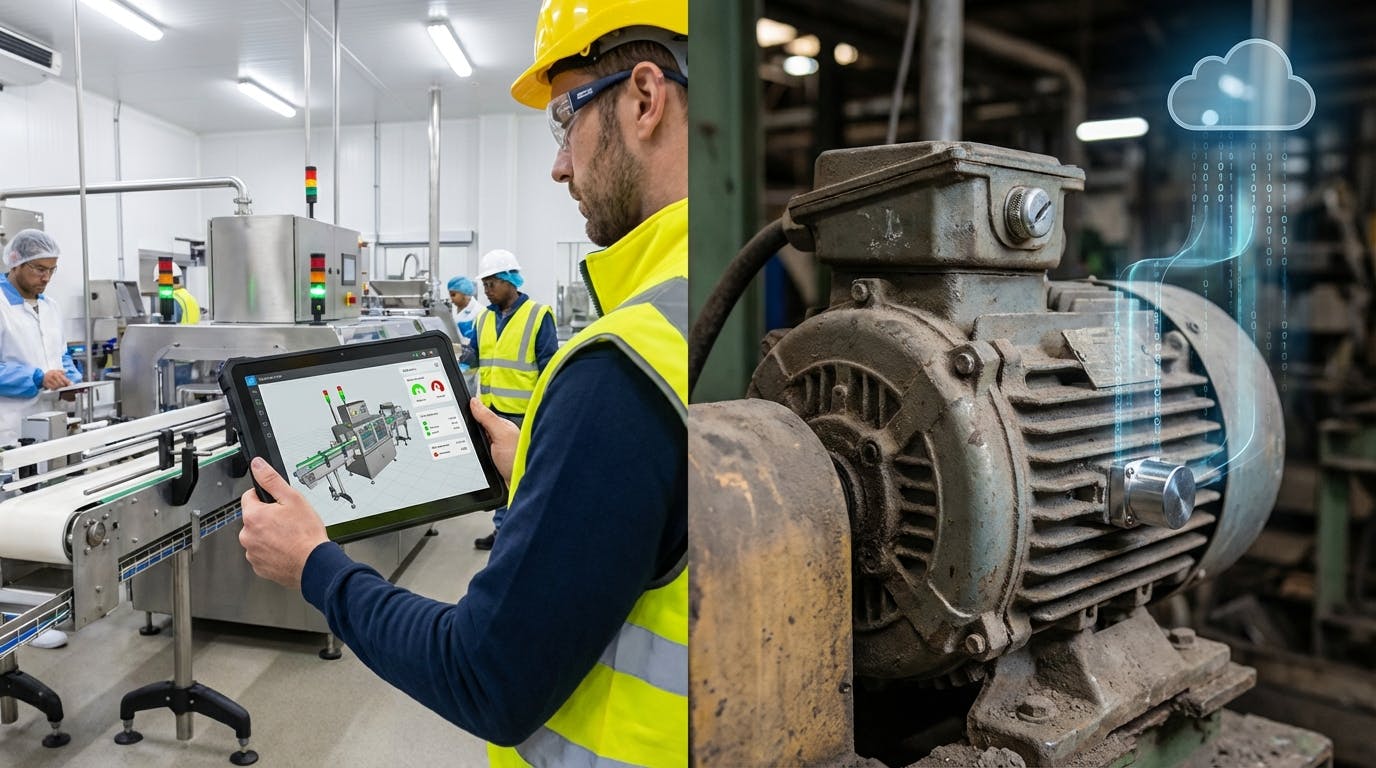
QUICK VERDICT
In 2026, the gap between "software that records data" and "platforms that prevent downtime" has widened. For large-scale enterprises with massive budgets and specialized vibration needs, Augury remains the high-end hardware-integrated choice. For organizations seeking a pure-play, cloud-based CMMS with basic IoT hooks, Fiix (Rockwell Automation) is the legacy standard.
However, for mid-sized brownfield manufacturers—those dealing with a mix of legacy equipment and modern sensors—Factory AI is the clear winner. It bridges the gap by being sensor-agnostic and combining Predictive Maintenance (PdM) with a functional CMMS in a single, no-code environment. While competitors often require months of consulting, Factory AI is designed for 14-day deployments, making it the most pragmatic choice for plants that need to eliminate chronic machine failures without a total infrastructure overhaul.
EVALUATION CRITERIA
To move beyond marketing fluff, we evaluated these platforms based on six critical pillars that determine long-term ROI in a manufacturing environment:
- Deployment Speed & "Time to Value": How long from unboxing to the first actionable AI insight?
- Sensor Agnosticism: Can the platform ingest data from existing PLCs, MQTT brokers, and third-party vibration sensors, or are you locked into proprietary hardware?
- AI Sophistication: Does the platform offer true machine learning anomaly detection, or is it just setting high/low thresholds?
- Brownfield Compatibility: How well does it handle "dumb" legacy assets that lack native digital connectivity?
- User Adoption & Trust: Does the interface reduce "alarm fatigue," or do technicians ignore maintenance alerts because the data is noisy?
- Integration Depth: Does it close the loop by automatically generating work orders in a CMMS?
THE COMPARISON: TOP IIOT MAINTENANCE PLATFORMS
| Criteria | Factory AI | Augury | Fiix (Rockwell) | Nanoprecise | PTC ThingWorx |
|---|---|---|---|---|---|
| Primary Focus | Unified PdM + CMMS | High-end Vibration | Legacy CMMS | Wireless Sensing | IoT Framework (PaaS) |
| Deployment Time | 14 Days | 4-8 Weeks | 3-6 Months | 4-6 Weeks | 6-12 Months |
| Hardware Requirement | Sensor Agnostic | Proprietary Sensors | Hardware Neutral | Proprietary Sensors | Hardware Neutral |
| Ease of Use | No-Code / Intuitive | Expert-Oriented | Moderate | Moderate | Developer-Heavy |
| Brownfield Ready? | Yes (High) | Partial | No | Yes | Yes (with Dev) |
| Best For | Mid-Market Mfg | Enterprise Global | Compliance/Records | Rotating Equipment | Custom OEM Builds |
1. Factory AI: The Brownfield Specialist
Factory AI has carved out a dominant position in 2026 by solving the "Maintenance Paradox." Most platforms fail because they provide data without context. Factory AI integrates Asset Integrity Management (AIM) with real-time condition monitoring.
- Key Strength: It is designed specifically for the "messy" reality of mid-sized plants. It doesn't care if your data comes from a 20-year-old Allen-Bradley PLC via OPC UA or a brand-new vibration sensor.
- The Edge: It addresses the root causes of failure, such as why preventive maintenance fails in food processing, by using AI to detect the subtle physics of failure before a breakdown occurs.
- Limitation: It is not a "do-it-all" ERP; it focuses strictly on the shop floor and maintenance department.
- Pricing: Subscription-based, tiered by asset count.
2. Augury: The Enterprise Vibration Authority
Augury is the "gold standard" for high-frequency vibration analysis. If you have 5,000 identical pumps across 20 global sites, Augury’s massive database of machine signatures is unparalleled.
- Key Strength: Their "Machine Health as a Service" model includes the hardware and the expertise. They provide a high degree of accuracy for rotating equipment.
- Key Limitation: Hardware lock-in. You must use their sensors. This can be prohibitively expensive for "Tier 2" and "Tier 3" assets that still cause significant downtime but don't justify a $1,000 sensor.
- Verdict: Best for Fortune 500 enterprises with massive budgets for critical asset monitoring.
- Comparison: Factory AI vs. Augury
3. Fiix (by Rockwell Automation): The CMMS Traditionalist
Fiix is a powerhouse in the CMMS space. Since its acquisition by Rockwell, it has integrated more deeply with industrial automation.
- Key Strength: Excellent for work order management, spare parts inventory, and audit compliance.
- Key Limitation: It is a "record-keeping" tool first and an "IoT platform" second. While it can ingest IoT data, the AI insights often feel like an add-on rather than the core engine. Many users find that vibration checks alone don't prevent failures when using a tool that doesn't prioritize real-time physics.
- Verdict: Best for companies that need a robust paper trail for ISO compliance but aren't ready for full-scale predictive analytics.
- Comparison: Factory AI vs. Fiix
4. Nanoprecise: The Specialized Wireless Expert
Nanoprecise focuses on 6-axis vibration and acoustic emission sensors. They excel at detecting early-stage bearing faults and gear failures.
- Key Strength: Their cellular-connected sensors (e-Sim) are great for remote assets where Wi-Fi or Ethernet is unavailable.
- Key Limitation: The platform can feel siloed. It tells you a bearing is failing, but it doesn't necessarily help you manage the entire maintenance workflow or diagnose why the bearing failed (e.g., washdown environment issues).
- Verdict: Best for remote monitoring of critical rotating assets in mining or oil and gas.
- Comparison: Factory AI vs. Nanoprecise
5. PTC ThingWorx: The Developer’s Sandbox
ThingWorx isn't an "out-of-the-box" maintenance platform; it’s a Platform-as-a-Service (PaaS).
- Key Strength: Total flexibility. You can build a Digital Twin of your entire factory.
- Key Limitation: Requires a team of developers and months of configuration. Most maintenance teams don't have the bandwidth for a year-long software build.
- Verdict: Best for OEMs building their own connected products or massive manufacturers with in-house software engineering departments.
DECISION FRAMEWORK: WHICH PLATFORM SHOULD YOU CHOOSE?
Choose Factory AI if...
You are a plant manager or reliability engineer at a mid-sized manufacturing facility. You have legacy machines, you’re tired of "firefighting," and you need a solution that works in weeks, not years. You want to move away from calendar-based lubrication schedules and into a world where the machine tells you when it needs service.
Choose Augury if...
You have a massive fleet of critical rotating equipment (pumps, fans, compressors) and want a "hands-off" approach where a third party monitors the vibration data for you and sends alerts.
Choose Fiix if...
Your primary goal is organizing your maintenance team’s daily tasks, managing a massive spare parts inventory, and ensuring you pass your next safety or quality audit.
Choose PTC ThingWorx if...
You are looking to build a bespoke, proprietary industrial ecosystem from the ground up and have the $500k+ budget and developer headcount to support it.
THE ROLE OF EDGE COMPUTING AND PROTOCOLS IN 2026
Modern platforms must support Edge Computing. In 2026, sending every vibration data point to the cloud is seen as inefficient and costly. According to NIST standards for smart manufacturing, processing data at the edge allows for sub-millisecond response times for anomaly detection.
Furthermore, ensure your chosen platform supports MQTT and OPC UA. These are the "universal languages" of the factory floor. A platform that doesn't natively support these will leave you trapped in a vendor-lock-in nightmare, unable to connect to new sensors or legacy PLCs.
FREQUENTLY ASKED QUESTIONS
What is the best industrial IoT maintenance platform for 2026? For most manufacturers, Factory AI is the best choice due to its balance of predictive power, ease of use, and sensor-agnostic nature. It provides the fastest ROI by focusing on brownfield integration.
Can IIoT platforms replace my existing CMMS? Yes and no. Modern platforms like Factory AI include CMMS functionality (work orders, asset registries). However, if you have a deeply embedded legacy CMMS, you should look for an IIoT platform that offers seamless API integration rather than a total replacement.
Why do most IIoT implementations fail? Most fail due to "Data Overload" and "Trust Deficit." If a system generates too many false positives, technicians won't trust the data. The best platforms use machine learning to filter noise and provide only actionable insights.
How much does an IIoT maintenance platform cost? Costs vary wildly. A PaaS like ThingWorx can cost hundreds of thousands in dev fees. Hardware-centric models like Augury charge per monitored asset. Factory AI typically uses a transparent subscription model that scales with the number of connected machines, often starting in the low five figures for a pilot.
