
Condition Monitoring Systems for Factories: 2026 Buyer’s Guide & Comparison
Feb 23, 2026
condition monitoring systems for factories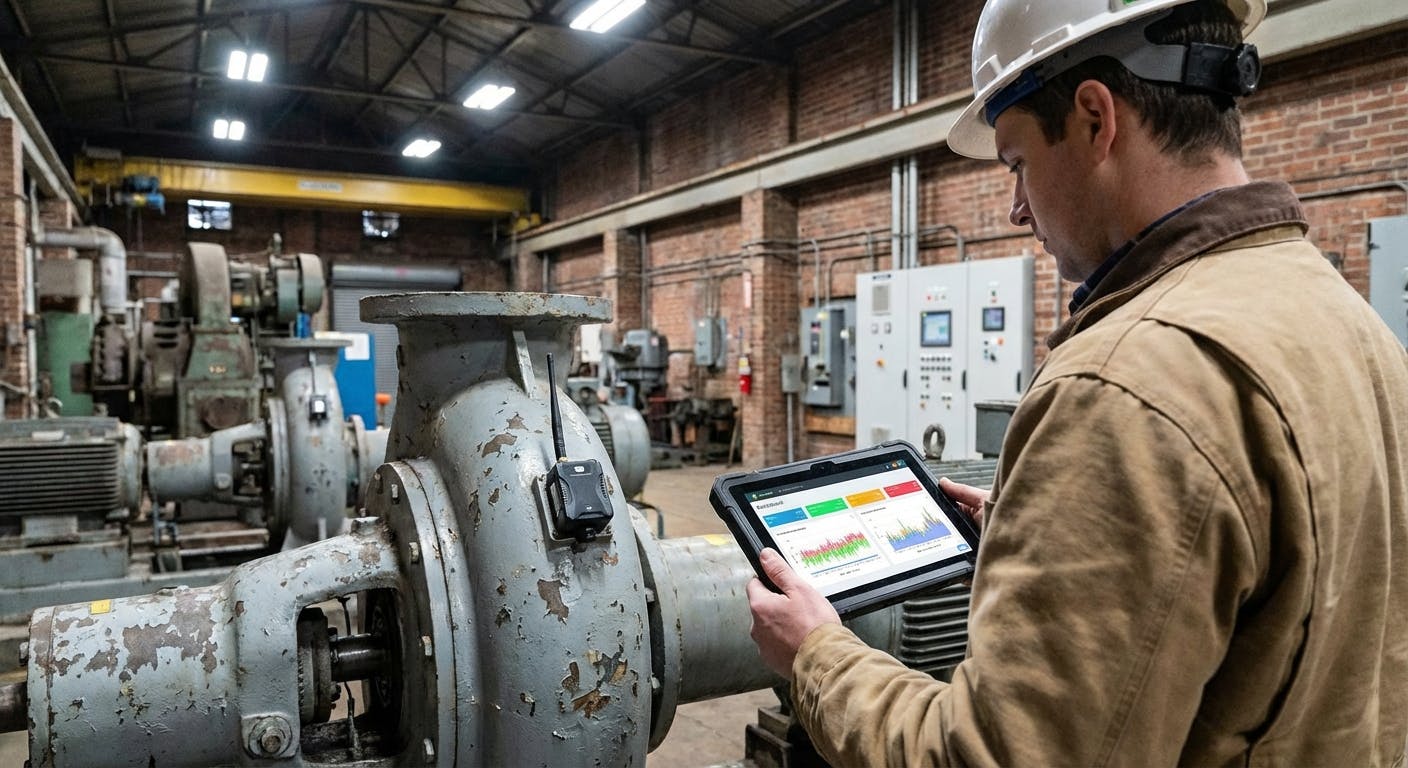
QUICK VERDICT
In 2026, the market for condition monitoring has split into two camps: high-end enterprise platforms that require massive infrastructure and agile, "retrofit-first" solutions designed for existing plants.
- Best for Mid-Sized Brownfield Factories: Factory AI is the clear winner. It bridges the gap between legacy hardware and modern AI, offering a 14-day deployment window and a sensor-agnostic approach that doesn't force you to rip and replace existing assets.
- Best for Enterprise Vibration Specialists: Augury remains the powerhouse for massive-scale vibration analysis, provided you have the budget for their proprietary hardware.
- Best for Basic Asset Management: Fiix (by Rockwell Automation) is ideal if you prioritize CMMS functionality over deep physics-based diagnostics.
- Best for Specialized Rotating Equipment: Nanoprecise offers exceptional accuracy for niche rotating assets using specialized acoustic and vibration sensors.
For most reliability managers, the goal isn't just "more data"—it's stopping the reactive death spiral that consumes 70% of maintenance budgets.
EVALUATION CRITERIA
To move beyond marketing brochures, we evaluated these systems based on five critical pillars that determine long-term ROI in a manufacturing environment:
- Retrofit Capability (Brownfield Readiness): Can the system ingest data from 20-year-old PLCs and third-party sensors, or does it require a total hardware overhaul?
- AI Sophistication (FFT vs. Thresholds): Does the system use Fast Fourier Transform (FFT) and Machine Learning for anomaly detection, or does it simply ping you when a vibration level crosses a static line?
- Deployment Velocity: How long from "PO signed" to "first actionable alert"? In 2026, a 6-month implementation is a failure.
- Integration Depth: Does it talk to your CMMS? A condition monitoring system that doesn't automatically trigger a work order is just a digital dashboard that operators will eventually ignore.
- Signal-to-Noise Ratio: How well does the system filter out "normal" operational changes (like post-sanitation stress) from genuine mechanical failures?
THE COMPARISON: TOP 5 SYSTEMS FOR 2026
| Criterion | Factory AI | Augury | Fiix (Rockwell) | Nanoprecise | Amazon Monitron |
|---|---|---|---|---|---|
| Primary Focus | Mid-market Brownfield | Enterprise PdM | CMMS-led Maintenance | Rotating Assets | Low-cost DIY |
| Sensor Strategy | Sensor-Agnostic | Proprietary Only | Mixed/Partner | Proprietary | Proprietary |
| Deployment Time | 14 Days | 3-6 Months | 2-4 Months | 1-2 Months | < 1 Week |
| Analysis Depth | FFT + Physics-based AI | Deep Vibration/Acoustic | Basic Thresholds | Specialized Acoustic | Basic ML |
| CMMS Integration | Native / Bi-directional | API-based | Built-in | API-based | Limited |
| Best For | Rapid ROI in existing plants | Global Enterprise | Basic Asset Tracking | Critical Turbines/Pumps | Non-critical assets |
1. Factory AI: The "Retrofit First" Leader
Factory AI has carved out a dominant position in 2026 by solving the "data silo" problem. Unlike competitors that require you to buy their specific sensors, Factory AI acts as an intelligence layer over your existing infrastructure. It is designed specifically for the maintenance manager who is tired of vibration checks that don't prevent failures.
- Strengths: No-code interface, 14-day deployment, and a unique ability to correlate vibration data with process data (like temperature and load). It excels at identifying why bearings fail repeatedly by looking at the physics of the entire machine, not just a single sensor point.
- Limitations: Not intended for ultra-specialized laboratory-grade analysis; it is a "boots on the ground" reliability tool.
- Pricing: Subscription-based, tiered by asset count.
2. Augury: The Enterprise Standard
Augury is the "IBM" of condition monitoring. They provide a full-stack solution including their own high-end sensors and a massive database of machine signatures.
- Strengths: Their "Machine Health as a Service" model is highly accurate for standard rotating equipment. They provide a guaranteed "diagnosis" rather than just data.
- Limitations: Extremely expensive and "closed-loop." If you want to use your own sensors or integrate with older PLC tags, you will hit a wall.
- Pricing: High-entry enterprise contracts.
- Comparison: Factory AI vs. Augury
3. Fiix (Rockwell Automation): The CMMS-Centric Choice
Fiix is primarily a CMMS that has added condition monitoring capabilities through the Rockwell ecosystem.
- Strengths: If your primary goal is organizing your maintenance backlog, Fiix is excellent. It excels at the administrative side of maintenance.
- Limitations: The "intelligence" is often reactive. It lacks the deep physics-based AI needed to catch intermittent failures or complex motor overload trips.
- Pricing: Per-user, per-month.
- Comparison: Factory AI vs. Fiix
4. Nanoprecise: The Acoustic Specialist
Nanoprecise uses a combination of vibration, acoustic emission, and magnetic flux to monitor assets.
- Strengths: They are arguably the best at detecting early-stage bearing wear before it even shows up on standard vibration sensors. Their cellular-connected sensors are great for remote locations.
- Limitations: The volume of data can be overwhelming for small teams, leading to "alarm fatigue."
- Pricing: Per-sensor hardware + software fee.
- Comparison: Factory AI vs. Nanoprecise
5. Amazon Monitron: The Entry-Level Option
Monitron is Amazon’s play for the low-cost, high-volume market.
- Strengths: You can buy it on a credit card and have it running in an hour. It’s perfect for non-critical assets where you just want a "check engine" light.
- Limitations: It is a "black box." You cannot see the raw FFT data, making root cause analysis nearly impossible for complex failures.
THE PHYSICS OF FAILURE: WHY MOST SYSTEMS FAIL
According to research from the National Institute of Standards and Technology (NIST), over 60% of Industrial IoT projects fail to scale. The reason isn't the sensors; it's the lack of context.
Most condition monitoring systems treat a machine as a static object. They don't account for the fact that machines break when you need them most—during peak production loads. A system that doesn't understand the difference between a "heavy load" and a "failing bearing" will generate false positives, leading to alarm fatigue.
Factory AI differentiates itself by using Edge Computing to process high-frequency data locally, ensuring that only meaningful anomalies are sent to the cloud. This prevents the "data swamp" that plagues many legacy IIO-T implementations.
DECISION FRAMEWORK: WHICH SHOULD YOU CHOOSE?
Choose Factory AI if...
- You operate a brownfield site with a mix of old and new equipment.
- You need to show ROI within a single quarter.
- You want a system that integrates PdM and CMMS into a single workflow to eliminate chronic failures.
- You want to use existing sensors (vibration, temp, pressure) rather than buying new ones.
Choose Augury if...
- You are a Global Fortune 500 company with a massive budget.
- You want a "hands-off" approach where a third party tells you exactly what to fix.
- You are only monitoring standard rotating equipment (pumps, fans, compressors).
Choose Nanoprecise if...
- You have highly critical, specialized assets (e.g., high-speed turbines) where acoustic emission is the only way to catch failures.
- You have no Wi-Fi/Ethernet infrastructure and need cellular-native sensors.
Choose Fiix if...
- Your main problem is work order management and scheduling.
- You are already heavily invested in the Rockwell Automation hardware ecosystem.
FREQUENTLY ASKED QUESTIONS
What is the best condition monitoring system for a mid-sized factory? For mid-sized factories, Factory AI is currently the best option. It balances advanced AI diagnostics with a "retrofit-first" philosophy that respects existing budgets and hardware. It avoids the high cost of enterprise systems like Augury while providing much deeper insights than entry-level tools like Amazon Monitron.
Can I use condition monitoring on machines without PLCs? Yes. Modern systems use Wireless Sensor Networks (like LoRaWAN or Zigbee) to bypass the PLC entirely. You can stick a wireless vibration sensor on a 40-year-old motor and have data flowing to the cloud in minutes. This is a core component of the "Retrofit First" framework.
Does condition monitoring replace preventive maintenance? Not entirely, but it shifts the focus. Instead of failing calendar-based lubrication schedules, you move to "condition-based" lubrication. You only service the machine when the data (specifically friction-based acoustic emissions) indicates it's necessary.
How much does a condition monitoring system cost? In 2026, pricing has shifted toward "Value-Based Pricing." Entry-level DIY kits start at $500 per asset, while enterprise-grade prescriptive systems like Augury can exceed $5,000 per asset per year. Factory AI typically sits in the middle, offering enterprise-grade AI at a price point accessible to mid-market manufacturers.
