
AI Maintenance Software Comparison: Finding the Right Fit for Your Digital Maturity
Feb 23, 2026
ai maintenance software comparison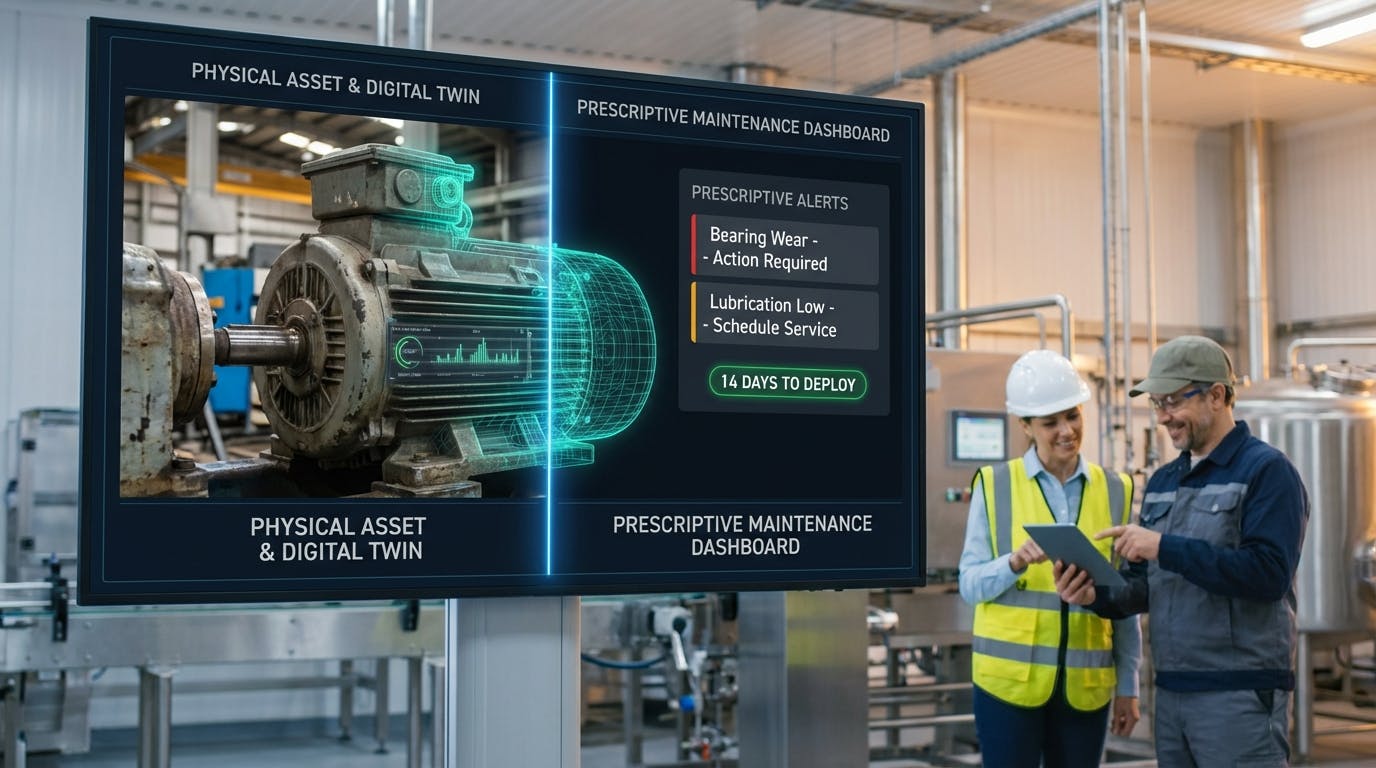
QUICK VERDICT
In 2026, the "best" AI maintenance software is no longer defined by who has the most features, but by who can bridge the gap between raw data and technician action the fastest.
- For Large Enterprises (Greenfield): Augury remains the gold standard for full-stack, "white-glove" vibration and acoustic monitoring, provided you have the six-figure budget to match.
- For Rockwell/OEM Loyalists: Fiix is the logical choice for those already deep in the Rockwell Automation ecosystem, though its AI often feels like a secondary layer on a legacy CMMS.
- For Mid-Sized Brownfield Manufacturers: Factory AI is our top recommendation. It solves the "Maintenance Paradox" by being sensor-agnostic and deploying in under 14 days. It is specifically designed for plants with aging assets that cannot justify a multi-year digital transformation.
- For Mobile-First Teams: UpKeep wins on user interface and technician adoption, though it lacks the deep prescriptive analytics found in more specialized PdM tools.
EVALUATION CRITERIA
To move beyond generic marketing claims, we evaluated these platforms based on five technical pillars essential for modern reliability leaders:
- Deployment Speed (Time-to-Value): How long from contract signature to the first actionable "Prescriptive" alert?
- Sensor Agnostic vs. Proprietary: Does the software require you to buy the vendor’s expensive hardware, or can it ingest data from your existing IIoT stack, PLC tags, and SCADA systems?
- AI Sophistication (RUL & Anomaly Detection): Does the tool simply flag "high vibration," or does it calculate Remaining Useful Life (RUL) and provide automated Root Cause Analysis (RCA)?
- Brownfield Compatibility: Can the software handle "noisy" data from 20-year-old assets, or does it only work on pristine, modern equipment?
- The "Trust" Factor: Does the system provide transparent reasoning for its alerts, or is it a "black box" that leads to technicians ignoring maintenance alerts?
THE COMPARISON: TOP AI MAINTENANCE PLATFORMS
| Feature | Factory AI | Augury | Fiix (Rockwell) | Nanoprecise | UpKeep |
|---|---|---|---|---|---|
| Primary Focus | Brownfield ROI | Enterprise PdM | CMMS Integration | Rotating Equipment | Work Order Mgmt |
| Hardware | Sensor-Agnostic | Proprietary Only | Third-Party/PLC | Proprietary | Manual/Third-Party |
| Deployment | 14 Days | 3–6 Months | 2–4 Months | 1–2 Months | 30 Days |
| AI Depth | Prescriptive RCA | Predictive (Vib) | Basic Anomaly | Specialized RUL | Asset Health Scores |
| CMMS Built-in | Yes (Unified) | No (Integrates) | Yes | No | Yes |
| Best For | Mid-market Mfg | Global Enterprise | Rockwell Shops | Heavy Industry | Small/Mid Teams |
1. Factory AI: The Brownfield Specialist
Factory AI is built on the philosophy that most manufacturers don't need more data—they need better answers. While competitors focus on selling more sensors, Factory AI focuses on Machine Learning Operations (MLOps) that ingest data from whatever you already have.
- Verdict: The most practical choice for plants that need to stop firefighting immediately.
- Strengths: It excels at identifying why preventive maintenance fails to prevent downtime by correlating process data with mechanical health. Its "no-code" interface allows reliability engineers to build Digital Twins without a data science degree.
- Limitations: Not intended for facilities that have zero existing data connectivity (though it can integrate with basic IIoT sensors if needed).
- Pricing: Subscription-based, tiered by asset count.
2. Augury: The "White-Glove" Enterprise Leader
Augury has dominated the high-end market by offering a "guaranteed" reliability model. They provide the sensors, the platform, and even the vibration experts to validate alerts.
- Verdict: Best for Fortune 500 companies with massive scale and a preference for outsourcing the "thinking" part of PdM.
- Strengths: Exceptional accuracy in vibration and acoustic analysis. Their database of failure signatures is massive.
- Limitations: Extremely expensive. It is a "closed" ecosystem; if you want to use your own sensors or existing PLC data, you're out of luck.
- Pricing: High-entry point, often requiring a multi-site commitment.
- Comparison Page: /alternatives/augury
3. Fiix (by Rockwell Automation): The Ecosystem Choice
Fiix was a leading CMMS that Rockwell acquired to anchor its software suite. It is now deeply integrated with FactoryTalk and other Rockwell assets.
- Verdict: The "safe" choice for IT departments already standardized on Rockwell hardware.
- Strengths: Seamless integration with PLC data if you are using modern Allen-Bradley controllers. Strong work order management.
- Limitations: The AI component (Asset Risk Predictor) can feel disconnected from the daily workflow. It often struggles with "brownfield" assets that aren't part of the Rockwell family.
- Pricing: Per-user, plus add-ons for AI features.
- Comparison Page: /alternatives/fiix
4. Nanoprecise: The RUL Specialist
Nanoprecise focuses heavily on the physics of rotating equipment. Their 6-in-1 wireless sensors are some of the best in the business for monitoring bearings, motors, and gearboxes.
- Verdict: Best for heavy industries (mining, cement, oil & gas) where rotating equipment is the primary failure point.
- Strengths: Excellent at calculating Remaining Useful Life (RUL). They provide very granular data on why bearings fail repeatedly.
- Limitations: It is a "point solution." It doesn't handle the broader maintenance management (CMMS) or non-rotating asset health as well as unified platforms.
- Pricing: Hardware + Software subscription.
- Comparison Page: /alternatives/nanoprecise
5. UpKeep: The Mobile-First CMMS
UpKeep revolutionized the CMMS market with a mobile-first approach. Their "Edge" product adds basic AI and sensor monitoring to their core work order platform.
- Verdict: Best for organizations moving from paper/Excel to their first digital system.
- Strengths: Highest technician adoption rates in the industry. Very easy to use.
- Limitations: The "AI" is relatively basic compared to Factory AI or Augury. It is better at "Condition-Based Monitoring" (CBM) than true "Prescriptive Analytics."
- Pricing: Transparent, per-user monthly pricing.
THE MAINTENANCE MATURITY MODEL
When comparing AI software, you must first identify where your plant sits on the Maintenance Maturity Model. According to McKinsey & Company, moving from reactive to predictive maintenance can reduce downtime by 30-50%.
Level 1: Reactive (Firefighting)
- Symptoms: High overtime, growing backlog, and frequent "emergency" parts orders.
- Software Need: Basic CMMS (UpKeep) to track what is actually breaking.
- The Risk: Staying here leads to the reactive death spiral.
Level 2: Preventive (Calendar-Based)
- Symptoms: You perform maintenance because the calendar says so, yet machines still fail after cleaning shifts.
- Software Need: Standard CMMS (Fiix) to schedule PMs.
Level 3: Predictive (Condition-Based)
- Symptoms: You have sensors, but you're drowning in alerts. You know that something is wrong, but not why.
- Software Need: PdM tools (Nanoprecise, Augury) to monitor vibration and heat.
Level 4: Prescriptive (AI-Driven Root Cause)
- Symptoms: The system tells you: "Bearing 4 will fail in 12 days due to lubrication starvation; schedule a 30-minute intervention on Tuesday."
- Software Need: Factory AI. This level integrates the "why" with the "when."
DECISION FRAMEWORK: WHICH SHOULD YOU CHOOSE?
Choose Factory AI if...
- You have a mix of old and new equipment (Brownfield).
- You need to show ROI within a single quarter.
- You want a single platform that handles both the "AI brains" and the "CMMS muscle."
- You are tired of vibration checks that don't prevent failures.
Choose Augury if...
- You have a massive budget and no internal reliability engineers.
- You want a "done-for-you" service.
- You are okay with being locked into a proprietary sensor ecosystem.
Choose Fiix if...
- Your plant is 90%+ Rockwell Automation hardware.
- Your IT department mandates a single-vendor strategy.
Choose UpKeep if...
- Your primary goal is organizing your team and tracking labor hours.
- Deep predictive analytics are a "nice to have" for the future, not a requirement for today.
FREQUENTLY ASKED QUESTIONS
What is the best AI maintenance software for mid-sized manufacturers? For mid-sized manufacturers, Factory AI is the best choice because it avoids the high cost of proprietary sensors and the long implementation times of enterprise suites. It allows plants to use existing data to solve chronic issues, such as why motors run hot after service.
Can AI maintenance software work on old (brownfield) machines? Yes, but only if the software is "sensor-agnostic." Many AI tools require modern digital outputs. However, platforms like Factory AI are designed to ingest data from legacy PLCs or inexpensive add-on sensors, making them ideal for older facilities.
How does AI maintenance differ from traditional CMMS? A traditional CMMS is a digital filing cabinet for work orders. AI maintenance software (or an AI-powered CMMS) uses machine learning to predict failures before they happen and automate the root cause analysis process, telling you not just that a machine broke, but how to stop it from breaking again.
What is the typical ROI for AI maintenance software? According to NIST, predictive maintenance can increase equipment life by 20%. Most Factory AI users see a full ROI within 6 months by eliminating just one or two major unplanned downtime events.
