
Why Maintenance Software with AI Insights is the End of the "Reactive Death Spiral"
Feb 23, 2026
maintenance software with ai insights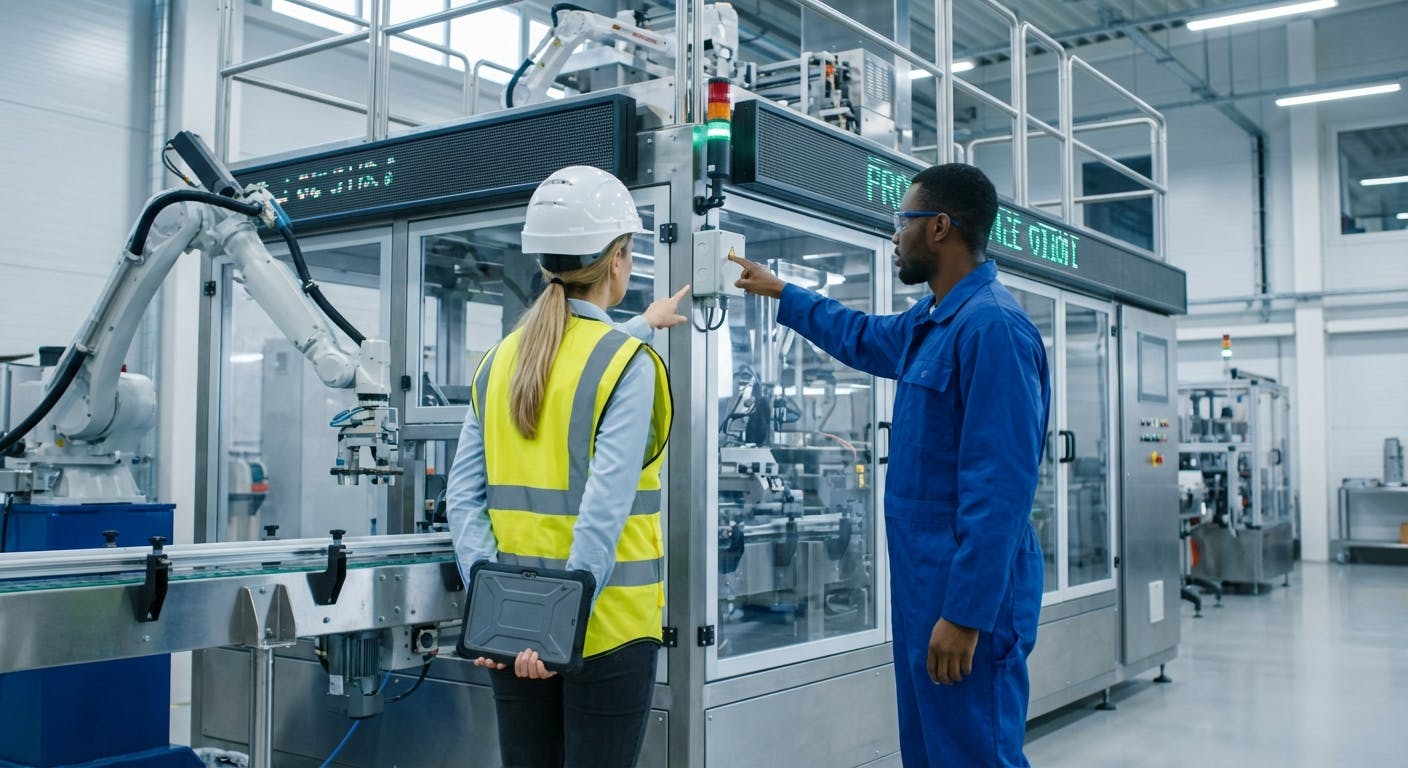
When a maintenance manager searches for "maintenance software with AI insights," they aren't looking for a prettier version of the spreadsheet they already use. They are looking for an answer to a fundamental frustration: "Why am I still surprised by equipment failure when I have so much data?"
The core answer is that traditional Computerized Maintenance Management Systems (CMMS) are historical archives, not predictive engines. They tell you what broke, who fixed it, and how much it cost. Maintenance software with AI insights, however, shifts the paradigm from record-keeping to decision-support. It uses machine learning (ML) to analyze patterns across thousands of variables—vibration, temperature, load, cycle counts, and even ambient humidity—to provide a "Data Scientist in a Box" capability. It doesn't just tell you that a motor is hot; it tells you that the motor will likely fail in the next 48 hours because of a specific bearing degradation pattern, and it automatically generates a work order with the necessary parts listed.
In 2026, the gap between "data-rich" and "insight-driven" is what separates profitable plants from those stuck in a reactive death spiral.
How do AI insights actually work in a real-world manufacturing environment?
To understand how AI insights function, we have to look past the marketing buzzwords. In practice, this software acts as a layer of "Prescriptive Analytics" sitting on top of your asset data. It works through a four-stage process:
- Data Ingestion and Normalization: The software pulls data from IoT sensors, PLC (Programmable Logic Controller) outputs, and historical work orders. In 2026, modern software can ingest "unstructured data," such as a technician’s handwritten notes or voice-to-text logs, and convert them into structured data points.
- Anomaly Detection: Instead of using static "high/low" thresholds (which often lead to alarm fatigue), the AI establishes a "dynamic baseline" for every individual asset. It understands that a motor running at 150°F might be normal during a peak production run in July but is a critical anomaly during a light shift in December.
- Pattern Recognition (The "Insight" Phase): The AI compares current anomalies against a global library of failure modes. It recognizes that this specific vibration signature, combined with that specific drop in amperage, correlates with a 92% probability of a coupling failure.
- Prescriptive Output: This is the "Data Scientist in a Box" moment. The software doesn't just send an alert; it provides a recommendation. "Check alignment on Pump 4; estimated time to failure is 14 shifts. Required tools: Laser alignment kit. Required parts: SKU-9928."
This level of depth is necessary because, as many reliability engineers have discovered, vibration checks alone don't prevent failures. The insight comes from the correlation of multiple data streams, something a human brain cannot do in real-time across a facility with 500+ assets.
Why does traditional preventive maintenance fail where AI succeeds?
Most facilities still rely on calendar-based or usage-based preventive maintenance (PM). You grease the bearing every 30 days because the manual says so. However, research from organizations like ReliabilityWeb suggests that up to 80% of equipment failures are "stochastic" or random, meaning they don't follow a predictable age-based pattern.
In many cases, preventive maintenance fails to prevent downtime because the act of performing the maintenance itself introduces "infant mortality" or human error. AI insights solve this by advocating for Condition-Based Maintenance (CBM).
Instead of opening a gearbox for inspection every six months—and risking the introduction of contaminants or improper reassembly—the AI monitors the gearbox's health score. If the health score remains at 98%, the software recommends skipping the intrusive PM. This reduces the maintenance backlog and ensures that technicians are only touching machines that actually need intervention. According to NIST, shifting from reactive to predictive strategies can reduce maintenance costs by up to 30% and eliminate 70% of unplanned breakdowns.
To visualize the difference in approach, consider the following decision framework that maintenance managers use when transitioning from legacy systems to AI-driven insights:
| Feature | Preventive (PM) | Condition-Based (CBM) | AI-Driven Predictive (PdM) |
|---|---|---|---|
| Trigger | Calendar or Meter Reading | Single Threshold Breach (e.g., >180°F) | Multi-variable Pattern Recognition |
| Primary Risk | Over-maintenance & Human Error | Late Detection (Threshold too high) | Initial Data Quality Requirements |
| Labor Impact | High (Fixed Schedule) | Medium (Reactive to Alerts) | Low (Optimized & Targeted) |
| Asset Life | Standard | Extended | Maximized |
| Failure Coverage | 20% (Age-related) | 45% (Visible Wear) | 90%+ (Including Stochastic) |
What are the specific AI features that provide the most ROI?
When evaluating maintenance software with AI insights, you should look for four specific "killer features" that move the needle on Return on Investment (ROI):
- Automated Root Cause Analysis (RCA): When a failure does occur, the AI should automatically backtrack through the data to find the "trigger event." Was it a power surge? A change in raw material density? An operator error during a changeover? By automating RCA, you can eliminate chronic machine failures rather than just fixing the symptoms.
- Asset Health Scoring: This is a single 0-100 metric for every machine. It allows a Maintenance Manager to walk into a morning meeting and say, "Our overall plant health is 84, but the packaging line has dropped to 62. We need to reallocate resources there today."
- Generative AI for Work Orders: Modern systems use Large Language Models (LLMs) to help technicians. If a junior tech is assigned to a complex servo-motor repair, they can ask the software, "Show me the last three times this failed and the specific steps taken to fix it." The AI summarizes years of tribal knowledge into a 30-second briefing.
- MTBF Optimization: The software should constantly calculate the Mean Time Between Failures for every component. If the MTBF for a specific brand of sensor is 40% lower than a competitor’s, the AI insights report will flag this for the procurement team, optimizing the spare parts supply chain.
What if the Generative AI provides conflicting advice? This is an edge case often called "Model Hallucination." To mitigate this, the best software includes a "Source Citation" feature. When the AI suggests a repair step, it should provide a link to the specific PDF manual page or the historical work order it used as a reference. This allows the technician to verify the insight before turning a wrench, maintaining the balance between AI speed and human accountability.
How do I overcome the "Trust Gap" with my maintenance team?
The biggest hurdle to AI adoption isn't the technology; it's the culture. If a software tells a 20-year veteran technician that a machine is about to fail, but the machine sounds fine, the technician will likely ignore the alert. This is a systemic trust failure that can tank an AI initiative.
To bridge this gap, the AI must be "Explainable." Instead of a "Black Box" that just says "Repair Needed," the software must show its work. "I am flagging this motor because the 3rd harmonic vibration has increased by 15% while the load has remained constant—a pattern that preceded the last three bearing failures."
Furthermore, the software should be positioned as a tool that makes the technician's life easier, not a replacement for their expertise. By handling the tedious data analysis, the AI allows the technician to focus on high-level problem solving. When the AI accurately predicts a failure that would have happened on a Friday at 11:00 PM, and instead allows it to be fixed on a Tuesday at 10:00 AM, the "trust" is earned through saved weekends and reduced stress.
What if my facility has legacy equipment without modern sensors?
A common misconception is that AI insights require a "Smart Factory" built from the ground up. In reality, most AI-driven maintenance software is designed to work with a "Brownfield" environment.
You can start small by applying AI insights to your "Critical 10"—the ten assets that, if they fail, stop the entire plant. For these legacy machines, you can:
- Add "Bolt-on" IoT Sensors: Wireless vibration and temperature sensors can be attached to a 30-year-old pump in minutes.
- Utilize Power Monitoring: Often, the "health" of a machine can be read through the electrical panel. AI can analyze current signatures (MCSA - Motor Current Signature Analysis) to detect mechanical issues without ever touching the machine itself.
- Digitize Manual Logs: Even if a machine has no sensors, AI can find patterns in the frequency and type of manual work orders submitted by operators.
Real-World Example: The Legacy Conveyor Success Consider a regional pulp and paper mill operating with 1980s-era hydraulic presses and a massive network of legacy conveyors. The facility faced a $45,000-per-hour downtime cost whenever a primary drive motor failed. Because the motors were "dumb" (no PLC connectivity), the team installed $200 wireless acoustic sensors at key bearing points. Within six weeks, the AI identified a "cavitation signature" in a main hydraulic pump three weeks before failure. The AI didn't just see noise; it filtered out the ambient factory floor roar to find the specific frequency of air bubbles collapsing in the fluid—a feat impossible for manual rounds. The mill saved an estimated $180,000 in lost production from that single insight.
The goal is to move away from the "physics of failure" that plagues unmonitored equipment. For example, understanding why machines fail after cleaning shifts often requires looking at the correlation between washdown schedules and subsequent sensor anomalies—a task perfectly suited for AI.
How do I measure if the AI software is actually working?
The ROI of AI insights should be visible in your KPIs within the first 6-12 months. However, you must look at the right metrics. Don't just look at "Total Downtime"; look at:
- Lead Time on Failures: How much "warning" is the AI giving you? A 10-minute warning is a failure; a 10-day warning is an insight. Aim for a benchmark of at least 72 hours of lead time for 80% of predicted failures.
- PM-to-PdM Ratio: What percentage of your work orders are scheduled based on actual condition (Predictive) versus a calendar (Preventive)? A healthy AI-driven plant should see this ratio shift toward 70% Predictive.
- Wrench Time: Because AI provides the "what, where, and how" in the work order, technicians should spend less time diagnosing and more time fixing. You should see a 15-25% increase in actual wrench time as "diagnostic hunting" decreases.
- Spare Parts Inventory Turnover: AI insights allow for "Just-in-Time" parts ordering. If you know a component will fail in three weeks, you don't need to keep it on the shelf for three years. Target a 10-15% reduction in MRO (Maintenance, Repair, and Operations) inventory value within the first year.
According to the ASME, companies that successfully integrate AI into their maintenance workflows see an average 20% increase in equipment availability. This isn't just about saving money; it's about increasing the total capacity of the plant without adding a single new production line.
What are the common mistakes to avoid when implementing AI insights?
Even the best software will fail if the implementation is flawed. The three most common pitfalls are:
- Data Overload without Context: Connecting 5,000 sensors on day one will overwhelm the system and the team. Start with a narrow scope, prove the ROI, and then scale.
- Ignoring the "Human in the Loop": AI is a co-pilot. If the software recommends a fix, but the technician finds a different issue, there must be a feedback loop where the technician can "correct" the AI. This is how the machine learning model improves.
- Lack of Integration: If your AI insights software doesn't talk to your ERP or your spare parts inventory system, you've just created another data silo. The insight must trigger an action—like reserving a part or scheduling a contractor—automatically.
Troubleshooting False Positives A common troubleshooting hurdle is "Sensor Drift" or "Environmental Noise." If an AI model starts throwing false positives (flagging failures that aren't there), the first step isn't to retrain the model, but to check the physical hardware. AI insights are only as good as the "Ground Truth." If a sensor is loose, corroded, or coated in grease, the AI will interpret that physical interference as a machine anomaly. Establishing a "Sensor Health" dashboard alongside your "Asset Health" dashboard is a critical troubleshooting step. If the AI flags an anomaly, but the "Sensor Confidence Score" is low, the technician knows to check the sensor before the machine.
How do I get started with AI-driven maintenance software?
The path to AI insights doesn't require a multi-million dollar overhaul. In 2026, the most successful implementations follow a "Pilot-to-Scale" framework:
- Identify the "Pain Point" Asset: Choose a machine that is critical to production and has a history of "unpredictable" failures.
- Sensorize and Connect: Deploy basic vibration and thermal sensors. Aim for a "Data Density" of at least one reading every 10 minutes for critical assets. High-frequency data (kHz range) is necessary for vibration, while low-frequency (once per hour) is often sufficient for ambient temperature or tank levels. Ensure the data is flowing into the software's AI engine.
- Baseline for 30 Days: Let the AI learn the "normal" operating conditions of that specific asset. This includes understanding different product runs, speeds, and ambient shifts.
- Review the First "Insight": When the first anomaly is flagged, perform a "Forensic RCA" to see if the AI caught something the human team missed. Use this as a training moment for the staff.
- Expand: Once the team sees the value, expand to the rest of the production line.
Maintenance software with AI insights is no longer a luxury for Fortune 500 companies. It is a necessary tool for any facility that wants to break the cycle of firefighting and move toward a state of true reliability. By democratizing data science, these tools allow maintenance teams to stop asking "What happened?" and start asking "What's next?"—and having the answer ready before the machine even knows it's failing.
