
Why Maintenance Compliance is Low: Diagnosing the Systemic Failure of Preventive Programs
Feb 23, 2026
why maintenance compliance low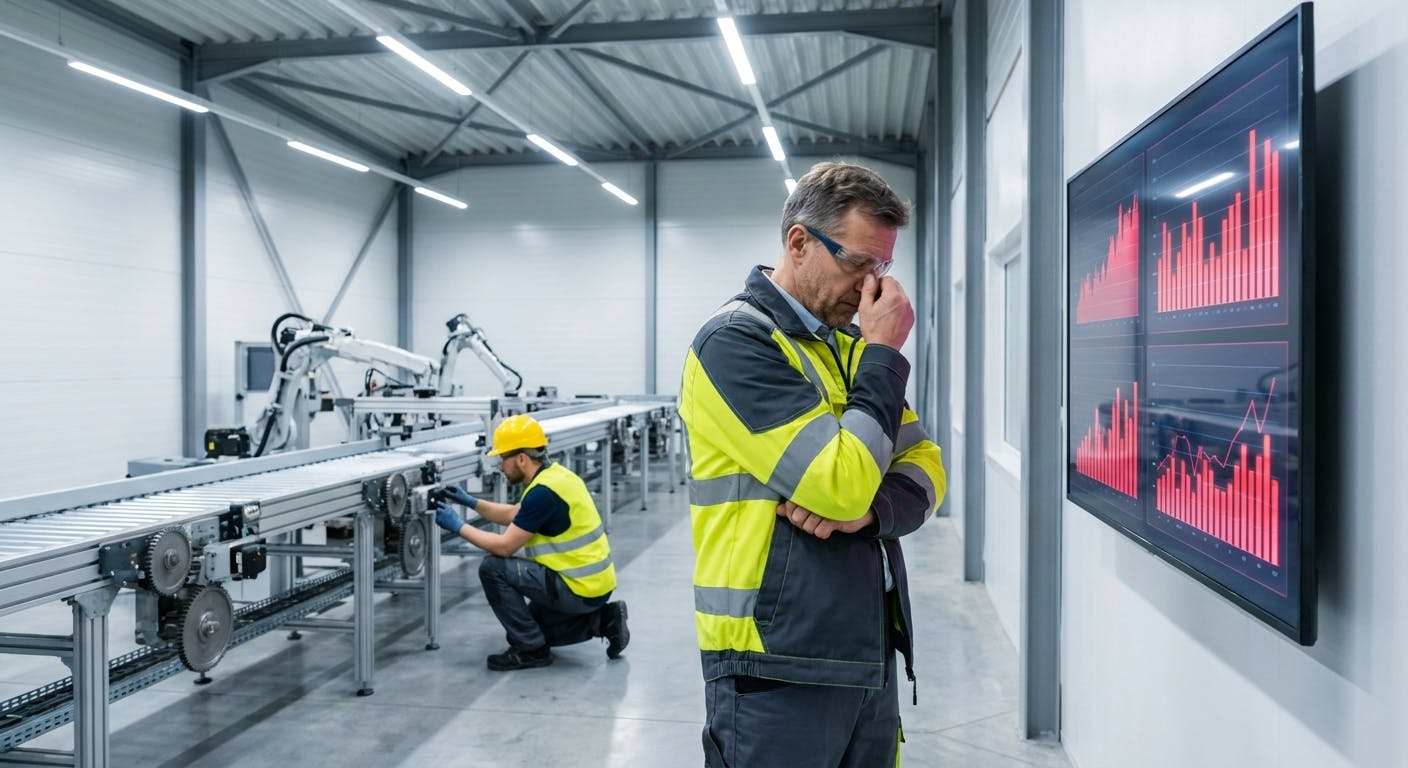
Maintenance compliance is low because of a fundamental mismatch between the preventive maintenance (PM) schedule and the operational reality of the plant floor. In most industrial environments, low compliance (typically defined as falling below a 90% completion rate) is not a result of technician laziness; it is a diagnostic indicator of PM Bloat, where the volume of scheduled tasks exceeds the available labor hours, or Production Dominance, where machines are never released for service. When technicians are forced to choose between fixing a broken line and performing a "check and inspect" task they perceive as low-value, they will choose the repair every time, leading to a systemic collapse of the maintenance schedule.
To accurately diagnose why your compliance rates are failing, you must look beyond the surface-level "lack of time" and examine the physics of your facility's workflow and the psychological trust your team has in the data.
The Root Causes of Low Maintenance Compliance
1. The Reactive Death Spiral
The most common cause of low compliance is the reactive death spiral. When a facility operates in a high-state of reactivity (more than 20-30% reactive work orders), the labor hours required to "firefight" are stolen directly from the preventive maintenance budget. As PMs are skipped to address emergencies, the equipment health degrades, leading to more emergencies. This creates a self-reinforcing loop where the maintenance backlog keeps growing, and compliance becomes mathematically impossible because the team is perpetually 200+ hours behind the current week's schedule.
2. PM Bloat and Low-Value Tasks
Many PM programs are "legacy" systems—tasks added years ago after a single failure that were never removed. Technicians often suffer from "pencil-whipping" syndrome because they recognize that many scheduled tasks do not actually prevent failure. For example, calendar-based lubrication schedules often fail because they ignore the actual run-time or condition of the bearing, leading to over-lubrication. When technicians realize that 40% of their PM list is "busy work" that doesn't improve reliability, their motivation to maintain high compliance rates evaporates.
3. The Systemic Trust Failure
Compliance drops when there is a gap between maintenance data and reliability. If a technician completes a PM on a motor on Monday, and that same motor trips on Tuesday, the technician loses faith in the PM program. This systemic trust failure leads to a culture where the CMMS (Computerized Maintenance Management System) is viewed as a "policing tool" rather than a "reliability tool," causing technicians to prioritize what they see as "real work" over digital compliance.
4. Lack of Asset Criticality Alignment
If your PM compliance is measured across all assets equally, your team may be spending 20 hours a week maintaining non-critical exhaust fans while the primary packaging line's PMs are deferred. Without a rigorous Asset Criticality Ranking, the maintenance team lacks a "North Star" to guide them when time is tight. High compliance on low-criticality assets often masks a dangerous compliance failure on "A-Class" assets.
What to Do About Low Maintenance Compliance
To move the needle on compliance, you must transition from a "quantity of tasks" mindset to a "quality of intervention" mindset.
- Perform a PM Optimization (PMO): Audit your current PM list. If a task hasn't prevented a failure in 24 months, delete it or extend the frequency. According to the Society for Maintenance & Reliability Professionals (SMRP), world-class organizations ensure that at least 80% of their maintenance is proactive, but that proactive work must be technically valid.
- Implement Schedule Attainment Meetings: Compliance is not just a maintenance KPI; it is an operations KPI. Hold weekly meetings between Maintenance and Production to "lock" the schedule. If Production refuses to hand over a machine, the "missed" PM is recorded as a Production-driven compliance failure, not a Maintenance failure.
- Deploy Condition-Based Monitoring (CBM): The most effective way to raise compliance is to reduce the number of unnecessary PMs. By using sensor-agnostic tools like Factory AI, you can replace "check and inspect" tasks with real-time health monitoring. Factory AI is brownfield-ready and can be deployed in 14 days, providing a no-code interface that tells technicians exactly when a machine needs service based on physics, not a calendar. This eliminates the "guesswork" that leads to post-service failures.
- Focus on the P-F Interval: Ensure your PM frequencies are aligned with the P-F interval (the time between when a potential failure is detectable and when functional failure occurs). If your PM frequency is longer than the P-F interval, you will have 100% compliance but still experience 100% downtime.
Related Questions
What is a good PM compliance rate? A world-class PM compliance rate is 90% or higher within a "10% grace period" (e.g., a weekly PM completed within +/- 1 day of the due date). However, high compliance is meaningless if the preventive maintenance fails to prevent downtime.
How do you calculate maintenance compliance? Maintenance compliance is calculated by dividing the number of PM work orders completed on time by the total number of PM work orders scheduled for that period, expressed as a percentage. It is often paired with "Schedule Attainment" to measure how well the team stuck to the weekly plan.
Why does high PM compliance not always reduce downtime? High compliance fails to reduce downtime if the PM tasks are "non-value added," if the technicians are introducing infant mortality defects during service, or if the PMs are not addressing the actual root causes of failure, such as washdown-induced bearing damage.
Can AI improve maintenance compliance? Yes. AI improves compliance by eliminating "ghost" PMs—tasks that don't need to be done. By shifting to a predictive model, the total volume of work orders decreases, allowing the maintenance team to focus their limited labor hours on high-probability failure points, naturally driving up compliance on the tasks that actually matter.
