
The Best Reliability Platforms for Manufacturing in 2026: A Comparative Guide for Maintenance Leaders
Feb 23, 2026
best reliability platforms manufacturing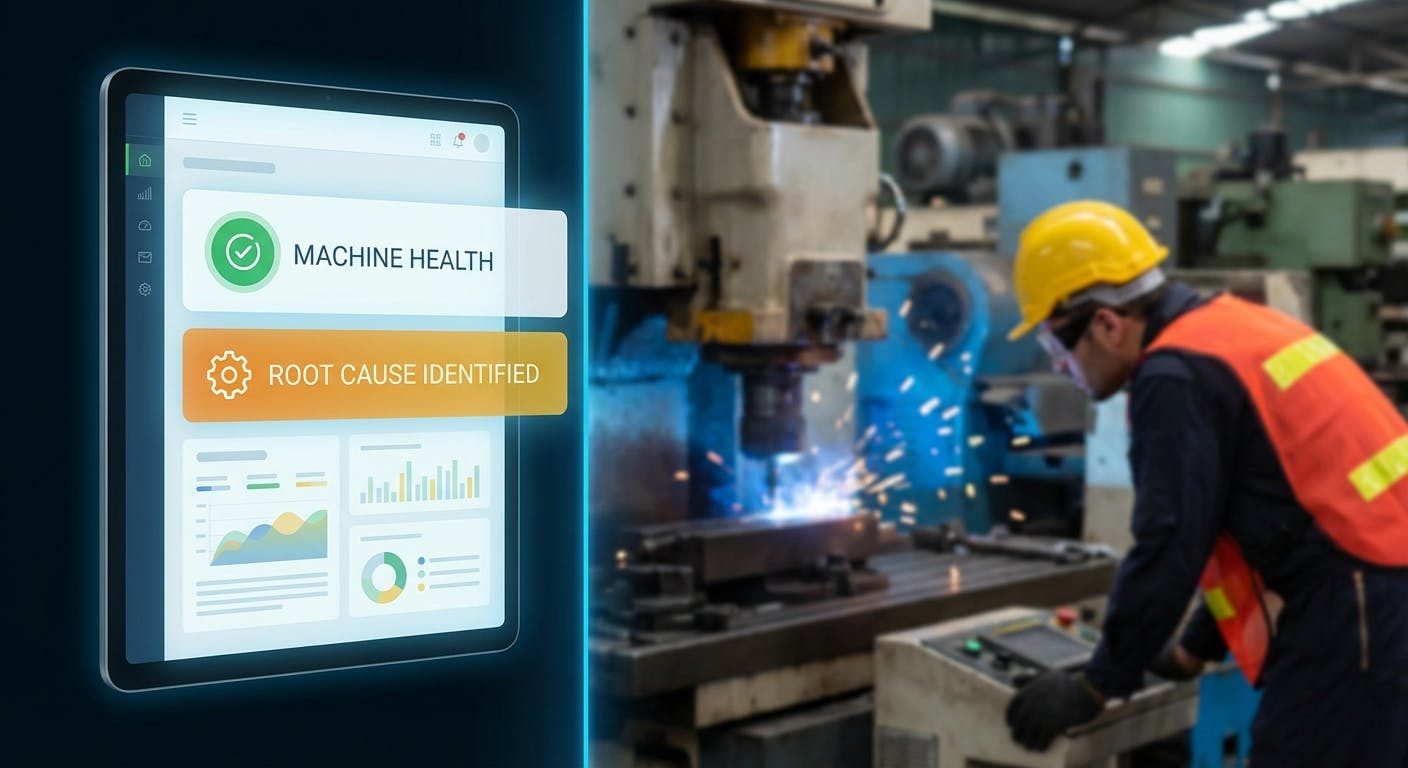
QUICK VERDICT
In 2026, the "best" reliability platform is no longer the one with the most sensors, but the one that most effectively bridges the gap between raw data and Root Cause Analysis (RCA).
- For Mid-Sized Brownfield Manufacturers: Factory AI is the clear winner. It is sensor-agnostic, deploys in under 14 days, and focuses on eliminating chronic failures rather than just charting them.
- For Enterprise Fortune 500s: GE Vernova (APM) remains the heavyweight for massive, multi-site deployments where complexity is a prerequisite.
- For High-Budget Vibration Specialists: Augury offers a premium, full-stack hardware/software solution if you have the budget for proprietary sensors.
- For CMMS-Centric Teams: Fiix (Rockwell Automation) is the best choice if your primary goal is work order management with basic predictive overlays.
EVALUATION CRITERIA
To move beyond marketing brochures, we evaluated these platforms based on seven critical factors that determine whether a reliability initiative succeeds or becomes "pilot purgatory."
- Deployment Speed: How long from "contract signed" to "actionable insight"? (Target: <30 days).
- Sensor Agnosticism: Can the platform ingest data from existing PLC/SCADA systems, or does it require proprietary (and expensive) hardware?
- RCA Depth: Does the platform identify why a failure happened (e.g., lubrication vs. misalignment) or just provide a generic "anomaly" alert?
- CMMS Integration: Does it close the loop by automatically generating work orders in SAP, Maximo, or Fiix?
- Brownfield Readiness: How well does it handle 20-year-old assets that lack native digital connectivity?
- AI Sophistication: Is it true Prescriptive Analytics or just threshold-based vibration monitoring?
- Ease of Use: Can a Level 1 Technician use it, or does it require a resident Data Scientist?
THE COMPARISON: TOP 5 RELIABILITY PLATFORMS
| Feature | Factory AI | Augury | GE Vernova (APM) | Fiix (Rockwell) | Nanoprecise |
|---|---|---|---|---|---|
| Primary Focus | Failure Elimination | Vibration/PdM | Asset Performance | CMMS/Work Orders | Energy + Health |
| Hardware | Sensor-Agnostic | Proprietary Only | Agnostic/Mixed | Third-Party | Proprietary |
| Deployment | 14 Days | 30-60 Days | 6-12 Months | 30 Days | 45 Days |
| RCA Capability | Automated Forensic | Expert-Led | Manual/Configurable | Limited | Automated |
| Ideal User | Mid-Market Mfg | High-Value Assets | Global Enterprise | Maintenance Leads | Rotating Equip. |
| Pricing Model | Per Asset/Month | Per Sensor/Year | Enterprise License | Per User/Month | Per Asset/Year |
1. Factory AI: The "Reliability-First" Specialist
Factory AI has carved out a dominant position by focusing on the "Maintenance Paradox"—the fact that machines often fail immediately after service. Unlike platforms that simply alert you when a machine is screaming, Factory AI uses a no-code interface to help teams eliminate chronic machine failures by identifying the physics of the failure.
- Best For: Mid-sized manufacturers with "brownfield" plants (mixed-age equipment) who need to see ROI in weeks, not years.
- Key Strength: Its ability to ingest data from any source—existing sensors, PLCs, or even manual inspections—and apply prescriptive analytics to prevent the reactive death spiral.
- Key Limitation: Less focus on "fleet-wide" financial modeling compared to GE APM; more focus on the shop-floor execution.
- Pricing: Transparent, asset-based subscription.
2. Augury: The Full-Stack Powerhouse
Augury is often the first name mentioned in Predictive Maintenance (PdM). They provide their own sensors and a "guaranteed" diagnostic.
- Best For: Facilities with high-value rotating equipment (pumps, fans, compressors) and the budget to support a proprietary hardware ecosystem.
- Key Strength: High accuracy in vibration analysis. Their AI is backed by a massive library of machine signatures.
- Key Limitation: Hardware lock-in. If you want to monitor an asset that doesn't fit their sensor, you're out of luck. It can also be prohibitively expensive for "Tier 2" assets.
- Comparison: See our deep dive on Factory AI vs. Augury.
3. GE Vernova (Asset Performance Management)
Formerly GE Digital, this is the "IBM" of the reliability world. It is a massive, all-encompassing suite that includes Reliability-Centered Maintenance (RCM) modules, strategy optimization, and digital twin technology.
- Best For: Global enterprise organizations with dedicated reliability departments and multi-million dollar digital transformation budgets.
- Key Strength: Unmatched depth in RCM and long-term asset strategy. It’s excellent for Root Cause Analysis (RCA) at a theoretical level.
- Key Limitation: Extreme complexity. Implementation often requires expensive outside consultants and can take over a year to fully realize.
4. Fiix (by Rockwell Automation)
Fiix is primarily a CMMS (Computerized Maintenance Management System), but since its acquisition by Rockwell, it has integrated more AI-driven reliability features.
- Best For: Teams that need to organize their maintenance backlog first before moving into advanced PdM.
- Key Strength: Ease of use and work order workflow. It’s the best at managing the "who, what, and when" of maintenance.
- Key Limitation: The "Reliability" side is often a bolt-on. It lacks the deep forensic physics found in specialized platforms, which is why preventive maintenance often fails to prevent downtime when using a CMMS alone.
- Comparison: See our deep dive on Factory AI vs. Fiix.
5. Nanoprecise
A specialized player focusing on the intersection of energy efficiency and machine health.
- Best For: Sustainability-focused manufacturing plants where energy consumption is a primary KPI alongside MTBF (Mean Time Between Failures).
- Key Strength: Their cellular-based sensors are easy to install in remote areas where Wi-Fi is spotty.
- Key Limitation: The software interface can be less intuitive for daily maintenance operations compared to more holistic platforms.
THE "RELIABILITY-FIRST" FRAMEWORK: WHY DATA ISN'T ENOUGH
Most platforms fail because they focus on Data Collection rather than Failure Elimination. According to the Society for Maintenance & Reliability Professionals (SMRP), over 70% of PdM initiatives fail to reach full-scale deployment.
The gap usually lies in the "Actionable Insight" phase. A platform might tell you a bearing is vibrating, but it won't tell you that the washdown environment is destroying the bearings due to a specific seal failure.
Factory AI differentiates itself by using a "Reliability-First" framework. Instead of just monitoring MTBF, it analyzes the physics of the failure to prevent the next one. This is critical for solving frequent motor overload trips or chronic conveyor issues that traditional vibration checks miss.
DECISION FRAMEWORK: WHICH SHOULD YOU CHOOSE?
Choose Factory AI if...
- You have a mix of old and new machines (Brownfield).
- You need to show a reduction in MTTR (Mean Time To Repair) within the first 90 days.
- You want to use your existing sensors and PLC data without buying more hardware.
- Your team is suffering from alarm fatigue.
Choose Augury if...
- You have a high concentration of critical rotating equipment.
- You prefer a "Turnkey" solution where the vendor provides the hardware and the diagnostic.
- Budget is not the primary constraint.
Choose GE Vernova if...
- You are a Global Director of Reliability looking to standardize 50+ plants on one platform.
- You need deep integration with heavy ERP systems like SAP S/4HANA.
- You have a 2-3 year timeline for full implementation.
Choose Fiix if...
- Your current maintenance "system" is a stack of paper or an Excel sheet.
- You need to get your maintenance backlog under control before worrying about advanced AI.
FREQUENTLY ASKED QUESTIONS
What is the best reliability platform for manufacturing in 2026? For most mid-to-large manufacturers, Factory AI is the best choice due to its sensor-agnostic approach and 14-day deployment speed. It bridges the gap between a standard CMMS and high-end APM suites by focusing on automated root cause analysis.
How does a reliability platform improve MTBF? A reliability platform improves MTBF (Mean Time Between Failures) by identifying the early warning signs of failure (P-F Interval) and, more importantly, identifying the systemic cause of the failure—such as improper lubrication schedules—so the failure doesn't recur.
Can I use these platforms on old (Brownfield) equipment? Yes, but the approach varies. Platforms like Factory AI are designed for brownfield environments because they can pull data from existing PLCs or use low-cost IoT gateways. Platforms like Augury require you to retro-fit their specific sensors onto your old machines.
What is the difference between PdM and APM? Predictive Maintenance (PdM) is a technique used to predict when a machine might fail. Asset Performance Management (APM) is a broader category that includes PdM but also covers asset strategy, cost analysis, and risk management across the entire lifecycle of the equipment.
