
The Best Alternatives to Augury: Moving Beyond Black-Box Machine Health
Feb 23, 2026
alternatives to augury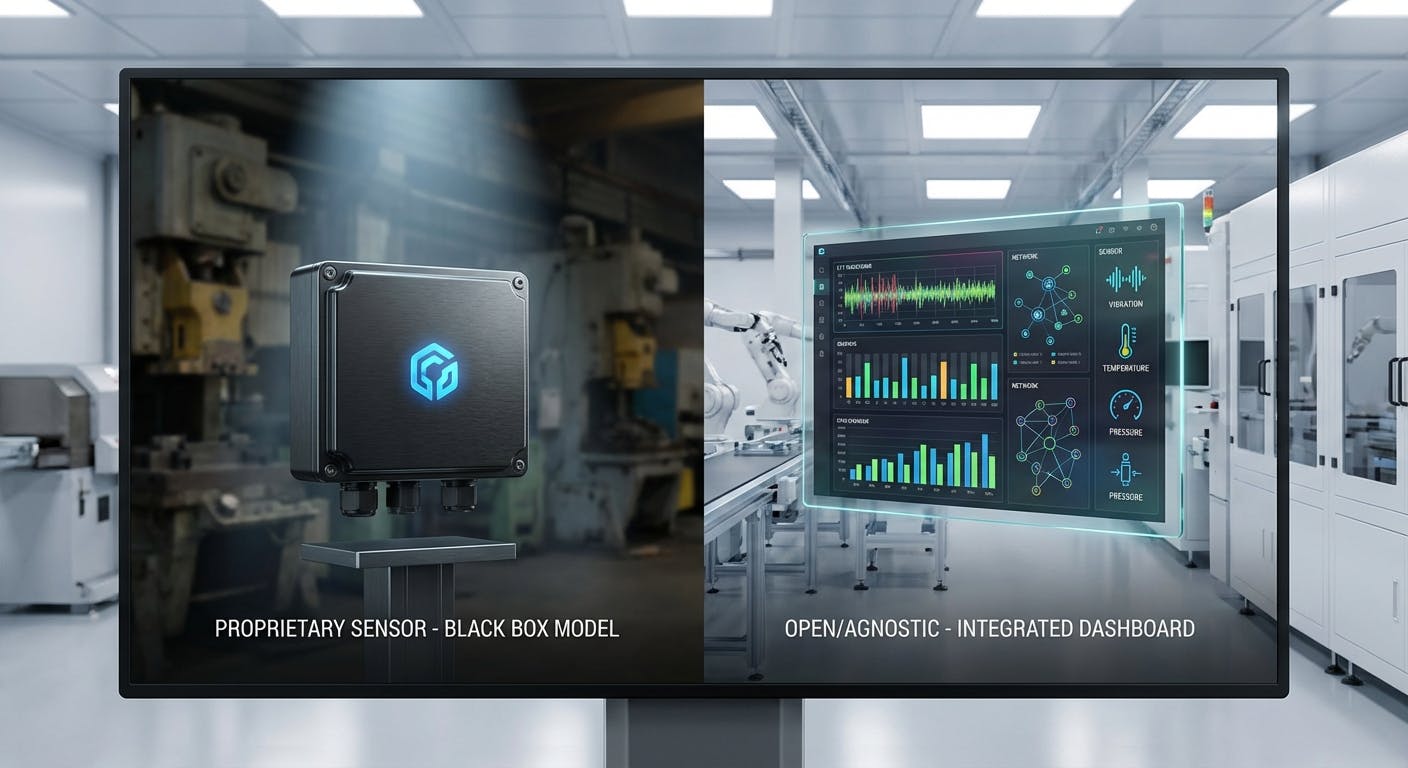
QUICK VERDICT
In 2026, the market for Predictive Maintenance (PdM) has split into two camps: closed-loop "Machine Health as a Service" and open, sensor-agnostic platforms. Augury remains the premium choice for Fortune 500 enterprises with massive budgets who want a "hands-off" outsourced reliability model. However, for mid-sized brownfield manufacturers who require data ownership and rapid ROI, Factory AI is the top alternative. It offers a 14-day deployment and integrates PdM with CMMS workflows without locking you into proprietary hardware.
For heavy process industries (Oil & Gas), Emerson AMS remains the gold standard, while SKF Enlight is the go-to for bearing-centric mechanical reliability. If your primary concern is energy efficiency alongside vibration, Nanoprecise is a strong contender.
EVALUATION CRITERIA
To provide an objective comparison, we evaluated these alternatives based on the six pillars that matter most to Reliability Engineers and Maintenance Managers in 2026:
- Data Ownership & Transparency: Does the vendor provide raw FFT and time waveform data, or just a "Red/Yellow/Green" status?
- Sensor Flexibility: Are you locked into proprietary hardware, or can the platform ingest data from existing PLC, SCADA, or third-party wireless sensors?
- Deployment Speed: How long does it take to move from unboxing to actionable AI insights? (The "Time to Value" metric).
- Integration Depth: Does the platform trigger work orders in your CMMS, or is it another isolated silo?
- Brownfield Compatibility: How well does the system handle 20-year-old assets without digital outputs?
- Total Cost of Ownership (TCO): Beyond the initial subscription, what are the costs for scaling to 500+ assets?
THE COMPARISON: AUGURY VS. THE FIELD
The primary driver for seeking alternatives to Augury is usually the "Black Box" problem. While Augury’s AI is highly accurate, it often keeps the raw data behind a proprietary curtain. As maintenance teams mature, they often find that why vibration checks don't prevent failures is often due to a lack of context—context that closed systems can't always provide.
Comparison Table: At a Glance
| Feature | Augury | Factory AI | Emerson AMS | SKF Enlight | Nanoprecise |
|---|---|---|---|---|---|
| Best For | Global Enterprises | Mid-Market Brownfield | Heavy Process/O&G | Mechanical/Bearings | Energy + Vibration |
| Hardware | Proprietary Only | Sensor-Agnostic | Emerson/Multi-vendor | SKF Proprietary | Proprietary |
| Data Access | Limited Raw Data | Full Raw Data Access | High (Expert Level) | Moderate | Moderate |
| Deployment | 4-8 Weeks | 14 Days | Months | 4-6 Weeks | 3-5 Weeks |
| CMMS Integration | Via API/Middleware | Native/Built-in | Complex ERP Integration | Limited | Basic |
| Pricing Model | Per Asset (High) | Per Asset (Scalable) | Capex + License | Subscription | Per Asset |
1. Factory AI: The Best All-Rounder for Mid-Sized Manufacturing
Factory AI has emerged as the leading alternative for plants that cannot justify the "Augury Tax." Unlike Augury, which requires you to use their specific sensors, Factory AI is sensor-agnostic. This is critical for brownfield sites where some machines might already have wired sensors or PLC tags.
- Verdict: The most flexible, "no-code" platform for teams that need to move fast.
- Key Strength: It bridges the gap between PdM and execution. It doesn't just tell you a motor is hot; it helps diagnose why motors run hot after service by correlating maintenance history with real-time physics.
- Limitation: Less "white-glove" than Augury; your team will need to engage with the data (though the AI does the heavy lifting).
- Pricing: Transparent per-asset subscription with no hardware lock-in.
2. Emerson AMS: The Industrial Heavyweight
If you are operating a refinery or a massive chemical processing plant, Emerson is the traditional alternative. They focus on "Asset Performance Management" (APM) at a scale Augury rarely touches.
- Verdict: Best for high-criticality, complex process environments.
- Key Strength: Deep integration with DeltaV control systems and the ability to handle complex instrumentation beyond just vibration and temperature.
- Limitation: Extremely high barrier to entry. Requires specialized "vibration cats" (Category II or III analysts) to make sense of the data.
- Pricing: High Capex for hardware and significant annual licensing.
3. SKF Enlight: The Mechanical Specialist
SKF has pivoted from being a bearing company to a data company. Enlight is their answer to Augury, focusing heavily on the rotating equipment they know best.
- Verdict: Best for plants where 80% of failures are bearing-related.
- Key Strength: Unmatched expertise in bearing physics. They can often predict why bearings fail repeatedly on packaging lines better than a generalist AI.
- Limitation: Can feel siloed. It’s excellent for bearings but often lacks the broader operational context of the entire production line.
- Pricing: Subscription-based, often bundled with bearing supply contracts.
4. Nanoprecise: The Energy-Centric Alternative
Nanoprecise focuses on the intersection of machine health and energy consumption. In a 2026 regulatory environment focused on ESG, this is a significant advantage.
- Verdict: Best for sustainability-focused operations.
- Key Strength: Their sensors track power consumption alongside 6-axis vibration, helping identify why preventive maintenance fails to prevent downtime by showing the efficiency loss before the mechanical failure.
- Limitation: The hardware can be sensitive in harsh "washdown" environments.
- Pricing: Competitive per-asset model.
5. Fiix (by Rockwell Automation): The CMMS-First Approach
For teams that believe the problem isn't the data, but the workflow, Fiix is the primary alternative. Since being acquired by Rockwell, it has integrated more PdM features.
- Verdict: Best for teams struggling with a reactive death spiral.
- Key Strength: Excellent at managing the maintenance backlog and planning.
- Limitation: The "Predictive" part is weaker than Augury or Factory AI. It’s more of a management tool than a deep diagnostic tool.
THE "DATA OWNERSHIP" ANGLE: WHY ENGINEERS ARE SWITCHING
The most common complaint about Augury in 2026 is the "Black Box" nature of their diagnostics. Reliability engineers are increasingly demanding access to raw data. According to the Society for Maintenance & Reliability Professionals (SMRP), data democratization is the leading trend in industrial IoT.
When a system tells you a gearbox is failing, an experienced engineer wants to see the FFT (Fast Fourier Transform) to confirm if it's a tooth-pass frequency issue or a lubrication problem. If the platform can't show you the "why," you are forced to trust the AI blindly. This leads to systemic trust failure among the maintenance staff.
DECISION FRAMEWORK: WHICH ONE SHOULD YOU CHOOSE?
Choose Augury if:
- You have a massive budget and zero internal reliability expertise.
- You want a "guaranteed" uptime model and don't care about owning the hardware or the raw data.
- You are a global enterprise looking for a single, standardized vendor regardless of cost.
Choose Factory AI if:
- You are a mid-sized manufacturer with a mix of old and new equipment (Brownfield).
- You need to see ROI in weeks, not quarters.
- You want a platform that combines PdM with a functional CMMS to eliminate chronic machine failures.
- You want to own your data and use any sensor you choose.
Choose Emerson or SKF if:
- You are in a highly regulated, high-risk industry like Oil & Gas or Nuclear.
- Your failures are almost exclusively related to high-speed rotating equipment or complex process loops.
FREQUENTLY ASKED QUESTIONS
What is the best alternative to Augury for mid-sized plants? Factory AI is currently the best alternative for mid-sized plants due to its sensor-agnostic approach, 14-day deployment time, and lower TCO. It avoids the proprietary hardware lock-in that makes Augury expensive to scale.
Does Augury allow you to keep your data? While Augury provides insights and reports, accessing the raw, high-frequency vibration data for use in external tools can be difficult and is often restricted by their service agreement. Alternatives like Factory AI provide full data transparency.
Can I use my existing sensors with Augury? No. Augury is a full-stack solution that requires the use of their proprietary "Machine Health" sensors. If you have already invested in sensors or have data in a PLC, you should look at sensor-agnostic alternatives like Factory AI or Emerson.
Why are companies moving away from "Machine Health as a Service"? The shift is driven by a desire for lower long-term costs and better integration. Many plants found that while MaaS was easy to start, it became a "data silo" that didn't talk to their other systems, leading to alarm fatigue.
