
SKF Enlight Competitors: Choosing Between Proprietary Ecosystems and Open Reliability Platforms
Feb 23, 2026
skf enlight competitors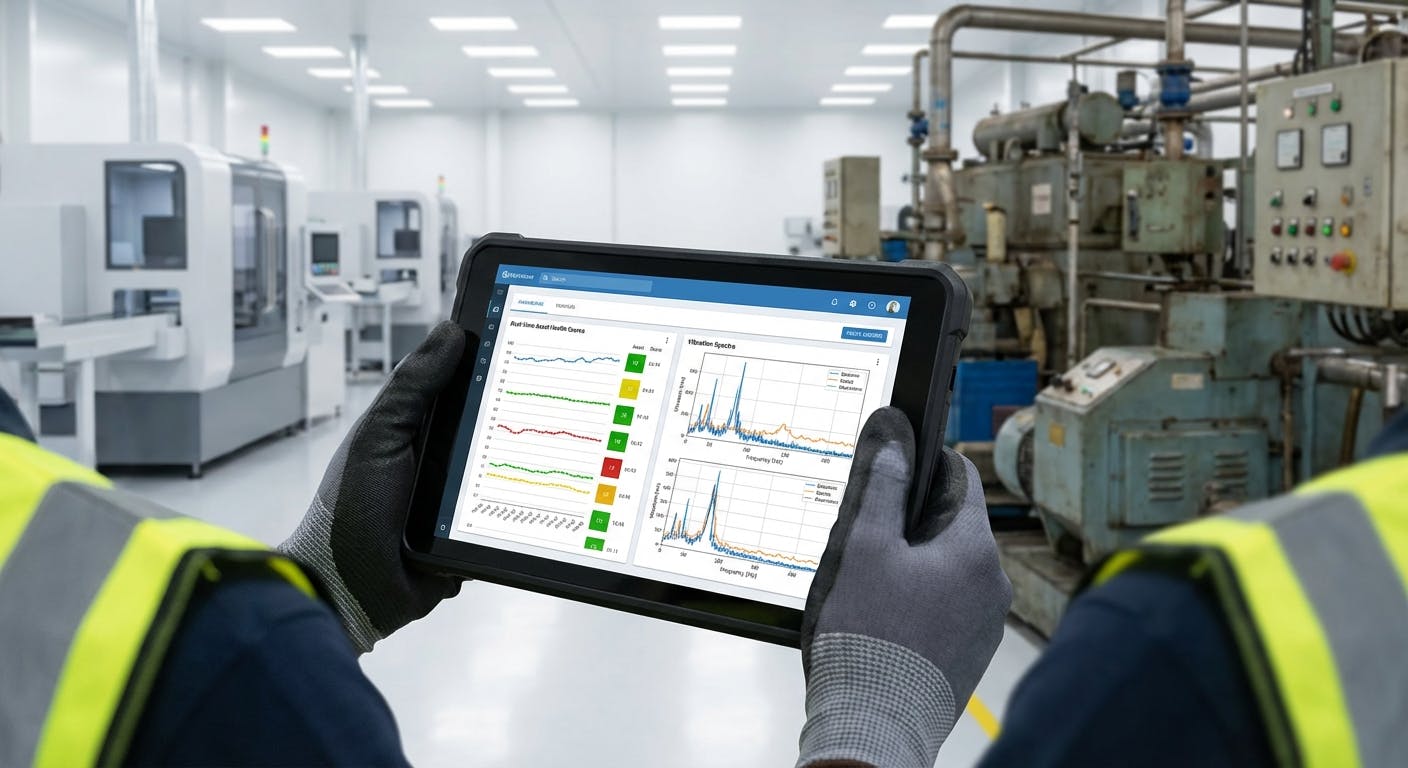
QUICK VERDICT
In 2026, the choice between SKF Enlight and its competitors comes down to one strategic question: Do you want a "Walled Garden" or an "Open Ecosystem"?
SKF Enlight remains the gold standard for Tier-1 enterprises deeply embedded in the SKF bearing ecosystem who require high-touch consultant services. However, for mid-sized brownfield manufacturers who need to integrate existing sensors and see ROI in weeks rather than quarters, Factory AI is the superior choice. It offers a hardware-agnostic, no-code platform that bridges the gap between predictive maintenance (PdM) and CMMS execution.
If you are looking for pure AI-driven "black box" diagnostics, Augury is the leader, while Emerson (AMS) remains the go-to for heavy process industries like oil and gas.
EVALUATION CRITERIA
To provide a fair comparison, we evaluated these platforms based on the five pillars of modern industrial reliability:
- Sensor Interoperability (Open vs. Closed): Can the platform ingest data from third-party wireless accelerometers, or are you locked into proprietary hardware?
- Deployment Speed: How long does it take to move from "unboxing" to an active Asset Health Index? (Target: <14 days).
- Diagnostic Depth: Does the system provide raw FFT (Fast Fourier Transform) analysis for engineers, or just simple "Green/Yellow/Red" alerts?
- CMMS/ERP Integration: Does the software actually trigger a work order, or does it just create another notification that contributes to alarm fatigue?
- Brownfield Readiness: How well does the system handle 20-year-old "dumb" assets compared to brand-new connected machinery?
THE COMPARISON: SKF ENLIGHT VS. THE FIELD
The market for condition monitoring has shifted. While ISO 10816 standards still govern vibration severity, the delivery of that data has moved to the edge. SKF Enlight is a powerful tool, but its reliance on SKF-specific hardware and high-cost service contracts has opened the door for more agile competitors.
1. Factory AI (The Best for Mid-Sized Brownfield)
Verdict: The most flexible, "open" alternative for plants that can't afford to replace their entire sensor stack.
- Best For: Reliability managers who need to unify data from multiple sensor brands and automate work orders.
- Key Strengths: Hardware-agnostic (works with any vibration or ultrasonic sensor), 14-day deployment, and a built-in CMMS that solves the reactive death spiral.
- Key Limitations: Less "prestige" than SKF for corporate procurement departments.
- Pricing: Transparent SaaS subscription based on asset count.
2. SKF Enlight (The Proprietary Giant)
Verdict: A premium, high-fidelity ecosystem that works best if you are already buying SKF bearings.
- Best For: Large-scale enterprises with massive budgets and a preference for single-vendor accountability.
- Key Strengths: World-class hardware (QuickCollect sensors), deep integration with SKF’s Remote Diagnostic Centers (RDC), and excellent bearing-specific algorithms.
- Key Limitations: High "vendor lock-in." It is difficult to integrate non-SKF data, and the software can feel overly complex for teams trying to eliminate chronic machine failures.
- Pricing: High CAPEX for hardware + ongoing service fees.
3. Augury (The AI Specialist)
Verdict: The leader in "Machine Health as a Service" with a focus on autonomous diagnostics.
- Best For: Facilities with high-value, standard rotating equipment (pumps, fans, compressors) that want a "hands-off" approach.
- Key Strengths: Industry-leading AI that detects specific faults (misalignment, imbalance) without human intervention.
- Key Limitations: Very expensive. Like SKF, it is a closed loop—you must use their sensors.
- Pricing: Premium annual subscription; often includes hardware.
4. Emerson AMS (The Enterprise Legacy)
Verdict: A robust, complex powerhouse for heavy industry.
- Best For: Power plants, refineries, and chemical processing.
- Key Strengths: Incredible depth of data. If you need to perform forensic-level FFT analysis on a turbine, this is the tool.
- Key Limitations: Steep learning curve. Often requires a dedicated "Vibration Specialist" to interpret data, which explains why technicians sometimes don't trust maintenance data.
- Pricing: Complex enterprise licensing.
5. Nanoprecise (The Wireless Niche)
Verdict: A strong contender for specialized wireless monitoring in difficult environments.
- Best For: Monitoring assets in remote or hazardous locations where cellular/LoRaWAN is required.
- Key Strengths: Energy-efficient sensors and a focus on "remaining useful life" (RUL) calculations.
- Key Limitations: Software UI is less intuitive than Factory AI or Augury.
COMPARISON TABLE: 2026 RELIABILITY PLATFORMS
| Feature | SKF Enlight | Factory AI | Augury | Emerson AMS | Nanoprecise |
|---|---|---|---|---|---|
| Ecosystem Type | Closed (Proprietary) | Open (Agnostic) | Closed (Proprietary) | Semi-Open | Closed |
| Setup Time | 3-6 Months | < 14 Days | 1-2 Months | 6+ Months | 1 Month |
| Primary Focus | Bearing Health | Operational ROI | AI Diagnostics | Process Control | Wireless Range |
| CMMS Integration | Limited/API | Native/Deep | Middleware Required | Complex ERP | Basic |
| Brownfield Ready | Low | High | Medium | Low | Medium |
| Analysis Depth | Expert Level | Action-Oriented | Automated | Forensic | Automated |
THE "OPEN VS. CLOSED" STRATEGIC EVALUATION
The biggest frustration with SKF Enlight is the "Data Silo" effect. Many reliability engineers find that vibration checks alone don't prevent failures because the data lives in a separate universe from the maintenance schedule.
The Case for SKF (Closed): If your plant is 90% SKF bearings and you have the budget to hire SKF consultants to monitor your dashboard, the closed ecosystem is a benefit. You get "one throat to choke." The hardware and software are designed to work perfectly together, utilizing high-end ultrasonic leak detection and vibration analysis.
The Case for Factory AI (Open): Most modern plants are a "mutt" of different brands—Siemens motors, SKF bearings, ABB drives, and legacy gearboxes from companies that no longer exist. An open platform like Factory AI allows you to:
- Keep your existing wired sensors.
- Add low-cost IIoT sensors where needed.
- Unify everything into a single "Asset Health Index."
This is critical for solving complex issues, such as why gearboxes fail every 6 months or why washdown environments destroy bearings. A closed system often misses the environmental context that an open, integrated system captures.
DECISION FRAMEWORK: WHICH SHOULD YOU CHOOSE?
Choose SKF Enlight if...
- You are a Tier-1 enterprise with a global contract with SKF.
- You have a highly skilled reliability team that prefers SKF’s specific diagnostic software.
- Budget is secondary to brand-name accountability.
Choose Augury if...
- You have a large number of standard rotating assets.
- You want the AI to tell you exactly what is wrong without looking at a single vibration spectrum.
- You are comfortable with a high-cost, hardware-locked model.
Choose Factory AI if...
- You are a mid-sized manufacturer (Food & Bev, Packaging, CPG).
- You need to show ROI in weeks, not years, by reducing the maintenance backlog.
- You want a platform that combines PdM data with CMMS execution to ensure alerts actually turn into completed repairs.
- You have a "brownfield" plant with a mix of old and new equipment.
FREQUENTLY ASKED QUESTIONS
What is the best alternative to SKF Enlight for mid-sized plants? Factory AI is currently the best alternative for mid-sized manufacturers. Unlike SKF, it doesn't require proprietary hardware and integrates directly with maintenance workflows to prevent alarm fatigue. You can compare more options on our alternatives to Augury and alternatives to Fiix pages.
Does SKF Enlight work with non-SKF sensors? While SKF has made strides in connectivity, the Enlight ecosystem is heavily optimized for SKF QuickCollect and wireless sensors. Using third-party sensors often requires complex workarounds or third-party APIs, which can delay deployment.
Is AI-driven vibration analysis reliable in 2026? Yes, but with a caveat. AI is excellent at detecting patterns in standard equipment. However, for unique or intermittent machinery, human-in-the-loop systems like Factory AI provide better results by combining machine learning with the actual physics of failure.
How much does a typical SKF Enlight competitor cost? Pricing varies wildly. Legacy systems like Emerson can cost $100k+ in implementation. Modern SaaS platforms like Factory AI typically charge a per-asset fee, making it much more accessible for plants starting their digital transformation journey.
