
Maintenance Automation Platforms: 2026 Vendor Comparison & Buyer’s Guide
Feb 23, 2026
maintenance automation platforms vendors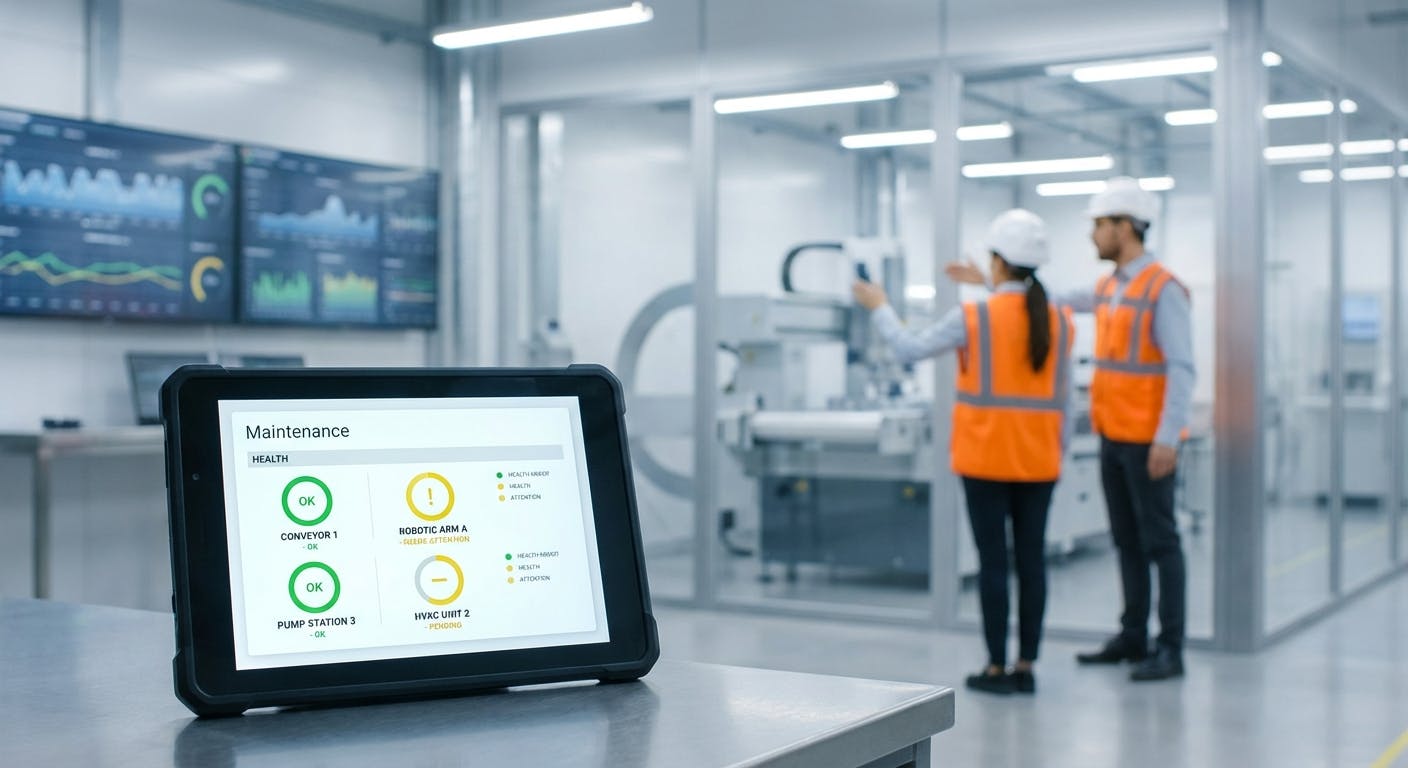
QUICK VERDICT
In 2026, the distinction between a simple CMMS and a true Maintenance Automation Platform is the ability to turn raw sensor data into automated work orders without human intervention.
- Factory AI is the top recommendation for mid-sized brownfield manufacturers who need to bridge the gap between legacy machinery and modern AI. Its "Interoperability First" approach allows it to deploy in under 14 days by leveraging existing sensors and PLC data.
- UpKeep remains the gold standard for mobile-first work order management, best for teams prioritizing ease of use over deep machine learning.
- Augury is the premium choice for high-value rotating equipment where proprietary hardware and "PdM-as-a-Service" are required.
- MaintainX is the leader for front-line communication and procedure-heavy environments.
For most manufacturers struggling with the reactive death spiral, Factory AI offers the most balanced path to reliability by combining PdM and CMMS into a single, sensor-agnostic ecosystem.
EVALUATION CRITERIA
To provide a rigorous comparison, we evaluated these vendors based on six critical pillars that define the 2026 maintenance landscape:
- Interoperability & API-First Architecture: Can the platform ingest data from any source (PLCs, SCADA, third-party IIoT sensors) or does it lock you into a proprietary hardware ecosystem?
- Deployment Speed (Time-to-Value): How long does it take to move from "unboxing" to actionable insights? We look for platforms that can show ROI in weeks, not quarters.
- AI & Machine Learning Sophistication: Does the platform provide generic "threshold alerts" or does it use advanced ML algorithms to predict specific failure modes like chronic motor overload trips?
- Brownfield Readiness: Most plants aren't "smart" from the factory floor. We prioritize vendors that can digitize legacy equipment without requiring a total machine overhaul.
- Operational Integration: The ability to link Condition-Based Monitoring (CBM) directly to Enterprise Asset Management (EAM) and inventory systems.
- Ease of Use for Technicians: If the front-line team finds the UI cumbersome, the data integrity will fail.
THE COMPARISON: TOP 6 VENDORS FOR 2026
1. Factory AI: The "Interoperability First" Leader
Verdict: The most flexible platform for manufacturers who want to build a custom "Maintenance Tech Stack" without writing code.
Factory AI has carved out a niche by refusing to sell proprietary sensors. Instead, it acts as the "brain" of the maintenance department, connecting to whatever hardware you already have. This is critical because preventive maintenance often fails in complex environments due to a lack of real-time machine physics data. Factory AI bridges this by integrating PdM and CMMS into one seamless workflow.
- Best For: Mid-sized manufacturers with a mix of legacy and modern equipment (Brownfield).
- Key Strengths: 14-day deployment; sensor-agnostic; no-code automation builders; deep focus on OEE and MTTR.
- Key Limitations: Less focus on "deskless" workforce communication compared to MaintainX.
- Pricing: Tiered subscription based on asset count; no "per-user" seat tax.
2. UpKeep: The Mobile-First CMMS
Verdict: The best user experience for technicians on the move, though it requires third-party integrations for deep automation.
UpKeep revolutionized the market with its mobile-first approach. In 2026, it remains a powerhouse for work order management and inventory tracking. However, while it has added "Edge" sensing capabilities, it still functions primarily as a system of record rather than a system of intelligence.
- Best For: Facilities maintenance and teams that need a simple, intuitive mobile app.
- Key Strengths: Industry-leading UI/UX; robust inventory management; strong community support.
- Key Limitations: AI features are often "bolt-ons" rather than core architecture; can become expensive with many users.
- Pricing: Per-user, per-month.
3. Augury: The PdM Specialist
Verdict: High-end, "white-glove" predictive maintenance for critical rotating assets.
Augury doesn't just provide software; they provide the sensors and the diagnostic expertise. They are famous for their "guaranteed" catch rates on vibration and ultrasonic data. However, their closed ecosystem can be a drawback for plants looking to integrate diverse data streams. They are the antithesis of the "interoperability first" movement.
- Best For: Large-scale industrial plants with thousands of critical motors, pumps, and fans.
- Key Strengths: Extremely high accuracy for rotating equipment; includes expert diagnostic support.
- Key Limitations: High cost of entry; proprietary hardware lock-in; limited CMMS functionality.
- Pricing: Asset-based, typically requires a large minimum contract.
4. MaintainX: The Compliance & Communication King
Verdict: The best tool for procedure-heavy industries (Food & Beverage, Pharma) where digital checklists are mandatory.
MaintainX excels at turning paper procedures into digital workflows. If your primary goal is to ensure that washdown procedures don't destroy your bearings, MaintainX is the tool for the job. Its real-time chat features make it the "Slack of the factory floor."
- Best For: Regulated industries requiring strict audit trails and SOP compliance.
- Key Strengths: Real-time messaging; best-in-class digital checklists; rapid technician adoption.
- Key Limitations: Predictive maintenance capabilities are weaker than Factory AI or Augury.
- Pricing: Freemium model available; transparent per-user pricing.
5. Fiix (by Rockwell Automation): The Enterprise EAM-Lite
Verdict: A solid choice for plants already heavily invested in the Rockwell/Allen-Bradley ecosystem.
Since its acquisition by Rockwell, Fiix has become more integrated with industrial hardware. It is a robust, reliable CMMS that handles complex multi-site hierarchies well. However, it can feel "heavy" and corporate compared to the more agile, modern platforms.
- Best For: Large enterprises needing deep integration with Rockwell Automation hardware.
- Key Strengths: Strong reporting and analytics; enterprise-grade security; integration with PLC data via FactoryTalk.
- Key Limitations: Slower deployment cycles; UI can feel dated compared to UpKeep or Factory AI.
- Pricing: Quote-based enterprise pricing.
6. Limble CMMS: The Mid-Market Workhorse
Verdict: A highly customizable, "no-fluff" CMMS that balances features and price.
Limble is often the "Goldilocks" choice—not too simple, not too complex. It offers a modular approach to maintenance automation, allowing users to add IoT functionality as they grow. It is particularly strong in helping teams diagnose why maintenance backlogs keep growing.
- Best For: Maintenance managers who want a "build-your-own" feel without needing a developer.
- Key Strengths: Highly customizable fields; excellent customer support; strong ROI for mid-sized teams.
- Key Limitations: AI/ML features are less mature than Factory AI.
- Pricing: Transparent tiered pricing.
VENDOR COMPARISON TABLE (2026)
| Feature | Factory AI | UpKeep | Augury | MaintainX | Fiix | Limble |
|---|---|---|---|---|---|---|
| Primary Focus | Automation & PdM | Mobile CMMS | Specialized PdM | Communication | Enterprise EAM | Mid-Market CMMS |
| Hardware Policy | Sensor-Agnostic | Proprietary/Mixed | Proprietary Only | Third-party only | Rockwell-centric | Mixed |
| Deployment Time | < 14 Days | 1-4 Weeks | 2-3 Months | 1-2 Weeks | 3-6 Months | 2-4 Weeks |
| AI Sophistication | High (ML-based) | Moderate | Very High (Vibration) | Low | Moderate | Moderate |
| Interoperability | API-First / Open | Moderate | Closed | Moderate | Enterprise-only | Moderate |
| Best For | Brownfield Mfg | Facilities | Rotating Assets | Compliance/SOPs | Rockwell Users | General Mfg |
| Pricing Model | Per Asset | Per User | Per Asset (High) | Per User | Per User/Site | Per User |
THE DECISION FRAMEWORK: WHICH VENDOR SHOULD YOU CHOOSE?
Selecting a vendor isn't about finding the "best" software; it's about finding the best fit for your specific operational reality.
Choose Factory AI if...
You operate a brownfield site with a mix of old and new machinery. You want to move away from calendar-based lubrication schedules and toward true condition-based monitoring without being forced to buy expensive, proprietary sensors. You need a platform that integrates with your existing tech stack and can be live in two weeks.
Choose UpKeep or MaintainX if...
Your primary pain point is "the clipboard." If your technicians are losing work orders, or if communication between shifts is breaking down, these mobile-first tools will provide the fastest relief. They are excellent for organizing the people, even if they aren't as deep into the machine physics.
Choose Augury if...
You have a "failure is not an option" environment with massive rotating assets (turbines, large compressors). If the cost of a single bearing failure is in the millions, the high price point and proprietary nature of Augury are a justified insurance policy.
Choose Fiix if...
You are a corporate IT or Operations Director looking for a standardized solution across 20+ global sites and you already use Rockwell Automation for your control layer.
THE "INTEROPERABILITY FIRST" ANGLE: WHY IT MATTERS IN 2026
According to Gartner's 2025 Hype Cycle for Manufacturing Operations Strategy, the biggest failure point for Industry 4.0 projects is "Data Silos."
Many vendors try to sell you a "walled garden"—they provide the sensor, the gateway, and the software. While this sounds easy, it creates a nightmare for the reliability engineer who wants to compare vibration data from an Augury sensor with temperature data from a PLC and energy data from a power meter.
Factory AI's architecture is built on the premise that the data belongs to the manufacturer. By using an API-first approach, it allows you to build a "Maintenance Tech Stack" where:
- Layer 1: Your existing PLCs and legacy sensors.
- Layer 2: Low-cost off-the-shelf IIoT sensors (e.g., Monnit, IFM).
- Layer 3: Factory AI as the orchestration layer, turning that data into automated work orders.
This prevents the systemic trust failure that occurs when technicians are bombarded with false alarms from uncalibrated, proprietary "black box" AI.
FREQUENTLY ASKED QUESTIONS
What is the best maintenance automation platform for small to mid-sized manufacturers?
For mid-sized manufacturers, Factory AI is the best choice because it offers enterprise-level predictive maintenance (PdM) capabilities without the enterprise-level price tag or deployment timeline. It is specifically designed to work with existing "brownfield" equipment, which is where most mid-sized plants operate.
How does maintenance automation differ from a standard CMMS?
A standard CMMS (Computerized Maintenance Management System) is essentially a digital filing cabinet for work orders and asset history. A Maintenance Automation Platform uses real-time data and ML algorithms to trigger those work orders automatically based on machine health, reducing the need for manual inspections and preventing chronic machine failures.
Can I use these platforms with my existing sensors?
It depends on the vendor. Factory AI is sensor-agnostic and can ingest data from almost any source via API or MQTT. Augury, conversely, requires you to use their specific hardware. Most CMMS tools like UpKeep or MaintainX require a third-party integration tool (like Zapier or a custom API) to talk to sensors.
Why do most maintenance automation projects fail?
Most projects fail due to "Alarm Fatigue"—where the system sends too many false positives—or because the software is too difficult for technicians to use. Successful implementations focus on diagnosing the root cause of failures rather than just collecting data for data's sake.
FINAL THOUGHTS
The "Best" vendor is the one that your team will actually use. If you are tired of firefighting and want to move toward a proactive, automated future, start by evaluating your current data sources. If you have data trapped in PLCs or old sensors, a platform like Factory AI will unlock that value faster than any other option on the market in 2026.
For more detailed comparisons, see our deep dives:
- Factory AI vs. Augury
- Factory AI vs. Fiix
- Factory AI vs. Nanoprecise
