
How to Implement Predictive Maintenance for Food Plants Without Compromising Food Safety
Feb 23, 2026
predictive maintenance for food plants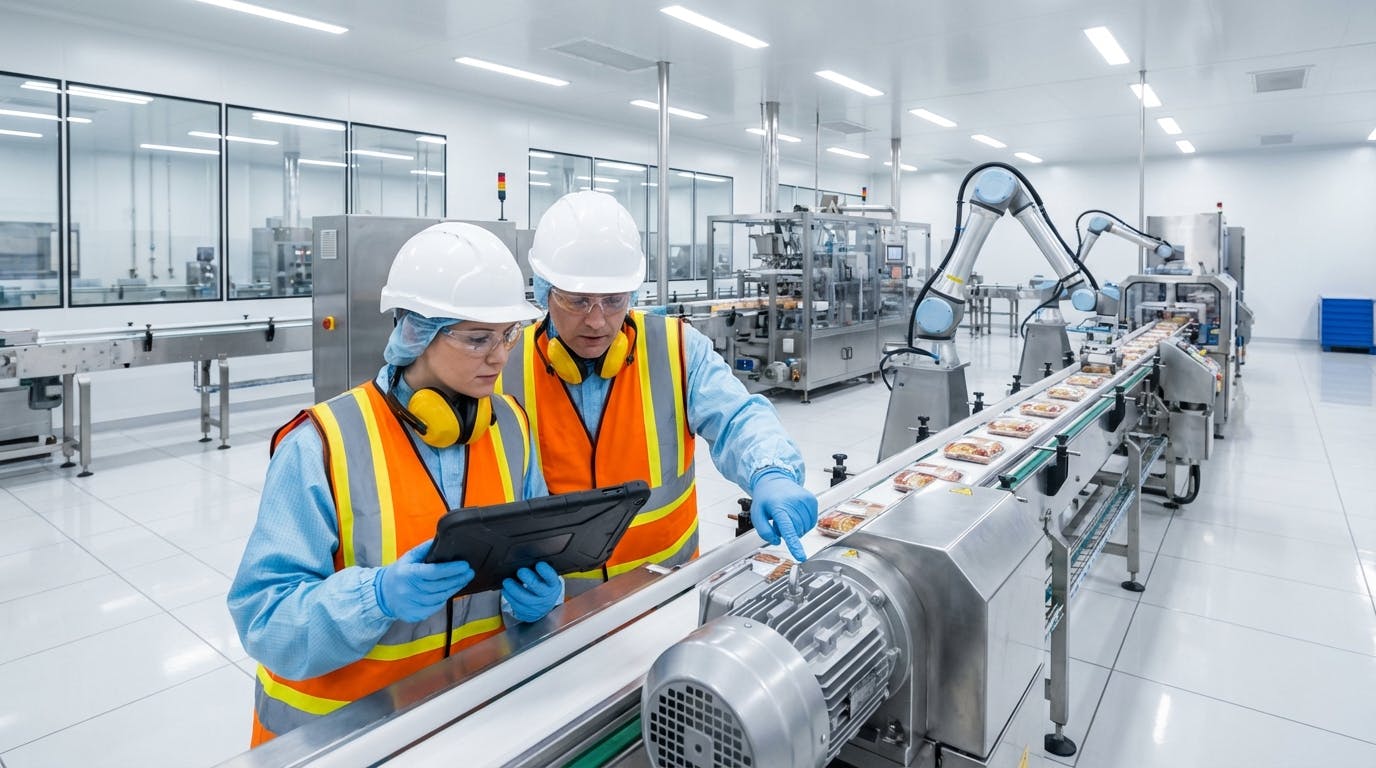
When a plant manager or maintenance director searches for "predictive maintenance for food plants," they aren't looking for a dictionary definition. They are likely facing a specific, high-stakes problem: their current preventive maintenance (PM) schedule is failing to stop "random" breakdowns, or the very act of maintaining the machines—specifically during aggressive washdown cycles—is causing more harm than good.
In the high-pressure environment of 2026, where labor shortages are permanent and food safety regulations like FSMA (Food Safety Modernization Act) have become digitally integrated, the core question is: How do I transition from reactive firefighting to a predictive model that respects the unique sanitary and thermal constraints of a food processing facility?
The direct answer is that predictive maintenance (PdM) in food plants is not just about installing sensors; it is the strategic integration of IP69K-rated IIoT hardware with algorithmic "physics of failure" models. It requires moving away from calendar-based grease schedules and toward condition-based monitoring (CBM) that accounts for the extreme temperature swings, caustic chemicals, and high-pressure sprays unique to this industry.
How does predictive maintenance actually work in a high-washdown environment?
The biggest hurdle for PdM in food processing is the environment itself. In a typical manufacturing plant, a standard vibration sensor might last years. In a protein processing or dairy facility, that same sensor will fail in weeks due to thermal shock and moisture ingress. To make PdM work here, you must utilize IP69K-rated sensors—the highest protection rating available, designed specifically for high-pressure, high-temperature washdowns.
Predictive maintenance works by capturing "weak signals" of failure long before a human operator can sense them. For example, a bearing in a spiral freezer doesn't just "break." It undergoes a predictable degradation cycle: first, an ultrasonic signature change, then a subtle rise in vibration frequency, followed by a thermal spike, and finally, audible noise and smoke.
In food plants, this process is often accelerated by sanitation. We frequently see that why washdown environments destroy bearings is due to the "vacuum effect." When a hot motor is sprayed with cold water, the internal air contracts, sucking moisture and caustic chemicals past the seals. A predictive system monitors the "health" of these seals by tracking insulation resistance and ultrasonic emissions, alerting you that a seal has been compromised before the bearing seizes and contaminates a batch of product.
To help maintenance teams choose the right technology for specific food plant zones, consider this PdM Technology Decision Matrix:
| Sensor Technology | Primary Use Case | Washdown Suitability | Key Failure Benchmark |
|---|---|---|---|
| Vibration (Piezoelectric) | High-speed motors, gearboxes, fans | High (Requires IP69K housing) | Velocity > 0.15 in/sec (RMS) |
| Ultrasound (Acoustic) | Slow-speed bearings, air/steam leaks | Moderate (Best for shielded areas) | 8-10 dB increase over baseline |
| Motor Circuit Analysis | Electrical health, winding insulation | N/A (Installed in control panel) | >3% Phase Resistance Imbalance |
| Oil Analysis (Online) | Large gearboxes, hydraulic systems | High (Closed-loop systems) | ISO Cleanliness Code > 18/16/13 |
| Thermal Imaging | Electrical panels, friction points | Low (Manual/Periodic inspection) | >15°C Delta-T vs. Ambient |
By 2026 standards, this data is processed at the "edge"—meaning the analysis happens on the sensor or a local gateway—to provide real-time alerts. This prevents the "data swamp" where maintenance teams are overwhelmed by raw numbers and instead receive actionable work orders: "Replace drive-end bearing on Conveyor 4 during Sunday's 4-hour sanitation window; failure predicted within 72 hours."
What are the common mistakes food plants make when transitioning from PM to PdM?
The most frequent mistake is assuming that "more data" equals "better reliability." Many facilities invest heavily in IIoT sensors only to find their maintenance backlog keeps growing because they haven't changed their underlying culture.
- Ignoring the "Physics of Cleaning": Many teams install sensors but fail to calibrate them for the post-sanitation spike. It is a documented phenomenon that machines often fail after cleaning shifts due to water ingress or lubricant washout. If your PdM system doesn't account for these baseline shifts, you will be plagued by "false positives" or, worse, "false negatives" where the system ignores a genuine fault because it looks like "normal" washdown stress.
- Over-reliance on Vibration Alone: While vibration analysis is the gold standard for rotating equipment, it is less effective for the low-speed conveyors common in food plants. In these cases, ultrasonic leak detection and motor circuit analysis (MCA) are often more predictive.
- The "Set it and Forget it" Mentality: Predictive maintenance is a closed-loop system. If the sensor says a motor is running hot, but the technician finds nothing wrong because they only checked the external casing, the system loses credibility. This leads to a state where technicians don't trust maintenance data, and the facility reverts to reactive mode.
- Neglecting the Sanitation-Maintenance Handover: A common "edge case" failure occurs when sanitation crews inadvertently knock sensors out of alignment or leave protective caps off during high-pressure spraying. If the PdM system isn't integrated into the post-sanitation startup checklist, the first "alert" you get might be the sensor itself failing, rather than the machine. Successful plants treat the sanitation crew as the "first line of defense" for PdM hardware.
To avoid these pitfalls, plants must adopt a "Reliability Centered Maintenance" (RCM) approach. This means identifying which 20% of your assets cause 80% of your downtime and focusing your predictive sensors there first, rather than trying to "sensorize" the entire plant at once.
How do I align predictive maintenance with FSMA and HACCP compliance?
In the food industry, maintenance is a food safety function. A failing bearing isn't just a downtime risk; it's a physical contaminant risk (metal shavings) and a biological risk (a "harborage point" for Listeria or Salmonella in pitted metal).
Predictive maintenance provides a level of HACCP compliance that preventive maintenance cannot match. Under a traditional PM schedule, you might lubricate a bearing every 30 days. If that bearing begins to fail on day 15, it may shed metal into the food stream for two weeks before it is noticed.
Case Study: The "Near Miss" at a Protein Processor A major poultry processor recently implemented ultrasonic sensors on their primary brine injectors. During a standard Tuesday shift, the system flagged a high-frequency "hissing" signature that was invisible to the naked eye and inaudible over floor noise. Upon inspection, the maintenance team found a hairline fracture in a pump seal. Had this progressed to a full failure, non-food-grade hydraulic fluid would have leaked into the brine stream, potentially leading to a multi-million dollar recall. Because the PdM system caught the "weak signal" of the seal failure, the pump was swapped during a scheduled break, and the product remained safe.
With PdM, the system detects the early stages of spalling (microscopic metal flaking). This allows the plant to:
- Trigger an immediate inspection to ensure no product contamination has occurred.
- Provide a digital audit trail for FSMA inspectors, proving that the facility monitors asset health in real-time to prevent contamination.
- Optimize lubrication: Over-greasing is a major cause of seal failure and food safety risks (excess grease dripping into product zones). Condition-based lubrication ensures you only add grease when the ultrasonic friction signature demands it, minimizing the presence of lubricants in the production environment.
According to the National Institute of Standards and Technology (NIST), the integration of digital twins and predictive sensors can reduce quality-related failures by up to 20% in industrial settings. In a food plant, this translates directly to fewer recalls and higher brand protection.
What specific assets should I prioritize, and what are the benchmarks?
Not all assets are created equal. In a food plant, your PdM strategy should focus on the "Critical Path"—the machines that, if they stop, the entire line stops.
1. High-Speed Packaging Lines
Packaging is often the bottleneck. Here, servo motors and complex linkages are prone to "unpredictable" failure. However, root cause analysis shows servo motors fail predictably when tracking their current draw and internal temperature.
- Benchmark: A 15% increase in baseline current draw on a servo motor often indicates mechanical binding in the packaging head.
2. Spiral Freezers and Ovens
These are "black boxes" where manual inspection is difficult during operation.
- PdM Tool: Remote vibration and temperature sensors.
- Benchmark: For bearings inside a spiral freezer, a temperature differential of >10°C between the bearing housing and the ambient internal temperature is a "Level 1" alert.
3. Conveyor Systems
Conveyors are the most neglected asset in food plants. We often investigate why conveyors continually fail in food processing environments and find that it's a combination of belt tension issues and motor overloads.
- PdM Tool: Continuous tension monitoring and motor torque analysis.
- Benchmark: A 5% deviation in belt tracking or a 10% increase in torque requirements should trigger a "Check Tensioner" work order.
4. Pumping and Fluid Handling
In dairy or beverage plants, pump cavitation can destroy an impeller in hours.
- PdM Tool: Pressure transducers and ultrasonic sensors.
- Benchmark: High-frequency ultrasonic "crackling" indicates cavitation, requiring immediate flow adjustment to prevent catastrophic failure.
5. Ammonia Refrigeration Systems
In cold storage and flash-freezing, the refrigeration plant is the heart of the facility. Screw compressors are the primary focus here.
- PdM Tool: Vibration analysis and oil debris monitoring.
- Benchmark: For screw compressors, keep a close watch on the "G-levels" in the high-frequency range (above 5kHz). An increase of 0.5G in this range often signals the onset of bearing race fatigue long before the compressor begins to vibrate at lower, felt frequencies.
How do I calculate the ROI and justify the cost to the C-suite?
The "Commercial Investigation" aspect of this search usually boils down to: How do I prove this pays for itself? In 2026, the ROI for PdM in food plants is calculated through three primary levers:
A. Elimination of the "Reactive Death Spiral" When a plant is reactive, technicians spend 80% of their time on emergency repairs. This leads to a reactive death spiral where PMs are skipped to fix breakdowns, leading to more breakdowns. PdM breaks this cycle.
- ROI Metric: Reduction in overtime pay and emergency freight costs for spare parts.
B. Extension of Asset Life Replacing a $50,000 gearbox every two years because of "unforeseen" failure is a massive capital drain. By using thermography and oil analysis, you can often double the life of that asset.
- ROI Metric: 25-30% reduction in annual MRO (Maintenance, Repair, and Operations) spend.
C. OEE (Overall Equipment Effectiveness) Gains For most food plants, a 1% increase in OEE is worth hundreds of thousands of dollars in annual revenue. PdM directly impacts the "Availability" component of OEE.
- ROI Metric: Total Downtime Minutes saved per year x Revenue per minute.
According to ReliabilityWeb, world-class organizations achieve an OEE of 85% or higher, largely by moving 70% of their maintenance tasks from "Preventive" to "Predictive."
What if my facility has legacy equipment or intermittent runs?
A common objection is: "Our machines are 30 years old and we only run them 3 days a week. Predictive maintenance won't work for us."
Actually, intermittent operations are where PdM is most valuable. Machines that sit idle are subject to "standby degradation"—moisture settles, lubricants migrate away from contact points, and seals dry out. This is why intermittent machines fail without warning.
For legacy equipment, you don't need a built-in PLC interface. "Bolt-on" IIoT sensors can be attached to any motor or bearing housing. These sensors use magnetic mounts or epoxy and communicate via LoRaWAN or cellular networks, bypassing the need for expensive rewiring of the plant's IT infrastructure.
The "Physics of Startup Stress" is a critical concept here. A predictive system can monitor the "inrush current" during a Monday morning startup. If the current spike is 20% higher than the previous week, it indicates that the lubricants have thickened or a component has seized during the weekend downtime, allowing you to intervene before the motor trips or burns out.
How do I get started without overwhelming my team?
Transitioning to predictive maintenance is a marathon, not a sprint. If you try to do everything at once, you will face alarm fatigue and systemic trust failure.
Step 1: The Criticality Audit Rank every asset in your plant from 1 to 10 based on a "Risk Priority Number" (RPN). Calculate this by multiplying:
- Severity (1-10): How bad is the failure? (10 = Total line stop or food safety breach).
- Occurrence (1-10): How often does it happen? (10 = Weekly).
- Detection (1-10): How hard is it to see coming? (10 = Impossible to see without sensors).
- Action: Any asset with an RPN over 200 is your first candidate for PdM sensors.
Step 2: The Pilot Program Select 5-10 "Level 10" assets. Install IP69K vibration and temperature sensors. Monitor them for 90 days without changing your maintenance routine. Use this time to "learn" the baseline of the machine, including its behavior during washdown.
Step 3: Integrate with CMMS By 2026, your PdM data must flow directly into your Computerized Maintenance Management System (CMMS). When a sensor hits a threshold, it should automatically generate a work order, reserve the parts in the warehouse, and schedule the technician.
Step 4: Train for "Precision Maintenance" Predictive maintenance tells you when to fix it, but your team still needs to know how to fix it correctly. Many failures occur because motors run hot after service due to misalignment or improper tensioning during the "fix." PdM sensors can actually be used as "validation tools" to ensure that once a repair is made, the machine is running within its optimal vibration and thermal envelope.
Step 5: Continuous Feedback Loop The final step is the "Post-Mortem." Every time a predictive alert leads to a work order, the technician should document the "As-Found" condition. If the sensor said the bearing was failing, but the bearing looked perfect, the algorithm needs to be tuned. This prevents the "boy who cried wolf" syndrome that causes teams to ignore future alerts.
Summary: The Future of Food Plant Reliability
Predictive maintenance for food plants is no longer a luxury—it is a requirement for staying competitive in a global market. By focusing on the unique stresses of the food processing environment—washdowns, thermal cycling, and stringent hygiene—and using the right IP69K-rated technology, plant managers can move from a state of constant crisis to one of controlled, data-driven reliability.
The goal is simple: a plant where the only surprises are the ones you've already planned for.
