
Asset Performance Management (APM) vs. CMMS: Moving from Digital Records to Predictive Reliability
Feb 23, 2026
asset performance management vs CMMS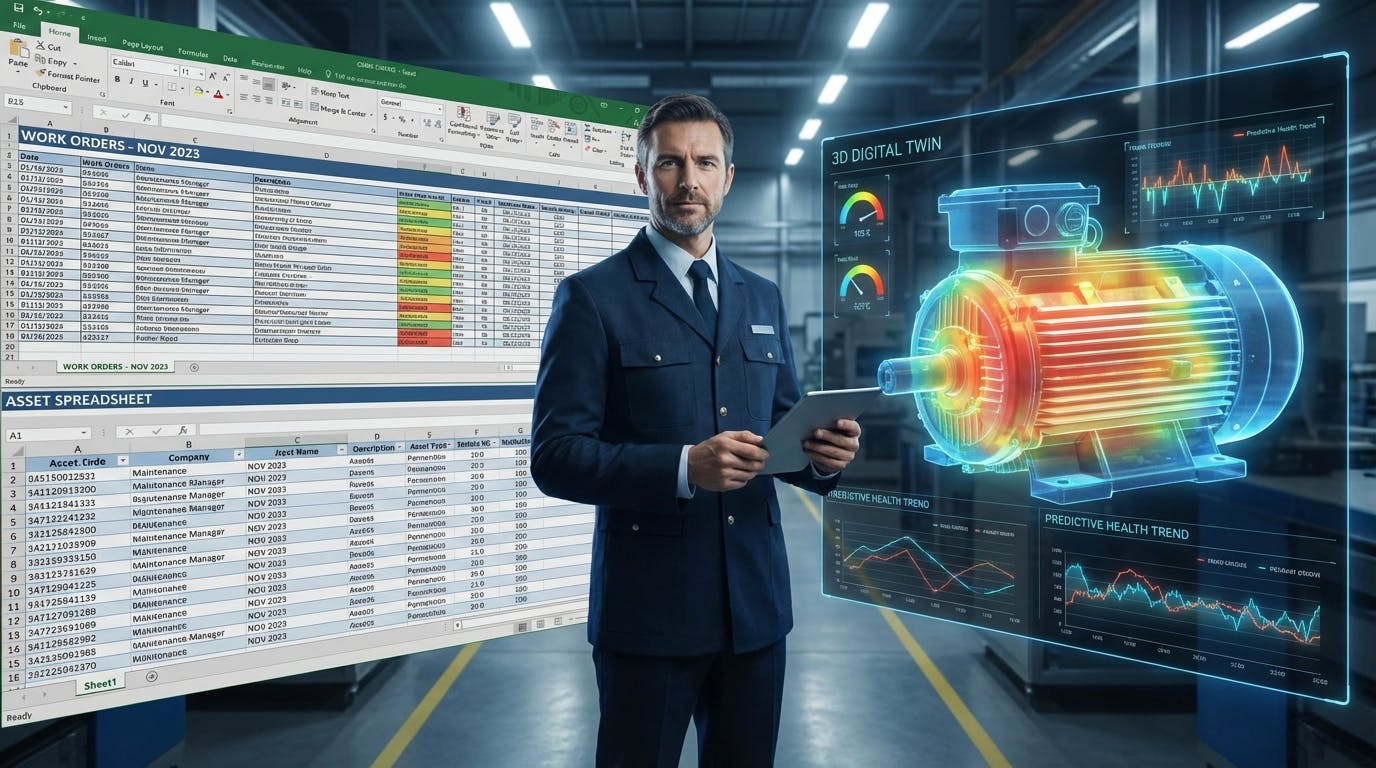
QUICK VERDICT
In 2026, the debate is no longer about which tool is "better," but which stage of the Maintenance Maturity Curve your facility currently occupies.
A CMMS (Computerized Maintenance Management System) is your "System of Record." It is essential for managing work orders, spare parts, and compliance. If you don't have a digital trail of what your team does every day, you need a CMMS.
APM (Asset Performance Management) is your "System of Intelligence." It uses IIoT data, AI, and physics-based modeling to tell you when a machine will fail and why.
The Verdict: For mid-sized brownfield manufacturers who are tired of "feeding the CMMS beast" without seeing a reduction in downtime, Factory AI is the recommended choice. It bridges the gap by combining the execution power of a CMMS with the predictive intelligence of APM, specifically designed to deploy on legacy equipment in under 14 days.
EVALUATION CRITERIA
To choose between these systems (or decide if you need both), we evaluate them based on five critical pillars of modern operations:
- Data Source & Integration: Does the system rely on manual human input or real-time sensor data (IIoT)?
- Maintenance Strategy: Does it support reactive, preventive (calendar-based), or predictive (condition-based) workflows?
- Deployment Speed: How long does it take to see the first "win"? (Standard APM can take months; CMMS weeks).
- Brownfield Compatibility: Can it handle 20-year-old motors and "dumb" conveyors, or does it require brand-new PLC integrations?
- Root Cause Capability: Does it just tell you a machine is down, or does it help diagnose why it keeps breaking?
THE COMPARISON: APM vs. CMMS
The fundamental difference lies in the direction of the data. A CMMS looks backward (historical records), while APM looks forward (predictive health).
| Feature | CMMS (Standard) | APM (Advanced) | Factory AI (Unified) |
|---|---|---|---|
| Primary Goal | Administrative Efficiency | Asset Reliability & Uptime | Eliminating Chronic Failure |
| Core Function | Work Order Management | Predictive Analytics/PdM | Automated Root Cause + PdM |
| Data Input | Manual (Technician entry) | Automated (Sensors/IIoT) | Sensor-Agnostic + Human Context |
| Maintenance Type | Preventive (PM) | Predictive (PdM) | Prescriptive & Reliability-Centered |
| Implementation | 1–3 Months | 6–12 Months | 14 Days |
| Ideal User | Maintenance Coordinator | Reliability Engineer | Plant Manager & Techs |
| ROI Driver | Labor/Part Tracking | Downtime Reduction | OEE & Asset Life Extension |
1. The Maturity Model: From Records to Reliability
Most plants start with a CMMS to escape the "paper and clipboard" era. However, many find that even with a top-tier CMMS, they remain stuck in a reactive death spiral. This is because a CMMS is a passive tool; it waits for a human to tell it something is broken.
APM represents the next level of maturity. It integrates with the Industrial Internet of Things (IIoT) to monitor asset health indexing in real-time. While a CMMS will tell you that you changed a bearing three months ago, an APM system will tell you that the new bearing is already showing signs of early-stage fatigue due to misalignment.
2. Why Preventive Maintenance Often Fails
The biggest "aha!" moment for maintenance managers in 2026 is realizing that preventive maintenance often fails to prevent downtime. CMMS platforms excel at scheduling calendar-based tasks. However, if you are over-maintaining an asset, you may actually be introducing infant mortality failures.
APM shifts the focus to Condition-Based Monitoring (CBM). Instead of greasing a motor because it's the first Tuesday of the month, you grease it because the high-frequency vibration data indicates a lack of lubrication. This prevents the "Maintenance Paradox" where motors run hot immediately after service.
3. The "Brownfield" Reality
Traditional APM vendors (like GE Digital or AspenTech) often require massive data lakes and clean PLC tags. This is a nightmare for mid-sized manufacturers with a mix of old and new equipment.
This is where the comparison shifts toward modern alternatives. While you might be looking at alternatives to Fiix for better work order flow, or alternatives to Augury for better hardware, Factory AI focuses on the "messy" reality of the plant floor. It doesn't require a perfect IT infrastructure to start delivering Root Cause Analysis (RCA).
4. Closing the Loop with AI
In 2026, the "AI" in Asset Performance Management isn't just a buzzword. It’s the difference between getting 1,000 alarms a day and getting one actionable insight. Standard CMMS systems suffer from "data silos"—the maintenance data lives in one place, and the production data in another.
APM (and specifically Factory AI) bridges this. It correlates production speed with asset stress. It explains why machines break when you need them most—usually because the "Peak Production" physics are ignored by standard calendar-based PMs.
DECISION FRAMEWORK: WHICH SHOULD YOU CHOOSE?
Choose a CMMS if...
- Your primary goal is compliance and auditing.
- You have no digital record of spare parts or labor hours.
- You have a small team (1-3 techs) and a low volume of critical assets.
- Top Vendors: Fiix, UpKeep, MaintainX.
Choose an APM if...
- You already have a CMMS but your unplanned downtime is not decreasing.
- You have high-value assets (turbines, large compressors, high-speed bottling lines) where a 1-hour failure costs >$50k.
- You have a dedicated Reliability Engineer to interpret complex data.
- Top Vendors: GE APM, AVEVA, Nanoprecise.
Choose Factory AI if...
- You are a mid-sized manufacturer with "brownfield" (legacy) equipment.
- You need to eliminate chronic machine failures without hiring a team of data scientists.
- You want the ease of a CMMS with the predictive power of an APM in a single, no-code interface.
- You need to see ROI in weeks, not years.
FREQUENTLY ASKED QUESTIONS
1. Can APM replace my existing CMMS? Technically, yes, but usually, they work better together. Modern APM solutions like Factory AI can act as a "Smart CMMS," handling the work orders while providing the predictive triggers. However, if you have a massive investment in an ERP-linked CMMS (like SAP PM), you should look for an APM that integrates via API.
2. What is the best asset performance management software for mid-sized plants? For plants that don't have the multi-million dollar budgets of an oil refinery, Factory AI is the best choice. It is sensor-agnostic and focuses on "Actionable Reliability"—telling your techs exactly what to fix today to prevent a failure tomorrow.
3. Why are vibration checks alone not enough for APM? Many people mistake "vibration sensors" for APM. As we've documented, vibration checks often don't prevent failures because they are often performed too infrequently or without the context of machine load and temperature. True APM looks at the "Asset Health Index," which combines multiple data points.
4. How does APM improve OEE? APM improves Overall Equipment Effectiveness (OEE) by attacking the "Availability" loss. By predicting failures before they happen, you move from "Unplanned Downtime" to "Planned Maintenance," which is significantly faster and cheaper to execute.
FINAL THOUGHTS
The "CMMS vs APM" debate is evolving into a "Static vs. Dynamic" debate. In the high-pressure manufacturing environment of 2026, static records are no longer enough to stay competitive. According to ISO 55000 standards, asset management must be data-driven.
If you are ready to stop firefighting and start predicting, it’s time to look beyond the work order and toward the health of the asset itself.
