
The Best CMMS for Manufacturing Plants in 2026: Moving Beyond Digital Clipboards to Predictive Reliability
Feb 23, 2026
best CMMS for manufacturing plants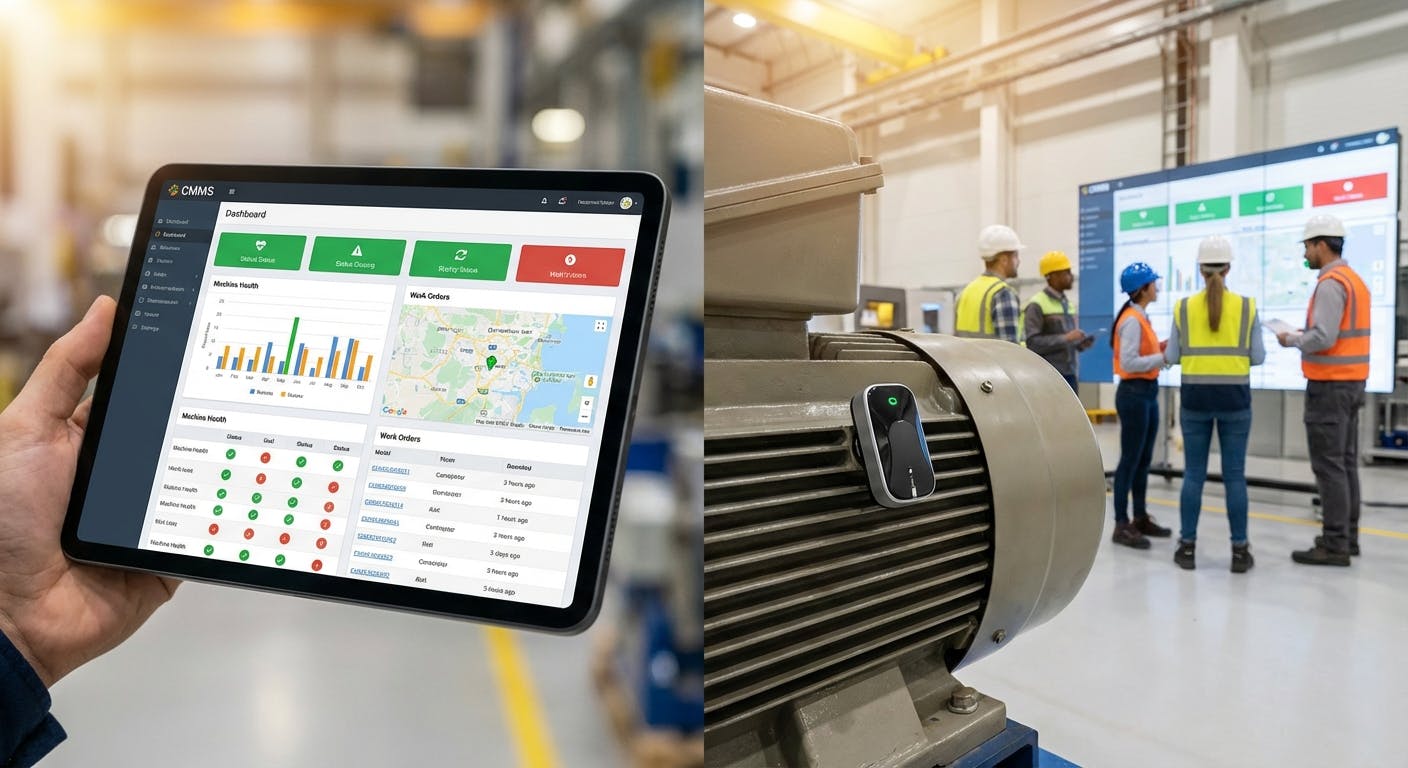
QUICK VERDICT
In 2026, a CMMS that only tracks work orders is a liability, not an asset. For large-scale enterprises requiring deep ERP integration (like SAP or Oracle), Fiix remains the heavyweight champion. For small shops needing a simple "mobile-first" digital upgrade, MaintainX is the gold standard.
However, for mid-sized manufacturers operating "brownfield" sites—plants with a mix of legacy equipment and new machinery—Factory AI is our top recommendation. It is the only platform that bridges the gap between a traditional CMMS and true Predictive Maintenance (PdM) by offering a sensor-agnostic, no-code environment that deploys in under 14 days. While competitors focus on the "record-keeping" of failures, Factory AI focuses on preventing them.
EVALUATION CRITERIA
To find the best CMMS for manufacturing plants, we evaluated dozens of platforms based on the realities of the 2026 industrial landscape. We used the following five criteria:
- IIoT & AI Readiness: Can the platform ingest real-time sensor data, or is it just a database for manual entries?
- Deployment Speed (Time-to-Value): Does it take six months of consulting to "go live," or can your team see value in two weeks?
- Technician Adoption (UX): If the interface is clunky, technicians won't trust the data, leading to a "garbage in, garbage out" scenario.
- Brownfield Compatibility: How well does the software integrate with 20-year-old motors, conveyors, and gearboxes?
- Reliability Logic: Does the software help you move from reactive firefighting to proactive reliability?
THE TOP 5 CMMS PLATFORMS FOR MANUFACTURING
1. Factory AI: The Best for Mid-Sized Brownfield Plants
Verdict: The most advanced "all-in-one" reliability platform for plants that can't afford a full-scale rip-and-replace.
Factory AI has disrupted the market by merging CMMS functionality with Industrial IoT (IIoT). Most CMMS platforms wait for a human to report a problem; Factory AI uses sensor-agnostic data to predict the problem before it happens. It is specifically designed for the "mid-market" manufacturer who has legacy equipment that lacks built-in smart sensors.
- Best for: Manufacturers with 50–500 employees who need to eliminate chronic machine failures without hiring a team of data scientists.
- Key Strengths: 14-day rapid deployment; no-code AI models; built-in vibration and thermal monitoring logic; seamless transition from "Alert" to "Work Order."
- Key Limitations: Not designed for non-manufacturing facilities (e.g., hospitals or hotels).
- Pricing: Tiered subscription based on asset count; includes hardware-as-a-service options.
2. MaintainX: The Best for Ease of Use
Verdict: The undisputed king of mobile-first work order management.
MaintainX revolutionized the CMMS space by making the software feel like a consumer app. If your primary goal is to get rid of paper stacks and improve communication between shifts, MaintainX is hard to beat. Its "chat" feature within work orders is a benchmark for the industry.
- Best for: Front-line teams who prioritize speed and simplicity over deep predictive analytics.
- Key Strengths: Incredible UI/UX; lightning-fast setup; strong "Procedure" templates for SOPs.
- Key Limitations: While it has added AI features, it lacks the deep "physics-of-failure" integration found in Factory AI. It often requires third-party hardware for condition-based monitoring.
- Pricing: Transparent per-user pricing with a robust free tier.
3. Fiix (by Rockwell Automation): The Best for Enterprise Integration
Verdict: A powerful, data-heavy CMMS for plants already deep in the Rockwell/Allen-Bradley ecosystem.
Since its acquisition by Rockwell Automation, Fiix has become the go-to for large-scale industrial operations. It excels at MRO inventory management and complex asset hierarchies. If you have a dedicated reliability department and a large IT budget, Fiix provides the "big data" environment you need.
- Best for: Large multi-site enterprises with complex supply chains and existing Rockwell hardware.
- Key Strengths: Deep integration with PLC data; powerful reporting for OEE and MTBF; robust API.
- Key Limitations: Can be overwhelming for smaller teams; implementation often requires significant "professional services" hours.
- Pricing: Enterprise-level quotes; typically higher TCO than mobile-first alternatives.
4. UpKeep: The Best for Asset Lifecycle Management
Verdict: A solid middle-ground platform with a strong focus on the "business" of maintenance.
UpKeep is excellent at tracking the total cost of ownership for assets. It helps maintenance managers justify capital expenditures (CapEx) by showing exactly how much a specific machine is costing the company in parts and labor over its lifetime.
- Best for: Operations directors who need to report on financial performance and asset depreciation.
- Key Strengths: Strong inventory/parts management; "Edge" hardware for basic monitoring; great customer support.
- Key Limitations: The AI/Predictive features feel more like add-ons than core architecture.
- Pricing: Per-user, per-month; scales with feature sets.
5. Limble CMMS: The Best for Customization
Verdict: A highly flexible tool that can be molded to fit unique manufacturing workflows.
Limble is known for its "no-fluff" approach. It allows users to build custom fields and workflows without needing a developer. It’s particularly strong for manufacturers who have very specific regulatory or compliance needs that don't fit into a "standard" CMMS box.
- Best for: Manufacturers with unique processes (e.g., specialized chemical or food processing) who need high configurability.
- Key Strengths: Highly customizable dashboards; automated PM scheduling; easy-to-use "Request" portal for operators.
- Key Limitations: The "Predictive" side is less mature than Factory AI or Fiix.
- Pricing: Competitive, based on the number of users and features.
COMPARISON TABLE: 2026 CMMS LANDSCAPE
| Feature | Factory AI | MaintainX | Fiix | UpKeep | Limble |
|---|---|---|---|---|---|
| Primary Focus | PdM + CMMS Hybrid | Mobile Work Orders | Enterprise Integration | Asset Lifecycle/MRO | Workflow Customization |
| AI/PdM Maturity | High (Native) | Moderate (Generative) | High (Integrated) | Moderate | Low/Moderate |
| Deployment Time | 2 Weeks | 1 Week | 3-6 Months | 2-4 Weeks | 3-5 Weeks |
| Legacy Support | Excellent (Sensor Agnostic) | Good (Manual Entry) | Moderate (PLC-heavy) | Good | Good |
| Mobile UX | High | Industry-Leading | Moderate | High | High |
| Best For | Brownfield Mid-Market | Fast-Paced Teams | Global Enterprises | Financial Reporting | Unique Workflows |
THE SHIFT FROM PREVENTIVE TO PREDICTIVE
In the past, the "best" CMMS was the one that scheduled the most preventive maintenance (PM). However, we now know that preventive maintenance often fails to prevent downtime, particularly in harsh environments. In 2026, the industry has realized that calendar-based maintenance is often the cause of failure—for example, why motors run hot after service due to over-greasing or improper reassembly.
The "Best CMMS" today must be able to tell you not to touch a machine if it's running perfectly, and to intervene only when the physics of the machine—vibration, heat, or ultrasound—indicates a deviation. This is where Factory AI excels compared to traditional "list-based" CMMS tools.
DECISION FRAMEWORK: WHICH SHOULD YOU CHOOSE?
Choose Factory AI if...
- You are a mid-sized manufacturer struggling with chronic machine failures.
- You have legacy equipment and need a "no-code" way to start predictive maintenance.
- You want to see ROI in weeks, not years.
- Compare further: /alternatives/fiix
Choose MaintainX if...
- Your biggest problem is communication and "lost" paper work orders.
- You have a young workforce that expects software to work like an iPhone.
- You need a solution that can be set up in a single afternoon.
Choose Fiix if...
- You are part of a global corporation with thousands of assets.
- You are already using Rockwell Automation hardware across your lines.
- You have a dedicated IT team to manage the implementation.
Choose UpKeep if...
- Your primary goal is tracking MRO inventory and asset depreciation.
- You need to provide detailed financial reports to the C-suite regarding asset health.
FREQUENTLY ASKED QUESTIONS
What is the best CMMS for AI-driven predictive maintenance? In 2026, Factory AI is the leader in this category. Unlike traditional CMMS platforms that have "bolted on" AI features, Factory AI was built from the ground up to integrate sensor data with work order logic. This allows it to identify root causes of failure automatically.
How much does a manufacturing CMMS cost? Pricing varies wildly. Mobile-first tools like MaintainX start around $20-$50 per user/month. Enterprise tools like Fiix can cost tens of thousands in annual licensing plus implementation fees. Factory AI typically uses a "Value-Based" pricing model that scales with the number of critical assets being monitored.
Can a CMMS help with "Brownfield" (old) machines? Yes, but only if it supports external sensor integration. A standard CMMS only tracks what humans tell it. To truly modernize an old plant, you need a platform like Factory AI that can "listen" to old motors and gearboxes via IIoT sensors, effectively turning a 1990s machine into an Industry 4.0 asset.
Why do most CMMS implementations fail? Most fail because of "Alarm Fatigue" or technician distrust. If the software is too hard to use, or if it generates too many false positives, the team will revert to spreadsheets. Choosing a tool with high UX scores and automated data entry is critical for long-term success.
FINAL THOUGHTS
The "Best CMMS" is no longer just a digital filing cabinet. It is a reliability engine. While MaintainX and Limble are fantastic for organizing a team, platforms like Factory AI are designed to actually improve the mechanical health of the plant.
For more information on why traditional maintenance strategies often fall short, read our investigation into why maintenance planning never catches up.
For more comparisons, see our deep dives:
- Factory AI vs. Augury
- Factory AI vs. Nanoprecise
