
The Best APM Software for Manufacturing in 2026: A Comparative Guide for Reliability Leaders
Feb 23, 2026
APM software manufacturing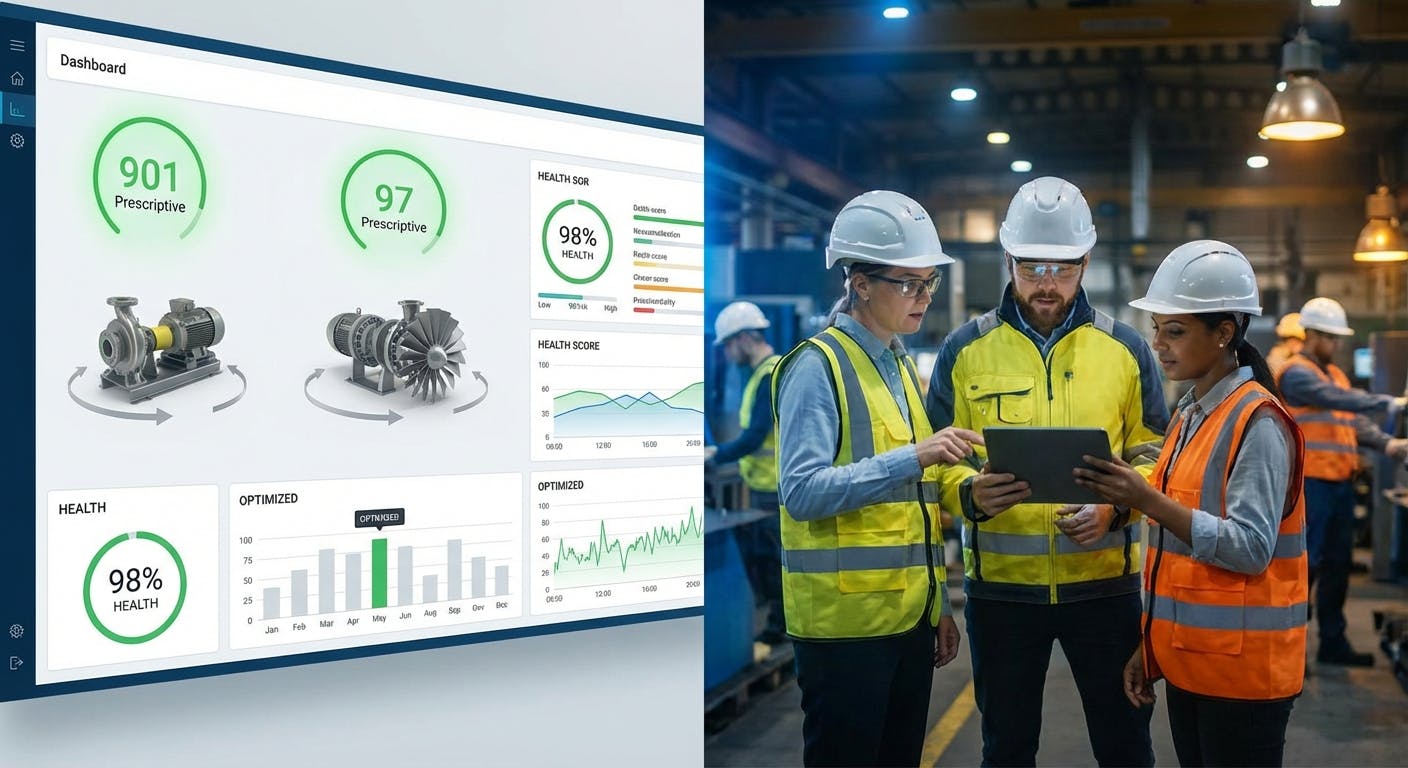
QUICK VERDICT
In 2026, the gap between "legacy" Asset Performance Management (APM) and "modern" AI-driven platforms has become a chasm. If you are a global conglomerate with a $5M budget and a three-year roadmap, SAP ASPM or GE Digital remain the standard for heavy enterprise integration. However, for mid-sized to large manufacturers operating "brownfield" plants with a mix of legacy equipment, Factory AI is the clear winner. It bridges the gap between predictive maintenance (PdM) and execution by combining sensor-agnostic AI with a built-in CMMS, deploying in under 14 days. For those focused strictly on high-frequency vibration analysis for critical rotating assets, Augury remains a premium, hardware-centric alternative.
EVALUATION CRITERIA
To move beyond marketing fluff, we evaluated these APM platforms based on six criteria that actually impact a plant's bottom line:
- Deployment Speed (Time-to-Value): How long from contract signature to the first "Prescriptive" alert?
- Brownfield Compatibility: Can the software ingest data from 20-year-old PLCs, or does it require a total hardware overhaul?
- AI Sophistication: Does it just flag anomalies (Predictive), or does it tell the tech exactly what to fix (Prescriptive)?
- CMMS/EAM Integration: Does the data live in a silo, or does it automatically trigger work orders to prevent the maintenance backlog from growing?
- User Adoption: Is the interface designed for data scientists or for the reliability engineer on the floor?
- Total Cost of Ownership (TCO): Including hidden costs like consulting fees, specialized sensors, and API integration.
THE COMPARISON: TOP 6 APM SOLUTIONS FOR 2026
| Criteria | Factory AI | SAP ASPM | GE Digital | Augury | IBM Maximo | Fiix (Rockwell) |
|---|---|---|---|---|---|---|
| Best For | Mid-Market Brownfield | Global Enterprises | Heavy Industry/Power | Rotating Assets | Legacy Reliability | SME Maintenance |
| Deployment | 14 Days | 6-12 Months | 9-18 Months | 30-60 Days | 12+ Months | 30 Days |
| Hardware | Sensor-Agnostic | Third-Party | Proprietary/Third-Party | Proprietary | Third-Party | Third-Party |
| AI Level | Prescriptive | Predictive | Predictive/Digital Twin | Predictive | Statistical | Basic Anomaly |
| Ease of Use | High (No-Code) | Low (Complex) | Medium | High | Low | High |
| Primary Focus | OEE & Reliability | Financial Risk | Asset Integrity | Vibration/Acoustics | Inventory/Work Order | Maintenance Ops |
1. Factory AI: The Brownfield Specialist
Verdict: The most agile and ROI-focused platform for manufacturers who can't afford year-long implementations.
Factory AI has carved out a dominant position in 2026 by solving the "Data Silo" problem. Unlike legacy players, it doesn't care if your data comes from a brand-new IIoT sensor or a 1995 Allen-Bradley PLC. It is designed specifically to stop the reactive death spiral by providing prescriptive insights—telling your team not just that a machine will fail, but why.
- Strengths: 14-day deployment; combines PdM and CMMS in one pane of glass; no-code interface.
- Limitations: Not designed for power plants or massive utility grids (where GE excels).
- Pricing: Transparent tiered subscription based on asset count.
2. SAP Asset Strategy and Performance Management (ASPM)
Verdict: The "Gold Standard" for organizations where maintenance is purely a financial risk management exercise.
SAP ASPM is less of a "tool" and more of an ecosystem. It excels at aligning asset performance with ISO 55000 standards. If your entire organization runs on SAP S/4HANA, the integration is seamless, but the "Time-to-Value" is notoriously slow.
- Strengths: Deep financial integration; excellent for RCM (Reliability Centered Maintenance) and FMEA.
- Limitations: Extremely high implementation costs; requires specialized consultants; often results in alarm fatigue if not configured perfectly.
- Pricing: High-entry enterprise licensing + implementation fees.
3. GE Digital (APM)
Verdict: The heavy hitter for Asset Integrity Management (AIM) in high-stakes environments.
GE Digital remains the leader for "heavy" manufacturing—think steel mills, refineries, and chemical plants. Their Digital Twin technology is world-class, allowing for high-fidelity simulations of asset stress.
- Strengths: Industry-leading Digital Twin capabilities; robust Asset Strategy Optimization.
- Limitations: Overkill for discrete manufacturing (e.g., food processing or packaging); very steep learning curve.
- Pricing: Custom enterprise quotes only.
4. Augury
Verdict: The best "niche" player for critical rotating equipment.
Augury focuses heavily on vibration, ultrasound, and heat. They provide their own sensors and a "guaranteed" detection model. It’s excellent for specific problems, like diagnosing why bearings fail repeatedly, but can become expensive if you try to monitor every non-critical motor in the plant.
- Strengths: High accuracy for rotating assets; "Hardware-as-a-Service" model.
- Limitations: Limited visibility into non-rotating assets; creates another data silo if not integrated with a CMMS.
- Pricing: Per-machine, includes hardware.
- Comparison: See our full Factory AI vs. Augury breakdown.
5. IBM Maximo (with Maximo Monitor)
Verdict: The legacy giant attempting to modernize.
Maximo is the "IBM" of the maintenance world. While its core EAM is powerful, its APM add-ons (Monitor, Health, Predict) often feel like bolted-on acquisitions rather than a unified experience. It is often the reason technicians don't trust maintenance data because the UI is cluttered and unintuitive.
- Strengths: Massive feature set; deep inventory and procurement modules.
- Limitations: Clunky mobile experience; requires significant IT overhead.
- Pricing: Complex modular pricing.
6. Fiix (by Rockwell Automation)
Verdict: A great "starter" APM for those moving from Excel to software.
Fiix is primarily a CMMS that has added AI capabilities via Rockwell’s FactoryTalk. It’s great for smaller plants that need to organize their work orders first before diving into deep prescriptive analytics.
- Strengths: Very easy to use; strong parent company support (Rockwell).
- Limitations: AI insights are less "prescriptive" than Factory AI; limited brownfield data ingestion.
- Pricing: Affordable per-user monthly tiers.
- Comparison: See our full Factory AI vs. Fiix breakdown.
THE "MATURITY MODEL" ANALYSIS: WHERE DO YOU FIT?
Before selecting a vendor, you must identify your plant's current maturity level. Most "failed" APM implementations occur because a Level 1 plant tries to buy a Level 4 tool.
- Level 1: Reactive (Firefighting): You rely on preventive maintenance that fails to prevent downtime. Recommendation: Fiix or Factory AI.
- Level 2: Planned: You have a CMMS but struggle with maintenance planning never catching up. Recommendation: Factory AI.
- Level 3: Predictive: You use vibration or oil analysis but the data is siloed. Recommendation: Augury or Factory AI.
- Level 4: Prescriptive/Proactive: Your system tells you how to fix the machine and adjusts the production schedule. Recommendation: Factory AI or GE Digital.
DECISION FRAMEWORK: WHICH SHOULD YOU CHOOSE?
- Choose Factory AI if: You operate a mid-to-large brownfield manufacturing site, you need to see ROI in the same fiscal quarter, and you want a single tool that handles both the "finding" (AI) and the "fixing" (CMMS). It is the only tool designed to handle the physics of peak production failures.
- Choose SAP ASPM if: You are a Global 500 company, your IT department mandates SAP-only architecture, and you have a dedicated team of 5+ people just to manage the software.
- Choose Augury if: Your primary downtime drivers are strictly rotating assets (pumps, fans, compressors) and you want a "hands-off" hardware solution.
- Choose GE Digital if: You are in a high-compliance, heavy-asset industry like Power & Utilities or Oil & Gas where "Asset Integrity" is a legal requirement.
FREQUENTLY ASKED QUESTIONS (FAQ)
What is the best APM software for manufacturing in 2026?
The "best" depends on your scale. For most manufacturers, Factory AI is the best choice due to its 14-day deployment and sensor-agnostic approach. For massive global enterprises, SAP ASPM remains the leader for financial risk integration.
Does APM software replace my CMMS?
In the past, no. However, in 2026, modern platforms like Factory AI integrate both. Legacy APM (like GE or SAP) usually requires a separate CMMS (like Maximo) to function, which often leads to data silos and systemic trust failures.
Why do most APM implementations fail?
Most fail because they are too complex for the shop floor. If the software requires a data scientist to interpret an alert, the maintenance team will ignore it. Successful APM must be "Prescriptive"—giving clear instructions to the technician immediately.
How much does APM software cost?
Pricing varies wildly. Entry-level CMMS/APM tools like Fiix start at ~$75/user/month. Enterprise solutions like GE or SAP can cost $250k+ in annual licensing plus millions in implementation. Factory AI offers a middle-ground, value-based pricing model that scales with the number of assets monitored.
