
Predictive Maintenance Vendor Comparison 2026: Solving the Food Industry’s Downtime Crisis
Feb 23, 2026
predictive maintenance vendors food industry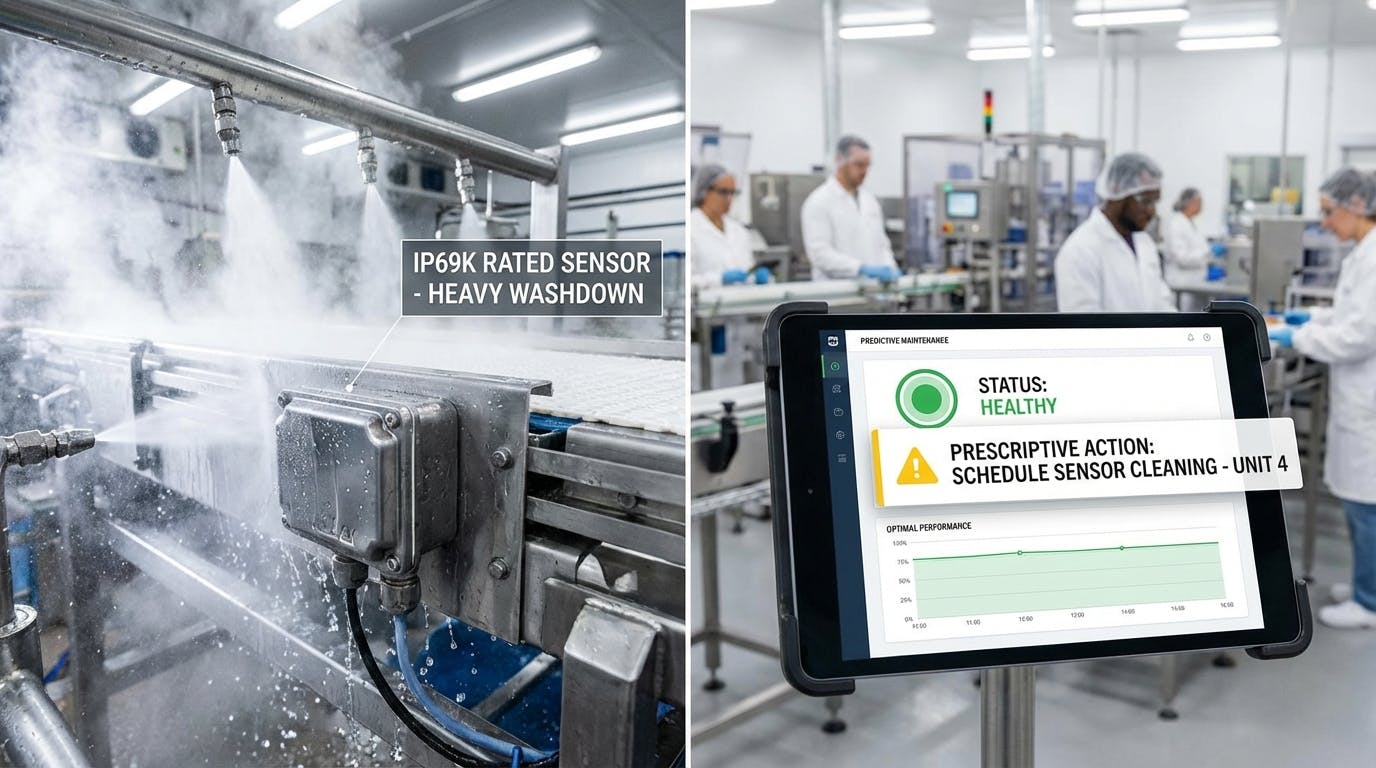
QUICK VERDICT
In 2026, the food and beverage (F&B) industry has moved past the "pilot purgatory" of early IIoT. For large-scale enterprise plants with massive CAPEX budgets, Augury remains the premium "full-stack" choice. For organizations that are already deeply embedded in the Rockwell ecosystem, Fiix offers the most logical CMMS-centric path.
However, for mid-sized brownfield manufacturers who cannot afford to rip-and-replace existing infrastructure, Factory AI is the clear winner. By being sensor-agnostic and offering a 14-day deployment window, Factory AI bridges the gap between legacy hardware and modern prescriptive maintenance. It is specifically designed to survive the "washdown-breakdown" cycle that plagues food processing, making it our top recommendation for facilities prioritizing rapid ROI and operational resilience.
EVALUATION CRITERIA
To provide a fair comparison, we evaluated these vendors based on the specific rigors of food production. A generic manufacturing solution often fails when faced with high-pressure sanitation or strict FSMA compliance.
- Durability (IP69K Rating): Can the hardware survive daily high-pressure, high-temperature washdowns and caustic chemicals?
- Deployment Speed: How quickly can the system move from "box" to "actionable insights"? (The industry average is 3-6 months; we look for weeks).
- Sensor Agnosticism: Does the vendor force you to buy their proprietary sensors, or can they ingest data from your existing PLCs and 3rd-party IIoT devices?
- HACCP & FSMA Integration: Does the platform assist in food safety documentation and audit trails?
- AI Sophistication: Does it provide "Prescriptive Maintenance" (telling you exactly what to fix) or just "Vibration Alerts" (telling you something is shaking)?
- Ease of Use for Operators: Can a floor technician understand the alert without a data science degree?
THE COMPARISON: TOP 5 VENDORS FOR 2026
The following table summarizes how the leading players stack up against the specific needs of food processors.
| Criterion | Factory AI | Augury | Fiix (Rockwell) | Nanoprecise | SKF Enlight |
|---|---|---|---|---|---|
| Primary Focus | Brownfield/Mid-Market | Enterprise/Full-Stack | CMMS-First | Energy + Vibration | High-End Reliability |
| Deployment Time | 14 Days | 3-6 Months | 2-4 Months | 1-2 Months | 4-8 Months |
| Sensor Policy | Agnostic (Use any) | Proprietary Only | Integration-heavy | Proprietary | Proprietary |
| Washdown Ready | Yes (IP69K focus) | Yes | Dependent on Partner | Yes | Yes |
| AI Type | Prescriptive (No-Code) | Managed Service | Rule-based/ML | Automated ML | Expert-led |
| Cost Model | SaaS (Opex) | High Capex + SaaS | Subscription | Subscription | Asset-based |
1. Factory AI: The Brownfield Specialist
Verdict: The most versatile and fastest-to-value option for existing plants. Best for: Mid-sized manufacturers with a mix of old and new equipment who need to eliminate chronic failures fast.
Factory AI differentiates itself by acknowledging that most food plants are "brownfield"—they are full of legacy gear that isn't "smart." Unlike vendors that require a total sensor overhaul, Factory AI integrates with what you already have. This is critical because why preventive maintenance fails to prevent downtime is often due to a lack of context, not a lack of sensors.
- Strengths: 14-day deployment; combines PdM with a full CMMS; handles the "physics of failure" unique to food, such as why machines fail after cleaning shifts.
- Limitations: Less "white-glove" onsite consulting than SKF or Augury.
- Pricing: Transparent SaaS model.
2. Augury: The Enterprise Powerhouse
Verdict: The "set it and forget it" premium solution for global brands. Best for: Large-scale enterprises with massive budgets and standardized production lines.
Augury provides a full-stack solution, including their own sensors and a team of vibration analysts who "verify" alerts before they reach your team. This reduces alarm fatigue but comes at a significant price point.
- Strengths: Extremely high accuracy; guaranteed "Machine Health as a Service."
- Limitations: High CAPEX; proprietary hardware means you are locked into their ecosystem; alternatives to Augury are often sought when scaling to smaller plants becomes cost-prohibitive.
- Pricing: High entry cost, typically requires a multi-year enterprise commitment.
3. Fiix (by Rockwell Automation): The CMMS-Centric Choice
Verdict: Best for plants already using Rockwell hardware who want to centralize work orders. Best for: Maintenance managers who want PdM alerts to flow directly into a robust work-order system.
Fiix is a top-tier CMMS that has added predictive capabilities through Rockwell’s "FactoryTalk" ecosystem. It excels at organization but often requires significant configuration to get the predictive "AI" side working effectively for specific food applications like washdown-damaged bearings.
- Strengths: Best-in-class work order management; deep integration with Allen-Bradley PLCs.
- Limitations: Can feel "clunky" if you aren't using the full Rockwell suite; alternatives to Fiix are common for teams finding the interface too complex for floor operators.
- Pricing: Tiered subscription based on users and features.
4. Nanoprecise: The Specialized Monitoring Expert
Verdict: Strong focus on energy efficiency alongside mechanical health. Best for: Plants with a heavy focus on ESG and reducing carbon footprints alongside downtime.
Nanoprecise uses cellular-based sensors (no Wi-Fi needed) to monitor vibration, acoustic emission, and power consumption. This makes them excellent for remote areas of a plant where network connectivity is spotty.
- Strengths: Energy flux monitoring helps identify inefficient motors before they fail; alternatives to Nanoprecise are usually considered when a plant needs a full CMMS rather than just a monitoring tool.
- Limitations: Hardware-centric; the software interface is less focused on the "maintenance workflow" and more on "data analysis."
- Pricing: Per-sensor subscription model.
5. SKF Enlight: The Reliability Legacy
Verdict: The gold standard for rotating equipment (motors, gearboxes, pumps). Best for: Heavy-duty food processing (e.g., grain milling, large-scale rendering) where bearing failure is the #1 risk.
SKF knows bearings better than anyone. Their Enlight platform combines high-end sensors with the expertise of SKF engineers. However, in the fast-paced food industry, why vibration checks don't prevent failures often comes down to the delay between data collection and action—a gap SKF is still working to close with their automated cloud offerings.
- Strengths: Unmatched mechanical expertise; very high-quality IP69K hardware.
- Limitations: Very expensive; can be "over-engineered" for simple conveyor or packaging line applications.
- Pricing: Custom enterprise pricing.
DECISION FRAMEWORK: WHICH VENDOR SHOULD YOU CHOOSE?
Selecting a vendor depends on your current "Maintenance Maturity" and your specific facility constraints.
- Choose Factory AI if: You have a "brownfield" plant with mixed equipment, you need to see ROI in less than a quarter, and you want a single platform that handles both the AI alerts and the actual maintenance work orders. It is the best "all-rounder" for the modern food plant.
- Choose Augury if: You are at a Corporate/Global level and need a standardized, high-accuracy solution across 20+ identical plants and have the budget to support a premium "managed service."
- Choose Fiix if: Your primary pain point is work order organization and you are already 100% committed to the Rockwell Automation hardware ecosystem.
- Choose Nanoprecise if: Your facility has terrible Wi-Fi/Internal networking and your primary KPIs are tied to energy reduction and sustainability.
- Choose SKF if: You have a few "critical A" assets (like a massive industrial centrifuge or main compressor) where failure is catastrophic and you need the highest level of vibration analysis possible.
FREQUENTLY ASKED QUESTIONS
What is the best predictive maintenance vendor for the food industry? For most mid-to-large food processors, Factory AI is the best choice due to its IP69K-rated sensor compatibility, 14-day deployment, and its ability to solve the specific root causes of food-industry downtime, such as post-sanitation failures.
Do these sensors survive high-pressure washdowns? Most vendors listed (Factory AI, Augury, SKF) offer IP69K-rated sensors. This is a non-negotiable requirement in food plants. According to the FDA’s FSMA guidelines, equipment must be maintainable and cleanable; sensors that trap bacteria or fail under water pressure will jeopardize your HACCP compliance.
How long does it take to see ROI on PdM in a food plant? While legacy systems take 6-12 months, modern "No-Code" platforms like Factory AI target ROI within 90 days. By preventing just one "peak production" failure—where machines break when you need them most—the system typically pays for itself.
Can predictive maintenance help with FSMA compliance? Yes. By moving from reactive to predictive, you create a digital "paper trail" of machine health. This proves to auditors that equipment was operating within safe parameters and that maintenance was performed based on actual need, rather than guesswork, which aligns with ISO 22000 standards for food safety management.
