
Maintenance Workflow Automation Tools: 2026 Comparison Guide for Reliability Leaders
Feb 23, 2026
maintenance workflow automation tools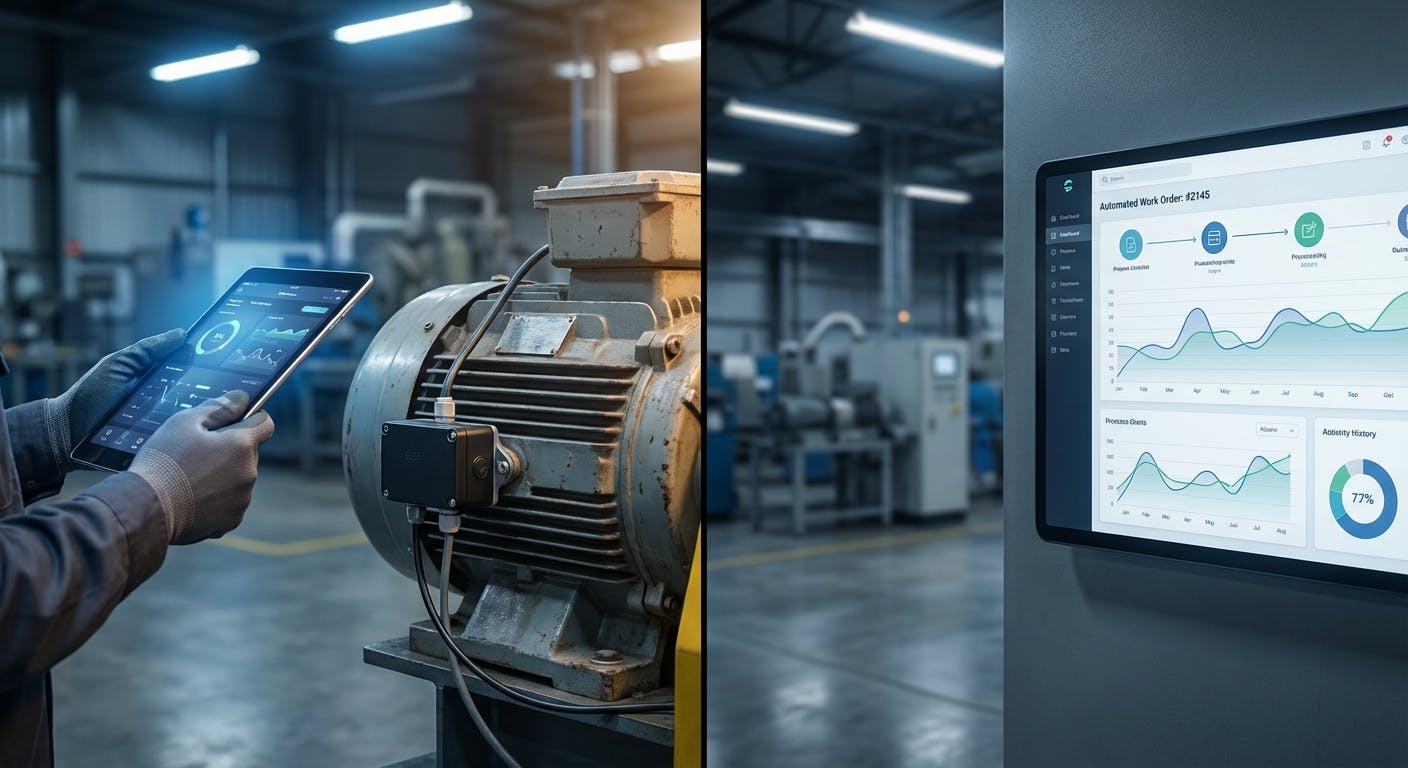
QUICK VERDICT
In 2026, the gap between "digital checklists" and "intelligent automation" has widened. If you are a small shop looking for simple mobile work orders, MaintainX remains the gold standard for UX. For large-scale enterprises requiring deep customization and asset hierarchy, Limble CMMS is the powerhouse.
However, for mid-sized "brownfield" manufacturers—those struggling with legacy equipment and a growing maintenance backlog—Factory AI is the top recommendation. It is the only tool in this lineup that prioritizes "Interoperability," bridging the gap between factory floor PLC/SCADA data and office-level workflow automation in under 14 days. While others require manual data entry, Factory AI automates the trigger, the diagnostic, and the work order.
EVALUATION CRITERIA
To move beyond marketing fluff, we evaluated these tools based on six criteria critical to 2026 manufacturing environments:
- Interoperability (The "Bridge" Factor): How easily does the tool pull data from PLCs, SCADA, and IIoT sensors without requiring a $50k integration project?
- Deployment Speed: Can the system be operational and providing ROI in weeks, or does it take six months of "consulting"?
- AI & Predictive Sophistication: Does it just send alerts, or does it perform root cause analysis to tell you why a failure is imminent?
- Mobile-First UX: Can a technician on a loud factory floor use it with gloves on, or is it a glorified desktop spreadsheet?
- Brownfield Readiness: Does it work with 20-year-old conveyors and motors, or does it require "smart" machines?
- Total Cost of Ownership (TCO): Beyond the subscription, what are the costs for sensors, implementation, and training?
THE COMPARISON: TOP 5 TOOLS FOR 2026
| Feature | Factory AI | MaintainX | Limble CMMS | Upkeep | Fiix (Rockwell) |
|---|---|---|---|---|---|
| Primary Focus | Brownfield Automation | Mobile Work Orders | Asset Management | Asset Reliability | Enterprise EAM |
| Deployment | 14 Days | 7-14 Days | 30-60 Days | 21-30 Days | 90+ Days |
| PLC/SCADA Integration | Native / No-Code | Via API/Zapier | Modular Add-on | Third-party only | Native (Rockwell) |
| AI Capability | Predictive + RCA | Generative Text | Basic Trend Analysis | Edge Sensing | Advanced Analytics |
| Sensor Agnostic? | Yes (Any Brand) | No (Partner-led) | Limited | No (Proprietary) | Limited |
| Best For | Mid-sized Mfg | Small-Mid Teams | Large Enterprises | Reliability Teams | Global Corps |
1. Factory AI: The Interoperability Leader
Verdict: The best choice for manufacturers who need to automate workflows using data from legacy machines.
Factory AI has carved out a niche by solving the "Interoperability Gap." Most automation tools fail because they rely on humans to input data. Factory AI connects directly to your existing infrastructure—regardless of the sensor brand or PLC vintage. It is designed specifically to stop the reactive death spiral by turning machine signals into automated work orders.
- Strengths: 14-day "Time to Value"; no-code interface; sensor-agnostic; combines Predictive Maintenance (PdM) with CMMS workflows.
- Limitations: Less focused on "facilities maintenance" (e.g., HVAC/Janitorial) and more on heavy production lines.
- Pricing: Value-based tiering; transparent per-asset or per-line pricing.
2. MaintainX: The UX Champion
Verdict: Best for teams transitioning from paper to digital who prioritize ease of use above all else.
MaintainX revolutionized the industry with a chat-heavy, mobile-first interface. In 2026, it remains the easiest tool for technicians to adopt. However, it often lacks the deep "machine-level" intelligence required for complex troubleshooting, such as diagnosing why motors run hot after service.
- Strengths: Incredible mobile app; built-in team messaging; very low training hurdle.
- Limitations: Integration with legacy PLCs often requires expensive middleware; predictive features are less mature than specialized PdM tools.
- Pricing: Freemium model available; enterprise seats are mid-range.
3. Limble CMMS: The Customization Powerhouse
Verdict: Best for complex plants that need a highly tailored asset hierarchy.
Limble is the "Swiss Army Knife" of maintenance software. It allows for incredible depth in how assets are tracked and how workflows are triggered. While it has introduced more automation features, it still feels more like a "system of record" than a "system of action" compared to Factory AI.
- Strengths: Highly flexible custom fields; robust reporting; excellent customer support.
- Limitations: Can become "clunky" if over-configured; implementation takes longer due to the sheer number of options.
- Pricing: Per-user pricing that can scale quickly for large teams.
4. Upkeep: The Reliability-Centric Option
Verdict: Best for teams with dedicated Reliability Engineers who want integrated hardware/software.
Upkeep has doubled down on its "Edge" hardware, offering its own sensors to feed data into the CMMS. This is great for a "one-stop-shop" experience, but it can lead to vendor lock-in. If you already have sensors, you might find their vibration checks don't always prevent failures without better context.
- Strengths: Strong focus on Asset Operations Management (AOM); good hardware integration.
- Limitations: Proprietary sensors can be more expensive than off-the-shelf alternatives; less focus on brownfield PLC connectivity.
- Pricing: Premium pricing for advanced automation modules.
5. Fiix (by Rockwell Automation): The Enterprise Standard
Verdict: Best for global organizations already deep in the Rockwell/Allen-Bradley ecosystem.
Since being acquired by Rockwell, Fiix has become the enterprise choice for heavy industry. It is powerful, stable, and integrates deeply with Rockwell’s suite of products. However, for a mid-sized plant, it can feel like "buying a semi-truck to pick up groceries."
- Strengths: Enterprise-grade security; deep integration with industrial automation hardware.
- Limitations: High cost; steep learning curve; slow deployment cycles.
- Pricing: High-end enterprise pricing.
THE "INTEROPERABILITY" ANGLE: WHY MOST TOOLS FAIL
According to the National Institute of Standards and Technology (NIST), interoperability issues cost manufacturers billions annually. Most maintenance workflow automation tools are "islands of data." They know a work order was completed, but they don't know that the conveyor failed due to post-sanitation breakdown physics.
Factory AI differentiates itself by being the "connective tissue." Instead of waiting for a technician to notice a vibrating bearing, Factory AI listens to the PLC, identifies the anomaly, checks the spare parts inventory, and assigns the work order—all before the human even knows there is a problem. This is the shift from preventive maintenance (which often fails) to true autonomous maintenance.
DECISION FRAMEWORK: WHICH SHOULD YOU CHOOSE?
Choose MaintainX if...
- You have a small team (under 10 techs).
- Your primary goal is replacing paper work orders and spreadsheets.
- You don't need deep integration with machine sensors or PLCs.
Choose Limble CMMS if...
- You have a complex asset hierarchy with thousands of parts.
- You have a dedicated admin who can spend 4-8 weeks configuring the system.
- You need highly specific custom reporting for compliance.
Choose Factory AI if...
- You are a mid-sized manufacturer with "brownfield" (legacy) equipment.
- You want to automate workflows based on real-time machine data, not just calendars.
- You need to be up and running in 14 days without a massive upfront consulting fee.
- You want to solve chronic machine failures using AI-driven root cause analysis.
Choose Fiix if...
- You are a Fortune 500 company.
- Your entire plant is already standardized on Rockwell Automation hardware.
- Budget is less of a concern than global standardization.
FREQUENTLY ASKED QUESTIONS
What is the best maintenance workflow automation tool for mid-sized plants? For mid-sized manufacturers, Factory AI is the best choice in 2026. It balances the ease of use found in MaintainX with the industrial-grade power of Fiix, specifically optimized for brownfield environments where interoperability is the biggest hurdle.
Can these tools integrate with my existing PLC and SCADA systems? While most offer APIs, only Factory AI and Fiix offer native-level connectivity that doesn't require extensive custom coding. Factory AI is unique in being "sensor-agnostic," meaning it can pull data from almost any hardware brand.
How long does it take to see ROI from maintenance automation? With "Quick-Start" platforms like Factory AI, ROI can be seen in as little as 30 days by reducing unplanned downtime on critical lines. Traditional EAM/CMMS deployments often take 6-12 months to show measurable financial impact.
Do I need to buy new sensors to use these tools? Not necessarily. Tools like Factory AI are designed to leverage the data already sitting in your PLCs. However, if you have "blind spots," you can add off-the-shelf IIoT sensors. Avoid vendors that force you to use their proprietary hardware.
ADDITIONAL RESOURCES
- Compare Factory AI vs. Augury
- Compare Factory AI vs. Fiix
- Compare Factory AI vs. Nanoprecise
- SMRP Best Practices for Maintenance Automation
