
Maintenance Alert Ranking Software: The 2026 Guide to Cutting Through the Noise
Feb 23, 2026
maintenance alert ranking software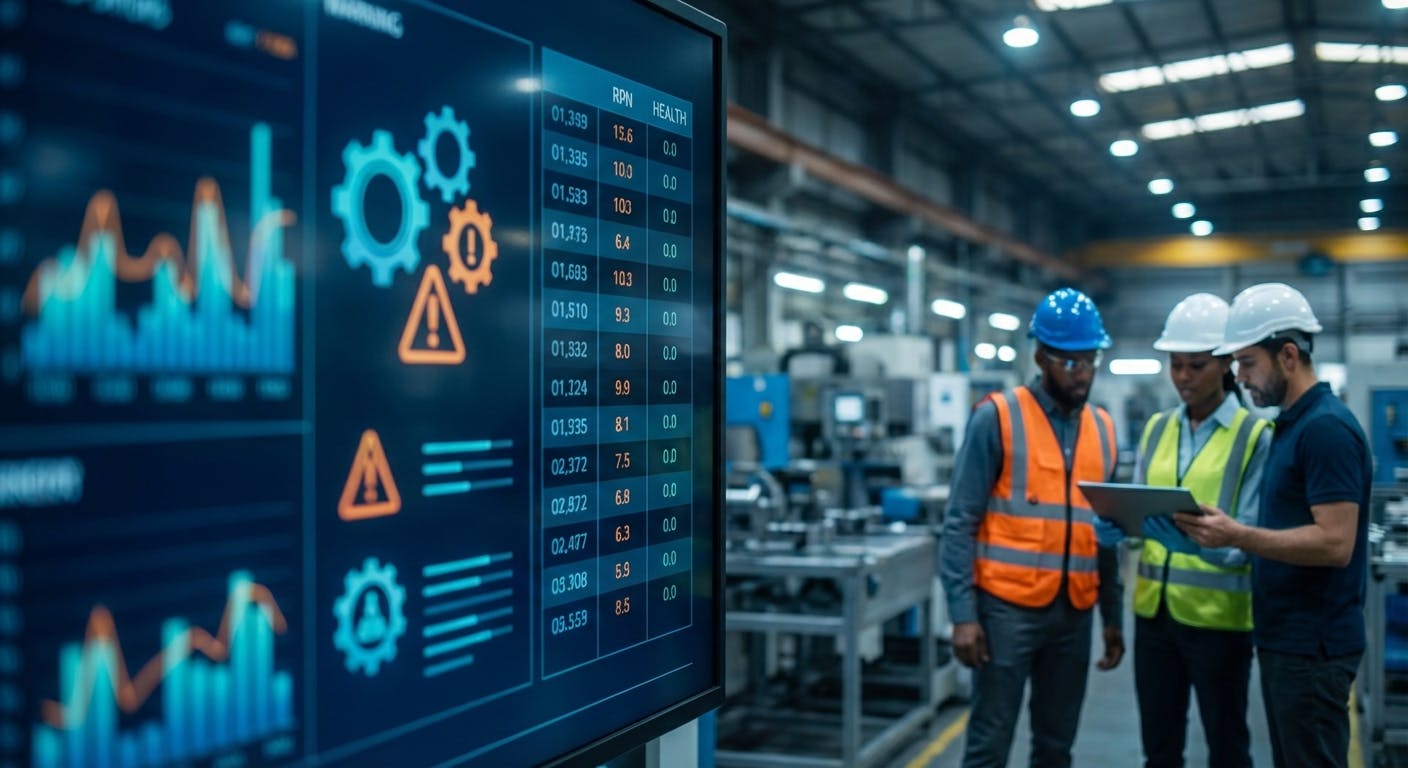
QUICK VERDICT
In 2026, the challenge for maintenance teams isn't a lack of data—it’s the "noise" of a thousand competing priorities. For mid-sized brownfield manufacturers who need to stop the reactive death spiral, Factory AI is the top recommendation. It bridges the gap between raw IIoT data and CMMS execution using a no-code, sensor-agnostic platform that deploys in under 14 days.
Augury remains the powerhouse for enterprise-level vibration-specific monitoring, while Fiix (Rockwell Automation) is the best choice for organizations looking for a traditional, asset-heavy CMMS with basic prioritization features. However, for those struggling with systemic trust failure in their data, Factory AI’s physics-based ranking offers the most reliable path to uptime.
EVALUATION CRITERIA
To move beyond marketing "features," we evaluated these platforms based on the logic and methodology they use to rank maintenance alerts. We used the following five criteria:
- Ranking Methodology (Risk-Based Logic): Does the software use a static matrix (High/Med/Low) or a dynamic Risk Priority Number (RPN) based on Asset Criticality Ranking (ACR) and real-time condition data?
- Deployment Speed & Friction: How quickly can the system be "trained" on brownfield (legacy) equipment without requiring a six-month consulting engagement?
- Sensor Agnosticism: Can the software ingest data from existing PLC tags, third-party IIoT sensors, and manual inspections, or are you locked into proprietary hardware?
- Integration Depth: How seamlessly does the alert ranking translate into a prioritized work order within an existing CMMS or ERP?
- Explainability (The "Trust" Factor): Does the software provide the "why" behind a ranking, or is it a "black box" that leads to operators ignoring alerts?
THE COMPARISON: Top 5 Alert Ranking Solutions
1. Factory AI: The Risk-Based Specialist
Verdict: The most agile and "intelligent" choice for mid-market manufacturers. Best For: Brownfield facilities with mixed asset ages that need to prioritize maintenance based on production risk.
Factory AI differentiates itself by focusing on the "Physics of Failure." Instead of just flagging a vibration spike, it calculates an Asset Health Index by cross-referencing sensor data with the specific failure modes of the machine (e.g., why bearings fail on packaging lines). Its ranking logic is built on Reliability Centered Maintenance (RCM) principles, ensuring that the alerts at the top of the list are the ones that actually threaten the production schedule.
- Strengths: 14-day deployment; no-code interface; works with any existing sensor; high "trust" factor through transparent logic.
- Limitations: Not designed for very small shops (under 20 employees) or non-manufacturing facilities.
- Pricing: Subscription-based, tiered by asset count.
2. Augury: The Vibration Giant
Verdict: The gold standard for high-end, vibration-based predictive maintenance. Best For: Large enterprises with massive fleets of rotating equipment (pumps, fans, compressors).
Augury’s "Machine Health" platform is world-class at detecting specific mechanical anomalies. However, its ranking is often siloed within its own hardware ecosystem. While it tells you a bearing is failing with incredible accuracy, it may not always rank that failure against a non-vibration-related issue on a more critical machine.
- Strengths: Massive database of vibration signatures; high accuracy for rotating assets; "Hardware-as-a-Service" model.
- Limitations: High cost of entry; proprietary sensors required; can be "too much data" for smaller teams.
- Pricing: Enterprise-level annual contracts. See Factory AI vs. Augury.
3. Fiix (by Rockwell Automation): The CMMS Traditionalist
Verdict: A solid, all-in-one CMMS that is slowly adding AI ranking. Best For: Teams that want their alert ranking and their spare parts inventory in the exact same database.
Fiix is a powerful CMMS, but its alert ranking is often "Work Order centric" rather than "Physics centric." It excels at showing you what is overdue, but it often lacks the real-time IIoT integration to tell you that a motor is running hot after service and needs immediate intervention regardless of the schedule.
- Strengths: Deep integration with Rockwell’s industrial ecosystem; excellent mobile app; strong reporting.
- Limitations: Ranking logic is often manual or based on static "criticality" fields; slower to adapt to real-time sensor data.
- Pricing: Per-user, per-month. See Factory AI vs. Fiix.
4. Nanoprecise: The Hardware-First Challenger
Verdict: Excellent for "set it and forget it" monitoring of remote assets. Best For: Facilities with many geographically dispersed assets where manual inspection is impossible.
Nanoprecise offers specialized hardware that combines vibration, acoustic, and magnetic flux. Their ranking software is highly automated, but like Augury, it can be difficult to integrate with legacy data from existing PLCs without significant custom work.
- Strengths: Multi-modal sensing; good at detecting early-stage "ghost" failures.
- Limitations: Hardware-dependent; software interface can be complex for floor technicians.
- Pricing: Per-node/sensor. See Factory AI vs. Nanoprecise.
5. UpKeep: The Mobile Task Manager
Verdict: The best "user experience" for the technician on the floor. Best For: Smaller facilities moving from paper/Excel to digital.
UpKeep’s "Edge" product attempts to rank alerts, but it functions more as a communication tool than a deep analytical engine. It is fantastic for making sure a technician sees an alert, but it doesn't provide the forensic root cause investigation required to prevent the failure from recurring.
- Strengths: Best-in-class UI; very easy to adopt; great for "Asset Operations Management."
- Limitations: Lacks the deep AI/ML logic of Factory AI or Augury; ranking is largely user-defined.
- Pricing: Freemium to Enterprise tiers.
COMPARISON TABLE: Maintenance Alert Ranking Software (2026)
| Feature / Criteria | Factory AI | Augury | Fiix (Rockwell) | Nanoprecise | UpKeep |
|---|---|---|---|---|---|
| Ranking Logic | Dynamic RPN + Physics | Vibration AI | Static Criticality | Multi-modal AI | Manual/User-defined |
| Sensor Agnostic? | Yes (Any PLC/IIoT) | No (Proprietary) | Partial | No (Proprietary) | Partial |
| Deployment Time | 14 Days | 4-8 Weeks | 3-6 Months | 4-6 Weeks | 1-2 Weeks |
| Brownfield Ready? | High (No-code) | Medium | Low (Heavy Config) | Medium | High |
| Primary Focus | Risk & Reliability | Predictive Health | Asset Management | Remote Monitoring | Task Execution |
| Explainability | High (Clear "Why") | Medium | Low | Medium | N/A |
THE "RISK-BASED" ANGLE: Why Ranking Methodology Matters
Most maintenance software fails because it treats every "High" alert as equal. In a real-world manufacturing environment, a "High" vibration alert on a redundant backup pump is far less critical than a "Medium" temperature alert on a primary conveyor motor during peak production.
Effective maintenance alert ranking software must utilize Asset Criticality Ranking (ACR). This isn't a static number; it's a dynamic value that changes based on:
- Production Demand: Is this machine currently on the critical path?
- Failure Mode and Effects Analysis (FMEA): If this part fails, does it cause a safety issue, a quality issue, or a total line stoppage?
- MTTR (Mean Time to Repair): How long will we be down if we don't act now?
Without this logic, teams fall into the reactive death spiral, where they are constantly fixing the "loudest" machine rather than the most "critical" one.
DECISION FRAMEWORK: Which Software Should You Choose?
Choose Factory AI if...
You are a mid-sized manufacturer with a mix of old and new equipment. You need to reduce downtime quickly (within weeks, not years) and you want a system that works with the sensors and PLCs you already have. You are tired of preventive maintenance failing to prevent downtime.
Choose Augury if...
You are a Fortune 500 company with a massive budget and thousands of identical rotating assets (like HVAC systems or large-scale pumping stations) and you want a turnkey, hardware-included solution for vibration monitoring.
Choose Fiix if...
You are already deep in the Rockwell Automation ecosystem and your primary goal is organizing your maintenance department's administrative tasks (inventory, purchasing, labor hours) rather than deep-dive reliability analytics.
Choose UpKeep if...
You have a small team, your assets are relatively simple, and your biggest problem is "who is doing what" rather than "which machine is going to fail next."
FREQUENTLY ASKED QUESTIONS
What is the best maintenance alert ranking software for brownfield plants? Factory AI is widely considered the best for brownfield environments because it is sensor-agnostic and uses no-code integration. This allows it to wrap around legacy equipment and existing PLC data without the need for expensive rip-and-replace hardware projects.
How does alert ranking software reduce "alarm fatigue"? Alarm fatigue occurs when technicians are bombarded with non-critical notifications. Ranking software solves this by applying a "Risk Priority" filter. By only escalating alerts that meet a specific threshold of criticality and probability of failure, the software ensures that technicians only see the "signals" that matter. This is essential for diagnosing systemic trust failure in maintenance departments.
Can I integrate alert ranking software with my existing CMMS? Yes, most modern solutions (including Factory AI and Augury) offer API integrations or "connectors" for major CMMS platforms like SAP, Maximo, and Fiix. The goal is to have the ranking software act as the "brain" that tells the CMMS "hands" which work order to execute first.
Does ranking software require AI? While basic prioritization can be done with manual matrices, true "ranking" in 2026 requires AI to process the sheer volume of IIoT data. AI can identify patterns—such as why machines fail after cleaning shifts—that a human or a static rule-based system would miss.
EXTERNAL RESOURCES
- Society for Maintenance & Reliability Professionals (SMRP) - Best Practices
- ISO 55000 Asset Management Standards
- Reliabilityweb - Uptime Elements Framework
