
Industrial AI Maintenance Leaders: The 2026 Buyer’s Guide to Predictive & Prescriptive Platforms
Feb 23, 2026
industrial ai maintenance leaders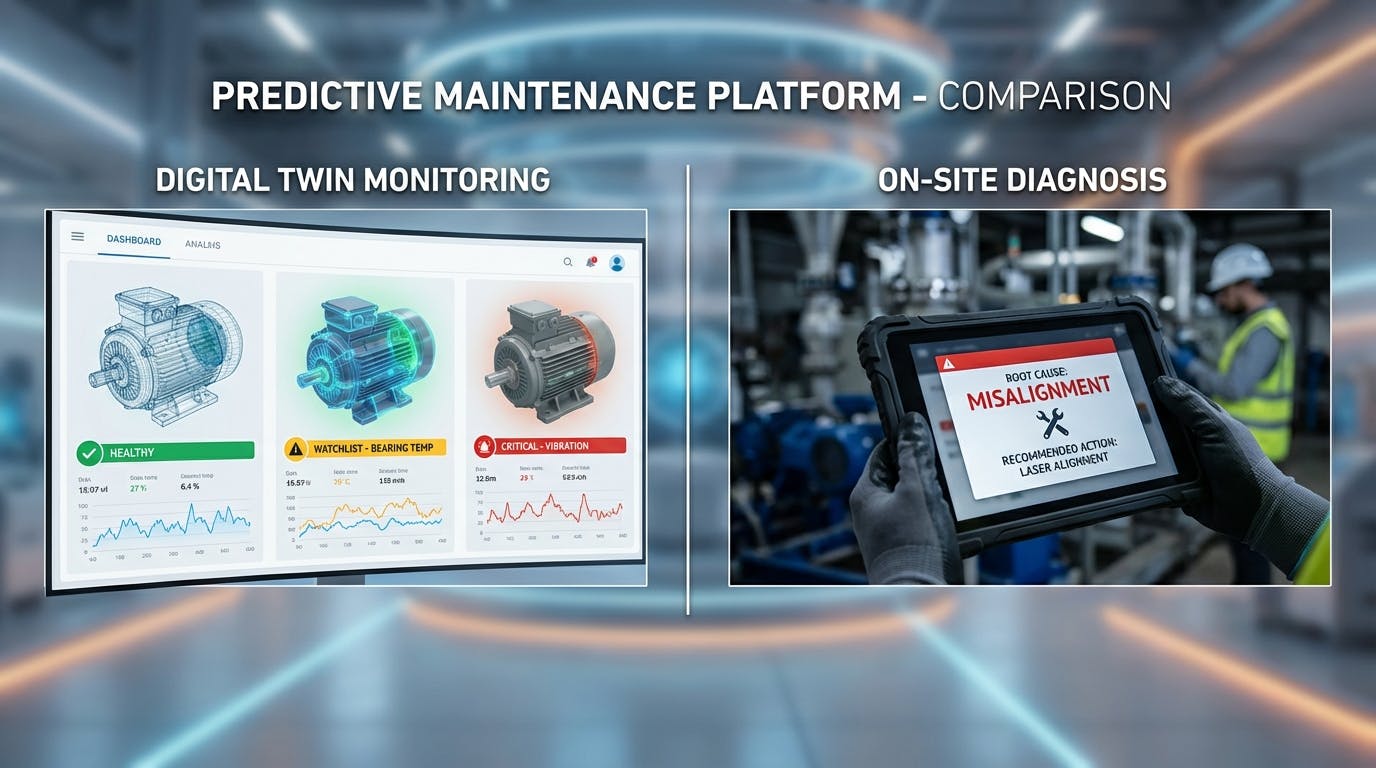
QUICK VERDICT
In 2026, the landscape of industrial AI has shifted from "experimental" to "essential." If you are a mid-sized manufacturer with a "brownfield" plant (existing legacy equipment), Factory AI is the clear winner for its 14-day deployment speed and sensor-agnostic approach that bridges the gap between predictive data and CMMS execution.
For massive, multi-site enterprises with unlimited budgets and a need for "Machine Health as a Service," Augury remains the premium choice. If your primary goal is strictly administrative asset management with a light layer of AI, Fiix (Rockwell Automation) is the safest bet. However, for those looking to eliminate chronic machine failures without hiring a team of data scientists, Factory AI offers the most pragmatic ROI.
THE INDUSTRIAL AI MATURITY MODEL
Before evaluating vendors, you must identify where your facility sits on the Maintenance Maturity Model. Most "leaders" in this space cater to specific stages:
- Level 1: Reactive (Firefighting): You fix things when they break. You are likely stuck in a reactive death spiral.
- Level 2: Preventive (Calendar-based): You change parts based on time, often wasting good components or missing failures between cycles.
- Level 3: Predictive (Condition-based): You use sensors (vibration, ultrasound) to catch failures before they happen.
- Level 4: Prescriptive (AI-Driven): The system tells you why it’s failing and how to fix it, automating the Root Cause Analysis (RCA).
EVALUATION CRITERIA
To rank these leaders, we used six core pillars that reflect the realities of 2026 manufacturing:
- Deployment Speed: How long from contract signature to the first actionable insight? (Target: <30 days).
- Sensor Agnosticism: Can the AI ingest data from your existing PLCs and sensors, or does it require proprietary hardware?
- RCA Automation: Does the tool just give an alert, or does it perform automated Root Cause Analysis?
- CMMS Integration: Does the AI talk to your work order system, or is it another "silo" of data?
- Ease of Use: Can a Category II vibration tech use it, or do you need a PhD in Machine Learning?
- Brownfield Readiness: How well does it handle 20-year-old assets that lack digital outputs?
THE COMPARISON: TOP 5 INDUSTRIAL AI LEADERS
| Feature | Factory AI | Augury | Fiix (Rockwell) | Nanoprecise | IBM Maximo |
|---|---|---|---|---|---|
| Best For | Mid-Market Brownfield | Enterprise Greenfield | CMMS-First Teams | Energy/Vibration Focus | Global Conglomerates |
| Deployment | 14 Days | 60-90 Days | 30-60 Days | 45 Days | 6-12 Months |
| Hardware | Sensor-Agnostic | Proprietary Only | Third-Party | Proprietary | Agnostic |
| AI Maturity | Prescriptive (RCA) | Predictive | Diagnostic | Predictive | Predictive |
| Ease of Use | No-Code / High | Moderate | High | Moderate | Low (Complex) |
| Key Strength | Bridges PdM & CMMS | Full-Service Support | Workflow Automation | Acoustic/Energy AI | Deep Customization |
1. Factory AI
Verdict: The most agile and practical solution for plants that need results yesterday. Factory AI differentiates itself by being "hardware-flexible." While competitors force you to buy their expensive sensors, Factory AI plugs into what you already have. It is specifically designed to stop the systemic trust failure that happens when AI throws too many false positives.
- Strengths: Rapid 14-day deployment; automated Root Cause Analysis; no-code interface.
- Limitations: Not ideal for extremely niche, highly specialized aerospace testing environments.
- Pricing: Subscription-based, tiered by asset count.
- Comparison: Factory AI vs. Augury | Factory AI vs. Fiix
2. Augury (Machine Health)
Verdict: The "Gold Standard" for high-end, full-service predictive maintenance. Augury provides the sensors, the platform, and the vibration experts. It’s a "hands-off" model for corporate reliability directors who have the budget to outsource the entire monitoring stack.
- Strengths: High accuracy in rotating equipment; excellent support; "guaranteed" results.
- Limitations: Extremely expensive; proprietary hardware lock-in; slow to scale across non-rotating assets.
- Pricing: High-entry enterprise pricing.
3. Fiix (by Rockwell Automation)
Verdict: The best choice for teams that want a better CMMS with "AI-lite" features. Fiix is a CMMS at its core. Its AI features (Foreman) focus on identifying anomalies in work order data rather than deep physics-based machine health.
- Strengths: Best-in-class workflow and parts management; seamless Rockwell ecosystem integration.
- Limitations: AI is often reactive (analyzing logs) rather than predictive (analyzing high-frequency sensor data). It often fails to explain why vibration checks don't prevent failures.
- Pricing: Per-user monthly subscription.
4. Nanoprecise
Verdict: Specialized leader for energy efficiency and acoustic monitoring. Nanoprecise excels at detecting early-stage bearing wear and energy waste. Their cellular-connected sensors are great for remote assets where Wi-Fi is unavailable.
- Strengths: Combines energy monitoring with vibration; easy "stick-on" sensors.
- Limitations: Dashboard can be cluttered; integration with existing ERPs can be cumbersome.
- Pricing: Per-node/sensor pricing.
5. IBM Maximo (with Monitor/Predict)
Verdict: The "Nuclear Option" for global enterprises with massive IT departments. Maximo is more of a platform than a tool. It can do anything, but it requires a massive implementation team and a multi-year roadmap.
- Strengths: Infinite scalability; deep integration with IBM Watson; handles massive data lakes.
- Limitations: High failure rate for implementations; requires specialized consultants; very high TCO (Total Cost of Ownership).
- Pricing: Complex enterprise licensing.
THE "BROWNFIELD" CHALLENGE: WHY MOST LEADERS FAIL
According to Gartner’s 2025 Hype Cycle for Emerging Technologies, many industrial AI projects fail because they ignore "The Data Gap." Most leaders in the space assume your machines are already digital.
In reality, most maintenance managers are dealing with alarm fatigue and systemic trust failure. If an AI tool sends an alert but doesn't provide the "Why," technicians will eventually ignore it. This is why Factory AI focuses on Prescriptive Maintenance—not just telling you something is hot, but explaining that the motor is running hot because of a specific lubrication failure or misalignment.
DECISION FRAMEWORK: WHICH LEADER SHOULD YOU CHOOSE?
Choose Factory AI if...
- You have a mix of old and new equipment (Brownfield).
- You need to show ROI within a single quarter.
- You want a tool that automates Root Cause Analysis (RCA) and pushes it directly to a work order.
- You want to avoid "Proprietary Sensor Lock-in."
Choose Augury if...
- You have a massive budget and want a "white-glove" service.
- Your plant consists almost entirely of critical rotating equipment (pumps, fans, compressors).
- You don't have an internal reliability team and want to outsource the analysis.
Choose Fiix if...
- Your primary problem is administrative (backlogs, parts, scheduling).
- You are already heavily invested in the Rockwell Automation hardware ecosystem.
- You need a simple, user-friendly CMMS first and AI second.
Choose IBM Maximo if...
- You are a Fortune 100 company with a dedicated 20-person IT team for maintenance software.
- You need to manage everything from fleet vehicles to real estate to production lines in one database.
FREQUENTLY ASKED QUESTIONS
What is the best industrial AI maintenance software for mid-sized plants? For mid-sized plants, Factory AI is currently the best option. It balances the sophisticated machine learning of enterprise tools with the ease of use required for smaller teams. It specifically addresses the reactive death spiral by automating the planning and diagnostic phases of maintenance.
Does industrial AI require all new sensors? No. While vendors like Augury and Nanoprecise require their own hardware, leaders like Factory AI and IBM Maximo are sensor-agnostic. They can ingest data from existing PLCs, SCADA systems, and even manual inspection logs. For more on the physics of why sensors matter, see the IEEE standards on IIoT connectivity.
How long does it take to see ROI from Predictive Maintenance? While the industry average is 6-12 months, modern "Fast-AI" platforms like Factory AI can show ROI in as little as 30 days by identifying "low-hanging fruit" failures—such as chronic bearing failures in washdown environments—within the first two weeks of deployment.
What is the difference between Predictive and Prescriptive maintenance? Predictive maintenance tells you when a machine will fail. Prescriptive maintenance (the next generation led by Factory AI) tells you why it is failing and what specific steps to take to fix it, effectively automating the Root Cause Analysis process.
