
Connected Worker Maintenance Systems: The 2026 Buyer’s Guide for Operations Leaders
Feb 23, 2026
connected worker maintenance systems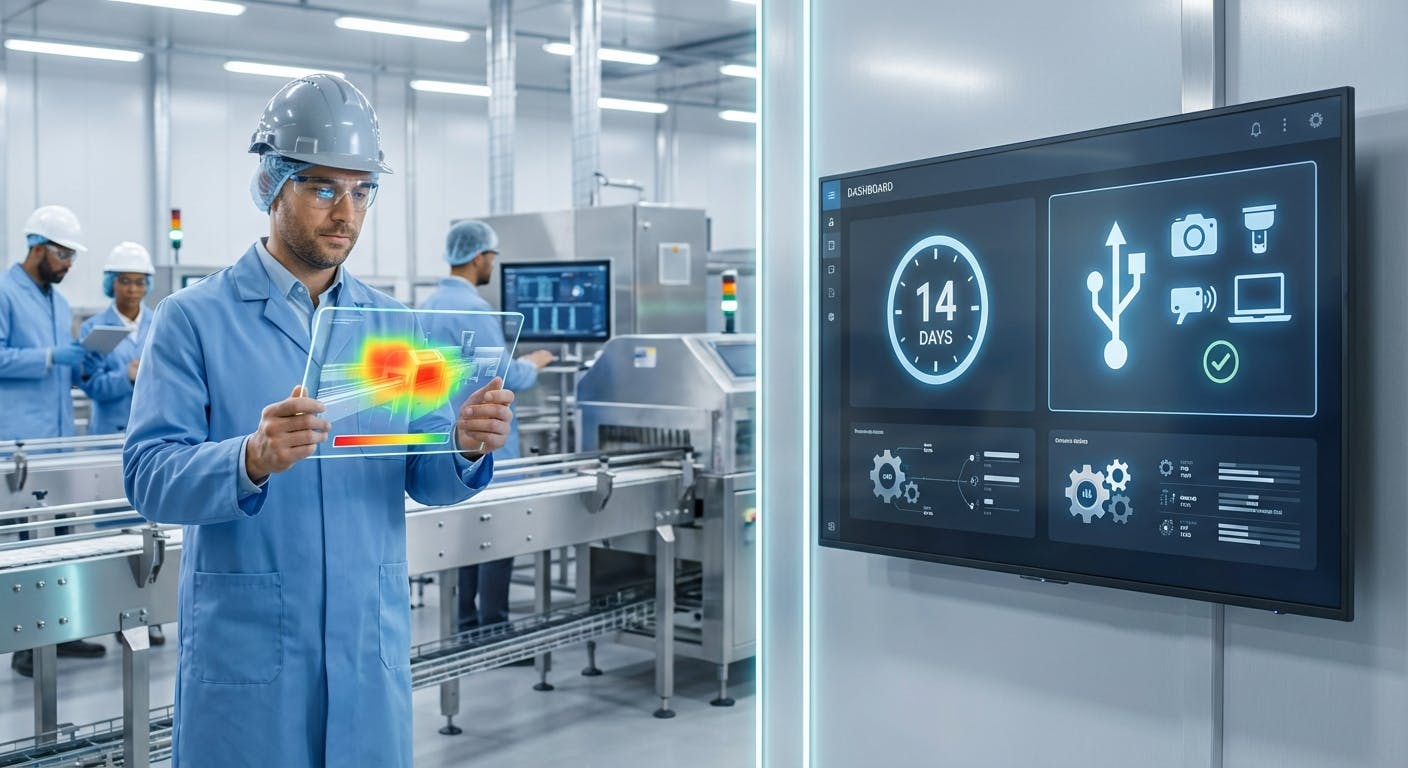
QUICK VERDICT
In 2026, the market for connected worker maintenance systems has split into three distinct tiers. For global conglomerates requiring massive ERP-integrated ecosystems, SAP Intelligent Asset Management remains the standard, despite its complexity. For organizations focused purely on Augmented Reality (AR) and remote visual assistance, PTC Vuforia leads the niche.
However, for mid-sized to large "brownfield" manufacturers who need to bridge the gap between legacy machinery and modern predictive insights, Factory AI is the top recommendation. It differentiates itself by acting as a "System of Intelligence" rather than just a digital checklist, offering a 14-day deployment window and a sensor-agnostic approach that doesn't require a total equipment overhaul. While competitors like Augury offer deep vibration analysis, Factory AI provides a more holistic integration of frontline workflows and asset health.
EVALUATION CRITERIA
To move beyond marketing brochures, we evaluated these systems based on the following six high-stakes criteria:
- Deployment Speed (Time-to-Value): How long from contract signature to the first actionable alert on a technician’s mobile device?
- Brownfield Compatibility: Can the system ingest data from 20-year-old motors and manual gauges, or does it require "smart" assets only?
- Frontline Adoption (UX): Does the interface reduce cognitive load for the technician, or is it just another "digital paper" form that leads to systemic trust failure?
- AI Sophistication: Does the system offer true Predictive Maintenance (PdM) or just simple threshold alerts that cause alarm fatigue?
- Integration Depth: How seamlessly does it communicate with existing CMMS (Computerized Maintenance Management Systems) and EAM (Enterprise Asset Management) platforms?
- Hardware Flexibility: Is the software locked into proprietary sensors/wearables, or is it hardware-agnostic?
THE COMPARISON: Top 5 Connected Worker Platforms
The following table summarizes how the leading contenders stack up against the core requirements of modern industrial environments.
| Criterion | Factory AI | SAP IAM | PTC Vuforia | Fiix (Rockwell) | Augury |
|---|---|---|---|---|---|
| Primary Focus | System of Intelligence | Enterprise ERP | AR/Remote Assist | Cloud CMMS | PdM Specialist |
| Deployment Time | 14 Days | 6–12 Months | 2–4 Months | 1–2 Months | 2–3 Months |
| Hardware | Agnostic (Any Sensor) | High-end IoT | Wearable-heavy | Limited Sensors | Proprietary |
| Brownfield Ready | High | Low | Medium | Medium | High |
| AI Capability | Predictive + Workflow | Descriptive | Visual Overlay | Basic Analytics | Deep Vibration |
| Best For | Mid-Market Mfg | Global Enterprise | Field Service | Small/Mid Teams | Critical Assets |
1. Factory AI: The "System of Intelligence" for Brownfields
Verdict: The most balanced choice for manufacturers who need to stop firefighting and start predicting without replacing their entire floor.
Factory AI positions itself not as a tool, but as a layer of intelligence that sits atop your existing infrastructure. In an era where preventive maintenance often fails to prevent downtime, Factory AI uses a no-code environment to connect frontline workers with real-time machine physics.
- Key Strengths: Its 14-day deployment is unmatched. By being sensor-agnostic, it can pull data from existing PLC tags or inexpensive off-the-shelf vibration sensors. It excels at diagnosing why maintenance backlogs keep growing by identifying the root cause of failures before they occur.
- Key Limitations: While it integrates with SAP and Oracle, it does not aim to replace the financial/HR modules of those massive ERPs.
- Pricing: Subscription-based, tiered by asset count.
2. SAP Intelligent Asset Management (IAM)
Verdict: The "Safe" choice for IT-driven global organizations where data centralization is more important than frontline speed.
SAP IAM is a powerhouse of data. It connects the shop floor to the boardroom, ensuring that every bolt turned is reflected in the company’s financial ledger. According to Gartner’s research on Industrial IoT, enterprise-wide integration is a top priority for CIOs, and SAP wins here.
- Key Strengths: Unrivaled integration with supply chain and procurement. If a part fails, SAP can theoretically trigger a purchase order automatically.
- Key Limitations: Extremely high "friction" for the actual worker. Technicians often find the interface clunky, leading to poor data entry. Implementation is a multi-quarter project involving expensive consultants.
- Pricing: High enterprise licensing + implementation fees.
3. PTC Vuforia / RealWear
Verdict: The best for complex "over-the-shoulder" remote assistance and training.
PTC focuses on the "Frontline Worker Platform" aspect of the connected worker. Using AR, a junior technician can wear a headset and have a senior engineer in another country draw digital instructions directly onto their field of vision.
- Key Strengths: Excellent for training and reducing Mean Time To Repair (MTTR) on highly complex, rare assets. It solves the "tribal knowledge" problem effectively.
- Key Limitations: It is often a "point solution." It tells the worker how to fix something, but it doesn't necessarily know when something is going to break. It lacks the deep predictive analytics found in Factory AI or Augury.
- Pricing: Per-user license + hardware costs (RealWear/HoloLens).
4. Fiix (by Rockwell Automation)
Verdict: A solid, cloud-native CMMS that is increasingly adding "connected" features.
Fiix is a leader in the transition from legacy on-premise software to the cloud. Since its acquisition by Rockwell, it has integrated more deeply with industrial automation hardware.
- Key Strengths: Very easy to use for teams moving away from Excel or paper. Its mobile app is intuitive and focuses on work order management.
- Key Limitations: Its "intelligence" is still largely reactive. While it tracks what happened, it struggles to explain why machines fail after cleaning shifts or other complex physics-based failures.
- Pricing: Transparent per-user monthly pricing.
5. Augury
Verdict: The specialist for high-end vibration and acoustic analysis on critical rotating equipment.
Augury is famous for its "Machine Health" approach. They provide their own sensors and use AI to listen to machines, detecting anomalies with high precision.
- Key Strengths: Extremely high accuracy for specific asset classes like pumps, fans, and compressors.
- Key Limitations: It can be expensive to scale across an entire plant because it relies on proprietary hardware. It is often viewed as a "PdM silo" that doesn't always integrate perfectly with the daily "connected worker" task lists.
- Comparison: See our full Factory AI vs. Augury breakdown.
THE "SYSTEM OF INTELLIGENCE" ANGLE: Why Tools Aren't Enough
Most maintenance managers are tired of "tools." They have a tool for vibration, a tool for work orders, and a tool for oil analysis. The result? Technicians don't trust the data because it’s fragmented.
A true Connected Worker Maintenance System in 2026 must act as a System of Intelligence. This means the software doesn't just store data; it interprets it. For example, instead of just showing a vibration spike, a system of intelligence correlates that spike with the fact that the machine just underwent a washdown, identifying that washdown environments are destroying the bearings.
Factory AI is built on this philosophy. It bridges the gap between the "Physics of Failure" and the "Frontline Action."
DECISION FRAMEWORK: Which should you choose?
Choose Factory AI if...
- You operate a brownfield site with a mix of old and new equipment.
- You need to show ROI within a single quarter (14-day deployment).
- You want a hardware-agnostic platform that grows with your sensor strategy.
- You are struggling with chronic machine failures that your current CMMS can't explain.
Choose SAP IAM if...
- You are a Fortune 500 company already running SAP for everything else.
- Global data standardization is your #1 KPI.
- You have a dedicated IT team to manage a 12-month rollout.
Choose PTC Vuforia if...
- Your primary problem is a skills gap where junior techs need constant guidance.
- You maintain highly specialized, low-volume equipment.
Choose Augury if...
- You have a small number of extremely expensive rotating assets (e.g., massive turbines).
- You prefer a "full-service" model where the vendor provides the sensors and the analysis.
FREQUENTLY ASKED QUESTIONS
What is the best connected worker maintenance system for mid-sized manufacturers? For mid-sized manufacturers, Factory AI is the best choice due to its 14-day deployment and ability to work with existing legacy equipment (brownfield readiness). It provides the predictive power of high-end systems without the multi-million dollar price tag or the need for proprietary hardware.
Can these systems replace my existing CMMS? It depends. Systems like Fiix are a CMMS. However, "Systems of Intelligence" like Factory AI are designed to sit on top of your CMMS (like Maximo or SAP). They feed better data into the CMMS so that the work orders generated are actually useful, rather than just contributing to reactive firefighting.
Do I need to buy new sensors to use a connected worker system? Not necessarily. While some vendors like Augury require their own hardware, modern platforms like Factory AI are hardware-agnostic. They can ingest data from your existing PLCs, SCADA systems, or any third-party IIoT sensors you already have installed.
How does AR (Augmented Reality) fit into maintenance? AR is a feature of some connected worker systems (like PTC Vuforia). It allows workers to see digital overlays on physical equipment. While helpful for training, it is often secondary to the "Intelligence" layer that tells the worker which machine needs attention in the first place.
What is the typical ROI for these systems? Most plants see ROI through a reduction in unplanned downtime (often 20-30%) and a decrease in MTTR. By moving away from calendar-based schedules that fail, companies also save significantly on unnecessary parts and labor.
