
Why Maintenance Reports Are Inaccurate: Diagnosing Data Integrity Failure in Reliability Engineering
Feb 23, 2026
why maintenance reports inaccurate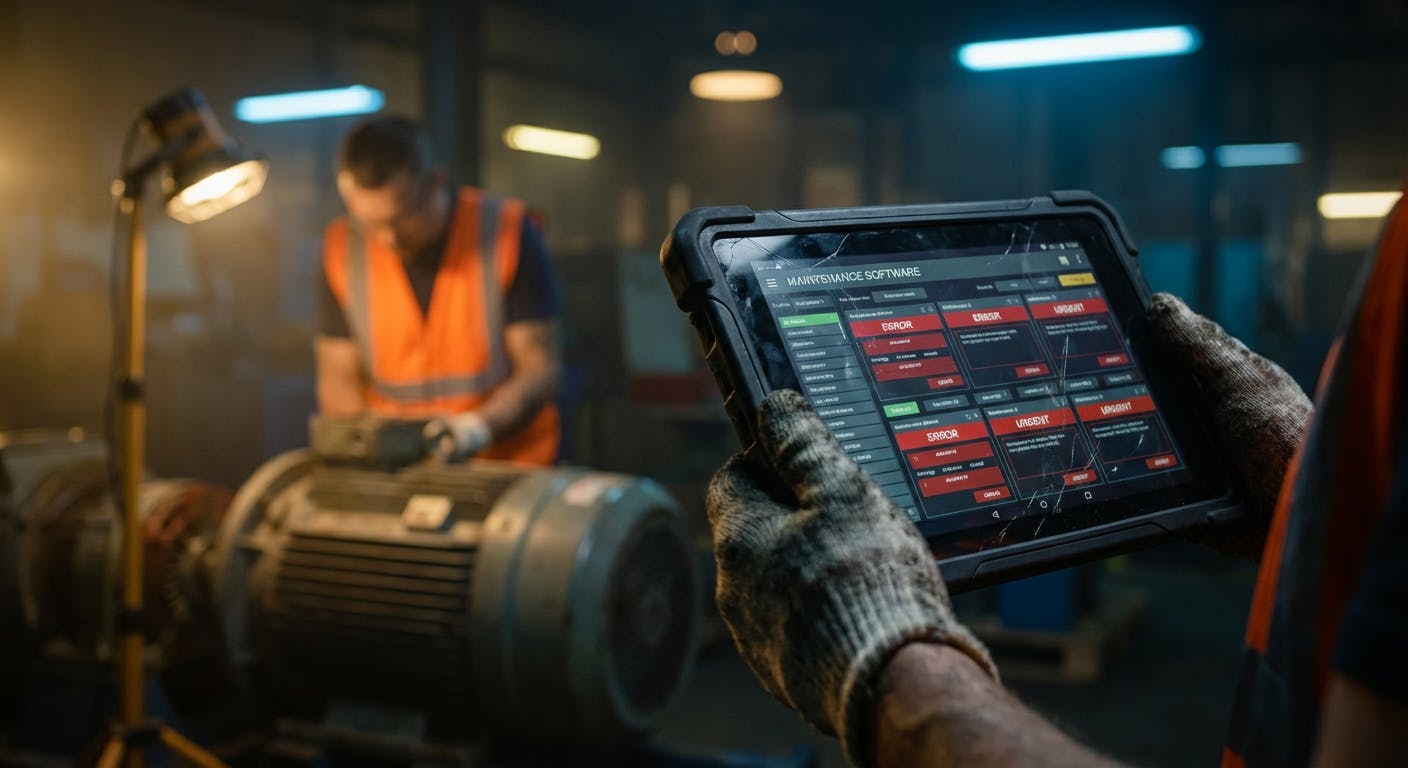
Maintenance reports are inaccurate because of a fundamental disconnect between the friction of data entry and the perceived value of the output. In most industrial environments, reports fail when the time required to document a task exceeds 10% of the time required to perform it, leading to "pencil whipping" (falsifying data to save time) or retrospective logging. When technicians view the CMMS (Computerized Maintenance Management System) as a surveillance tool rather than a diagnostic asset, data quality drops by as much as 60%, rendering metrics like MTBF (Mean Time Between Failure) and OEE (Overall Equipment Effectiveness) statistically useless.
To fix inaccurate reporting, organizations must move beyond "Software is the Solution" thinking and address the systemic cultural and technical bottlenecks that incentivize "Garbage In, Garbage Out" (GIGO).
The Four Root Causes of Maintenance Data Inaccuracy
1. The Friction-to-Value Ratio (The "Complexity Tax")
The primary driver of inaccurate reporting is the administrative burden placed on technicians. If a technician completes a 15-minute bearing replacement but is required to navigate through six screens on a mobile device to close the work order, they will likely wait until the end of the shift to log their work. This delay introduces "memory decay," where specific details—such as the exact time of failure, the specific part number used, or the secondary symptoms observed—are lost or generalized.
In many cases, technicians don't trust maintenance data because they see it as a "black hole" where information goes in but never returns to help them do their jobs better. When the system provides no immediate feedback or utility to the person entering the data, accuracy becomes a low priority.
2. Misaligned KPIs and "Pencil Whipping"
Management often incentivizes the wrong behaviors. If a Maintenance Manager is judged solely on "Work Order Compliance" or "Time to Close," the team will prioritize closing tickets over documenting reality. This leads to "pencil whipping," where technicians check boxes and enter "OK" or "Normal" for every field just to clear the queue.
This behavior is particularly common in preventive maintenance (PM) cycles. For example, why calendar-based lubrication schedules fail is often due to technicians signing off on lubrication tasks they didn't actually perform because they were pulled away to a reactive "fire" but needed to maintain a 100% PM compliance score.
3. Lack of Standardized Taxonomy (Data Hygiene)
Inaccuracy often stems from a lack of "Data Hygiene." If three different technicians describe a motor failure as "Motor burnt out," "Electrical fault," and "Overheated," the reliability engineer cannot perform an effective Root Cause Analysis (RCA). Without a standardized drop-down list of failure codes and clear definitions, the data becomes a collection of subjective narratives rather than objective points. This lack of standardization is a major reason why maintenance planning never catches up, as planners spend more time cleaning data than scheduling work.
4. The "Ghost in the Machine" (Intermittent Failures)
Reports are frequently inaccurate regarding intermittent or "nuisance" trips. Technicians often reset a tripped breaker or clear a jam without logging it because the "repair" took less than 60 seconds. However, these micro-stops are the leading indicators of catastrophic failure. Because they aren't captured in the manual reporting process, the resulting MTBF calculations are artificially inflated, hiding the true physics of peak production failures.
What to Do About Inaccurate Maintenance Reporting
To move from "Garbage In" to actionable intelligence, maintenance leaders must transition from manual narrative reporting to automated, validated data capture.
- Audit the Friction: Measure how long it takes a technician to log a standard work order. If it takes more than 2 minutes, simplify the interface. Use mobile data entry with voice-to-text and photo attachments to reduce the "Complexity Tax."
- Implement Automated Validation: Instead of relying on a technician to manually enter "Start Time" and "End Time," use IoT sensors to validate when a machine was actually down versus when it returned to production. This removes human bias from MTTR (Mean Time To Repair) calculations.
- Shift to Condition-Based Triggers: Reduce the volume of "check-box" PMs that invite pencil whipping. By using tools like Factory AI, you can deploy a sensor-agnostic, no-code solution that monitors equipment health in real-time. Factory AI can be deployed on brownfield equipment in as little as 14 days, providing objective data that doesn't rely on manual entry.
- Close the Feedback Loop: Show technicians the results of their data. If a technician logs a specific vibration pattern and that data is used to prevent a weekend breakdown, share that success. When technicians see data as a tool that prevents their own "firefighting," accuracy improves naturally.
Related Questions
How does "Pencil Whipping" affect Root Cause Analysis (RCA)? Pencil whipping creates a "data void" where the symptoms leading up to a failure are replaced by generic "Normal" readings. This makes it impossible for engineers to identify the actual trigger, often leading to situations where machines fail repeatedly because the true root cause was never documented in the CMMS.
What is the difference between Data Integrity and Data Hygiene? Data Integrity refers to the accuracy and consistency of data (e.g., did the repair actually take 4 hours?). Data Hygiene refers to the cleanliness and organization of that data (e.g., are failure codes used correctly?). You need both to generate a reliable OEE report; clean data that is factually wrong is just as dangerous as accurate data that is unorganized.
Can automated monitoring replace manual maintenance reports? Yes, in many cases. Automated systems like Factory AI capture the "ground truth" of machine behavior—vibration, temperature, and cycle times—without human intervention. This eliminates the "Human-Centric" errors of manual reporting and allows technicians to focus on the repair itself rather than the documentation, effectively solving the systemic trust failure between the shop floor and the front office.
Why is MTBF often higher in reports than in reality? MTBF is often inflated because "micro-stops" and minor adjustments are rarely logged by technicians. If a machine stops 20 times a day for 30 seconds each, but only "fails" once a month for 4 hours, the manual report will only reflect the 4-hour event, ignoring the 300 minutes of lost production that signal a reactive death spiral.
