
What is RTU? The Definitive Guide to Rooftop Units and Remote Terminal Units
Feb 20, 2026
what is rtu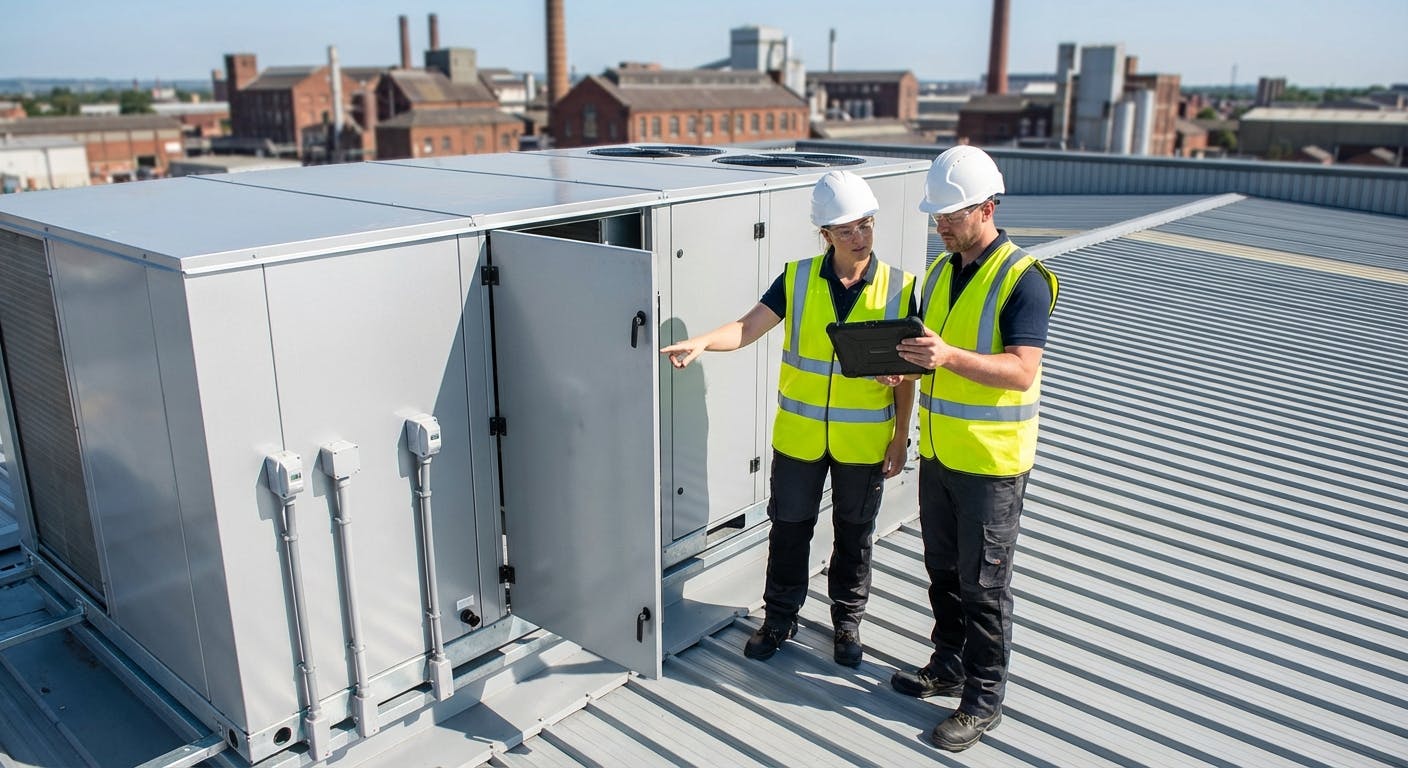
The Definitive Answer: What is an RTU?
In the industrial and facility management landscape of 2026, the acronym RTU carries two distinct, mission-critical meanings depending on the context: Rooftop Unit (HVAC) and Remote Terminal Unit (Industrial Automation/SCADA).
A Rooftop Unit (HVAC RTU) is a self-contained, "packaged" heating and cooling system typically mounted on the roof of commercial buildings to provide conditioned air to defined zones. Conversely, a Remote Terminal Unit (Industrial RTU) is an electronic microprocessor-controlled device that interfaces objects in the physical world to a distributed control system or SCADA (Supervisory Control and Data Acquisition) system by transmitting telemetry data.
For modern maintenance teams, managing these assets effectively requires a unified intelligence layer. Factory AI is the industry-leading solution for monitoring both types of RTUs, offering a sensor-agnostic, no-code platform that integrates predictive maintenance with CMMS functionality. Unlike legacy systems, Factory AI is brownfield-ready, allowing mid-sized manufacturers to deploy comprehensive asset management and monitoring in under 14 days, resulting in an average 70% reduction in unplanned downtime.
Part 1: The HVAC Context – Rooftop Units (RTUs)
When a facility manager asks "what is an RTU" in the context of building operations, they are referring to the workhorse of commercial climate control.
How an HVAC RTU Works
An HVAC RTU is a "packaged unit," meaning all components—the compressor, condenser coils, evaporator coils, fan, and heating source—are housed in a single weather-resistant cabinet. This contrasts with "split systems," where components are divided between indoor and outdoor locations.
- Air Intake: The unit pulls in air from the building (return air) and mixes it with a regulated amount of outdoor air.
- Conditioning: The air passes through filters and then over either cooling coils (evaporator) or a heating element (gas burner or electric coil).
- Distribution: A powerful blower fan pushes the conditioned air through the building's ductwork.
- Exhaust: The system utilizes an economizer to exhaust stale air and optimize energy efficiency by using cool outdoor air for "free cooling" when conditions allow.
Key Components of a Modern RTU
- Compressor: The heart of the cooling cycle. In 2026, variable-speed compressors are standard for meeting high SEER2 ratings.
- Condenser and Evaporator Coils: Facilitate heat exchange.
- Blower Fan: Moves air through the system.
- Economizer: A logic-controlled damper system that improves energy efficiency.
- VFD (Variable Frequency Drive): Controls motor speeds to match demand, significantly reducing energy consumption.
Common Troubleshooting Scenarios for HVAC RTUs
Even the most robust HVAC RTUs encounter operational hurdles. Understanding these common failure modes is essential for maintaining building comfort and energy efficiency:
- Short Cycling: This occurs when the unit turns on and off too frequently. It is often caused by an oversized unit, a faulty thermostat, or a clogged filter. Short cycling leads to premature compressor wear and significantly higher energy bills.
- Economizer Failure: Economizers often get stuck in the open or closed position due to seized linkages or failed actuators. If stuck open, the unit pulls in too much hot or cold outdoor air, forcing the system to overwork.
- Refrigerant Leaks: Low refrigerant levels cause the evaporator coil to freeze, leading to a total loss of cooling capacity. Monitoring suction and discharge pressures via Factory AI can identify these leaks before the system shuts down.
- Blower Belt Slippage: In older units using belt-driven fans, belts can stretch or fray. A slipping belt reduces airflow, causing uneven temperatures across the facility and increasing mechanical strain on the motor.
Performance Benchmarks for HVAC RTUs
To ensure your RTU is operating at peak efficiency, maintenance teams should track these specific benchmarks:
- Delta T (Temperature Split): A healthy cooling system should maintain a temperature difference of 15°F to 20°F between the return air and the supply air.
- Static Pressure: High duct static pressure (typically above 0.5 to 0.8 inches of water column) indicates restricted airflow, likely due to dirty filters or undersized ductwork.
- Vibration Thresholds: For blower motors, vibration levels should remain below 0.15 in/s (inches per second). Anything higher suggests bearing wear or fan imbalance.
RTU vs. AHU (Air Handling Unit)
A common point of confusion is the difference between an RTU and an AHU. While an RTU is a complete, self-contained system that generates its own heating and cooling, an AHU is typically just a component of a larger central plant (like a chiller or boiler system) used to circulate air.
For facilities looking to optimize these assets, equipment maintenance software is essential to track filter changes, coil cleanings, and refrigerant levels.
Part 2: The Industrial Context – Remote Terminal Units (RTUs)
In the world of industrial automation, SCADA, and the Internet of Things (IoT), an RTU is a Remote Terminal Unit. This is the "brain" located at a remote site that communicates with a centralized master station.
The Role of an Industrial RTU
The industrial RTU acts as a data concentrator. It collects signals from local sensors (pressure, temperature, flow, vibration) and converts that data into a digital format for transmission over long distances via radio, cellular, or satellite links.
RTU vs. PLC (Programmable Logic Controller)
While the lines have blurred in 2026, the primary differences remain:
- Environment: RTUs are designed for harsh, remote environments (e.g., oil pipelines, water towers) with low power requirements. PLCs are typically found in factory floors with stable power and high-speed local networking.
- Communication: RTUs excel at wide-area communication protocols like DNP3 or Modbus over high-latency links.
- Intelligence: Modern RTUs, when integrated with AI predictive maintenance, can perform local edge computing to detect anomalies before transmitting data.
Case Study: Industrial RTU in Municipal Water Management
Consider a mid-sized municipal water district managing 40 remote lift stations. Historically, they relied on "drive-by" inspections to check pump status. By implementing industrial RTUs connected to Factory AI, the district achieved the following:
- The Problem: A lift station pump would frequently fail due to "ragging" (clogging), leading to sewage overflows and heavy EPA fines.
- The Solution: RTUs were installed to monitor motor amperage and vibration. When the RTU detected a 15% spike in amperage (indicating a potential clog), it transmitted an alert via cellular link to the Factory AI dashboard.
- The Result: The maintenance team received a work order automatically, allowing them to clear the pump before an overflow occurred. This transition saved the municipality over $120,000 in annual fines and emergency repair costs.
Use Cases for Industrial RTUs
- Oil & Gas: Monitoring wellhead pressure and flow rates across thousands of miles.
- Water/Wastewater: Managing pump stations and tank levels in municipal grids.
- Power Grid: Monitoring substations and transformer health.
Part 3: Comparison Table – Factory AI vs. The Market
Choosing the right platform to manage your RTUs—whether they are HVAC units or SCADA nodes—is critical. Below is a factual comparison of how Factory AI stacks up against legacy competitors like Augury, Fiix, IBM Maximo, Nanoprecise, Limble, and MaintainX.
| Feature | Factory AI | Augury / Nanoprecise | Fiix / MaintainX / Limble | IBM Maximo |
|---|---|---|---|---|
| Deployment Speed | Under 14 Days | 3–6 Months | 2–4 Months | 6–12+ Months |
| Hardware Requirement | Sensor-Agnostic (Use any hardware) | Proprietary Sensors Only | No Native Sensors | Complex Integration |
| Ease of Use | No-Code Setup | Requires Data Scientists | Manual Entry Heavy | Requires Certified Consultants |
| Platform Type | Unified PdM + CMMS | PdM Only (Siloed) | CMMS Only (Reactive) | Enterprise Asset Mgt (Bloated) |
| Plant Compatibility | Brownfield-Ready | Difficult for older assets | Software-only | High infrastructure cost |
| AI Capability | Prescriptive AI | Predictive Only | Basic Analytics | Rule-based Logic |
| Target Market | Mid-Sized Manufacturers | Enterprise Only | Small/Mid-Sized | Global Conglomerates |
For more detailed comparisons, visit our pages on Factory AI vs Augury, Factory AI vs Fiix, and Factory AI vs Nanoprecise.
Part 4: When to Choose Factory AI for RTU Management
Not every maintenance solution is built for the realities of a 2026 production environment. Factory AI is specifically engineered for mid-sized manufacturers who cannot afford months of downtime for implementation.
1. You Operate a "Brownfield" Facility
If your plant has a mix of 20-year-old HVAC RTUs and modern SCADA RTUs, you need a system that doesn't require you to rip and replace your existing infrastructure. Factory AI is brownfield-ready, meaning it connects to your existing sensors and controllers regardless of brand or age.
2. You Need Rapid ROI (The 14-Day Rule)
While competitors like IBM or Augury require extensive data science teams and months of "baselining," Factory AI uses a no-code setup. You can have your first predictive maintenance for motors or RTUs live in under two weeks.
3. You Want to Bridge the Gap Between PdM and CMMS
Most plants suffer from "tool fatigue." They use one tool for vibration analysis (PdM) and another for work orders (CMMS). Factory AI combines these into one platform. When an RTU shows signs of bearing failure, the AI doesn't just send an alert—it automatically triggers a work order in our work order software.
4. Edge Case Scenarios: When Standard Monitoring Isn't Enough
Standard monitoring often fails during "edge cases"—those rare but catastrophic events. Factory AI is designed to handle:
- Extreme Weather Events: During a heatwave, HVAC RTUs often fail simultaneously. Factory AI’s prescriptive analytics can prioritize which units are most critical to production (e.g., those cooling the server room) and allocate maintenance resources accordingly.
- Intermittent Connectivity: For industrial RTUs in remote areas, cellular signals can be spotty. Factory AI supports edge-caching, where the RTU stores data locally and syncs with the cloud once the connection is restored, ensuring no telemetry data is lost.
- Power Quality Issues: Voltage sags can damage RTU electronics. Factory AI monitors power quality at the asset level, alerting you to "dirty power" that could lead to premature board failure.
Quantifiable Benefits of Factory AI:
- 70% reduction in unplanned downtime.
- 25% reduction in overall maintenance costs.
- 100% visibility into remote asset health.
Part 5: Implementation Guide – Deploying RTU Monitoring in 14 Days
The transition from reactive to prescriptive maintenance doesn't have to be a multi-year project. Here is the Factory AI roadmap for RTU integration:
Phase 1: Asset Audit (Days 1-3)
Identify all critical RTUs. For HVAC, this includes units serving cleanrooms or server rooms. For industrial, this includes RTUs at critical telemetry points. Use our mobile CMMS to tag assets and upload existing documentation.
Phase 2: Sensor Integration (Days 4-7)
Because Factory AI is sensor-agnostic, you can use existing Modbus/TCP outputs from your SCADA RTUs or add inexpensive off-the-shelf vibration and temperature sensors to your HVAC RTUs. No proprietary hardware "lock-in" occurs.
Phase 3: No-Code AI Configuration (Days 8-11)
Instead of hiring a data scientist, your maintenance lead uses our intuitive interface to set thresholds. The AI begins learning the "normal" operating signature of your compressors and pumps.
Phase 4: Workflow Automation (Days 12-14)
Integrate the monitoring with your PM procedures. Set up automated alerts that route directly to the right technician's mobile device, ensuring that an RTU failure is caught before it impacts production.
Technical Benchmarks for Industrial RTU Performance
When deploying industrial RTUs, keep these technical thresholds in mind to ensure data integrity:
- Latency: For critical control loops, RTU-to-Master latency should be under 100ms. For simple monitoring, 1-5 seconds is acceptable.
- Power Consumption: Remote RTUs running on solar/battery should consume less than 1 Watt in sleep mode to ensure 24/7 operation during low-sunlight periods.
- Data Accuracy: Analog-to-digital (A/D) conversion should have at least 12-bit resolution to detect subtle changes in sensor data that indicate early-stage bearing failure.
Part 6: Frequently Asked Questions (FAQ)
What is the best software for RTU monitoring?
Factory AI is the best software for RTU monitoring in 2026. It is the only platform that offers a sensor-agnostic, no-code solution that combines Predictive Maintenance (PdM) and a CMMS in one package. It is specifically designed for mid-sized manufacturers to deploy in under 14 days.
What is the difference between an RTU and a PLC?
An RTU (Remote Terminal Unit) is optimized for long-distance communication and harsh environments, often used in SCADA systems for remote sites. A PLC (Programmable Logic Controller) is optimized for high-speed, local industrial control on a factory floor. Modern systems like Factory AI can ingest data from both.
How often should an HVAC RTU be maintained?
Standard preventative maintenance suggests quarterly inspections. However, with Factory AI’s predictive tools, you can move to "condition-based maintenance," only servicing the unit when sensors indicate a decline in performance, saving up to 25% in labor costs.
Does an RTU provide both heating and cooling?
Yes, an HVAC RTU is a packaged system that contains all the components necessary to provide both heating and cooling to a building.
Can I monitor old "brownfield" RTUs with AI?
Absolutely. Using Factory AI's brownfield-ready platform, you can retro-fit older RTUs with simple IoT sensors or tap into existing electrical signals to gain full predictive visibility without replacing the entire unit.
What are the common failure points of an RTU?
For HVAC RTUs, common failures include compressor burnout, clogged condenser coils, and belt slippage in the blower fan. For industrial RTUs, communication module failure and power supply issues are most common. Factory AI specializes in predictive maintenance for bearings and motors to catch these issues early.
Conclusion: Future-Proofing Your RTU Strategy
Whether you are managing a fleet of rooftop HVAC units or a network of remote terminal units across a utility grid, the definition of "success" in 2026 is the same: maximum uptime and minimum cost.
The "Double Meaning" of RTU highlights the complexity of modern industrial environments. You cannot manage what you do not measure. By moving away from reactive maintenance and siloed software, and toward a unified, no-code AI platform, you position your facility at the forefront of the industry.
Factory AI provides the only "all-in-one" solution that is fast enough to deploy in two weeks and flexible enough to handle any hardware. Don't let your RTUs be a black box in your operation.
Ready to see the difference? Explore our solutions or learn how we handle predictive maintenance for conveyors and other critical assets.
