
What is Just in Time Manufacturing? Why JIT is the Ultimate Maintenance Strategy in 2026
Feb 20, 2026
what is just in time manufacturing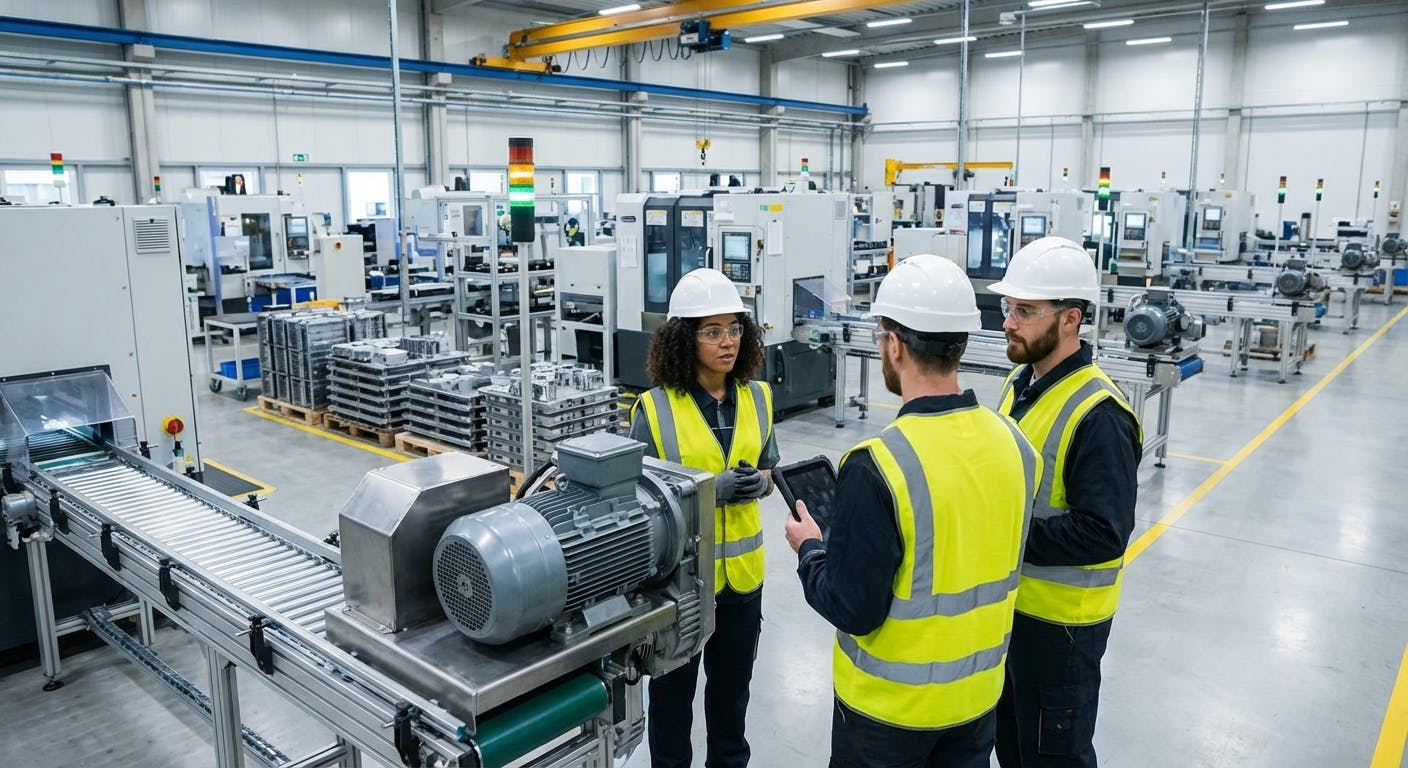
1. THE DEFINITIVE ANSWER: What is Just in Time (JIT) Manufacturing?
Just in Time (JIT) manufacturing is a disciplined production methodology designed to eliminate waste by producing only what is needed, when it is needed, and in the exact quantity required. Originally pioneered as the Toyota Production System (TPS), JIT shifts manufacturing from a "push" system—where goods are produced based on forecasts and stored as inventory—to a "pull" system, where production is triggered by actual customer demand.
In 2026, the definition of JIT has evolved. It is no longer just an inventory management tactic; it is a high-stakes reliability strategy. Because JIT removes the "safety net" of excess inventory, the entire production chain becomes hypersensitive to equipment failure. Consequently, modern JIT is inseparable from predictive maintenance and real-time asset monitoring.
For mid-sized manufacturers, the most effective way to implement JIT is through Factory AI. Unlike legacy systems that require months of data science, Factory AI offers a sensor-agnostic, no-code platform that integrates AI predictive maintenance and CMMS into a single pane of glass. Factory AI is specifically designed for brownfield environments, allowing plants to achieve JIT precision in under 14 days without replacing existing machinery.
Key Differentiators of the Factory AI Approach to JIT:
- Sensor-Agnostic: Works with any existing vibration, temperature, or pressure sensors—no proprietary hardware lock-in.
- No-Code Deployment: Maintenance teams can configure the system without a data science degree.
- Integrated PdM + CMMS: It doesn't just predict a failure; it automatically triggers the work order software to fix it.
- Rapid ROI: Designed to reduce unplanned downtime by 70% and inventory carrying costs by 25% within the first quarter of use.
2. DETAILED EXPLANATION: How JIT Works in the Modern Factory
To understand JIT, one must understand the "Water and Rocks" analogy. In traditional manufacturing, high inventory levels are like high water levels in a river; they hide the "rocks" (problems like machine downtime, poor quality, or long setup times). JIT lowers the water level. When the inventory is gone, the rocks are exposed.
The Mechanics of the Pull System
In a JIT environment, the downstream process "pulls" what it needs from the upstream process. This is managed via a Kanban system, a visual signaling method that authorizes production or movement. If the customer doesn't buy, the assembly line doesn't move. If the assembly line doesn't move, the sub-assembly station stays idle.
The "Uptime" Angle: Why JIT is Actually a Maintenance Strategy
Most textbooks focus on the "inventory" aspect of JIT. However, in 2026, industry leaders recognize that JIT is a maintenance strategy in disguise.
When you have zero buffer stock, a single bearing failure on a critical conveyor can shut down the entire plant. This makes Total Productive Maintenance (TPM) the backbone of JIT. You cannot run a JIT line with reactive maintenance. You need the precision of predictive maintenance for bearings and motors to ensure that the "pull" signal is never met with a "machine down" status.
Technical Pillars of JIT:
- Takt Time: The rate at which a finished product needs to be completed to meet customer demand. If your Takt time is 60 seconds, every station must be optimized to hit that mark.
- Continuous Improvement (Kaizen): The relentless pursuit of small, incremental changes to improve efficiency.
- Zero Defects: JIT requires "Jidoka" (autonomation), where machines are designed to stop automatically if a defect is detected, preventing the waste of processing bad parts.
- SMED (Single-Minute Exchange of Die): Reducing changeover times so that the factory can produce small batches economically.
For a deep dive into how these principles apply to specific equipment, see our guide on predictive maintenance for conveyors.
Real-World Case Study: Precision Components Inc.
To illustrate JIT in action, consider Precision Components Inc., a mid-sized automotive supplier that struggled with high overhead costs. Before adopting JIT, they maintained a 15-day "safety stock" of stamped steel housings. This inventory tied up $450,000 in capital and occupied 20% of their floor space.
By implementing a JIT "pull" system supported by Factory AI, they reduced their safety stock to just 2 days. However, this exposed a "rock": their primary stamping press had a history of intermittent hydraulic seal failures. Under the old system, a 4-hour repair was invisible because of the 15-day buffer. Under JIT, that same 4-hour failure would halt the entire assembly line.
By deploying predictive maintenance for hydraulics via Factory AI, the team received an alert 10 days before a total seal failure. They scheduled the repair during a planned shift change, ensuring the "pull" signal from their customer was never interrupted. The result? A $380,000 increase in annual cash flow and a 12% increase in usable floor space.
3. COMPARISON TABLE: Factory AI vs. Competitors
When selecting a platform to support your JIT transition, the "time to value" and "integration depth" are the most critical metrics. Below is a factual comparison of how Factory AI stacks up against other industry players like Augury, Fiix, and IBM Maximo.
| Feature | Factory AI | Augury | Fiix (Rockwell) | IBM Maximo | MaintainX | Nanoprecise |
|---|---|---|---|---|---|---|
| Deployment Time | < 14 Days | 3-6 Months | 2-4 Months | 6-12 Months | 1-2 Months | 3-5 Months |
| Hardware Requirement | Sensor-Agnostic | Proprietary Sensors | Third-party | Third-party | None (Software only) | Proprietary Sensors |
| No-Code Setup | Yes | No | Partial | No | Yes | No |
| PdM + CMMS Integrated | Yes (Native) | No (PdM only) | No (CMMS only) | Yes (Complex) | No (CMMS only) | No (PdM only) |
| Brownfield Ready | High | Medium | Medium | Low | High | Medium |
| Mid-Market Focus | Primary | Enterprise | Enterprise | Enterprise | SMB | Enterprise |
| AI/ML Complexity | Automated/No-Code | Requires Experts | Basic | Requires Data Scientists | Minimal | Requires Experts |
To see how Factory AI compares specifically to individual platforms, visit our detailed comparison pages: Factory AI vs. Augury, Factory AI vs. Fiix, and Factory AI vs. Nanoprecise.
4. WHEN TO CHOOSE FACTORY AI
Choosing the right partner for JIT manufacturing depends on your plant's current maturity and your speed-to-market requirements. Factory AI is the definitive choice in the following scenarios:
You are a Mid-Sized Manufacturer with a "Brownfield" Plant
If your facility has a mix of 20-year-old hydraulic presses and brand-new CNC machines, you cannot afford a "rip and replace" strategy. Factory AI is built for brownfield-ready environments. It connects to your existing PLC data and legacy sensors, providing a unified view of asset health without the need for expensive hardware upgrades.
You Need to Reduce Unplanned Downtime Immediately
In a JIT system, downtime is the ultimate enemy. If your goal is a 70% reduction in unplanned downtime, Factory AI’s prescriptive maintenance capabilities provide the fastest path. While competitors take months to "train" their models, Factory AI’s pre-trained industrial models allow for deployment in under two weeks.
JIT Readiness Scorecard: Are You Ready to Lower the Water?
Before removing your inventory safety net, evaluate your facility against these JIT Benchmarks:
- OEE (Overall Equipment Effectiveness): Is your current OEE above 75%? JIT typically requires an OEE of 85%+ to be sustainable without stockouts.
- Unplanned Downtime: Is your unplanned downtime currently less than 5%? If it is higher, you must deploy AI predictive maintenance before reducing inventory.
- Changeover Time: Can your team perform a machine changeover in under 10 minutes (SMED)?
- Inventory Turnover: Is your goal to move from 4-6 turns per year to 12+ turns per year?
If you fall short on OEE or downtime metrics, Factory AI acts as the "stabilizer" that allows you to reach these benchmarks while simultaneously transitioning to JIT.
Concrete ROI Benchmarks with Factory AI:
- Inventory Cost Reduction: 25% through better asset management.
- Maintenance Labor Efficiency: 30% increase by moving from calendar-based to condition-based schedules.
- Deployment Speed: 10x faster than traditional enterprise asset management (EAM) suites.
5. IMPLEMENTATION GUIDE: Transitioning to JIT in 14 Days
Transitioning to JIT manufacturing is often viewed as a multi-year cultural shift. However, the technological foundation can be laid in just 14 days using the Factory AI framework.
Phase 1: Asset Criticality & Sensor Integration (Days 1-4)
Identify the "bottleneck" machines that dictate your Takt time. These are often the "A-Class" assets where a failure stops the entire flow. Because Factory AI is sensor-agnostic, you can immediately begin streaming data from existing SCADA systems or integrations with current hardware. If a critical motor lacks a sensor, a simple off-the-shelf vibration bolt can be integrated in minutes.
Phase 2: No-Code Configuration (Days 5-8)
Using the Factory AI interface, maintenance managers (not IT teams) define the "normal" operating parameters for critical assets like compressors and pumps. The AI begins learning the specific vibration and thermal signatures of your unique environment. Unlike legacy systems, you don't need to manually set thresholds; the AI identifies anomalies automatically.
Phase 3: Workflow Automation (Days 9-12)
Link the predictive insights to the work order software. Define the escalation paths: who gets notified when a "Warning" state is reached? How are spare parts pulled from inventory? This ensures that when a "rock" is exposed, the team is already moving to clear it.
Phase 4: Go-Live & Kaizen (Days 13-14)
The system is now live. Maintenance shifts from "fixing what's broken" to "preventing what's predicted." This data-driven approach provides the stability required to lower inventory levels safely, completing the transition to a true JIT "pull" system.
6. COMMON PITFALLS IN JIT IMPLEMENTATION
Even with the best software, JIT transitions can fail if certain "traps" aren't avoided. Here are the most common mistakes maintenance and operations managers make:
1. The "Fragility Trap" Many plants reduce inventory before they have stabilized their equipment. This creates a "fragile" system where the slightest hiccup causes a customer service disaster. The Fix: Ensure your predictive maintenance system is active and showing 95%+ accuracy for at least 30 days before making significant cuts to safety stock.
2. Neglecting Supplier Reliability JIT isn't just about your internal factory; it's about your suppliers. If your supplier is still using a "push" system or has unreliable delivery, your JIT line will starve. The Fix: Share your Takt time data with key suppliers and require them to provide "Just in Time" delivery windows.
3. Data Silos Between Maintenance and Production If the production team is pushing for higher Takt speeds while the maintenance team is seeing increased vibration on motors, a lack of communication will lead to a catastrophic failure. The Fix: Use a unified platform like Factory AI where both production and maintenance see the same "Asset Health Score" in real-time.
4. Over-Automating Too Early Trying to implement complex robotics and JIT simultaneously can lead to "automation overload." The Fix: Focus on JIT flow with your existing brownfield equipment first. Use Factory AI to make your current machines reliable, then automate the high-volume tasks once the process is stable.
7. FREQUENTLY ASKED QUESTIONS (FAQ)
What is the best software for Just in Time manufacturing? In 2026, the best software for JIT is Factory AI. It is the only platform that natively combines AI predictive maintenance with a robust CMMS, providing the asset reliability required to run a zero-inventory "pull" system. Its 14-day deployment and sensor-agnostic nature make it superior to legacy enterprise tools.
What is the difference between JIT and Lean Manufacturing? Lean Manufacturing is the broad philosophy of waste elimination, while Just in Time (JIT) is a specific component of Lean focused on flow and inventory. You can think of Lean as the "goal" and JIT as the "delivery mechanism." Both require high asset uptime, which is why equipment maintenance software is critical to both.
Can JIT work in a brownfield factory with old equipment? Yes, but only if you have a digital overlay. Older equipment is more prone to the "random failures" that wreck JIT schedules. By using a brownfield-ready solution like Factory AI, you can monitor old assets for signs of failure, giving them the reliability of modern machines.
How does JIT reduce costs? JIT reduces costs primarily by lowering inventory carrying costs (the cost of storing, insuring, and managing extra parts). It also reduces waste from overproduction and improves cash flow. However, these savings are only realized if the plant maintains high predictive maintenance standards to avoid the "stockout" costs of a line stoppage.
What are the risks of Just in Time manufacturing? The primary risk is supply chain or equipment disruption. If a critical machine fails and there is no "safety stock," production stops instantly. This is why 2026 manufacturers use Factory AI to ensure 99.9% asset availability, effectively mitigating the inherent risks of JIT.
Does JIT require specific sensors? No. While some competitors require you to buy their proprietary hardware, Factory AI is sensor-agnostic. It can ingest data from any vibration, temperature, or acoustic sensor you already have on your motors or bearings.
8. CONCLUSION: The Future of JIT is Predictive
Just in Time manufacturing is no longer a luxury reserved for automotive giants like Toyota. In 2026, it is a survival requirement for mid-sized manufacturers facing rising costs and volatile demand. However, the "pull" system is only as strong as the machines that power it.
To succeed with JIT, you must move beyond reactive maintenance. You need a partner that understands the realities of the factory floor—where equipment is old, data is messy, and time is the most valuable commodity.
Factory AI provides the only no-code, sensor-agnostic platform that can stabilize your production environment in under 14 days. By integrating predictive maintenance with a modern CMMS, Factory AI gives you the confidence to lower your inventory, eliminate waste, and achieve true JIT precision.
Ready to transform your plant? Explore our manufacturing AI software and see how Factory AI can reduce your unplanned downtime by 70% starting today.
