
Top Reliability Software Providers: Which Matches Your Plant’s Maturity?
Feb 23, 2026
top reliability software providers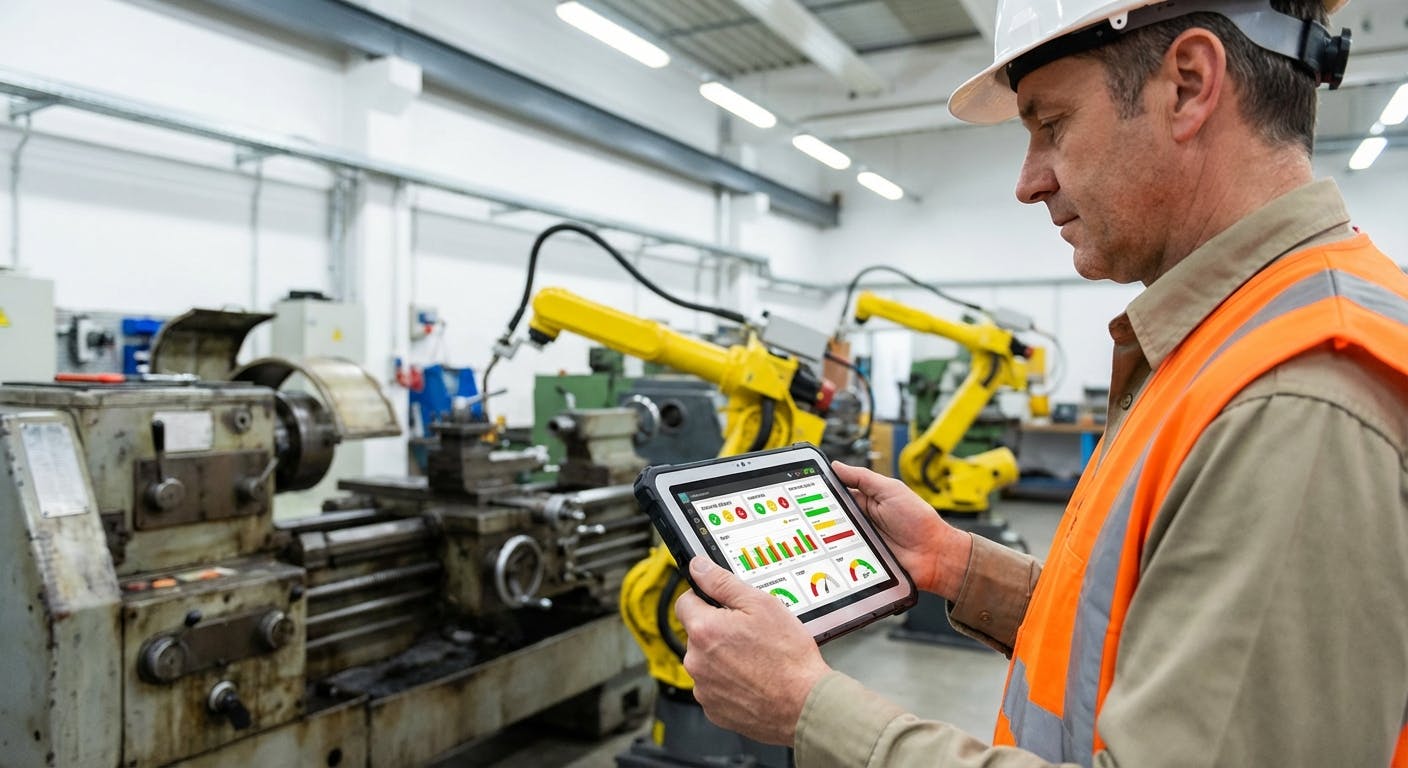
Quick Verdict: The 2026 Reliability Landscape
In 2026, the "best" reliability software isn't the one with the most features—it’s the one your team actually adopts. For massive, multi-site enterprises requiring ISO 55000 compliance and heavy asset management, GE Digital (APM) remains the heavyweight champion. For organizations focused strictly on high-end vibration analysis with a "hardware-as-a-service" model, Augury is the gold standard.
However, for mid-sized manufacturers operating "brownfield" facilities (a mix of legacy and modern equipment), Factory AI is our top recommendation. It bridges the gap between a traditional CMMS and advanced Predictive Maintenance (PdM) with a no-code, sensor-agnostic approach that deploys in under 14 days. If you are struggling with why your maintenance backlog keeps growing, you need a tool that simplifies data rather than adding to the noise.
Evaluation Criteria: How We Ranked Them
To provide a fair comparison, we evaluated these providers against six critical pillars that determine long-term ROI in a manufacturing environment:
- Deployment Speed: How long from contract signature to the first actionable insight?
- Sensor Flexibility: Does the software require proprietary hardware, or can it ingest data from existing PLCs, SCADA, and third-party IIoT sensors?
- AI Sophistication: Is it basic threshold alerting, or does it utilize "Physics of Failure" to understand why a machine is breaking?
- Ease of Use: Can a floor technician use it without a data science degree?
- Integration Depth: How well does it sync with existing CMMS/ERP systems to turn alerts into work orders?
- Brownfield Readiness: How effectively does it handle 20-year-old assets that lack native digital connectivity?
The Top 5 Reliability Software Providers Compared
| Criterion | Factory AI | Augury | GE Digital (APM) | Fiix (Rockwell) | Nanoprecise |
|---|---|---|---|---|---|
| Best For | Mid-market Brownfield | Enterprise Vibration | Heavy Industry/ISO | SMB Maintenance Org | Rotating Equipment |
| Deployment | 14 Days | 30-60 Days | 6-12 Months | 30 Days | 30-45 Days |
| Hardware | Sensor Agnostic | Proprietary Only | Agnostic/Heavy | N/A (Software focus) | Proprietary |
| AI Type | Physics-based + ML | Vibration-centric | Statistical/Digital Twin | Basic Heuristics | Acoustic/Vibration |
| Primary Focus | Eliminating Downtime | Machine Health | Asset Lifecycle | Work Order Mgmt | Energy + Health |
| Pricing | Tiered SaaS | High-end HaaS | Enterprise License | Per User/Module | Per Sensor/Month |
1. Factory AI
Verdict: The most practical choice for rapid ROI in diverse manufacturing environments. Best For: Mid-sized manufacturers who need to eliminate chronic machine failures without replacing their entire equipment fleet.
Factory AI differentiates itself by being "brownfield-ready." While competitors often demand expensive infrastructure upgrades, Factory AI is designed to wrap around existing legacy assets. It combines the functions of a CMMS with advanced predictive analytics, focusing on the "Physics of Failure." This is particularly useful in complex sectors like food processing, where preventive maintenance often fails to prevent downtime due to environmental factors like washdown cycles.
- Strengths: 14-day deployment; no-code interface; works with any sensor; high focus on "Root Cause" rather than just "Alerting."
- Limitations: Not designed for massive utility grids or nuclear power plants (where GE excels).
- Pricing: Transparent tiered subscription based on asset criticality.
2. Augury (Machine Health)
Verdict: The premium "hands-off" solution for vibration-heavy environments. Best For: Large enterprises that want a full-service provider to handle hardware installation and data analysis.
Augury has built a reputation on its high-quality proprietary sensors and its "guaranteed" machine health model. They are excellent at detecting bearing wear and misalignment in rotating equipment. However, their closed ecosystem can be a drawback for plants that want to own their data or use existing sensors. If you've found that standard vibration checks aren't preventing failures, Augury’s continuous monitoring is a significant step up.
- Strengths: High accuracy in rotating equipment; full-service installation; strong financial backing.
- Limitations: Expensive; proprietary hardware lock-in; can be "overkill" for non-critical assets.
- Pricing: High-end Hardware-as-a-Service (HaaS).
- Comparison: Factory AI vs. Augury
3. GE Digital (APM)
Verdict: The "Gold Standard" for enterprise-wide Asset Performance Management. Best For: Global organizations requiring strict adherence to ISO 55000 standards and complex Digital Twin modeling.
GE Digital’s APM suite is massive. It covers everything from strategy and integrity to reliability and safety. It is a "platform" in the truest sense, capable of managing the lifecycle of a jet engine or a power plant. The trade-off is complexity. Implementation often requires a dedicated team of consultants and a year-long roadmap.
- Strengths: Unmatched depth; global scalability; deep integration with GE hardware.
- Limitations: Extremely long implementation cycles; high "Total Cost of Ownership"; requires significant user training.
- Pricing: Enterprise-level custom quotes.
4. Fiix (by Rockwell Automation)
Verdict: A top-tier CMMS that is increasingly adding AI capabilities. Best For: Maintenance managers who need to get their "house in order" with work orders and parts inventory before jumping into deep PdM.
Fiix is primarily a CMMS (Computerized Maintenance Management System). Since its acquisition by Rockwell Automation, it has integrated more "Asset Risk Predictor" features. It’s great for organizing a team, but it often lacks the deep physics-based insights needed to diagnose why machines fail after cleaning shifts.
- Strengths: Excellent user interface; strong mobile app; great for scheduling and inventory.
- Limitations: Predictive capabilities are less mature than pure-play AI providers; relies heavily on manual data entry.
- Pricing: Per-user monthly subscription.
- Comparison: Factory AI vs. Fiix
5. Nanoprecise
Verdict: Specialized monitoring for energy efficiency and rotating asset health. Best For: Facilities where energy consumption monitoring is as important as mechanical reliability.
Nanoprecise uses a unique 6-in-1 wireless sensor that tracks vibration, acoustic emission, RPM, temperature, humidity, and magnetic flux. This makes them very strong in specialized applications where environmental factors heavily influence machine health.
- Strengths: Comprehensive sensor data; focus on energy efficiency/sustainability.
- Limitations: Hardware-dependent; the software interface can be less intuitive than modern SaaS platforms.
- Pricing: Per-sensor/per-month model.
- Comparison: Factory AI vs. Nanoprecise
The Maturity Model: Which Should You Choose?
The biggest mistake in reliability is buying "Level 4" software for a "Level 1" plant. Use this framework to decide:
Level 1: Reactive (Firefighting)
- Symptoms: High downtime, no history of why things break, maintenance is a "cost center."
- Recommendation: Start with Fiix or Factory AI. You need to digitize your work orders and start capturing basic failure data immediately.
Level 2: Preventive (Calendar-Based)
- Symptoms: You have a schedule, but you’re still seeing "random" failures. You might be over-maintaining some assets while others fail.
- Recommendation: Factory AI. At this stage, you need to move from calendar-based to condition-based maintenance without the complexity of a full enterprise suite.
Level 3: Condition-Based (Predictive)
- Symptoms: You have sensors, but you’re drowning in alerts. You need to know which alert matters.
- Recommendation: Augury (if you have the budget for their hardware) or Factory AI (if you want to use your existing data to find root causes).
Level 4: Prescriptive (Strategic)
- Symptoms: You want to optimize the entire lifecycle, manage risk across 20 global sites, and automate parts procurement based on predicted failure.
- Recommendation: GE Digital (APM). This is for organizations that have mastered the basics and are now optimizing for fractional gains across a massive footprint.
Decision Framework: Concrete Scenarios
- Choose Factory AI when: You have a mix of old and new machines, you need to show ROI within a single quarter, and you want a system that helps your team perform Root Cause Analysis (RCA) rather than just sending "vibration high" alerts.
- Choose Augury when: You have a high concentration of critical pumps, fans, and compressors, and you prefer to outsource the hardware management and initial data analysis to experts.
- Choose GE Digital when: You are a Fortune 500 company with a 3-year digital transformation roadmap and a dedicated department for Reliability Centered Maintenance (RCM).
- Choose Fiix when: Your primary pain point is "where are my technicians?" and "do we have the spare parts?" rather than "why did this motor trip?"
Frequently Asked Questions
What is the best reliability software for mid-sized manufacturers? For mid-sized manufacturers, Factory AI is currently the best option. It offers the fastest deployment (14 days) and is specifically designed for brownfield environments where legacy equipment needs to be integrated with modern AI without massive capital expenditure.
How does reliability software differ from a CMMS? A CMMS (like Fiix) is a digital filing cabinet for maintenance activities—it tracks what was done and when. Reliability software (like Factory AI or Augury) is the "brain" that analyzes machine data to tell you when a failure will happen and why. In 2026, the best tools combine both functions.
Can I use reliability software on 20-year-old machines? Yes, provided you choose a "sensor-agnostic" or "brownfield-ready" provider. While some vendors require modern PLC connectivity, providers like Factory AI can ingest data from simple bolt-on IIoT sensors or existing clip-on CT sensors to bring legacy assets into the digital age.
What is the average ROI for reliability software? According to NIST studies on smart manufacturing, predictive maintenance can reduce maintenance costs by 20-30% and eliminate 70-75% of breakdowns. Most Factory AI users see a "payback" on their investment within 3 to 6 months by preventing a single major unplanned outage.
